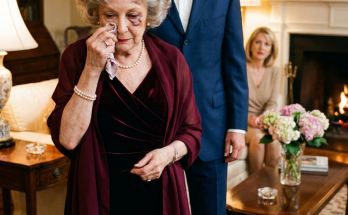
At dinner, my husband grabbed my purse and demanded my bank card.When I refused, he slammed his fist against the table so hard that the wine glasses jumped.
“Then you can leave with nothing.”The room went silent.For twelve years, I had known every version of my husband’s anger.
The silent treatment.The sarcastic comments.The doors slammed a little too hard.
The occasional fist against a wall when he wanted me to understand that he could become violent without actually touching me.
But that night was different.He wasn’t trying to scare me.He was trying to take control of my money.And for the first time in our marriage, I realized something terrifying.
He didn’t think of me as his wife anymore.He thought of me as an asset.I looked across the table at him.His name was Daniel.
He was forty-two, successful, polished, and the kind of man strangers immediately trusted.
He wore expensive watches, remembered people’s birthdays, shook hands firmly, and smiled at neighbors.
At home, however, he had slowly turned our marriage into a system of permissions.What I could spend.Where I could go.Who I could visit.
How much money I was allowed to keep in my own account.When we first married, none of that seemed dangerous.
Daniel had told me, “We’re building a life together. We shouldn’t have secrets.”I agreed.
So I closed my small savings account and moved most of my money into our joint account.
I thought marriage meant trust.
Daniel apparently thought marriage meant access.
I had worked for fifteen years as a financial analyst for a regional manufacturing company.
I wasn’t rich.
But I was careful.
I saved.
I invested.
I kept records.
And every month, I contributed nearly sixty percent of my salary to our household expenses.
Daniel earned more than I did, but he spent more too.
New cars.
Golf memberships.
Business dinners.
Weekend trips with friends.
Designer clothes.
He always said those expenses were “networking.”
I never questioned him.
Until six months earlier.
That was when I noticed our joint account balance had started disappearing faster than usual.
At first, I assumed it was the mortgage, insurance, or some unexpected repair.
Then I found a $14,800 transfer to a company called DKM Holdings.
I asked Daniel about it.
He barely looked up from his phone.
“Business.”
“What business?”
“Why do you need to know?”
That answer bothered me.
A month later, another transfer.
$22,000.
Then $8,500.
Then $31,000.
Each time, the explanation changed.
Investment.
Tax payment.
Equipment.
Consulting.
Eventually I stopped asking.
Instead, I started watching.
And what I discovered made my stomach turn.
Daniel wasn’t simply moving money.
He was moving money into accounts I had never seen.
Accounts connected to a company that wasn’t technically owned by him.
Technically.
That word would become very important later.
Because Daniel had spent years telling me that paperwork didn’t matter between married people.
But paperwork was about to save me.
That night at dinner, he reached across the table again.
“Give me the card.”
“No.”
His eyes narrowed.
“What did you say?”
“I said no.”
“You’re really going to make this difficult?”
I put my fork down.
“Why do you need my card?”
“Because I said I need it.”
“That isn’t an answer.”
He laughed.
Not because anything was funny.
Because he couldn’t believe I had questioned him.
“You’ve been acting strange lately.”
“I’ve been noticing things.”
“What things?”
“The transfers.”
His face changed.
Only for a second.
But I saw it.
“You’ve been looking at my accounts?”
“Our accounts.”
He pushed his chair backward.
“You don’t understand business.”
“Maybe not.”
I stood.
“But I understand arithmetic.”
He slammed his fist against the table.
“Then you can leave with nothing!”
The words hung in the air.
I looked at him.
Then at my purse.
Then at the hallway leading upstairs.
Something inside me became strangely calm.
I didn’t cry.
I didn’t yell.
I didn’t threaten him.
I simply said,
“Okay.”
Daniel blinked.
“Okay?”
“Yes.”
I walked upstairs.
Behind me, I heard him mutter something about me being dramatic.
I went into our bedroom and closed the door.
Then I opened my closet.
I packed quietly.
Three changes of clothes.
My work laptop.
My passport.
My birth certificate.
My father’s watch.
The gold earrings he had given me before he died.
The small diamond necklace my mother had left me.
My medication.
My charger.
A folder containing copies of our mortgage documents.
And another folder.
The one Daniel had forgotten existed.
My financial records.
For the past four months, I had been quietly documenting every suspicious transfer I could find.
I didn’t know exactly what Daniel was planning.
But I knew enough to understand that I needed evidence.
I placed everything into two suitcases.
Then I called my sister, Claire.
She answered immediately.
“What’s wrong?”
“I need somewhere to stay tonight.”
There was a pause.
“Are you safe?”
“Yes.”
“Are you sure?”
I looked at the bedroom door.
“No.”
Claire didn’t ask another question.
“I’ll call you a hotel.”
“No. I’m calling the police first.”
Her voice became quiet.
“Did he hurt you?”
“Not yet.”
That was the first time I said those words out loud.
Not yet.
I called the police.
When the officers arrived twenty minutes later, Daniel was sitting in the living room drinking whiskey.
He looked amused.
One of the officers asked him what happened.
Daniel shrugged.
“My wife is having some kind of breakdown.”
I said nothing.
The officer turned toward me.
“Did he threaten you?”
“Yes.”
“What exactly did he say?”
I looked directly at Daniel.
“Then you can leave with nothing.”
Daniel laughed.
“She isn’t actually leaving me.”
The officer didn’t laugh.
“Sir, please don’t interrupt.”
Daniel’s smile disappeared.
The officers documented what had happened.
They noted the damaged table where his fist had struck.
They photographed the room.
They spoke to me privately.
One officer asked whether I had somewhere safe to go.
I said yes.
Before leaving, I looked at Daniel one last time.
He was standing in the hallway.
“You’re really doing this?”
I nodded.
He shook his head.
“You’ll regret it.”
I didn’t answer.
By midnight, I was sitting in a hotel room.
My suitcases were beside the bed.
My passport was in my purse.
My laptop was charging on the desk.
My father’s watch was wrapped inside a sweater.
And on the nightstand was a police report.
For the first time in twelve years, I was completely alone.
And completely safe.
I thought I would feel devastated.
Instead, I felt something I hadn’t felt in years.
Relief.
I slept for three hours.
At 6:17 the next morning, my phone started ringing.
Daniel.
I didn’t answer.
Then came the messages.
WHERE ARE YOU?
CALL ME.
THIS IS RIDICULOUS.
YOU CAN’T JUST LEAVE.
Then one final message.
You have until noon to come home.
I stared at it.
Then deleted it.
At 8:03, Claire called.
“Don’t look at your joint account.”
I sat upright.
“Why?”
“Because Daniel just opened it.”
My heart started pounding.
I opened my banking app.
The balance was $3.17.
I stared at the screen.
Daniel had no idea.
He had no idea that the previous afternoon, before dinner, I had already transferred every dollar that legally belonged to me from the joint account into my separate account.
I hadn’t stolen anything.
I hadn’t hidden anything.
I had simply withdrawn my documented share before leaving.
And now he was staring at an empty account.
Three dollars and seventeen cents.
I almost laughed.
Not because it was funny.
Because I could already imagine his face.
Five minutes later, my phone rang again.
Daniel.
This time I answered.
“What did you do?”
His voice was shaking.
“I left.”
“You emptied our account!”
“No.”
“You transferred everything!”
“I transferred my portion.”
“You had no right!”
“I had every right to protect my money.”
“You’re going to put it back.”
“No.”
He breathed heavily.
“You don’t understand what you’ve done.”
“I understand exactly what I’ve done.”
“You’re going to destroy us.”
Daniel paused.
Then his voice became softer.
“You’re my wife.”
I closed my eyes.
For years, those words would have broken me.
That morning, they didn’t.
“Then you should have treated me like one.”
I hung up.
An hour later, I met with an attorney.
Her name was Rebecca Morgan.
I gave her the police report.
Then the bank records.
Then the screenshots.
Then the documents I had collected.
She studied everything carefully.
Finally she looked at me.
“Did your husband know you had these?”
“No.”
“Good.”
She leaned back.
“You may have just protected yourself from a very complicated financial situation.”
“What do you mean?”
She pointed to the company name on one of the transfers.
“DKM Holdings.”
“Yes.”
“This company is connected to your husband.”
“I thought so.”
“You were right.”
She opened another document.
“Daniel owns forty percent through an intermediary.”
I felt cold.
“What?”
“He’s been transferring marital funds into a business structure designed to make the money difficult to trace.”
I stared at her.
“Why?”
“That’s what we’re going to find out.”
Over the next week, everything changed.
Daniel filed for divorce.
He claimed I had abandoned the marriage.
He claimed I had stolen marital funds.
He claimed I had “financially manipulated” our accounts.
His attorney demanded that I return every dollar I had transferred.
Rebecca smiled when she read the letter.
“Don’t worry.”
“Why?”
“Because they just made a mistake.”
“What mistake?”
“They admitted the account was jointly funded.”
She tapped the page.
“They’re claiming you took money from an account you were legally entitled to access.”
I exhaled.
“But that’s not the only thing.”
She opened a folder.
“We subpoenaed the business records.”
My stomach tightened.
“And?”
“Your husband has been lying.”
Not just about the money.
About everything.
DKM Holdings wasn’t a legitimate investment company.
It was a shell structure used to move money from several businesses Daniel advised.
There were questionable transfers.
Undisclosed commissions.
Fake consulting invoices.
Payments to accounts controlled by people connected to him.
And buried inside those records was something even worse.
A spreadsheet.
Daniel had labeled it:
HOUSEHOLD CONTRIBUTIONS.
My name appeared on one side.
His name appeared on the other.
Under my name was every dollar I had contributed during our marriage.
Under his name were selected expenses.
He had calculated that he had “supported” me financially.
But he hadn’t included the mortgage payments I made.
The utilities.
The insurance.
The renovations.
The years I worked overtime.
The retirement contributions.
He had created a financial narrative in which I was dependent on him.
Rebecca looked at me.
“He planned this.”
I couldn’t speak.
“How long?”
“At least two years.”
Two years.
That meant the controlling behavior hadn’t been random.
It had been preparation.
Daniel had been preparing to leave me while making sure I left with as little as possible.
Then we found the final document.
A draft agreement.
It wasn’t a divorce agreement.
It was a private asset-transfer document.
Daniel had planned to transfer the house to DKM Holdings before filing for divorce.
If he had succeeded, our home would have become entangled in litigation for years.
And he had planned to claim that I had no ownership interest because the business structure technically controlled the property.
I stared at the document.
“That was our home.”
Rebecca nodded.
“Yes.”
I remembered all the times Daniel had told me not to worry about paperwork.
We’re married.
What’s mine is yours.
We don’t need lawyers.
We trust each other.
I finally understood.
Those words hadn’t been expressions of love.
They had been convenient excuses for keeping me uninformed.
The divorce proceedings became ugly.
Daniel told everyone I had betrayed him.
His mother called me a thief.
His sister posted vague messages online about “women who destroy families for money.”
Our neighbors stopped speaking to me.
One even told Claire that Daniel was “heartbroken.”
Heartbroken.
I wanted to scream.
But I didn’t.
I kept every message.
Every accusation.
Every email.
Every threat.
And then something unexpected happened.
One evening, I received a message from a former employee of Daniel’s.
He wanted to meet.
We met at a coffee shop.
He placed an envelope on the table.
“I don’t want my name involved.”
“What is this?”
“Copies.”
“Copies of what?”
He looked around.
“Payments.”
Inside were invoices.
Dozens of them.
Companies that had supposedly paid Daniel for consulting.
Except some of the companies didn’t exist.
Others had paid for services that were never provided.
And several payments had been routed through DKM Holdings.
I gave everything to Rebecca.
Three weeks later, federal investigators contacted my attorney.
I was asked to cooperate.
I agreed.
Daniel had believed he was fighting his wife.
He didn’t realize he was fighting the paper trail.
Months passed.
The divorce was finalized first.
The court recognized my contributions to the marital assets.
The house remained subject to proper division.
The money I had transferred was not ruled stolen.
And the jewelry my father left me remained mine.
But Daniel wasn’t finished.
He called me after the hearing.
“I know you think you’ve won.”
I said nothing.
“You ruined my life.”
“No, Daniel.”
My voice was calm.
“You ruined your own life.”
“You could have stayed.”
“You told me to leave with nothing.”
“I was angry.”
“You were honest.”
Silence.
Then he whispered,
“I loved you.”
That sentence hurt.
Not because I believed it.
Because I remembered the woman I had been when I did.
“I loved you too,” I said.
Then I hung up.
Six months later, Daniel’s business dealings were under investigation.
His accounts were frozen.
Several clients terminated their contracts.
The company collapsed.
The expensive car disappeared from our driveway.
The golf membership was canceled.
The house eventually sold.
And the man who had once told me I would leave with nothing ended up renting a small apartment across town.
I heard this from someone else.
I never checked.
I didn’t need to.
I had built a new life.
I moved into a smaller place near my office.
I bought a secondhand dining table.
It wasn’t beautiful.
But it was mine.
I put my father’s watch in a glass box on the bookshelf.
I framed one photograph of my parents.
I opened a new investment account.
I updated my will.
I hired an accountant.
And I learned something I wish someone had taught me when I was twenty-five.
Love does not require financial blindness.
Marriage does not require surrendering your independence.
And trust does not mean refusing to read the paperwork.
One year after I left Daniel, I received a letter from my attorney.
There was one final matter.
During the investigation, authorities had discovered another account.
An account Daniel had created shortly before our wedding.
It contained money from a property his father had left him.
That money wasn’t marital property.
It was his.
I could have fought for it.
I didn’t.
I told Rebecca I wanted no part of it.
She asked why.
“Because I don’t want anything that belongs to him.”
She smiled.
“That may be the healthiest decision you’ve made.”
Maybe she was right.
That evening, I sat alone at my new dining table.
I made myself dinner.
Nothing fancy.
Soup.
Bread.
A glass of sparkling water.
And for the first time, I realized I wasn’t afraid of eating alone.
I wasn’t afraid of being alone.
I wasn’t afraid of Daniel.
I wasn’t afraid of money.
I wasn’t afraid of paperwork.
I wasn’t afraid of starting over.
My phone buzzed.
A message from Claire.
How are you feeling?
I typed back:
Free.
Then I looked at the empty chair across from me.
For twelve years, I had thought the empty chair would represent loneliness.
Instead, it represented space.
Space to breathe.
Space to think.
Space to decide.
Space to become someone I had forgotten existed.
A woman who could say no.
A woman who could walk away.
A woman who knew exactly what belonged to her.
And most importantly, a woman who no longer needed anyone’s permission to protect herself.
Daniel had thought that when he slammed his fist against the table and told me I could leave with nothing, he was threatening me.
He thought I would panic.
He thought I would beg.
He thought I would return before morning.
He thought the money gave him power.
He was wrong.
Because by midnight, I had my passport.
My clothes.
My laptop.
My father’s jewelry.
My evidence.
My police report.
And my freedom.
The next morning, he opened the joint account expecting to find me financially trapped.
Instead, he found $3.17.
That number became a strange kind of symbol in my life.
Three dollars and seventeen cents.
That’s what was left of the account after I took what legally belonged to me.
But Daniel had misunderstood something.
I hadn’t left with nothing.
I had left with everything he could never take.
My documents.
My career.
My memories.
My father’s watch.
My ability to work.
My ability to think.
My courage.
And my own name.
Years later, people sometimes asked me how I managed to walk away so calmly.
The truth was simple.
I wasn’t calm that night.
I was terrified.
My hands shook while I packed.
I cried in the hotel bathroom.
I stared at my passport for ten minutes because I couldn’t believe I was actually leaving.
But courage isn’t the absence of fear.
Sometimes courage is packing your suitcase while your hands are shaking.
Sometimes courage is calling the police when the person you married tells you you’re nothing without him.
Sometimes courage is opening your own bank account and realizing you are capable of surviving.
And sometimes courage is looking at the person who promised to love you forever and finally believing what their actions have been telling you.
Daniel wanted me to leave with nothing.
Instead, I left with the one thing he could never put into a joint account.
My freedom.
And that was worth far more than every dollar in the bank.