My husband Wallace kept a storage unit for twenty-two years.I knew about it.At least, I thought I did.He called it his “fishing locker,” and for most of our marriage, I never had a reason to question him.
Every month, seventy-five dollars disappeared from our joint account.Every time I asked about it, Wallace would smile and say, “Old fishing stuff.
You know how men are. We keep things we’ll never use.”I would laugh.Sometimes I teased him.
“You haven’t gone fishing in fifteen years.”“I might.”“When?”
“One day.”That was Wallace.Quiet. Private. Predictable.He was sixty-eight when his memory began slipping.At first, it was little things.He forgot where he’d put his glasses.
Then he forgot conversations we’d had the night before.
Then, one October morning, he stood in our kitchen and asked me why the coffee machine wasn’t working.
It was on.He had used it every morning for twenty-seven years.
I started making appointments.Doctors.Tests.Scans.Lists stuck to the refrigerator.I bought him a pill organizer.I wrote our address on a card and put it in his wallet.
And then, one rainy Tuesday, an envelope arrived.It was from the storage facility.
I opened it because Wallace was asleep upstairs.
The renewal notice was addressed to him, but underneath his name was mine.
Apparently, they’d updated their records because of some billing issue.
I almost threw it away.
Then I saw the second page.
An access log.
I read it casually at first.
Then I stopped breathing.
Wallace had visited the storage unit every Friday at exactly 4:00 p.m.
Not occasionally.
Every Friday.
For twenty-two years.
The dates stretched down the page like a timeline of a secret life.
Twenty-two years of Fridays.
4:02 p.m.
4:07 p.m.
4:00 p.m.
Always Friday.
Always alone.
I stared at the paper until the words blurred.
My first thought was ridiculous.
An affair.
I hated myself for thinking it.
But what else could explain twenty-two years of secret Friday visits?
A woman?
A second family?
A child?
That last thought made my stomach twist.
Wallace had no children.
At least, not that I knew.
We had been married for thirty-four years.
He had never mentioned another child.
Not once.
I waited until he fell asleep that afternoon.
Then I took the spare key from his old tackle box.
I drove to the storage facility.
The rain had stopped, but everything was wet and gray.
Unit 214 was at the end of a long corridor.
I stood outside it with the key trembling between my fingers.
I almost turned around.
Then I thought about twenty-two years.
I put the key in the lock.
The door rolled upward.
I expected fishing rods.
Reels.
Camping equipment.
Old chairs.
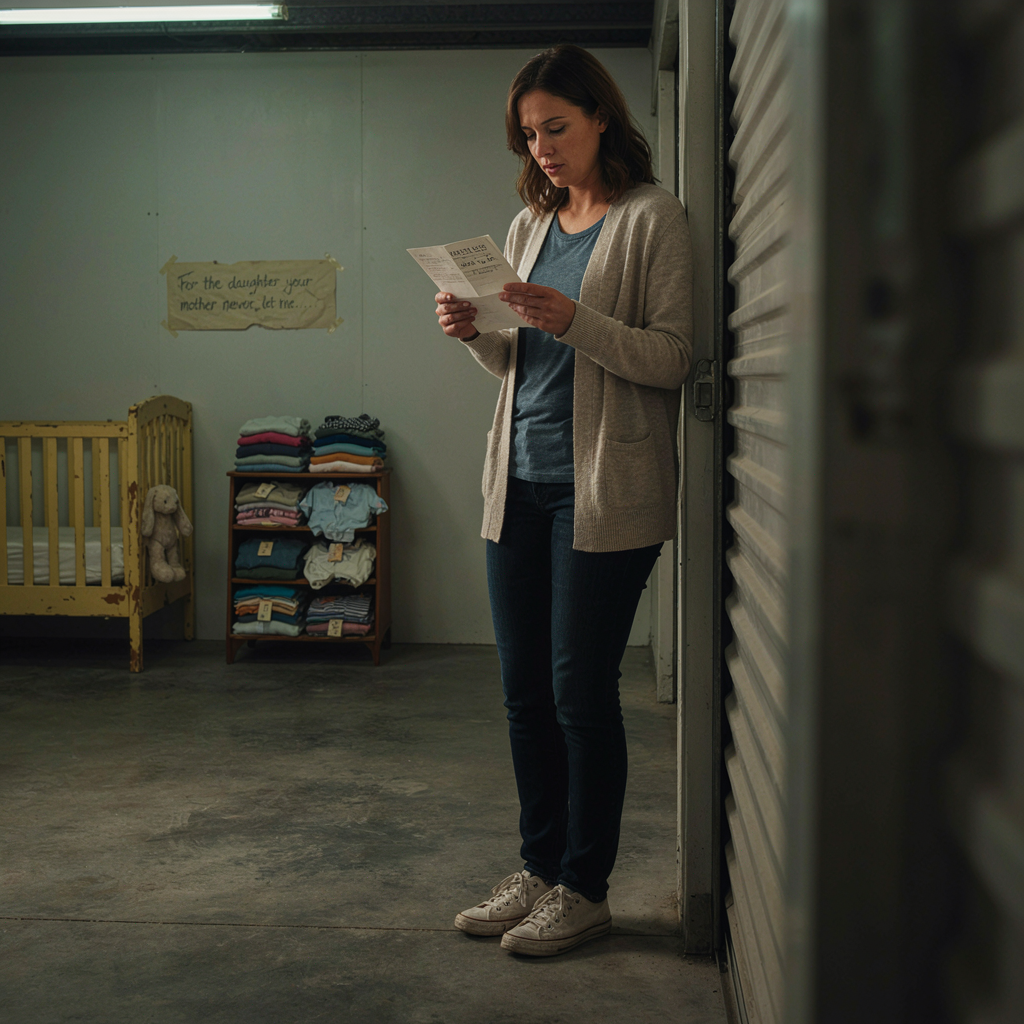
Instead, I saw a yellow crib.
I froze.
There was no fishing equipment.
Not one rod.
Not one reel.
The crib stood in the center of the room beneath a small battery-powered lamp.
Beside it was a wooden dresser.
I walked toward it.
The drawers were filled with tiny clothes.
Newborn.
Three months.
Six months.
One year.
Two.
Three.
Four.
Five.
All the way to ten.
Every outfit still had its original tag.
Some had never been removed from the packaging.
There were birthday dresses.
Winter coats.
Shoes.
Pajamas.
Little sweaters.
A pink bicycle helmet.
A purple backpack.
A stuffed rabbit.
I touched one tiny yellow dress.
My knees nearly gave out.
There were boxes stacked against the wall.
I opened one.
Inside were birthday cards.
Twenty-two years of them.
One for every birthday.
I pulled out the first.
The handwriting was Wallace’s.
On the front was a cartoon butterfly.
Inside:
Happy first birthday, sweetheart.
Another.
Happy second birthday.
Another.
I hope you’re learning to ride your bike.
Another.
I’m sorry I wasn’t there.
My hands started shaking.
I opened another box.
Photographs.
Dozens of them.
Then hundreds.
A little girl.
Newborn.
Toddler.
Kindergarten.
School plays.
Birthday cakes.
Christmas mornings.
First day of school.
A missing front tooth.
A crooked ponytail.
A graduation ceremony.
I sat on the floor.
The room seemed to tilt.
Wallace had a daughter.
A daughter I’d never known about.
And he’d been coming here every Friday for twenty-two years.
Then I saw the card taped to the wall.
It was older than the others.
The paper had yellowed.
Wallace’s handwriting covered the front.
I peeled it from the wall.
The first line said:
For the daughter your mother never let me…
The sentence stopped.
I turned it over.
On the back, he’d finished it.
…tell you how much I loved you.
I couldn’t breathe.
Underneath, he had written:
Your name is Emily.
I stared at that name.
Emily.
His daughter.
Then I saw something else.
A photograph taped beside the card.
Wallace was standing beside a young woman.
She looked about twenty-five.
In her arms was a baby.
Emily.
The woman was smiling.
Wallace wasn’t.
He looked terrified.
On the back of the photograph was a date.
June 17, 2004.
And beneath it:
The day everything was taken from me.
I called Wallace.
He answered after four rings.
“Hello?”
“Wallace.”
Silence.
“Where are you?”
“At home.”
“I’m at the storage unit.”
Another silence.
Longer this time.
Then I heard him whisper:
“Oh.”
That one word told me everything.
He knew.
He had always known I’d find it eventually.
I drove home without remembering the drive.
Wallace was sitting at the kitchen table when I walked inside.
His face looked older than it had that morning.
He didn’t ask what I’d found.
He simply looked at me.
“I should have told you.”
“Yes.”
“I wanted to.”
“You had thirty-four years.”
“I know.”
“Twenty-two years of Friday afternoons.”
He lowered his eyes.
“I know.”
I placed the photograph on the table.
“Who is she?”
“Rachel.”
“Emily’s mother?”
“Yes.”
“Did you love her?”
He looked at me.
“No.”
The answer came immediately.
“I loved Emily.”
“That’s not what I asked.”
Wallace swallowed.
“Rachel was my girlfriend before you.”
I stared at him.
“When?”
“Two years before I met you.”
“And Emily?”
“She was born in 2004.”
I calculated.
The storage unit had been rented that same year.
“Why didn’t you marry Rachel?”
“Because Rachel didn’t want me.”
“That doesn’t make sense.”
“She wanted money.”
I waited.
Wallace rubbed his forehead.
“Rachel and I were young. We were stupid. When she got pregnant, I wanted to marry her. She refused. She said she’d raise Emily herself.”
“And you agreed?”
“No.”
His voice cracked.
“I fought.”
He looked toward the window.
“I hired a lawyer. I went to court. I asked for custody.”
“What happened?”
“Rachel’s mother had money. Connections. She convinced everyone I was unstable.”
“Were you?”
“No.”
He laughed bitterly.
“I was twenty-nine. I worked construction. I had no degree, no money, and no family nearby.”
He paused.
“Rachel claimed I drank too much.”
“Did you?”
“Sometimes. Never around Emily.”
“Then what happened?”
“They gave Rachel custody.”
I sat down.
“But you could still see her.”
“That was the problem.”
Wallace’s hands began trembling.
“Rachel moved.”
“To where?”
“California.”
My eyes widened.
“She took Emily away?”
“She left while the court case was still being appealed.”
“And you followed?”
“I tried.”
He stared at the floor.
“I found them once.”
“When?”
“When Emily was three.”
“Did you see her?”
“Yes.”
“What happened?”
“Rachel called the police.”
I couldn’t speak.
“She told them I’d been stalking her.”
“Were you?”
“No.”
He looked at me.
“I stood across the street from a playground because I wanted to see my daughter.”
He wiped his eyes.
“The police told me if I came back, I’d be arrested.”
“And you never went again?”
“I did.”
My heart stopped.
“Where?”
“Here.”
He pointed toward the hallway.
“I came here every Friday because the storage facility was close to the courthouse.”
I didn’t understand.
“What does the courthouse have to do with anything?”
Wallace looked at me.
“I went to court every Friday for years.”
“For Emily?”
“Yes.”
“But the custody case ended.”
“Not the appeals.”
He reached into his pocket and pulled out a folded piece of paper.
“I kept fighting.”
He placed it on the table.
It was a court document.
I read the date.
Then another.
He had been petitioning the court for contact with Emily for years.
Every petition had been denied.
The reason?
“Father has demonstrated an inability to respect boundaries.”
I looked up.
“Did you?”
“No.”
“Then why?”
Wallace didn’t answer.
I looked at the storage unit again in my mind.
The crib.
The clothes.
The birthday cards.
“Did you ever meet her?”
He nodded.
“Once.”
“When?”
“Her sixteenth birthday.”
My heart tightened.
“You saw her?”
“Yes.”
“Did she know you were her father?”
“No.”
“What did you do?”
“I watched her from a distance.”
I stared at him.
“That sounds terrible.”
“I know.”
He closed his eyes.
“I didn’t know what else to do.”
He pulled another photograph from his wallet.
Emily at sixteen.
Long dark hair.
A soccer uniform.
A smile.
On the back:
She has your mother’s eyes.
I looked at Wallace.
“You kept all of this for twenty-two years.”
“Yes.”
“Why the storage unit?”
“Because Rachel found the boxes once.”
“What?”
“When Emily was seven, Rachel discovered I’d been sending gifts.”
“What did she do?”
“She burned them.”
I felt sick.
“All of them?”
“Yes.”
Wallace’s voice became quiet.
“So I stopped sending them.”
He pointed toward the storage unit.
“I started keeping them instead.”
“Every birthday?”
“Every Christmas.”
“Every age?”
“Yes.”
“Why?”
He looked at me.
“Because someday she might come looking.”
I wanted to be angry.
I wanted to scream.
Instead, I felt something I hadn’t expected.
Grief.
Not just for Wallace.
For a little girl who had grown up believing her father didn’t want her.
I spent that night awake.
At 3:17 a.m., I went downstairs.
Wallace was sitting in the dark.
“Why didn’t you tell me?” I asked.
He looked confused.
“About Emily.”
He stared at me for a long time.
Then he whispered:
“Because I was afraid you’d leave.”
I sat beside him.
“You should have trusted me.”
“I know.”
“Did you think I wouldn’t understand?”
“No.”
“Then what?”
“I thought you’d think I was a liar.”
“You were.”
He nodded.
“Yes.”
The next morning, I searched through the boxes again.
There was something I hadn’t noticed.
A small envelope hidden beneath the dresser.
It had my name on it.
For Margaret.
I opened it.
Inside was a letter.
Margaret,
If you’re reading this, then either I’m dead, or my mind has gotten bad enough that I can’t protect this secret anymore.
I’m sorry.
Not for Emily.
For you.
You deserved to know.
I met you in 1992. You made me believe I could have a family again.
I never stopped loving my daughter.
But I was ashamed.
I thought if I told you, you’d see me differently.
I was afraid you would look at me and wonder what kind of man loses a child.
The truth is, Margaret, I never lost her.
She was taken.
And I never stopped trying to find her.
I lowered the letter.
Then I read the final paragraph.
If something happens to me, please don’t let Emily believe I abandoned her.
She deserves the truth.
She deserves to know that every Friday at four, her father came.
My eyes filled with tears.
That afternoon, I made a decision.
I was going to find Emily.
Not for Wallace.
For her.
It took me three days.
The name Rachel was common.
Emily’s name was even more common.
But Wallace had left clues.
Photographs.
Old court papers.
A school program.
A soccer trophy.
A university brochure.
I pieced the years together.
Emily had studied architecture.
She lived in Oregon.
She was thirty-two.
She was married.
She had a four-year-old daughter.
Her name was Emily Carter.
My hands shook when I found her address.
I didn’t tell Wallace.
I drove six hours.
When I reached the house, I sat in the car for twenty minutes.
Then I knocked.
A woman opened the door.
She was older than the photographs.
But I recognized her immediately.
The eyes.
Wallace’s eyes.
She looked at me politely.
“Can I help you?”
I couldn’t speak.
She frowned.
“Are you okay?”
“My name is Margaret.”
Her expression changed.
“Do I know you?”
“No.”
I swallowed.
“But I know your father.”
Her face went completely still.
“My father?”
“Wallace.”
She stepped backward.
“Who are you?”
“His wife.”
She stared at me.
Then she laughed once.
Not because anything was funny.
Because she didn’t believe me.
“My father died when I was ten.”
“No.”
She shook her head.
“My mother told me he abandoned us.”
“She was wrong.”
“You don’t know that.”
“I do.”
I held out the photograph.
Emily took it.
Her hands began shaking.
“That isn’t possible.”
“It is.”
She looked at the picture.
Then at me.
“Why are you here?”
“Because your father has been paying for a storage unit for twenty-two years.”
She frowned.
“What storage unit?”
I told her.
She stared at me.
“What was inside?”
“Everything.”
Her eyes filled with tears.
“Everything?”
“Your birthdays.”
She covered her mouth.
“Your Christmas presents.”
She sat down on the porch step.
“He remembered?”
“Every one.”
I handed her the letter.
She read it silently.
When she finished, she couldn’t move.
“My mother said he didn’t want me.”
“I know.”
“She said he never contacted us.”
“He tried.”
“Why didn’t he come?”
“He did.”
Emily looked up.
“When?”
“Every Friday.”
She stared at me.
“Every Friday?”
“At four.”
Her face crumpled.
“I used to wait for him.”
I felt my heart break.
“What?”
“When I was little.”
She wiped her eyes.
“My mother told me my father wasn’t coming.”
She laughed through tears.
“But I used to sit by the window every Friday afternoon.”
I closed my eyes.
“Why Friday?”
“She said he used to visit on Fridays before he left.”
I looked at her.
“Emily…”
She whispered:
“I thought he stopped because he didn’t love me.”
“He never stopped.”
She began crying.
I sat beside her.
For almost an hour, neither of us spoke.
Then she asked:
“Where is he?”
“At home.”
“Is he sick?”
“Yes.”
“How sick?”
I hesitated.
“His memory is getting worse.”
She stood immediately.
“Take me to him.”
We drove back the next morning.
Wallace was sitting in his chair when we entered the house.
He looked at me.
Then at Emily.
For several seconds, he didn’t move.
I wondered if his memory had already betrayed him.
Then he whispered one word.
“Emily?”
She covered her mouth.
Wallace stood too quickly.
He nearly fell.
I caught his arm.
He stared at her like she was something impossible.
“I knew you’d come.”
Emily walked toward him.
“You remembered me.”
He laughed.
“I remembered everything.”
She hugged him.
Wallace broke down.
He held her like a father who had been waiting twenty-two years to hold his child.
“I tried,” he whispered.
“I know.”
“I bought you things.”
“I know.”
“I wrote you letters.”
“I know.”
“I went every Friday.”
“I know.”
He pulled back.
“Your mother told you?”
Emily shook her head.
“Your wife did.”
Wallace looked at me.
His eyes filled with tears.
“Thank you.”
I smiled through my own tears.
But there was still one mystery.
The storage unit wasn’t the only secret.
That evening, Emily asked about her mother.
“Is she still alive?”
“Yes.”
Emily looked at Wallace.
“Does she know about this?”
“No.”
Emily was silent.
Then she asked:
“Why did she lie?”
Wallace looked exhausted.
“I don’t know.”
But I did.
At least, I suspected.
The next day, Emily contacted Rachel.
They agreed to meet.
I wasn’t there.
Neither was Wallace.
But Emily returned that evening with a box.
She put it on the table.
“What is it?”
“My mother’s.”
She opened it.
Inside were old court documents.
Photographs.
Letters.
Then she pulled out one final envelope.
Rachel had written it in 2019.
Emily read it.
Her face went pale.
“What?”
She handed me the letter.
It said:
I know someday you’ll discover the truth.
Your father never abandoned you.
I was angry.
I wanted to punish him.
And eventually, I didn’t know how to undo what I’d done.
At the bottom was a confession.
Rachel had admitted that she’d intercepted Wallace’s letters.
She’d returned his gifts.
She’d lied about his court petitions.
And she’d told Emily he never came.
But there was another sentence.
One that changed everything.
Your father didn’t stop coming because the court ordered him to.
He stopped because I threatened to tell you that he was the reason your grandfather died.
Emily looked at me.
“What does that mean?”
We called Wallace.
He stared at the letter.
Then he sighed.
“Your grandfather had a heart attack during our custody battle.”
“You blamed yourself?”
“Rachel did.”
“Was it your fault?”
“No.”
“Then why did you let her say it?”
“Because I thought protecting you meant staying away.”
Emily shook her head.
“You spent twenty-two years protecting me from a lie.”
Wallace nodded.
“Yes.”
She reached across the table.
“You should have told me.”
“I know.”
“I would have wanted you.”
“I know.”
“Even if you were broke.”
“I know.”
“Even if you were imperfect.”
Wallace smiled sadly.
“I was very imperfect.”
She laughed through tears.
“So am I.”
He reached for her hand.
“I missed your whole life.”
“No.”
She squeezed his fingers.
“You’re here now.”
And for the first time since I’d known him, Wallace looked peaceful.
A month later, we emptied the storage unit.
Emily took the crib.
She took the birthday cards.
She took every outfit.
She took the photographs.
But she left one thing behind.
The card on the wall.
“For the daughter your mother never let me tell you how much I loved you.”
I asked her why.
She smiled.
“Because I want Dad to keep it.”
So Wallace kept it.
Until the day his memory became so bad that he couldn’t remember my name.
But strangely, he always remembered Emily.
Sometimes he would look at her and say:
“I’ve been waiting for you.”
And she would answer:
“I know.”
One year later, Emily’s daughter turned five.
Her name was Grace.
We celebrated in our backyard.
There were balloons.
A cake.
A crooked homemade banner.
Wallace sat beneath the oak tree, watching Grace run through the grass.
Emily brought him a present.
He opened it slowly.
Inside was a framed photograph.
It showed three generations.
Wallace.
Emily.
Grace.
He stared at it.
“Who’s that little girl?”
Emily smiled.
“Your granddaughter.”
He nodded.
“And who’s she?”
“Your daughter.”
He looked at Emily.
For a moment, there was no confusion in his eyes.
Only recognition.
Only love.
Then he looked at me.
“And you?”
I smiled.
“Your wife.”
He took my hand.
“I chose well.”
I laughed.
“You did.”
That night, after everyone left, I walked into the spare room.
On the wall was the old card from the storage unit.
Underneath it, Emily had added something.
A photograph of Wallace holding her as a baby.
And beneath the photograph, she’d written:
He didn’t miss my life because he didn’t love me.
He missed it because someone convinced him loving me meant staying away.
Then, below that:
But he came every Friday.
At four o’clock.
For twenty-two years.
I stood there for a long time.
And I finally understood what the storage unit had really been.
It wasn’t a secret place for an affair.
It wasn’t a hiding place for another family.
It wasn’t evidence of betrayal.
It was a museum of a father’s love.
A place where Wallace had stored every birthday he wasn’t allowed to attend.
Every Christmas he couldn’t celebrate.
Every letter he couldn’t send.
Every little dress he hoped his daughter might someday wear.
He hadn’t been keeping fishing gear.
He had been keeping time.
Twenty-two years of it.
One Friday at a time.
And sometimes, the deepest secrets in a marriage aren’t the things someone did behind your back.
They’re the things they were too afraid to tell you because they thought the truth would make you leave.
Wallace had spent thirty-four years afraid I would.
Instead, the truth gave me a daughter.
And on the last Friday of his life, at exactly four o’clock, Emily sat beside him.
She held his hand.
He looked at her.
His memory was almost gone.
But he smiled.
“You came.”
Emily squeezed his hand.
“Of course I did, Dad.”
He closed his eyes.
And for the first time in twenty-two years, there was no storage unit.
No locked door.
No secret.
No waiting.
Just a father and his daughter, together at four o’clock on Friday.
Exactly where they were always meant to be.