“WHO’S FEEDING MY MOTHER?”
My calf burned beneath the splint, and the emergency room smelled sharply of antiseptic when his forty-seventh call came through.I stared at the stitches going into my skin.
My phone vibrated again against the plastic hospital tray.JULIAN.I had stopped answering twenty minutes ago.
Not because I didn’t hear him.Because I finally understood that if I answered, I would hear the same question.
Not—Are you okay, Madeline?Not—How badly are you hurt?Not even—
What happened?8=His question was always the same.“Who’s feeding my mother?”I looked down at my swollen ankle.“Your mother isn’t my responsibility anymore,” I whispered.
The nurse adjusting my IV glanced at me.I swallowed the lump in my throat.“Neither is this marriage.”
The words felt strange coming out of my mouth.
But they also felt like the first honest thing I’d said in years.
My name is Madeline Carter.I was forty-two years old.And for sixteen years, I had been married to Julian Carter.For sixteen years, I had believed marriage meant standing beside someone when life became difficult.
I was wrong.In my marriage, standing beside Julian meant standing behind him.Behind his career.Behind his mother.
Behind his excuses.Behind every crisis that somehow became my responsibility.
And on the day my leg broke, I finally stopped.
It happened on a rainy Tuesday afternoon.
I had been carrying groceries up the front steps of our house when my shoe slipped.
One second I was reaching for the railing.
The next, I was falling.
My body twisted.
There was a horrible crack.
Then another.
I screamed so loudly that our neighbor, Mrs. Patterson, ran outside.
She called an ambulance.
I remember the paramedic asking me questions.
“Can you move your toes?”
“Yes.”
“Any pain in your back?”
“No.”
“Where does it hurt?”
“My leg.”
My phone rang while they loaded me into the ambulance.
Julian.
I answered because, even then, some part of me was still trained to respond.
“Hello?”
“Madeline, where are you?”
“I fell.”
“What?”
“I broke my leg, I think.”
There was silence.
Then he asked the question that changed everything.
“Who’s feeding Mom?”
I thought I’d misunderstood him.
“What?”
“Mom hasn’t eaten lunch. I told you I had meetings all afternoon.”
I stared at the ceiling of the ambulance.
“I’m being taken to the hospital.”
“So?”
“So I can’t feed her.”
He exhaled impatiently.
“You knew I had meetings.”
“My leg is broken, Julian.”
“You’re always making everything into a crisis.”
I closed my eyes.
The paramedic beside me looked at my face.
“Ma’am?”
I shook my head.
“I’m fine.”
Julian continued.
“Just order something for Mom.”
“I don’t have access to her food.”
“You live in the same house.”
“I’m in an ambulance.”
Another silence.
Then:
“Fine. I’ll handle it.”
He hung up.
I stared at my phone.
That should have been the moment I understood.
But I didn’t.
Not completely.
I still loved him.
Or maybe I loved the man I remembered.
The man who had once held my hand during my father’s funeral.
The man who had promised, on our wedding night, that I would never have to face anything alone.
That man had disappeared somewhere along the way.
And I had spent years pretending he was still there.
At the hospital, the doctors confirmed I had fractured my tibia and fibula.
I needed surgery.
My leg was placed in a temporary splint while they prepared me.
My sister, Claire, lived three hours away.
My parents were gone.
I had no children.
For years, I’d told myself that was unfortunate.
That day, lying alone beneath fluorescent lights, I realized something else.
If I had a daughter, I would tell her never to confuse being needed with being loved.
My phone rang again.
Julian.
I ignored it.
Then again.
Again.
By the time the surgeon came in, I had forty-seven missed calls.
I finally answered.
“Julian.”
“Finally.”
“I’m going into surgery.”
“Who’s feeding Mom?”
I laughed.
Not because anything was funny.
Because sometimes your mind laughs when your heart can’t process what it’s hearing.
“Julian, I have a broken leg.”
“And Mom has diabetes.”
“She has a caregiver.”
“She doesn’t want the caregiver.”
“Then you need to call the caregiver.”
“She only listens to you.”
I stared at the ceiling.
“That sounds like a problem you should solve.”
“You’re her daughter-in-law.”
“No,” I said quietly. “I’m her daughter-in-law who is currently being wheeled into surgery.”
He became angry.
“You’re being selfish.”
That word.
Selfish.
I’d heard it before.
Whenever I wanted an evening away.
Whenever I asked him to hire additional help.
Whenever I complained about Eleanor screaming at me.
Whenever I said I was exhausted.
Whenever I asked Julian to take his mother to a doctor’s appointment.
I was selfish.
But Julian was never selfish.
He was simply “busy.”
His mother was never demanding.
She was “elderly.”
And I was never exhausted.
I was “overreacting.”
The nurse took my phone.
“Ma’am, we’re ready.”
I nodded.
Before the doors closed, I looked at the screen.
One new message appeared.
IF MOM MISSES DINNER, I’LL MAKE SURE EVERYONE KNOWS YOU ABANDONED HER.
Something inside me went cold.
I turned the phone off.
Three hours later, I woke from surgery.
My leg was wrapped in a heavy cast.
My throat was dry.
The room was dim.
And Julian was nowhere to be seen.
I wasn’t surprised.
What surprised me was who stood beside my bed.
Two police officers.
“Mrs. Carter?”
I blinked.
“Yes?”
“I’m Officer Ramirez. This is Officer Collins.”
I stared at them.
“Why are you here?”
Officer Ramirez looked uncomfortable.
“Your husband reported that you abandoned an elderly dependent in your home.”
For a moment, I couldn’t speak.
Then I started laughing.
The officers exchanged a glance.
“I’m sorry,” I said. “He reported me?”
“Yes.”
“I was brought here by ambulance.”
“We know.”
“I had surgery.”
“We know.”
“I have a broken leg.”
“We know.”
Officer Collins opened a folder.
“We have your emergency admission time, ambulance report, surgical record, and accident report.”
My laughter disappeared.
“So you know I didn’t abandon her.”
“We’re aware that your medical records strongly contradict the allegation.”
I stared at them.
“Did he tell you I left the house voluntarily?”
“Yes.”
“Did he say I refused to care for her?”
“Yes.”
I felt something inside me break that had nothing to do with my leg.
“He knew I was injured.”
Officer Ramirez nodded.
“Your husband also told us you had been threatening to leave his mother without care.”
I whispered:
“He’s lying.”
“I believe you.”
The officer hesitated.
“There is something else.”
He opened another page.
“Mrs. Carter, your mother-in-law’s caregiver told us she had been instructed by your husband not to enter the house today.”
My heart stopped.
“What?”
“She said Mr. Carter told her not to come because you were responsible for his mother’s care.”
I stared at the wall.
There it was.
The trap.
He hadn’t simply been angry that I wasn’t feeding Eleanor.
He had deliberately prevented the caregiver from coming.
Then he called the police and accused me of abandoning her.
He had created the emergency himself.
“Why?” I whispered.
Officer Ramirez looked at me.
“That’s something you’ll have to ask your husband.”
I didn’t want to ask him anything.
I wanted to leave him.
But leaving required money.
And that reminded me of another problem.
Our joint account.
For years, Julian had handled the finances.
At least, that’s what I thought.
We had approximately $100,000 in our primary savings account.
Money we’d accumulated together.
I had contributed nearly half.
But Julian controlled the online banking.
I had access.
I simply never checked it.
Because I trusted him.
That was another mistake.
I called the bank from my hospital bed.
“I’m calling about a joint account.”
The representative verified my identity.
Then I said:
“I need to place a temporary restriction on withdrawals.”
There was a pause.
“Are you concerned about unauthorized activity?”
“Yes.”
“Is there an immediate concern?”
“Yes.”
My voice shook.
“My husband is trying to use our money against me.”
The representative transferred me to the fraud department.
Twenty minutes later, the account was frozen pending verification.
I exhaled.
For the first time in years, I felt like I had made a decision that belonged entirely to me.
Then I called Claire.
She answered immediately.
“Madeline?”
I cried.
Not quietly.
Not gracefully.
I sobbed.
“Claire, I broke my leg.”
“What?”
“I had surgery.”
“Oh my God.”
“And Julian reported me to the police.”
Silence.
“Why?”
“Because his mother hadn’t eaten.”
Claire’s voice became dangerously calm.
“Madeline.”
“I know.”
“No. Listen to me. This isn’t normal.”
“I know.”
“I’m driving there.”
“You don’t have to.”
“Yes, I do.”
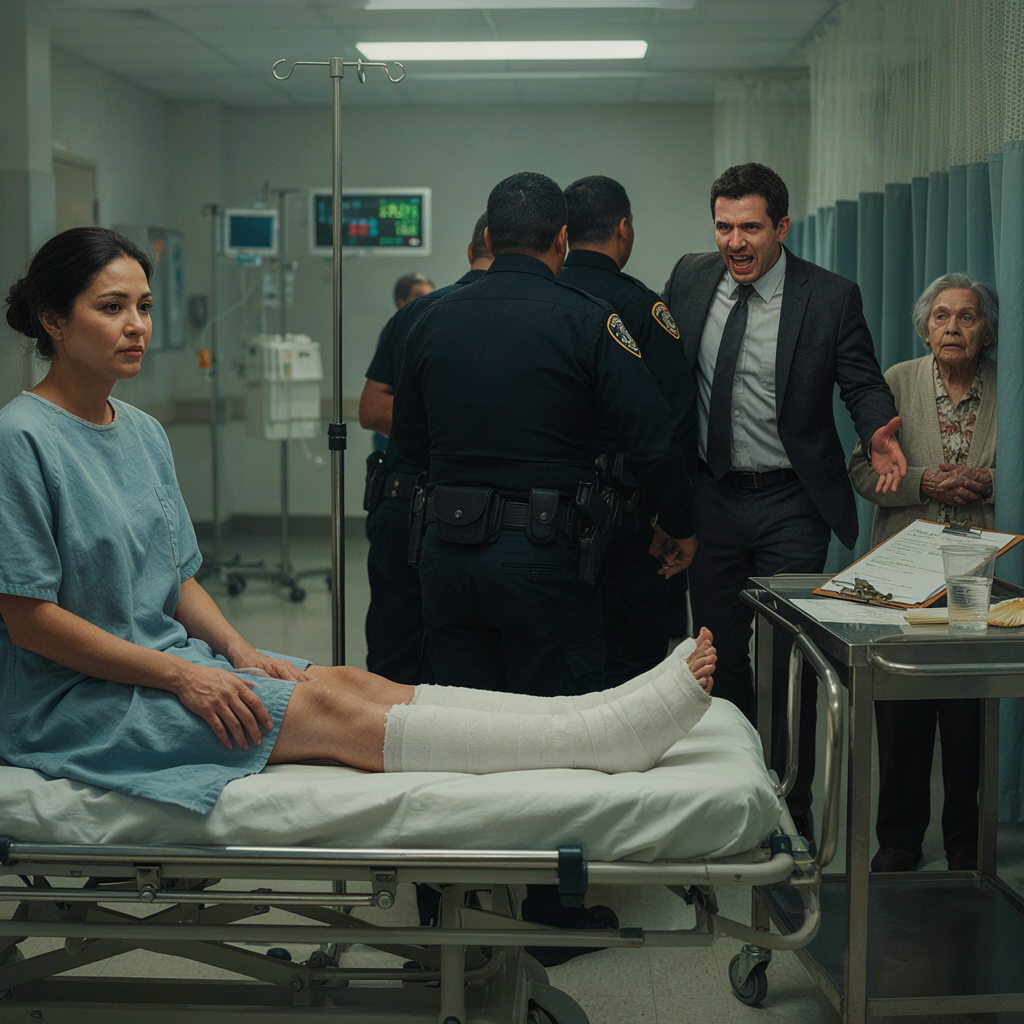
An hour later, Julian arrived.
And he wasn’t alone.
Eleanor came behind him in her wheelchair.
The moment they reached the curtain, two hospital security officers stepped in front of them.
“Sir, you need to stop here.”
Julian stared.
“What?”
“You can’t enter without the patient’s permission.”
“I’m her husband.”
The guard checked the paperwork.
“She’s listed as restricted visitation.”
Julian looked directly at me.
I had never seen such rage in his eyes.
“Madeline.”
I didn’t answer.
Eleanor began shouting.
“You ungrateful woman!”
Claire stood beside my bed.
“Don’t you dare.”
Eleanor pointed at me.
“She abandoned me!”
Julian stepped forward.
“She left my mother alone.”
I looked at him.
“No.”
His face tightened.
“You know that’s not true.”
“You refused to let her caregiver come.”
He froze.
For the first time, I saw uncertainty.
Then he recovered.
“You’re confused because of the medication.”
I smiled.
“No.”
I lifted my phone.
“The police already spoke to the caregiver.”
His expression changed.
Claire whispered:
“Good.”
Julian lowered his voice.
“Madeline, let’s not do this here.”
“You started it here.”
“What do you want?”
“A divorce.”
Eleanor gasped.
Julian stared at me.
“You’re serious?”
“I’ve never been more serious.”
“You can’t walk.”
“I don’t need to walk to file for divorce.”
His face reddened.
“You’re destroying our family.”
I looked at Eleanor.
“Your mother destroyed our marriage long before today.”
Eleanor screamed.
But Julian suddenly became quiet.
Because he knew something.
He knew what was coming next.
The next morning, Claire brought me my laptop.
I opened the frozen bank account.
Then I noticed something strange.
There were withdrawals I didn’t recognize.
Thousands of dollars.
I called the bank.
They gave me a transaction history.
My hands trembled.
Over the previous eighteen months, nearly $63,000 had been withdrawn.
Not for groceries.
Not for medical care.
Not for Eleanor.
The money had gone to a company called Carter Strategic Consulting.
I stared at the name.
Julian’s company.
“What is this?” Claire asked.
“I don’t know.”
We kept digging.
Then we found transfers from the consulting company to another account.
An account I had never seen.
Claire leaned closer.
“That’s a lot of money.”
I nodded.
Then I saw the beneficiary name.
Lydia Monroe.
I recognized it.
Lydia was Julian’s office manager.
I felt sick.
“Why would Julian be paying Lydia?”
Claire looked at me.
“Maybe ask him.”
I didn’t.
Instead, I called an attorney.
Her name was Rebecca Sloan.
She arrived at the hospital that afternoon.
I handed her everything.
The police report.
The bank records.
The caregiver statement.
The messages.
The medical documentation.
Rebecca read silently.
Finally, she looked up.
“Madeline, your husband has made a serious mistake.”
“What kind?”
“He created a false narrative that you abandoned a vulnerable adult while simultaneously interfering with the care arrangements.”
She turned a page.
“And these transfers?”
“That’s what I need to know.”
Rebecca nodded.
“We’re going to find out.”
Two days later, the hospital released me.
Claire took me to her house.
Julian didn’t know where I was.
For the first time in sixteen years, I slept without listening for Eleanor’s wheelchair rolling down the hallway.
I woke up at six the next morning.
No demands.
No shouting.
No accusations.
Just silence.
It was beautiful.
Then Rebecca called.
“We found something.”
My stomach tightened.
“What?”
“Your husband has been preparing for this.”
I sat up.
“What do you mean?”
“He has been moving marital assets.”
“How much?”
“Approximately $91,000 that we can currently trace.”
I closed my eyes.
“Where?”
“Several accounts. Some connected to his business.”
“And Lydia?”
“Lydia appears to have received payments.”
“For what?”
Rebecca paused.
“That’s the interesting part.”
“What?”
“The payments were described as consulting fees.”
“Were they?”
“No.”
My heart pounded.
“What were they?”
Rebecca sent me a file.
I opened it.
It was a lease.
For an apartment downtown.
The tenant’s name was Lydia Monroe.
The lease was paid by Julian.
I stared at the screen.
“How long?”
“Fourteen months.”
I couldn’t breathe.
Fourteen months.
He had been cheating on me.
While I was caring for his mother.
While I cooked.
While I cleaned.
While I drove Eleanor to appointments.
While Julian told me I was selfish for asking for help.
He had been maintaining another woman.
With our money.
I didn’t cry.
That surprised me.
I simply felt empty.
Then Rebecca said:
“There is one more thing.”
“What?”
“The apartment isn’t the biggest problem.”
“What is?”
“Lydia is pregnant.”
I closed my eyes.
Everything went silent.
Julian had spent months building a second life.
And he had expected me to keep maintaining the first one.
His mother.
His house.
His meals.
His reputation.
His comfort.
I was supposed to carry all of it while he quietly replaced me.
But he had made one mistake.
He thought I was powerless.
He had forgotten that I knew where everything was.
The accounts.
The passwords.
The contracts.
The business documents.
The investments.
Because while Julian pretended I was only a housewife, I had been the person organizing his company’s tax files for twelve years.
I knew his business better than he thought.
Rebecca looked at me.
“Do you want to fight?”
I looked out the window.
“I don’t want revenge.”
“What do you want?”
I thought about the woman I had been.
The woman who apologized when other people hurt her.
The woman who stayed quiet to keep peace.
The woman who believed being a good wife meant tolerating anything.
“I want my life back.”
Rebecca smiled.
“Then that’s exactly what we’re going to get.”
The divorce proceedings began three weeks later.
Julian tried everything.
He claimed I was emotionally unstable.
He claimed I had neglected Eleanor.
He claimed the bank transfers were legitimate business expenses.
He claimed Lydia was merely an employee.
But the evidence kept piling up.
The caregiver testified.
The police report documented the false abandonment claim.
The hospital records proved I had been medically incapable of caring for Eleanor.
Then came the financial records.
That was what finally broke Julian.
Because the $63,000 wasn’t missing.
It was sitting in accounts connected to Lydia.
And the $100,000 joint account?
It had been frozen before he could drain it.
He had assumed he could empty it after accusing me of abandonment.
He couldn’t.
One afternoon, Julian asked to speak with me privately.
I agreed.
We sat across from each other in the attorney’s office.
He looked exhausted.
Older.
Smaller.
“I made mistakes,” he said.
I stared at him.
“You made choices.”
He looked down.
“I was going to tell you.”
“When?”
“I don’t know.”
“After Lydia had the baby?”
He flinched.
“So you knew.”
“Yes.”
“You knew she was pregnant.”
He nodded.
I swallowed.
“And you still wanted me to take care of your mother.”
He looked ashamed.
“I didn’t know what else to do.”
I almost laughed.
“You could have hired someone.”
“I didn’t want to spend the money.”
“You spent $63,000 on another woman.”
Silence.
Then he whispered:
“I loved you.”
“No.”
He looked at me.
“You loved what I did for you.”
His eyes filled with tears.
I didn’t feel victorious.
I felt sad.
Because I finally understood that our marriage hadn’t ended the day I broke my leg.
It had ended years earlier.
I had simply been the last person to know.
The divorce was finalized eight months later.
I received my share of the marital assets.
The $100,000 account was divided fairly.
The funds transferred through Julian’s company were investigated.
His business reputation suffered.
His relationship with Lydia didn’t last either.
Apparently, building a relationship on betrayal doesn’t make it stronger.
Eleanor moved into assisted living.
She never apologized.
Not once.
Julian eventually sold the house.
The place where I had spent sixteen years trying to keep everyone happy became someone else’s home.
And strangely, I didn’t miss it.
My leg healed.
Slowly.
Painfully.
But it healed.
Six months after the accident, I returned to work.
I had spent years believing I needed Julian’s permission to have a life.
I didn’t.
I bought a small house of my own.
Nothing extravagant.
Just a quiet place with a garden and large windows.
Claire helped me paint the kitchen.
One Saturday morning, while unpacking a box, I found my old wedding album.
I opened it.
There I was.
Twenty-six years old.
Smiling.
Hopeful.
Standing beside a man I thought would protect me.
I stared at that young woman for a long time.
Then I closed the album.
I didn’t hate her.
She didn’t know.
She couldn’t have known.
She had entered that marriage believing love meant sacrifice.
Now she understood something different.
Love should never require you to disappear.
A year after the accident, I received a letter from Officer Ramirez.
He had heard the divorce had been finalized.
At the bottom, he had written:
“I’m glad you’re doing better. For what it’s worth, the medical records saved you that day.”
I smiled.
They had.
But not only because they proved I hadn’t abandoned Eleanor.
They had reminded me that facts matter.
Truth matters.
And sometimes, when someone has spent years rewriting reality around you, documentation becomes your lifeline.
I kept the letter.
Then I went outside.
My leg still ached when the weather changed.
But I could walk.
I walked slowly through my garden.
No wheelchair behind me.
No voice calling my name.
No one asking what I had cooked.
No one demanding that I fix someone else’s problems.
Just birds.
Wind.
Sunlight.
Freedom.
My phone rang.
I looked at the screen.
It was an unknown number.
I almost ignored it.
Then I answered.
“Hello?”
A woman’s voice trembled.
“Is this Madeline Carter?”
“Yes.”
“My name is Lydia Monroe.”
I froze.
She continued.
“I know you probably hate me.”
I said nothing.
“I’ve been trying to call you for months.”
“Why?”
There was a long silence.
Then she said:
“Because Julian lied to me too.”
My heart began pounding.
“What do you mean?”
“He told me you knew about us.”
I closed my eyes.
Of course.
He had told her a story too.
A different version.
One where I was cold.
One where our marriage was already over.
One where he was trapped.
Lydia began crying.
“He told me you were staying with him for financial reasons.”
I almost laughed.
“That’s what he told you?”
“Yes.”
I sat down on the garden bench.
“What do you want from me?”
“Nothing.”
“Then why call?”
Her voice broke.
“Because I found something in his office.”
I straightened.
“What?”
“A file.”
“What kind of file?”
“Your name was on it.”
My stomach tightened.
“What was inside?”
“I don’t know everything.”
“Tell me.”
“He had been planning to declare you mentally incompetent.”
The world seemed to stop.
I couldn’t breathe.
“He what?”
“He had spoken to an attorney before your accident.”
“Why?”
“To gain control over your finances.”
I gripped the edge of the bench.
“And the police report?”
“He needed evidence.”
I whispered:
“What evidence?”
“That you were unstable. Neglectful. Unable to care for yourself or his mother.”
Everything clicked.
The forty-seven calls.
The accusation.
The caregiver.
The police.
The financial transfers.
The medical records.
He hadn’t panicked when I broke my leg.
He had seen an opportunity.
He had expected my injury to become proof that I was incapable.
He had planned to use my vulnerability against me.
But the accident had done the opposite.
It had placed me in a hospital surrounded by witnesses.
Doctors.
Nurses.
Paramedics.
Police.
Medical records.
People who documented the truth.
His perfect story collapsed because reality had been recorded.
I thanked Lydia and ended the call.
Then I sat in my garden for a long time.
I thought about how close I had come to believing him.
How close I had come to losing everything.
My home.
My savings.
My independence.
My voice.
Maybe that was the real lesson.
Sometimes the person trying hardest to convince everyone that you’re the problem is the person most afraid of what happens when people finally hear your side.
Julian wanted me silent.
He wanted me dependent.
He wanted me frightened.
Instead, he gave me something he never intended to give me.
A reason to stop being afraid.
I never remarried.
People asked why.
I simply told them:
“I’m not looking for someone to complete my life.”
Because my life was already complete.
I had friends.
I had Claire.
I had my little garden.
I had work.
I had mornings without fear.
And I had learned to trust myself.
A year after the divorce, I donated the wheelchair the hospital had given me during rehabilitation.
I didn’t need it anymore.
Before the charity truck took it away, I ran my fingers across the handle.
That chair had once represented everything I couldn’t do.
Now it represented everything I had survived.
I watched the truck disappear down the street.
Then I turned toward my house.
For the first time in years, when I looked at my home, I didn’t think about who needed something from me.
I thought about what I wanted.
I went inside.
Made myself coffee.
Opened the windows.
And smiled.
Because once upon a time, my husband had asked:
“Who’s feeding my mother?”
He had expected me to panic.
Expected me to apologize.
Expected me to crawl back into the role he’d created for me.
Instead, I answered the only way I should have answered years earlier.
“Not me.”
And that two-word answer changed my entire life.