The Birthday Cards From the Dead
My granddaughter had received a birthday card every year since she was born.There was nothing unusual about the card itself.It was always small.
Always cream-colored.Always unmarked.No return address.No sender’s name.
Inside, there was always exactly twenty dollars and the same handwritten message:
Happy Birthday, sweet girl.That was it.No more.No less.
For twelve years, the cards arrived like clockwork.And for twelve years, I told myself they were impossible.Because the handwriting belonged to my mother.
And my mother had been dead for twelve years.Her name was Evelyn Hart.
She had died at seventy-eight after a short battle with pneumonia. She’d gone peacefully in her sleep, holding my hand.
I remembered every detail of that night.The hospital room.The rain tapping against the window.The faint smell of disinfectant.
The way her breathing became quieter and quieter until there was nothing left but the soft hum of the machines.
I remembered kissing her forehead.
I remembered whispering, “I love you, Mom.”
And I remembered knowing, with absolute certainty, that she was gone.So when the first birthday card arrived for my granddaughter, Lily, I thought it was some strange coincidence.
Lily was born three months after my mother died.My daughter, Rebecca, had been devastated that her grandmother never got to meet the baby.
Mom had spent years talking about becoming a great-grandmother.
She had even bought a tiny yellow sweater before Lily was born.
“She’s going to be my sweet girl,” Mom had said.
Those were her exact words.
“Every family needs a sweet girl.”
Three months later, Mom was gone.
Then Lily was born.
On her first birthday, Rebecca opened the mailbox and found a cream-colored envelope.
There was no stamp.
No return address.
Just Lily’s name written neatly across the front.
LILY REBECCA CARTER
Rebecca brought it inside.
“I wonder who sent this.”
She opened it.
Twenty dollars fell onto the kitchen table.
Then she unfolded the note.
Her face changed.
“Mom?”
“What?”
She handed it to me.
I read the four words.
Happy Birthday, sweet girl.
My hands began to shake.
Rebecca laughed nervously.
“That’s weird.”
I stared at the handwriting.
“No.”
“What?”
“This is Grandma’s handwriting.”
Rebecca looked at me.
Then at the note.
Then back at me.
“Mom, Grandma’s been dead almost a year.”
“I know.”
“Maybe someone copied it.”
“Who?”
She shrugged.
“A relative?”
“We don’t have relatives who would do this.”
“Maybe somebody from Grandma’s church.”
“No.”
“Mom.”
“I know her handwriting.”
Rebecca sighed.
“You haven’t slept much.”
“I’m not imagining this.”
“I didn’t say you were.”
But I could see the doubt in her eyes.
And honestly, I doubted myself too.
For the next few years, we tried to explain it.
Someone was playing a joke.
An old friend of my mother’s had found out about Lily.
A distant relative wanted to remain anonymous.
Maybe Rebecca’s father had sent the cards without telling us.
Except he hadn’t.
I asked him.
He swore it wasn’t him.
The cards kept coming.
Second birthday.
Third.
Fourth.
Fifth.
Always twenty dollars.
Always cream-colored.
Always the same handwriting.
Happy Birthday, sweet girl.
Sometimes the envelope was postmarked from our city.
Sometimes there was no postmark at all.
Once, it appeared in the mailbox before dawn even though the previous evening the mailbox had been empty.
By Lily’s seventh birthday, I had stopped telling Rebecca that the handwriting looked exactly like my mother’s.
She had heard it enough.
Instead, I simply kept the cards.
I put every one in a box.
Twelve cards.
Twelve twenty-dollar bills.
Twelve identical messages.
I couldn’t bring myself to spend the money.
Neither could Rebecca.
Lily didn’t know what to think.
By the time she was nine, she had started calling them “Grandma Evelyn’s cards.”
“Is Grandma sending them from heaven?”
I laughed the first time she asked.
But she didn’t laugh.
“Do you think she is?”
I swallowed.
“I don’t know, honey.”
“She said she was going to give me presents.”
“She did.”
“But she’s dead.”
“I know.”
“Dead people can’t mail things.”
“No.”
She thought for a moment.
“Maybe somebody is helping her.”
That answer stayed with me.
By Lily’s tenth birthday, I began looking at the cards differently.
Not as strange little mysteries.
As evidence.
Someone was deliberately sending them.
Someone knew Lily’s birthday.
Someone knew my mother’s handwriting.
Someone knew the exact phrase Mom had used for Lily.
And whoever it was had been doing it for ten years.
That wasn’t a prank.
That was devotion.
Then came Lily’s twelfth birthday.
And I decided I was going to find out who was behind it.
I didn’t tell Rebecca.
I didn’t tell Lily.
I didn’t tell anyone.
The night before the birthday, I checked the mailbox.
Nothing.
At midnight, I checked again.
Nothing.
At 3 a.m., nothing.
At 5:30, I was sitting in my car across the street from our mailbox.
It was March, and the morning was cold.
The sky was still dark.
I had a thermos of coffee beside me and my mother’s old photograph sitting on the dashboard.
I stared at her face.
“Who are you sending these cards through?” I whispered.
At 6:45, nothing.
7:00.
Nothing.
7:10.
Still nothing.
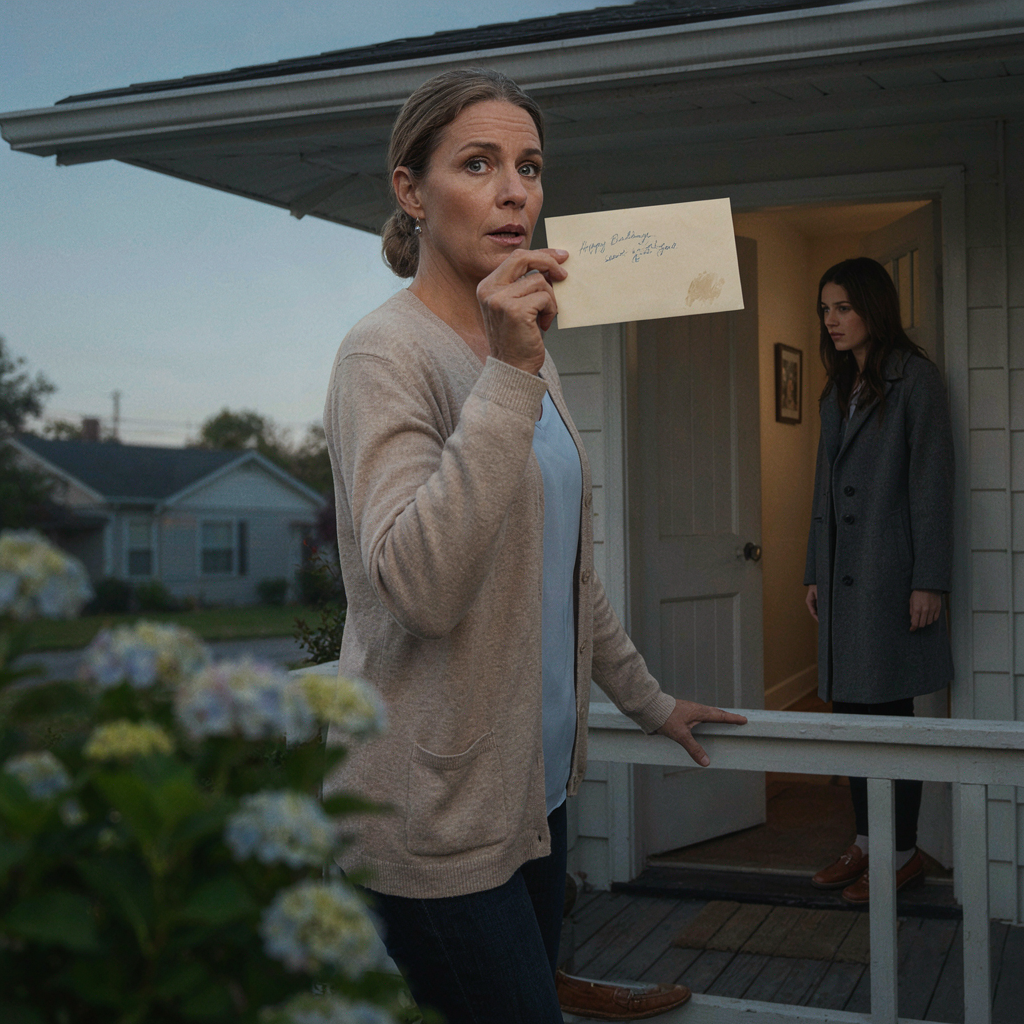
Then at 7:15, I saw her.
A young woman in a gray coat.
She walked slowly down the sidewalk.
She looked around once.
Then she stopped beside our mailbox.
My heart started pounding.
She opened the mailbox.
Placed an envelope inside.
Closed it.
And walked away.
I got out of my car.
I didn’t even think.
I followed her.
She turned left.
Then right.
Then crossed the street.
I kept twenty feet behind her.
She walked for nearly ten minutes before stopping in front of a small white house on Birch Street.
She unlocked the door.
I waited until she stepped inside.
Then I walked to the porch.
I knocked.
My heart was pounding so hard I could hear it.
A few seconds later, the door opened.
The woman stared at me.
She was younger than I’d thought.
Maybe twenty-five.
Brown hair.
Pale face.
Gray-green eyes.
For some reason, those eyes made my stomach drop.
I held up the envelope.
“Who are you?”
She went completely still.
Her eyes dropped to the envelope.
Then back to me.
For several seconds, neither of us spoke.
Finally, she whispered:
“My name is Clara.”
“Clara what?”
She hesitated.
“Clara Hart.”
Everything inside me stopped.
Hart.
My mother’s last name.
I stared at her.
“You’re related to Evelyn Hart?”
She swallowed.
“Yes.”
“How?”
She looked over her shoulder.
Then she opened the door wider.
“Please come inside.”
I should have walked away.
Instead, I stepped into the house.
It was small but spotless.
There were books everywhere.
Photographs covered the walls.
And then I saw one.
A photograph of my mother.
Not a photograph I’d ever seen.
Mom was younger.
Maybe forty.
She was standing beside a woman I didn’t recognize.
The woman was holding a baby.
I walked toward it.
“Where did you get this?”
Clara didn’t answer.
I turned around.
“Who is that woman?”
“My mother.”
“What’s her name?”
“Anna.”
“And the baby?”
Clara’s eyes filled with tears.
“Me.”
I looked back at the photograph.
My mother’s face was unmistakable.
But she was smiling in a way I hadn’t seen in years.
A relaxed smile.
A secret smile.
The kind of smile people wear when they’re standing beside someone they love.
I turned toward Clara.
“How did my mother know your mother?”
Clara wiped her eyes.
“Because Evelyn was my grandmother.”
My knees almost gave out.
“No.”
“Yes.”
“My mother had one child.”
“Your mother had two.”
The room seemed to tilt.
“That’s impossible.”
“I know.”
“You’re saying my mother had another daughter?”
“Yes.”
“Who was your mother?”
“Anna.”
I shook my head.
“Anna doesn’t exist.”
Clara gave a sad smile.
“She did.”
“Where is she?”
“She died when I was six.”
I stared at her.
Then at the photograph.
Then back at her.
“Why didn’t I know about her?”
“Because your mother wanted it that way.”
I felt anger rise through the shock.
“My mother didn’t have secrets from me.”
Clara looked at me gently.
“She had one.”
She walked into the kitchen and returned with a small wooden box.
She placed it on the table.
“This belonged to her.”
I recognized it immediately.
It was Mom’s jewelry box.
I had seen it hundreds of times.
I had thought it had been buried with her.
My voice came out barely above a whisper.
“Where did you get that?”
“She gave it to me.”
“When?”
“Two months before she died.”
I stared at Clara.
“Why?”
“Because she knew she didn’t have much time.”
She opened the box.
Inside were letters.
Dozens of them.
Some yellowed with age.
Some newer.
And on top was a photograph.
Mom.
Anna.
And Clara.
Three generations.
My hands trembled as I picked it up.
“When did this happen?”
“Three years before I was born.”
I looked at her.
“Why?”
Clara took a breath.
“Because your grandfather wasn’t my grandfather.”
I didn’t understand.
“What?”
“My grandmother was having an affair.”
I stared at her.
“With my father?”
“No.”
She paused.
“With another man.”
The room went silent.
“My grandmother was married to your grandfather. She became pregnant with Anna. Your grandfather knew Anna wasn’t his.”
My mouth went dry.
“But he stayed?”
“Yes.”
“Why?”
“Because he loved your grandmother.”
I sat down.
Clara continued.
“When Anna was born, your grandfather made your grandmother promise something. She could raise Anna, but nobody could ever know that Anna wasn’t his child.”
“Not even me?”
“Especially not you.”
“Why?”
“Because you were young.”
I shook my head.
“That doesn’t explain why Mom never told me.”
Clara looked down.
“Because Anna was sent away.”
My heart broke.
“Where?”
“To live with another family.”
“What?”
“Your mother visited her secretly.”
I closed my eyes.
I remembered my childhood.
The weekends Mom said she had errands.
The holidays she spent away.
The times I asked why she sometimes disappeared for an entire afternoon.
She had always said she was visiting a friend.
I suddenly understood.
“Anna grew up thinking Evelyn had abandoned her,” Clara said.
“No.”
“She knew Evelyn was her mother.”
“Then why hide her?”
“Because your grandfather threatened to take everything away if the truth came out.”
I stared at the floor.
“My father…”
“No.”
She shook her head.
“Your grandfather.”
The word felt strange.
My entire understanding of my family had shifted in minutes.
I looked at the letters.
“Why are you sending Lily the cards?”
Clara smiled faintly.
“Because Grandma asked me to.”
My breath caught.
“Before she died?”
“Yes.”
“She told you?”
“She gave me twelve envelopes.”
“Twelve?”
“One for every year after her death.”
I looked at the envelope in my hand.
“The first one?”
“Already written.”
“The second?”
“Already written.”
“All twelve?”
“Yes.”
I opened the envelope.
Inside was the twenty-dollar bill.
And the note.
The handwriting was my mother’s.
But beneath it, in smaller letters, was something I’d never noticed.
A date.
March 17, 2014.
The year before Mom died.
I looked at Clara.
“She wrote these before she died.”
“Yes.”
“Why?”
“Because she knew she wouldn’t live long enough to meet Lily.”
I started crying.
Clara sat across from me.
“She loved your granddaughter.”
“She never met her.”
“I know.”
“How did she know what Lily would be like?”
“She didn’t.”
She smiled.
“She just knew she would love her.”
I covered my face.
For twelve years, I had thought the cards were some impossible message from the dead.
But the truth was more human.
And somehow, more painful.
My mother had known she was dying.
She had known she would never meet her great-granddaughter.
So she had written twelve birthday cards.
Twelve small reminders.
Twelve little pieces of herself.
And she had trusted someone else to deliver them.
I looked at Clara.
“Why didn’t you ever tell me?”
She looked away.
“Because Grandma didn’t want you to know until Lily was twelve.”
“Why?”
“She said twelve was old enough to understand secrets.”
I laughed through my tears.
“She always did have rules for everything.”
Clara smiled.
“She talked about you.”
“What did she say?”
“That you were stubborn.”
I laughed.
“That’s true.”
“She said you were brave.”
My smile disappeared.
“She said she was proud of you.”
I looked down.
“She never said that to me.”
“She did.”
“Not those words.”
Clara reached across the table.
“She said she wasn’t good at saying what she felt.”
I closed my eyes.
That was my mother.
She had never been affectionate with words.
But she showed love through actions.
She cooked.
She mended clothes.
She remembered birthdays.
She kept old photographs.
She left groceries on my porch when I was struggling.
She showed up.
Always.
Even when she couldn’t say, “I’m proud of you.”
Clara pushed the wooden box toward me.
“There’s something else.”
She removed an envelope.
My name was written across it.
Margaret.
I stopped breathing.
“She wrote this for you.”
I opened it.
Inside was a single sheet of paper.
My mother’s handwriting covered it.
I recognized every curve.
Every letter.
My eyes blurred as I began reading.
My dearest Margaret,
If you are reading this, then I have finally run out of time.
There are things I should have told you years ago.
Things I was ashamed of.
Things I thought protecting you from would make your life easier.
I was wrong.
I stopped reading.
My hands were shaking.
I continued.
Anna was my daughter.
I loved her.
I never stopped loving her.
But I was afraid.
Your father gave me an impossible choice, and I made the coward’s choice.
I kept my marriage.
I kept my reputation.
And I lost my daughter.
I pressed the letter against my chest.
Clara was crying too.
I read on.
Then you were born.
You gave me another chance to be a mother.
I wanted to tell you everything.
Every year.
But every year I found another reason to remain silent.
Please don’t make the same mistake.
Tell Lily you love her.
Tell her when she’s annoying you.
Tell her when you’re proud.
Tell her when you’re afraid.
Say the words.
Don’t assume people know.
Then came the line that destroyed me.
And if I cannot be there to tell my sweet girl Happy Birthday, please let my granddaughter’s granddaughter hear it from me.
I couldn’t read anymore.
I folded over the table and sobbed.
Clara came around and put her arms around me.
For several minutes, neither of us spoke.
When I finally looked up, she said quietly:
“She wanted you to know she was sorry.”
I nodded.
“I forgive her.”
Clara smiled.
“I think she knew you would.”
I looked at the photograph again.
Three generations.
A mother.
A daughter.
A granddaughter.
Separated by secrets.
Connected by love.
Then I realized something.
“Why did you come to the mailbox yourself this year?”
Clara hesitated.
“Because it was the last card.”
I looked at the envelope.
“What do you mean?”
“Grandma only wrote twelve.”
I stared at her.
“Today is Lily’s twelfth birthday.”
“Yes.”
“So there won’t be another one.”
“No.”
Something about that hurt more than I expected.
For twelve years, even though I knew the cards came from someone living, I had grown attached to them.
They had become part of our family.
A ritual.
A mystery.
A piece of my mother.
And now it was ending.
I stood.
“Can I ask you something?”
“Of course.”
“Why did you wait outside the mailbox for twelve years?”
Clara looked surprised.
“I didn’t.”
“What?”
“Different people delivered the cards.”
I froze.
“What?”
“Grandma arranged everything.”
“What do you mean?”
“She gave the first card to Anna.”
“Your mother?”
“Yes.”
“Before she died?”
“Yes.”
“Then who delivered the second?”
“Anna.”
“And the third?”
“Anna again.”
“But your mother died when you were six.”
Clara nodded.
“That’s why I took over.”
I stared at her.
“You’ve been sending them?”
“Since I was thirteen.”
My mouth fell open.
“Thirteen?”
“Grandma left instructions.”
I couldn’t speak.
She smiled sadly.
“I’ve been doing it for nine years.”
“Nine years?”
“Yes.”
“And you never told anyone?”
“No.”
“Why?”
“Because Grandma asked me not to.”
I shook my head.
“She really did have rules for everything.”
Clara laughed.
Then something occurred to me.
“How did you know where we lived?”
“She left the address.”
“But we moved.”
“She left instructions for that too.”
I laughed through my tears.
“Of course she did.”
Clara stood.
“I think there’s one more thing you should have.”
She went upstairs.
A minute later, she returned holding a small envelope.
She handed it to me.
“This isn’t from Grandma.”
“Who is it from?”
“Anna.”
I stared at the envelope.
My aunt.
My mother’s secret daughter.
Someone I had never known existed.
I opened it.
Inside was a photograph.
On the back was written:
For my sister, if she ever finds out.
I turned it over.
It showed a much younger version of my mother holding two little girls.
One was me.
The other was Anna.
I stared at it for a long time.
Then I looked at Clara.
“Why did Anna never come to find me?”
Clara looked down.
“She tried.”
“When?”
“Several times.”
“Why didn’t she?”
“Because every time she got close, she lost her courage.”
I understood.
Fear had shaped my family for generations.
My grandfather was afraid of scandal.
My mother was afraid of losing her marriage.
Anna was afraid of rejection.
And I had spent twelve years afraid that someone was somehow impersonating my dead mother.
We had all inherited the same thing.
Silence.
I folded the photograph carefully.
Then I stood.
“Come with me.”
“Where?”
“To Lily’s birthday.”
Clara shook her head.
“I don’t think that’s a good idea.”
“Why?”
“She doesn’t know me.”
“Neither did I.”
She smiled.
“I don’t want to ruin her birthday.”
“You won’t.”
“But what will you tell her?”
I thought about it.
“The truth.”
Clara looked frightened.
“All of it?”
“Not today.”
I held the photograph against my heart.
“Today I’ll tell her that her great-grandmother loved her enough to plan twelve birthdays she would never see.”
Clara’s eyes filled with tears.
“And tomorrow?”
“Tomorrow, I’ll tell her about you.”
We drove back to my house together.
When I walked through the front door, Lily was sitting at the kitchen table wearing a paper birthday crown.
She jumped up.
“Grandma! Where were you?”
I looked at her.
Twelve years old.
Tall.
Bright-eyed.
My mother’s “sweet girl.”
I smiled.
“I had to find something.”
“What?”
I reached into my purse and pulled out the cream-colored envelope.
Her eyes widened.
“Another card!”
She ran over.
“Can I open it?”
“Yes.”
She tore it open.
The twenty-dollar bill fell onto the table.
She unfolded the note.
Her eyes moved across the familiar handwriting.
Then she looked up.
“Great-Grandma Evelyn.”
I nodded.
“She wrote this before she died.”
Lily’s eyes widened.
“Really?”
“Yes.”
“How?”
“Because she knew she wouldn’t get to meet you.”
Lily hugged the note.
“She knew me?”
“No.”
I smiled.
“But she knew she would love you.”
Lily was quiet.
Then she asked:
“Who delivered them?”
I looked toward the doorway.
Clara stood there.
Lily stared at her.
“Who is she?”
I walked over and put my arm around Clara.
“This is Clara.”
Lily looked confused.
“Is she family?”
I took a breath.
“Yes.”
“How?”
I looked at Clara.
She nodded.
So I told Lily the beginning.
Not every painful detail.
Not the betrayal.
Not the shame.
Not the years of silence.
Just the truth.
“Your great-grandmother had another daughter.”
Lily’s eyes widened.
“Another daughter?”
“Yes.”
“What’s her name?”
“Anna.”
“Where is she?”
I swallowed.
“She died.”
Lily looked at Clara.
“And you’re her daughter?”
Clara nodded.
“Yes.”
Lily stared at her for several seconds.
Then she smiled.
“So you’re my cousin?”
Clara laughed.
“Yes.”
Lily thought about that.
“Do you like cake?”
Clara burst out laughing.
“I love cake.”
“Good.”
Lily grabbed her hand.
“Then you’re invited.”
I watched them walk toward the kitchen.
And for the first time in twelve years, I understood the real purpose of the cards.
They had never been about the twenty dollars.
They had never been about proving whether ghosts existed.
They were about keeping a promise.
My mother had spent her life believing that silence protected the people she loved.
In the end, she learned that silence only leaves empty chairs at the family table.
So she spent her final months filling those empty chairs in advance.
One birthday at a time.
One twenty-dollar bill at a time.
One sentence at a time.
Happy Birthday, sweet girl.
That night, after everyone had gone home, I sat alone at my kitchen table.
I spread all twelve cards in front of me.
The first.
The second.
The third.
All the way to the twelfth.
The handwriting was identical.
But now I could see something I hadn’t noticed before.
On the back of the final card was another message.
I turned it over.
Four words.
Written in my mother’s hand.
Don’t let this end.
I smiled through my tears.
She wasn’t talking about the cards.
She was talking about us.
The next morning, I called Clara.
“Would you like to have dinner?”
She was silent.
Then she said:
“Are you sure?”
“Yes.”
“Why?”
I looked at the photograph of my mother.
“Because you’re my family.”
She started crying.
So did I.
And that was how the secret ended.
Not with anger.
Not with revenge.
Not with a dramatic confrontation.
It ended with a dinner invitation.
A chair pulled out.
A plate placed on the table.
And a family finally saying the things it had been too afraid to say.
Years later, Lily still kept the twelve birthday cards.
She framed the final one.
Underneath it, she wrote:
My great-grandmother never met me.
But she remembered me anyway.
And every year on Lily’s birthday, we still put twenty dollars in an envelope.
Only now, we don’t mail it.
We sit around the table together.
Clara comes.
Rebecca comes.
Lily comes.
And I always write the same four words.
Happy Birthday, sweet girl.
Then I hand the envelope to Lily myself.
Because my mother taught me something before she died.
Love shouldn’t have to travel through a mailbox.
It shouldn’t need secrets.
It shouldn’t need ghosts.
And it should never be left unsaid.
So every birthday, before Lily blows out the candles, I tell her exactly what my mother never said enough.
“I love you.”
And Lily always smiles.
Then she hugs me and whispers:
“I know.”
But I tell her anyway.
Because now I understand.
Knowing isn’t the same as hearing it.
And sometimes, the words we think people already know…
are the very words they need us to say.