The Ladle Went Still
When my son Dustin told me his girlfriend was pregnant, he was seventeen.I remember exactly where we were standing.The kitchen clock said 8:17 p.m.
Rain tapped against the window over the sink, and a pot of chicken soup simmered on the stove.
I had been chopping carrots when Dustin walked through the back door, soaked from the shoulders down.
He didn’t take off his jacket.He just stood there.”Mom?”
Something in his voice made me turn.”What?”He swallowed.”Emily’s pregnant.”The knife stopped halfway through a carrot.For a few seconds, neither of us moved.
Then I laughed.Not because it was funny.Because I didn’t know what else to do.
“You’re seventeen.””I know.””Seventeen, Dustin.””I know.”
“You can’t even keep the oil in your car changed.”
“I know.””You work twelve hours a week at a grocery store.””I know.””And you’re telling me you’re going to be a father?”He looked down.”Yes.”
That one word changed everything.I remember feeling fear first.Then anger.Then something worse.
Shame.What would the neighbors say?What would the women at church say?
What would my sister say?
I had spent seventeen years trying to raise a respectable son after his father left us when Dustin was six.
I had worked double shifts.
I had packed his lunches.
I had attended every parent-teacher conference.
I had sat beside him during fevers.
I had taught him to shave.
And now, at seventeen, he had thrown all of it away.
At least that’s what I told myself.
“Dustin,” I said, “you’re not bringing a baby into this house.”
His eyes lifted.
“What?”
“You heard me.”
“But where am I supposed to go?”
“You’re going to figure that out.”
“I’m seventeen.”
“And you decided you were old enough to become a father.”
His face went pale.
“Mom, please.”
“No.”
“Emily’s scared.”
“So am I.”
“I don’t want to leave.”
“Then you shouldn’t have gotten yourself into this.”
His lips trembled.
“I can work.”
“Work?”
“I can get another job.”
“You can’t support yourself.”
“I’ll try.”
“Trying isn’t enough.”
He stared at me.
And I made the sentence that I would spend the next sixteen years wishing I could take back.
“If you want to be a man, Dustin, go be one.”
He didn’t answer.
I walked to the counter, opened my purse, and pulled out two hundred dollars.
I slapped the bills onto the table.
“Not under my roof.”
He stared at the money.
Then at me.
“You mean that?”
I crossed my arms.
“Yes.”
He picked up the money.
His hand was shaking.
“What if I come back?”
I should have said, Of course you can.
I should have crossed that kitchen and hugged my frightened seventeen-year-old boy.
Instead, I said:
“Don’t.”
He nodded.
One small nod.
Then he went upstairs.
Twenty minutes later, he came down carrying a blue duffel bag.
That was the last time I saw him for sixteen years.
He walked out into the rain.
I watched from the kitchen window.
I remember thinking:
He’ll come back tomorrow.
He didn’t.
Then I thought:
He’ll call next week.
He didn’t.
Then Christmas came.
Nothing.
His birthday.
Nothing.
My birthday.
Nothing.
Six months.
Nothing.
A year.
Nothing.
Eventually, I stopped checking the phone every time it rang.
I told myself he had made his choice.
At church, people asked about him.
I smiled.
“He’s doing well out west.”
That became my answer.
I never said where.
Because I didn’t know.
I invented details.
“He found work.”
“He’s saving money.”
“He’s doing great.”
Sometimes I even said, “He sends his love.”
That was the biggest lie.
Because Dustin never sent anything.
Not a letter.
Not a birthday card.
Not a photograph.
Nothing.
Sixteen years passed.
And people assumed that meant I had won.
I had taught my son responsibility.
I had forced him to grow up.
I repeated those words so often that eventually they sounded like truth.
Every Tuesday, I volunteered at the church food pantry.
It was my favorite place.
We served soup, bread, canned vegetables, fruit, and whatever else local businesses donated.
I liked being useful.
I liked seeing people leave with full bags.
Mostly, I liked believing that I was a good person.
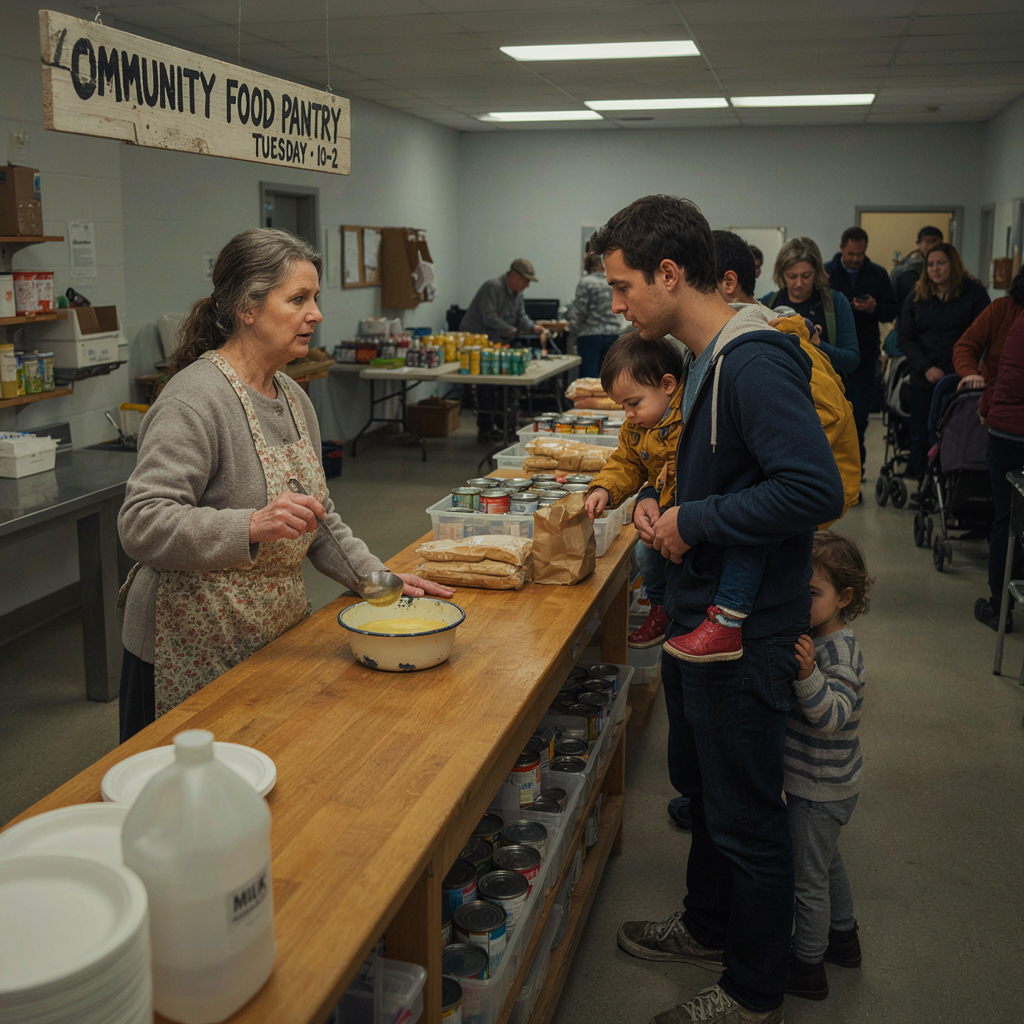
Every Tuesday at noon, I stood behind the counter and ladled soup into plastic bowls.
“Next.”
A woman would step forward.
“Thank you.”
“Of course.”
“Next.”
An elderly man.
“Thank you, ma’am.”
“Take some bread too.”
“God bless you.”
“Next.”
It was simple.
Predictable.
Safe.
Until last Tuesday.
The line moved slowly.
I was tired.
My back hurt.
I had spent the morning cleaning the church kitchen.
I remember looking down at the soup pot and thinking I might ask someone else to finish my shift.
Then the line moved.
I lifted my head.
And everything inside me stopped.
A thin man stood three people away.
His clothes were wet.
His beard was uneven.
His cheeks were hollow.
He carried a toddler on one hip.
Another child clung to his jeans.
The little girl couldn’t have been older than five.
The toddler looked maybe two.
The man lowered his eyes as he stepped forward.
Then he looked up.
Our eyes met.
The ladle went still in my hand.
I knew him immediately.
Dustin.
My son.
Sixteen years disappeared.
He wasn’t seventeen anymore.
He was thirty-three.
Older.
Thinner.
Tired.
There were faint lines around his eyes.
But those eyes were the same.
Brown.
Wide.
Afraid.
He saw me.
His mouth opened slightly.
For several seconds neither of us spoke.
Then he whispered:
“Mom.”
The woman beside me gasped.
I couldn’t breathe.
The toddler on his hip shifted.
“Daddy?”
Dustin looked down.
“It’s okay, buddy.”
Then he looked at me again.
His voice became so quiet I almost didn’t hear it.
“I just need…”
He stopped.
His eyes dropped to the soup.
“…food.”
The ladle trembled in my hand.
I wanted to say his name.
I wanted to run around that counter.
I wanted to touch his face.
Instead, I looked at the children.
“How old are they?”
He hesitated.
“Four and two.”
“And their mother?”
His jaw tightened.
“She’s gone.”
The words hit harder than I expected.
“Gone where?”
He shook his head.
“She left.”
I stared at the children.
The little girl was watching me.
She had Dustin’s eyes.
“What are their names?”
“Caleb.”
He nodded toward the boy.
“And Lily.”
The little girl tightened her grip on his leg.
I felt something crack inside my chest.
“Lily,” I whispered.
She looked at me.
“Hi.”
I nearly cried.
Dustin looked uncomfortable.
“Can we just get the food?”
I nodded.
“Of course.”
I filled three bowls.
Then four.
I packed bread.
Fruit.
Milk.
Canned pasta.
Peanut butter.
Crackers.
Everything I could fit into two bags.
When I handed them to him, our fingers touched.
He pulled away immediately.
“Thank you.”
“Dustin.”
He froze.
I lowered my voice.
“Where are you staying?”
“A motel.”
“Which one?”
He didn’t answer.
“Dustin.”
He looked at the floor.
“We don’t have a room tonight.”
My heart sank.
“What?”
“The money ran out.”
I stared at him.
“Where were you sleeping?”
“In the car.”
I looked at the toddler.
Then at Lily.
“You’ve been sleeping in a car with them?”
He nodded.
“We’ve done worse.”
I felt ashamed.
Not of him.
Of myself.
“Come home.”
He looked up sharply.
“No.”
“Dustin—”
“You told me not to come back.”
“I was wrong.”
“You said you meant it.”
“I did.”
His eyes filled with tears.
“And I believed you.”
I couldn’t answer.
He picked up the bags.
“Thank you for the food.”
“Dustin, please.”
He turned.
“Dustin.”
He stopped.
I walked around the counter.
For sixteen years, I had imagined hugging my son.
I had imagined him running into my arms.
I had imagined tears.
Forgiveness.
A perfect reunion.
Reality was different.
He stood six feet away, guarded and exhausted.
I took one step.
He took one back.
That hurt more than anything.
“I don’t know what you want from me,” he said.
“I want you to come home.”
He shook his head.
“You don’t have to forgive me.”
“I already did.”
“No.”
He wiped his eyes.
“You forgave the son you imagined I’d become.”
His voice broke.
“You never forgave the kid I actually was.”
Then he walked away.
I stood there crying while the line of hungry people waited behind me.
That night, I couldn’t sleep.
I sat at the kitchen table.
The same table where sixteen years earlier I had put two hundred dollars in my son’s hand.
I opened an old drawer.
Inside was a photograph.
Dustin at twelve.
Missing front tooth.
Terrible haircut.
Big grin.
I turned the photograph over.
On the back I had written:
My boy. My greatest blessing.
I pressed it against my chest.
Then I heard something in my mind.
His voice.
“What if I come back?”
And mine.
“Don’t.”
I cried until morning.
At seven, I drove to the food pantry.
The director, Margaret, was unlocking the door.
“You look terrible.”
“I found my son.”
She stared at me.
“The one you told us about?”
I nodded.
“He needs help.”
Margaret didn’t hesitate.
“Then help him.”
“I don’t know if he’ll let me.”
“Try.”
So I tried.
I called every shelter in town.
Nothing.
I called social services.
Nothing immediate.
I called churches.
One had a family room available for three nights.
Three nights.
It wasn’t enough.
So I called a motel.
Then I paid for a week.
Then I drove around looking for Dustin.
I found him sitting in his car behind a supermarket.
The children were asleep.
He looked at me through the windshield.
“What are you doing here?”
“I found a room.”
His face hardened.
“I don’t need charity.”
“It’s not charity.”
“What is it?”
“A mother trying to correct a mistake.”
He looked away.
“I can’t.”
“Why?”
“Because every time I look at you, I remember that night.”
I nodded.
“I do too.”
Silence.
Then he whispered:
“I waited.”
My throat tightened.
“For what?”
“For you to come.”
He stared through the windshield.
“I slept in three different places that first year. I worked construction. I washed dishes. I unloaded trucks.”
He laughed bitterly.
“You know what I kept thinking?”
I shook my head.
“That if I saved enough money, I’d come home.”
My eyes filled.
“But then months passed.”
He looked at me.
“And I started believing you were better off without me.”
“Dustin…”
“I called once.”
I froze.
“When?”
“About two years after I left.”
“Why didn’t I know?”
“You didn’t answer.”
“Where did you call?”
“Your old number.”
I stared at him.
I had changed that number eight months after he left.
He had called.
And I hadn’t known.
“I left a message.”
“What did you say?”
He looked down.
“I said I was sorry.”
I covered my mouth.
“Then I waited for you to call back.”
“I never got it.”
“I know.”
He looked at me.
“That’s when I stopped trying.”
I cried.
“I thought you hated me.”
“I did.”
The honesty hurt.
“Then why did you come to the pantry?”
He looked at his sleeping children.
“Because I didn’t know where else to go.”
I nodded.
“Then let me help.”
He was silent for a long time.
Finally he said:
“One week.”
“Okay.”
“Nothing more.”
“Okay.”
That one week became two.
Two became a month.
The children started calling me Grandma.
The first time Lily said it, I dropped a spoon.
“Grandma?”
She nodded.
“Can you make pancakes?”
I laughed through tears.
“I can make pancakes.”
Dustin watched from the doorway.
He didn’t smile.
But he didn’t leave either.
Slowly, I learned what had happened.
Emily had stayed with Dustin for years.
They had married young.
They had struggled.
They had another child.
Then Emily developed an addiction.
She left after Lily was born.
Dustin fought to keep the children.
He worked two jobs.
He paid rent.
He tried.
But one medical emergency after another pushed him underwater.
Eventually he lost the apartment.
He had been sleeping in the car for eleven days when he walked into the food pantry.
He hadn’t come looking for me.
He hadn’t even known I volunteered there.
It was coincidence.
Or fate.
I didn’t know which.
One evening, after the children were asleep, Dustin sat across from me at the kitchen table.
“Why did you do it?”
I knew exactly what he meant.
“Because I was afraid.”
“Of what?”
“Of what people would think.”
He stared at me.
“I thought I was protecting you from becoming a failure.”
His eyes filled.
“But you taught me something else.”
“What?”
“That when you make a mistake, you lose the right to be loved.”
I closed my eyes.
“No.”
He shook his head.
“That’s what I believed.”
“I was wrong.”
“I know.”
I looked at him.
“Do you hate me?”
He thought for a long time.
“No.”
I started crying.
“I tried.”
“I know.”
“I was angry.”
“I know.”
“I was scared.”
“I know.”
“I missed you every day.”
He looked down.
“I missed you too.”
That was the first time he said it.
I reached across the table.
He stared at my hand.
For several seconds, I thought he would pull away.
Instead, he put his hand in mine.
It was calloused.
Rough.
Older.
But it was my son’s hand.
I held it.
And for the first time in sixteen years, I felt like I had him back.
Not the seventeen-year-old boy I remembered.
Not the son I had imagined.
A grown man.
A father.
A survivor.
My son.
Months passed.
Dustin found steady work repairing commercial refrigeration units.
He rented a small apartment.
Lily started kindergarten.
Caleb learned to say “Grandma” before he could properly pronounce my name.
Every Tuesday, Dustin brought the children to the food pantry.
Not because they needed food anymore.
He volunteered.
The first time he walked behind the counter beside me, he looked nervous.
“You sure?”
I smiled.
“Next.”
He picked up a ladle.
An elderly man stepped forward.
Dustin filled his bowl.
“Thank you.”
Dustin smiled.
“Of course.”
I watched him.
Sixteen years earlier, I had believed being a man meant never needing help.
Now I knew better.
Being a man meant staying when things were hard.
Asking for help when you couldn’t do it alone.
Taking responsibility.
Loving your children when you’re exhausted.
Forgiving when you had every reason not to.
And sometimes…
It meant coming back to the place that had hurt you.
One afternoon, Lily found the old photograph of Dustin at twelve.
She held it up.
“Daddy, you looked funny.”
Dustin laughed.
“Thanks.”
She looked at me.
“Grandma, were you there?”
“Yes.”
“Were you his mommy?”
I smiled.
“I still am.”
She looked confused.
“But Daddy’s a grown-up.”
“Yes.”
“Can grown-ups still need their mommies?”
Dustin looked at me.
I waited.
He smiled.
“Sometimes.”
Lily nodded seriously.
“Okay.”
Then she ran outside.
Dustin sat beside me.
“Mom?”
“Yes?”
“I’ve been thinking.”
“About what?”
“I want to tell people the truth.”
“What truth?”
He looked at me.
“That you threw me out.”
My heart stopped.
“Okay.”
“But I don’t want them to think you’re a monster.”
I swallowed.
“They should know what I did.”
“Why?”
“Because it happened.”
He nodded.
“And I want them to know you apologized.”
I smiled sadly.
“That doesn’t erase it.”
“No.”
He looked toward the window.
“But it matters.”
I reached for his hand.
“Do you forgive me?”
He looked at me for a long time.
“I don’t think forgiveness is forgetting.”
“No.”
“I remember that night.”
“So do I.”
“I remember walking into the rain.”
I nodded.
“And I remember thinking my mother didn’t want me.”
Tears rolled down my cheeks.
“But now?”
He squeezed my hand.
“Now I know you were a scared woman who made the worst decision of her life.”
I cried.
“And I know you spent sixteen years punishing yourself.”
He looked at me.
“You don’t have to anymore.”
I leaned against his shoulder.
For the first time since he was seventeen, I let myself cry against my son’s shoulder.
He held me.
Just like he had when he was little.
Just like I should have held him that night.
A year later, the church held its annual food pantry fundraiser.
Hundreds of people attended.
Dustin stood beside me.
Lily and Caleb ran around the tables.
Margaret asked me to say a few words.
I stepped onto the small stage.
I looked at the crowd.
Then at my son.
“My name is Ruth,” I said.
“I have volunteered here for sixteen years.”
People smiled.
Some knew me.
Some didn’t.
“I used to think helping people meant giving them what they needed.”
I paused.
“But sometimes people need something more.”
The room grew quiet.
“They need someone to tell them they’re still worth loving.”
I looked at Dustin.
“Sixteen years ago, I failed to do that.”
He looked down.
I continued.
“My son made a mistake when he was seventeen. I thought punishment would make him responsible.”
I took a breath.
“Instead, I taught him that home was a place he could lose forever.”
No one moved.
“But I got a second chance.”
I smiled at my son.
“And so did he.”
Applause filled the room.
Dustin stood.
He came toward me.
For a moment, we simply looked at each other.
Then he hugged me.
The crowd applauded louder.
I closed my eyes.
Sixteen years earlier, I had watched my son walk into the rain carrying a blue duffel bag and two hundred dollars.
I had thought I was sending a boy into adulthood.
I had actually sent a frightened child into the world alone.
I couldn’t change that.
No apology could give him back those sixteen years.
No amount of money could erase the nights he slept in cars.
No explanation could undo the hurt.
But sometimes life gives you something almost as precious as a chance to go back.
It gives you a chance to go forward differently.
These days, every Tuesday, I still stand behind the food pantry counter.
I still ladle soup.
But now, when someone walks through those doors embarrassed because they need help, I don’t just hand them a bowl.
I look them in the eyes.
I tell them to take bread.
I tell them to take fruit.
I tell them there is no shame in needing help.
And sometimes, when I see a young father standing in line with a child on his hip, I remember a thin man in the rain.
My son.
The boy I thought I had lost forever.
Then I look across the room.
And there he is.
Thirty-four now.
Smiling.
His daughter holding one hand.
His son holding the other.
Sometimes he catches my eye.
And every time he does, I see the same question in his face.
The question he asked sixteen years ago.
What if I come back?
And now I finally know the answer.
I put down the ladle.
I walk around the counter.
I open my arms.
And I tell him:
“Come home.”
This time…
I mean it.