She Stopped Telling Me When It Hurt
My daughter was fifteen when she finally looked me in the eyes and whispered, “I stopped telling Dad when it hurts. He says I’m only doing it for attention.”
I remember almost everything about that moment.The kitchen clock said 8:17 p.m.Rain tapped softly against the windows.
There was a half-eaten bowl of pasta in front of her, untouched for nearly twenty minutes.
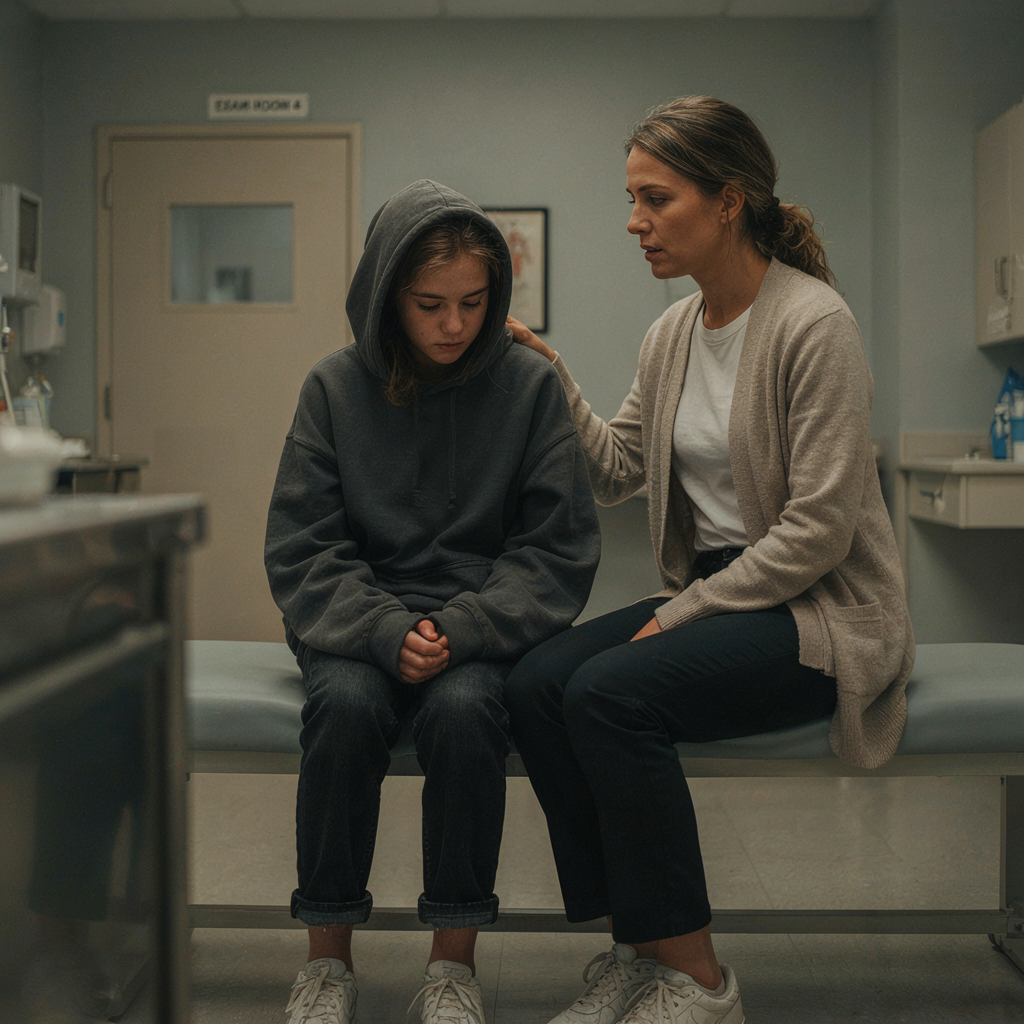
Her dark hair was pulled into a messy ponytail, and the sleeves of her oversized gray hoodie covered most of her hands.
She looked smaller than fifteen.Much smaller.“What hurts, sweetheart?” I asked.She shrugged.“Everything sometimes.”My stomach tightened.“Your stomach?”
She shook her head.“My head. My back. Sometimes my legs.”“How long?”
She stared at her plate.“A while.”“How long is a while?”
“Months.”The fork slipped from my fingers.It landed against the plate with a sharp metallic sound.“Months?”She nodded.I leaned toward her.“Why didn’t you tell me?”
She finally looked up.And the hurt in her eyes nearly broke me.“Because Dad said I’d grow out of it.”
I swallowed.“What else did Dad say?”She hesitated.“He said I do this when I want people to feel sorry for me.”
My heart stopped.“Your father said that?”She nodded again.
“And when I told him it was getting worse, he said, ‘You always have something wrong when you don’t want to go to school.’”
I stared at my daughter.My sweet, stubborn, funny girl.
The child who had once cried because we had to throw away a broken stuffed rabbit.
The girl who still slept with the bedroom door cracked open when thunderstorms came.
And for months, she had been hurting.
Silently.
Because her father had convinced her that asking for help made her dramatic.
“Does it hurt right now?” I whispered.
She nodded.
“Where?”
She pressed a hand against the left side of her abdomen.
“Here.”
Then she added quietly, “And my back.”
I stood so quickly my chair scraped the floor.
“We’re going to the hospital.”
Her eyes widened.
“Mom—”
“Now.”
“Dad’s going to be mad.”
I froze.
“Let him be mad.”
She looked frightened.
I crouched beside her chair.
“Listen to me. You never have to hide pain from me. Not because your father thinks you’re exaggerating. Not because you’re worried someone will be angry. If you’re hurting, I want to know.”
Her eyes filled with tears.
“I tried telling him.”
“I know.”
“He said I was making it up.”
I pulled her into my arms.
“No,” I whispered. “You weren’t.”
That night, I didn’t tell my husband where we were going.
I didn’t call him.
I didn’t text him.
I simply grabbed my daughter’s medical card, my purse, and a jacket.
Then I drove through the rain with both hands gripping the steering wheel.
My husband, Daniel, was supposed to be working late.
At least, that’s what he’d told me.
For fifteen years, I had trusted him.
That night, something inside me began to question everything.
The emergency department was crowded.
We waited nearly forty minutes before a nurse called my daughter’s name.
They took her temperature, blood pressure, oxygen level, and asked a long list of questions.
When the nurse asked how long she’d been experiencing pain, my daughter looked at me.
“Several months,” I answered.
The nurse frowned.
“Has she seen a doctor for this?”
I hesitated.
“I don’t know.”
My daughter stared at the floor.
The nurse entered something into the computer.
“Any previous imaging?”
“I don’t think so.”
Another pause.
Then the nurse asked, “Does she have a pediatrician?”
“Yes.”
“Has anyone referred her for further testing?”
My daughter became very still.
“I don’t know.”
That answer bothered me.
More than I could explain.
Because Daniel handled most of our daughter’s medical appointments.
He had insisted on it after changing jobs three years earlier.
He worked closer to the pediatrician’s office.
“It makes more sense,” he’d said.
I had agreed.
I trusted him.
The doctor ordered bloodwork and imaging.
My daughter was taken to a scanning room the next afternoon.
I sat beside her while the technician prepared the machine.
She tried to joke.
“Do I get a cool picture afterward?”
I smiled.
“Maybe.”
She smiled back.
But the moment the scan began, everything changed.
The technician was cheerful at first.
Then she became quiet.
Not normal quiet.
The kind of silence that makes your skin tighten.
She stared at the screen.
Moved the wand.
Paused.
Adjusted something.
Looked again.
My daughter noticed.
“Is something wrong?”
The technician didn’t answer immediately.
Then she said, “The doctor will come talk to you.”
My heart began pounding.
“Can you tell me what you see?”
“I can’t interpret the scan.”
She left.
A few minutes later, a doctor entered.
She was calm, professional, but her expression had changed.
She closed the door behind her.
Then she looked directly at me.
“How long has her father known about this?”
I felt the room tilt.
“What?”
The doctor looked at the chart.
“There are records indicating she was evaluated here five weeks ago.”
I stared at her.
“No.”
“Yes.”
“My daughter hasn’t been here.”
The doctor looked at my daughter.
“Were you here with your father about five weeks ago?”
My daughter’s face went white.
She slowly nodded.
“Yes.”
I turned toward her.
“You were?”
She looked terrified.
“Dad brought me.”
“Why didn’t you tell me?”
Her eyes filled with tears.
“Because Dad said I wasn’t supposed to.”
I couldn’t breathe.
The doctor gently placed a hand on the edge of the desk.
“I’m sorry. I assumed you were aware.”
I shook my head.
“I wasn’t.”
The doctor pulled up the previous report.
“Five weeks ago, the imaging showed something that required follow-up. The physician recommended additional testing and specifically documented that a parent should be informed.”
I looked at my daughter.
“What did they tell you?”
She pulled her hoodie sleeves over her hands.
“Dad said it wasn’t serious.”
The doctor continued.
“There was a recommendation for a specialist consultation. It appears that appointment never happened.”
My voice trembled.
“What did the earlier scan show?”
The doctor hesitated.
“There is a significant mass near the left kidney.”
My daughter made a tiny sound.
I grabbed her hand.
The doctor continued carefully.
“We don’t know exactly what it is yet. It could be several things. But based on today’s imaging, it has grown, and we need to investigate it urgently.”
The room blurred.
I heard only one sentence.
“It has grown.”
Five weeks.
Five weeks my daughter had been walking around with something inside her.
Five weeks while I thought she was safe.
Five weeks while Daniel knew.
I looked at the doctor.
“Did you speak to her father?”
“Yes.”
“What did he say?”
The doctor glanced at the chart.
“He said he would discuss the follow-up with the child’s mother.”
My stomach turned.
“He never did.”
“I understand.”
“No,” I whispered. “You don’t.”
I looked at my daughter.
“Sweetheart, why didn’t you tell me?”
She began crying.
“Dad said you’d panic.”
My chest hurt.
“He told me you were fine,” she continued. “He said if I told you, you’d make everything a big deal and he’d be in trouble.”
I pulled her against me.
The doctor stepped out to arrange an urgent referral.
My daughter cried into my shoulder.
And I cried too.
But beneath the fear was something colder.
Anger.
Because this wasn’t an accident.
Daniel hadn’t forgotten.
He hadn’t misunderstood.
He had been told.
And he had chosen silence.
We were admitted for further evaluation.
Specialists came.
More tests were ordered.
They explained possibilities without giving us certainty.
The mass was concerning.
There were signs of pressure against nearby structures.
Her bloodwork showed abnormalities that required monitoring.
But the doctors were careful.
They wouldn’t call it cancer without pathology.
They wouldn’t predict the future.
They only told me one thing repeatedly:
“We need to act quickly.”
I stayed beside my daughter all night.
Around 3 a.m., she finally whispered, “Mom?”
“I’m here.”
“Are you mad at me?”
My heart shattered.
“No.”
“Even though I didn’t tell you?”
I brushed her hair away from her forehead.
“I’m not mad at you.”
“Dad said you wouldn’t believe me.”
I closed my eyes.
“I would have believed you.”
“I know that now.”
She stared at the ceiling.
“Sometimes it hurt so badly that I cried in the bathroom at school.”
My hand covered my mouth.
“How many times?”
She shrugged.
“I don’t know.”
“Why didn’t you call me?”
“Dad said you were busy.”
I looked at my daughter.
“No matter how busy I am, you call me.”
“I know.”
“Even if it’s midnight.”
She nodded.
“Even if I’m at work.”
She nodded again.
“Even if you think I’m going to be angry.”
She started crying.
“You promise?”
“I promise.”
Daniel arrived at the hospital the next morning.
He walked into the room carrying a coffee and wearing the same jacket he’d worn the previous evening.
He looked at me.
Then at our daughter.
Then at the machines beside her bed.
“What happened?”
I stared at him.
“You knew.”
His expression changed.
“About what?”
“Don’t.”
“What are you talking about?”
“You brought her here five weeks ago.”
Silence.
His eyes flicked toward our daughter.
Then back to me.
“She told you?”
“She didn’t have to. The hospital records did.”
Daniel put the coffee down.
“It wasn’t what you think.”
“Then explain it.”
“I brought her because she was complaining.”
“And?”
“They did some tests.”
“And?”
“They said it was probably nothing.”
“Probably?”
His jaw tightened.
“They said she needed follow-up.”
“You knew.”
“I was going to tell you.”
“When?”
He didn’t answer.
I stepped closer.
“You knew she needed a specialist.”
“I said I was going to handle it.”
“You didn’t handle anything.”
“She wasn’t dying.”
My blood went cold.
“You don’t know that.”
“The doctors didn’t say cancer.”
“They said they needed urgent evaluation.”
“She was fine.”
“She was in pain.”
“She exaggerates.”
Our daughter flinched.
I turned toward him.
“Say that again.”
Daniel looked uncomfortable.
“She has always been sensitive.”
I walked closer.
“You told our fifteen-year-old daughter that her pain was attention-seeking.”
“I was trying to keep her calm.”
“You told her not to tell me.”
“I didn’t want you to panic.”
“You don’t get to decide whether I’m allowed to know when our daughter is sick.”
He lowered his voice.
“You’re making this bigger than it is.”
I stared at him.
Then I said something I had never said to my husband before.
“Get out.”
His eyes widened.
“What?”
“Get out of this room.”
“She’s my daughter too.”
“Then you should have acted like it.”
He looked at our daughter.
“Sweetheart—”
She pulled the blanket higher.
“Please don’t.”
That stopped him.
For the first time, Daniel looked ashamed.
But shame wasn’t enough.
Not anymore.
The next two weeks changed our family forever.
Our daughter underwent additional imaging.
Doctors discovered that the mass was larger than the earlier scan had indicated.
A biopsy was scheduled.
Daniel tried to convince me that we should keep everything private.
I refused.
We needed legal advice.
We needed medical records.
We needed answers.
And we needed to understand exactly what had happened during that first appointment.
The hospital records showed that Daniel had been told in writing that our daughter needed urgent follow-up.
The report contained his signature.
There was also a note indicating that the doctor had explained the seriousness of the findings.
Daniel had initialed it.
He couldn’t claim he hadn’t understood.
He couldn’t say he’d forgotten.
He couldn’t say the doctor never told him.
He had known.
And he’d done nothing.
When I confronted him, he finally admitted why.
He had been afraid.
Not of losing our daughter.
Not entirely.
He was afraid of what the diagnosis might do to our family.
He was afraid of medical bills.
He was afraid of missing work.
He was afraid people would blame him.
But then he said something that made me realize there was more.
“I thought if we waited, maybe it would disappear.”
I stared at him.
“A mass doesn’t disappear because you ignore it.”
“I didn’t know what else to do.”
“You could have told me.”
“I knew you’d blame me.”
“You’re being blamed because you made a choice.”
He looked away.
Then he admitted something else.
Five weeks earlier, before the hospital visit, he’d been drinking heavily.
He had missed work.
He had been struggling with debt.
He’d been terrified that a serious diagnosis would expose how badly our finances were collapsing.
He thought he could delay everything.
He thought he could fix the money.
Then the appointment.
Then the follow-up.
Then another excuse.
Five weeks disappeared.
Our daughter’s health didn’t.
It got worse.
The biopsy results came on a Thursday.
I remember sitting beside the hospital bed.
The doctor entered with two specialists.
That was when I knew.
She sat down.
“Our pathology confirms that the mass is malignant.”
My daughter stared at her.
I squeezed her hand.
The doctor explained the diagnosis and treatment plan carefully.
There would be surgery.
There would likely be chemotherapy.
There would be months of treatment.
But the doctors also said something that gave me a small breath of hope.
“We caught it before there was evidence of distant spread.”
I began crying.
Not because everything was okay.
It wasn’t.
But because there was still a path forward.
A hard one.
A frightening one.
But a path.
My daughter looked at me.
“Am I going to die?”
I leaned toward her.
“No.”
The doctor gently corrected me.
“We can’t promise outcomes, but we have treatment options, and we’re going to fight this aggressively.”
My daughter nodded.
She looked terrified.
So was I.
But I wasn’t going to let her face it alone.
The surgery lasted nearly six hours.
I sat in the waiting room with my sister.
Daniel wasn’t there.
He had been told he could visit, but our daughter had asked that he not come.
I respected her wishes.
When the surgeon finally appeared, I stood.
“She did well.”
Those four words nearly made my knees collapse.
The tumor had been removed.
The doctors would still need to review everything, but the operation had gone according to plan.
That night, I sat beside my daughter’s bed.
She was pale.
Exhausted.
But awake.
“Mom?”
“Yes?”
“Did they get it?”
“Yes.”
She closed her eyes.
“Good.”
Then, after a moment:
“I’m sorry.”
I shook my head.
“For what?”
“For not telling you.”
I kissed her forehead.
“You don’t ever apologize for being sick.”
She whispered, “I was scared.”
“I know.”
“I thought Dad would be angry.”
“He was wrong.”
She opened her eyes.
“Promise me something.”
“Anything.”
“If I ever say something hurts, you won’t tell me I’m being dramatic.”
I felt tears burn my eyes.
“I promise.”
“And if someone tells me to keep something about my body secret from you?”
I squeezed her hand.
“You tell me immediately.”
She nodded.
“Even if it’s Dad?”
I looked at her.
“Especially then.”
Daniel eventually asked to see her.
Our daughter said no.
He asked again.
She said no again.
He wrote letters instead.
The first one was an apology.
The second explained how scared he’d been.
The third asked her to forgive him.
She read them.
She didn’t answer.
Months passed.
Our daughter began treatment.
There were good days and terrible days.
Some mornings she laughed.
Other mornings she couldn’t get out of bed.
She lost her hair.
She hated the way strangers looked at her.
She missed school.
She missed soccer.
She missed being normal.
But she never again hid her pain.
If something hurt, she told me.
If she was frightened, she told me.
If she had questions, she asked.
And slowly, she began healing.
Not just physically.
Emotionally too.
As for Daniel, the marriage ended.
Not because I stopped loving him.
Because I finally understood that love without trust could become dangerous.
He had made a decision that belonged to both parents.
He had taken medical information about our child and turned it into a secret.
And when that secret became dangerous, he still chose silence.
I couldn’t build a life on that.
Our divorce was ugly.
There were lawyers.
Arguments.
Accusations.
But there was one thing I refused to compromise on.
Our daughter’s safety.
The court reviewed the medical records.
The hospital documentation.
The missed follow-up.
The messages between Daniel and our daughter.
Eventually, Daniel’s access to medical decision-making was restricted until professionals determined that he could safely participate.
He hated that.
I didn’t care.
Our daughter needed adults who protected her.
Not adults who protected themselves from uncomfortable truths.
A year after that first night in the emergency room, my daughter stood in our backyard wearing a yellow sundress.
Her hair had started growing back.
She was still thinner than before.
Still tired sometimes.
But she was smiling.
She held a small paper lantern in her hands.
“Mom?”
“Yeah?”
“Do you remember what I told you that night?”
I smiled.
“Which part?”
“That I stopped telling Dad when it hurt.”
I nodded.
She looked at the lantern.
“I don’t think I ever told you the whole thing.”
“What didn’t you tell me?”
She took a breath.
“The night before you took me to the hospital, Dad told me if I told you about the pain, you’d leave him.”
I stared at her.
“What?”
“He said you’d blame him. He said you’d take me away.”
My throat tightened.
“He told you that?”
She nodded.
“I thought if I talked, I’d destroy our family.”
I walked toward her.
“You didn’t destroy anything.”
She looked at me.
“Dad did.”
I shook my head gently.
“Your father made choices. But you didn’t cause them.”
She smiled faintly.
“I know that now.”
Then she handed me the lantern.
“What do I do?”
“Let it go.”
She smiled.
Together, we released it into the evening sky.
We watched it rise.
Higher.
Higher.
Until it became a tiny point of light.
My daughter leaned her head against my shoulder.
“Mom?”
“Yeah?”
“I’m glad I finally told you.”
I wrapped my arm around her.
“So am I.”
She was quiet for a moment.
Then she whispered:
“It still hurts sometimes.”
I looked at her.
“Where?”
She touched her side.
“Here.”
I immediately reached for her hand.
“Let’s call the doctor.”
She smiled.
“Okay.”
And that was when I realized how much had changed.
Once, she had learned to hide pain because she thought pain made her difficult.
Now she understood something different.
Pain wasn’t attention-seeking.
Fear wasn’t weakness.
Asking for help wasn’t dramatic.
And telling the truth didn’t destroy families.
Sometimes, telling the truth was the only thing that could save you.
The marriage didn’t survive.
The secrets didn’t survive.
The man who had convinced my daughter to suffer silently eventually had to face the consequences of his choices.
But my daughter survived.
And every morning when she woke up, I thanked God for one simple thing:
She had finally looked me in the eyes.
And she had finally told me it hurt.