The Vanity He Laughed About
My husband fought me for everything in the divorce.The house.The cars.The camper we’d used maybe twice.The lawn equipment he never touched.Even the stupid patio furniture.
By the end, I was so exhausted that I stopped caring.I just wanted it over.So I let him have almost everything.
There was only one thing he didn’t bother fighting for.
His grandmother’s old vanity.
It was a heavy, dark wooden thing with clawed feet, brass handles, and a cloudy oval mirror that made everyone who looked into it appear ten years older.
It had sat in the hallway of his grandmother’s house for as long as I’d known him.
When the movers carried it away from our house on the final day, my husband actually laughed.
“You can have that ugly thing,” he said.
He folded his arms and looked at it with disgust.”Nobody wants it.”I remember staring at him.After twelve years of marriage, that was what our life had become.
He had taken the expensive things.I had taken the ugly thing nobody wanted.”Fine,” I said.
And I meant it.For the better part of a year, the vanity sat in my spare bedroom collecting laundry.
I hung scarves from its brass handles.I stacked unopened mail on top.
Sometimes I caught myself avoiding the mirror because the cloudy glass made me look as tired as I felt.Then one afternoon, almost eleven months after the divorce, I decided to finally sell it.
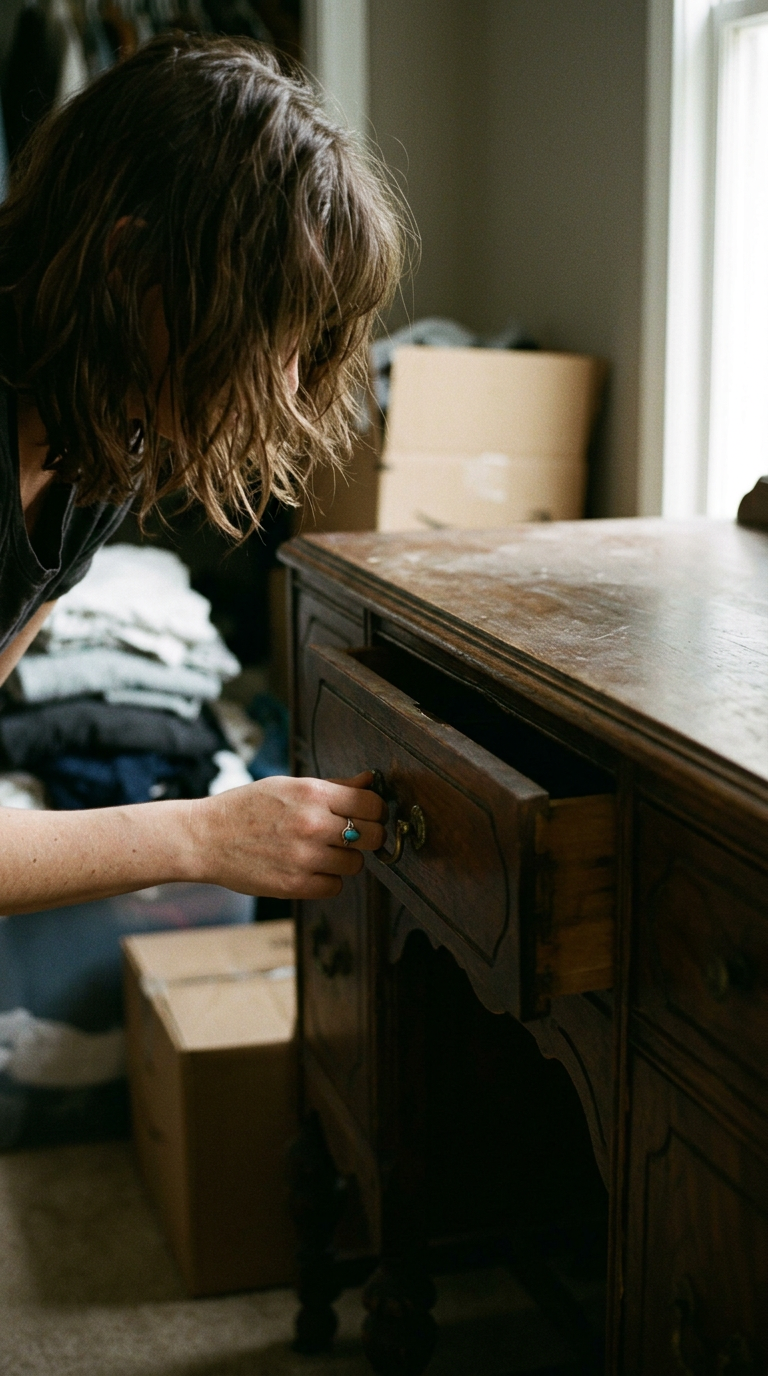
I needed the space.And honestly?I wanted the last piece of his family out of my house.I pulled the middle drawer.
It moved about four inches and stopped.
I tugged harder.
Nothing.
“Seriously?”
I crouched down and looked underneath.
Nothing.
I pulled again.
The drawer groaned forward another inch, then slammed against something behind it.
Something solid.
Something that shouldn’t have been there.
I took out a screwdriver.
And when I finally managed to remove the drawer—
I found a hidden compartment.
Inside was a brown envelope.
And my name was written on it.
Not my maiden name.
Not my married name.
My full name.
In handwriting I recognized immediately.
His grandmother’s.
And the first sentence inside changed everything I thought I knew about my marriage.
I should explain how I got there.
My name is Claire Bennett.
At least it was Claire Bennett when I met Daniel.
He was thirty-one, charming, ambitious, and apparently incapable of making a decision without first asking what everyone else thought.
I was twenty-nine and working as an accountant for a construction company.
We met at a friend’s barbecue.
Daniel spent most of the afternoon trying to convince me that he could grill better than anyone in the neighborhood.
He burned three steaks.
I married him anyway.
For the first few years, we were happy.
Or at least I thought we were.
We bought a small house.
We renovated the kitchen.
We traveled.
We talked about having children.
Then Daniel’s career took off.
His company started making serious money.
And somewhere along the way, he changed.
The dinners became business dinners.
The weekends became golf trips.
His phone became something he carried everywhere, even into the shower.
If I asked questions, he called me insecure.
If I complained, he called me controlling.
If I pointed out that he was never home, he’d say, “I’m doing this for us.”
Then I discovered the affair.
Her name was Vanessa.
She worked in Daniel’s office.
She was thirty-four, blonde, polished, and apparently had no trouble finding time for my husband.
I found out because Daniel accidentally sent me a text meant for her.
It said:
I can’t wait until Claire is out of the picture.
I stared at those words for nearly five minutes.
Then I walked into his office.
He didn’t deny it.
That hurt more than anything.
He simply sat there with his elbows on the desk.
“How long?” I asked.
He looked at me.
“About a year.”
A year.
He had kissed me goodnight for a year while sleeping with another woman.
He had sat across from me at Thanksgiving.
He had held my hand during my mother’s surgery.
He had told me he loved me.
And all that time, he was planning how to get rid of me.
“I want a divorce,” I said.
He smiled.
Not sadly.
Not regretfully.
Almost triumphantly.
“Then you’re going to regret making this difficult.”
He was right about one thing.
The divorce became a war.
Daniel wanted the house.
Then he wanted the cars.
Then he wanted the camper.
Then he wanted the investment account.
Then he wanted half the furniture.
He even demanded a dining table that had been a wedding gift from my parents.
Every meeting with our lawyers became another battlefield.
He had money.
He had a team of attorneys.
And he had a talent for making me feel guilty for wanting anything.
“You’ve always been financially irresponsible,” he told me.
I almost laughed.
I had managed our household finances for twelve years.
I had paid every bill.
I had handled the mortgage.
I had tracked his business expenses.
But suddenly I was irresponsible.
Eventually, I reached my limit.
“Take it.”
My attorney looked at me.
“Claire, you don’t have to surrender everything.”
“I know.”
“Then why are you?”
“Because I want my life back.”
So I gave him the house.
The cars.
The camper.
The furniture.
I kept my savings, my clothes, my mother’s jewelry, and the small townhouse I’d inherited from my aunt.
And when Daniel’s attorney asked about the old vanity, I shrugged.
“Let him have that too.”
Daniel shook his head.
“I don’t want it.”
“Are you sure?” the attorney asked.
Daniel laughed.
“Absolutely. Claire can have the antique junk.”
That’s how it ended.
Twelve years of marriage.
Three hours of legal paperwork.
And a piece of ugly furniture nobody wanted.
For eleven months, I tried to rebuild my life.
It wasn’t easy.
The townhouse felt enormous when I moved in alone.
I learned how to fix a leaky faucet.
I learned how to sleep without listening for someone else’s key in the front door.
I learned that silence could be peaceful.
I stopped checking Daniel’s social media.
I stopped wondering whether Vanessa was living in my old house.
And slowly, I became myself again.
Then came the vanity.
It was the last thing left.
So I decided to sell it.
I expected to make maybe fifty dollars.
I didn’t expect to find a secret.
The drawer refused to open.
I removed the brass handle.
I tried pulling from both sides.
Finally, I took the drawer completely out.
Behind it was a thin wooden panel.
I tapped it.
Hollow.
My heart started beating faster.
I found a tiny latch hidden underneath the drawer frame.
When I pressed it, the panel popped open.
There was a compartment.
And inside was an envelope.
My name was written across the front.
CLAIRE BENNETT
I recognized the handwriting immediately.
Eleanor Whitmore.
Daniel’s grandmother.
She had died six years earlier.
I had always liked Eleanor.
She was one of the few people in Daniel’s family who treated me like a person rather than an accessory.
She used to squeeze my hand at family dinners and whisper,
“Don’t let them make you doubt yourself, sweetheart.”
I opened the envelope.
Inside was a letter.
The first line read:
Claire, if you’re reading this, then Daniel has either finally shown you who he is—or you’ve reached the point where you no longer trust him.
I stopped breathing.
I kept reading.
I have watched my grandson become a man I barely recognize.
He believes money gives him power over people.
It doesn’t.
People who understand money know something different.
Money only reveals who someone already is.
I sat on the floor.
The letter continued.
There is something about Daniel’s father that I never told him.
My hands started shaking.
Daniel’s father, Richard, had died when Daniel was twenty-four.
According to the family, Richard had left behind debts.
That was why Eleanor had supposedly sold most of her property.
That was why the family had struggled financially for several years.
At least, that’s what I’d been told.
But Eleanor’s letter said otherwise.
Richard did not die broke.
He left an inheritance.
A very large one.
I read the next sentence three times.
Thirty-two million dollars.
My mouth went dry.
Thirty-two million?
I kept reading.
According to Eleanor, Richard had built a private investment company before his death.
Most of its assets had been placed in a trust.
The beneficiaries were Eleanor and Daniel.
But there was a condition.
Daniel would not receive the majority of his father’s inheritance until he reached forty.
He was thirty-eight when I met him.
That meant his fortieth birthday was only two years away.
Then I saw the part that made my stomach twist.
Daniel does not know that I changed the trust.
After watching how he treated his first fiancée, I became afraid of what he would become with access to the money.
I blinked.
His first fiancée?
I had never heard about her.
The letter explained.
Daniel had been engaged before me.
Her name was Rachel.
The engagement ended suddenly.
Daniel told everyone she had cheated.
But Eleanor didn’t believe him.
Rachel did not cheat.
Daniel emptied her bank account and threatened to ruin her family unless she signed a confidentiality agreement.
I covered my mouth.
No.
No, that couldn’t be true.
Then I read the next sentence.
He did the same thing to his business partner.
And another.
He has done it repeatedly.
The room seemed to tilt.
I kept reading.
Eleanor had hired a private investigator years earlier.
She had documented Daniel’s behavior.
Financial manipulation.
Hidden accounts.
Forged signatures.
Secret transfers.
Affairs.
Threats.
Everything.
And then came the final paragraph.
I created a second condition in the trust.
Daniel cannot receive the remaining inheritance if he is found to have financially or legally harmed his spouse.
I stared at the words.
His spouse.
Me.
Then I found another document behind the letter.
A copy of the trust.
My name appeared as a protected beneficiary.
Not because I would inherit Daniel’s money.
Because Eleanor had designed the trust so that if Daniel attempted to strip his wife of marital assets through fraud or coercion, the trust would freeze.
And there was one more provision.
If Daniel divorced his spouse while hiding marital assets, the entire inheritance would transfer into an independent charitable foundation.
He would receive nothing.
I sat there in silence.
Then I laughed.
Not because it was funny.
Because suddenly everything made sense.
Daniel hadn’t been fighting me for the house because he wanted the house.
He’d been fighting me because he needed to establish a pattern.
He wanted to make me look greedy.
He wanted to empty my resources.
He wanted me financially dependent.
And he wanted the divorce finalized before his fortieth birthday.
But why?
I looked again at the date on the trust.
Daniel would turn forty in four months.
Four months.
He had been racing toward something.
And I had unknowingly been standing in his way.
The next morning, I called the attorney who had handled Eleanor’s estate.
His name was Thomas Reed.
He was nearly seventy, with silver hair and a voice that sounded permanently tired.
When I told him what I had found, he was silent.
Then he said,
“Where are you?”
“At home.”
“Do not move those documents.”
“I already have them.”
“Good. Do not tell Daniel.”
“I wasn’t planning to.”
“Claire, I need you to listen carefully.”
His voice changed.
“The vanity wasn’t supposed to leave Eleanor’s house.”
I frowned.
“What?”
“It was part of her personal property. When she died, Daniel’s father tried to claim it. Eleanor specifically instructed the executor to make sure it went to you.”
“Why?”
“She didn’t explain.”
I looked at the dark wooden vanity.
“But the divorce papers say Daniel waived his claim.”
“I know.”
“Then why didn’t you tell me about the trust?”
“Because the trust was sealed.”
“Until when?”
“Until Daniel turned forty.”
My stomach dropped.
“Four months.”
“Exactly.”
There was a pause.
Then Thomas said,
“Claire, I need to ask you something.”
“What?”
“During your divorce, did Daniel ever accuse you of hiding money?”
“Constantly.”
“Did he demand access to your accounts?”
“Yes.”
“Did he ever ask you to sign anything without reading it?”
I remembered.
“Yes.”
“What did you sign?”
“Mostly financial disclosures.”
“Mostly?”
I closed my eyes.
There had been one document.
A settlement addendum.
Daniel had told me it was simply confirmation that I was waiving future claims against his business.
I had signed it.
Thomas exhaled.
“Claire, that document may be important.”
“Why?”
“Because Daniel’s company was never his alone.”
I felt cold.
“What are you saying?”
“Your marital estate may include a significant ownership interest.”
I stared at the floor.
“How significant?”
“Approximately forty percent.”
I couldn’t speak.
Thomas continued.
“And if Daniel deliberately concealed the trust and misrepresented the business valuation during divorce proceedings, your settlement may be challengeable.”
I thought about the house.
The cars.
The camper.
The years I’d spent building a life with him.
And suddenly I understood.
He hadn’t won the divorce.
He had manipulated me into surrendering.
There was a difference.
That afternoon, I met Thomas at his office.
He showed me documents.
Bank records.
Corporate filings.
Trust amendments.
Eleanor’s private investigator’s reports.
The deeper we went, the worse Daniel looked.
There were shell companies.
Hidden accounts.
Transfers to Vanessa.
Payments made to lawyers before the divorce.
And something even more disturbing.
Three months before filing for divorce, Daniel had moved nearly $2.7 million from one of his companies into an account controlled by a holding company in Nevada.
The holding company was owned by Vanessa.
I stared at the document.
“He gave her two point seven million dollars?”
Thomas nodded.
“And that’s only what we’ve found.”
“Why?”
“Because he expected to recover it through the divorce settlement.”
I suddenly remembered Daniel’s words.
You’ll regret making this difficult.
He hadn’t been threatening me.
He had been warning me.
He thought he could take everything.
He thought I would be too tired to fight.
He was right.
Until the vanity.
Three weeks later, my attorney filed a motion to reopen the financial settlement.
Daniel’s reaction was immediate.
He called me.
I didn’t answer.
He called again.
Then again.
Finally, he left a voicemail.
“Claire, this is ridiculous. Whatever you think you found, you’re wrong. Call me.”
I deleted it.
The next day, his attorney contacted mine.
They demanded the return of Eleanor’s documents.
My attorney refused.
Then Daniel appeared outside my townhouse.
I saw him through the window.
He stood on the sidewalk in an expensive coat.
For a moment, I remembered the man I had married.
Then I remembered the letter.
I opened the door but didn’t step outside.
“What do you want?”
His jaw tightened.
“Where did you get the documents?”
“So you know about them.”
He stared at me.
That was all the answer I needed.
“You knew.”
“I knew there were old family papers.”
“You knew about the trust.”
He said nothing.
“Daniel.”
Finally, he whispered,
“Give them to me.”
“No.”
“You don’t understand what you’re doing.”
“I understand perfectly.”
“You could destroy my life.”
I almost smiled.
“You destroyed yours.”
His face hardened.
“You were never supposed to find that.”
“Find what?”
He looked away.
“The trust.”
“So it exists.”
He cursed under his breath.
I felt something inside me settle.
For the first time in years, I wasn’t afraid of him.
“You fought me for everything,” I said.
“You took the house. The cars. The camper. You tried to take my savings.”
“You let me have those things.”
“Because I was exhausted.”
He looked at me.
“And now?”
“Now I’m awake.”
His expression changed.
For the first time, Daniel looked afraid.
The court hearing took place six weeks later.
Daniel arrived with two attorneys.
I arrived with Thomas and my lawyer.
Vanessa was there too.
She sat behind Daniel.
They had apparently broken up.
That didn’t surprise me.
People like Daniel didn’t love people.
They loved leverage.
The judge reviewed the financial records.
Then the hidden trust.
Then the investigator’s reports.
Then the transfers to Vanessa.
Daniel’s attorneys tried to argue that the trust was irrelevant.
The judge disagreed.
“What concerns me,” she said, “is the apparent concealment of substantial assets during the original settlement.”
Daniel’s lawyer tried to interrupt.
The judge raised a hand.
“No.”
Silence.
Then she looked at Daniel.
“Mr. Whitmore, did you knowingly conceal the existence of this trust from your former wife?”
Daniel swallowed.
“No.”
My attorney placed a document on the table.
“Then perhaps you’d like to explain this.”
It was an email.
Sent by Daniel to his attorney four days before our settlement.
Claire cannot know about the trust until after the divorce is final.
The courtroom went completely silent.
Daniel stared at the document.
I looked at him.
He looked at me.
And suddenly I understood something.
The man who had made me feel powerless for years had never actually been powerful.
He had just been good at making me afraid.
The judge ordered a full forensic accounting.
The results came two months later.
Daniel had concealed over eleven million dollars in assets.
The house was sold.
The business ownership was recalculated.
The money he’d transferred to Vanessa was recovered through legal proceedings.
My original settlement was thrown out.
And the court awarded me a substantial portion of the marital assets that had been hidden.
Not because I had suddenly become greedy.
Because the truth had finally been allowed into the room.
Daniel was also referred for potential criminal investigation over fraudulent financial disclosures.
His company collapsed within a year.
Vanessa disappeared from his life.
And the house he’d fought so hard to keep?
He lost it.
The cars?
Gone.
The camper?
Sold.
The expensive things he’d insisted were his?
Liquidated to pay legal judgments.
Meanwhile, I kept my townhouse.
And the vanity.
Six months after the hearing, I finally restored it.
I took the vanity to a furniture restorer.
He stripped away decades of dark varnish and revealed beautiful walnut underneath.
The cloudy mirror was replaced.
The brass handles were polished.
The carved legs were repaired.
When he finished, I barely recognized it.
It was beautiful.
Not ugly.
Never ugly.
Just neglected.
Like so many things people stop seeing because they’ve become accustomed to them.
I brought it home and placed it in my bedroom.
That evening, I opened the middle drawer.
The secret compartment was empty now.
But I hadn’t thrown away Eleanor’s letter.
I kept it beneath the drawer.
One final sentence stood out to me.
I’d read it dozens of times.
But now I understood what she meant.
Sometimes the things people dismiss as worthless are the things that were quietly protecting you all along.
I touched the old wood.
Then I looked at myself in the new mirror.
For the first time in years, I didn’t see a tired woman.
I saw someone who had survived.
Someone who had been underestimated.
Someone who had finally stopped apologizing for taking up space.
My phone rang.
It was an unknown number.
I almost ignored it.
Then I answered.
“Hello?”
A man’s voice said,
“Ms. Bennett? My name is David Whitmore.”
I froze.
Daniel’s younger brother.
“What do you want?”
“I found something in my father’s old records.”
My heart started pounding.
“What?”
There was a pause.
“You need to know that Eleanor wasn’t the only person who knew about the trust.”
I sat down.
“What are you talking about?”
“My father knew.”
“Richard?”
“Yes.”
“What did he know?”
David’s voice dropped.
“He knew Eleanor was protecting you.”
I frowned.
“Protecting me from what?”
Silence.
Then he said,
“From Daniel.”
I looked toward the vanity.
“Why?”
“Because Eleanor discovered something before she died.”
“What?”
“Daniel wasn’t the first person in the family to use the trust.”
My blood ran cold.
“What does that mean?”
David exhaled.
“It means your divorce wasn’t the first time someone tried to steal from it.”
I stood.
“Who?”
“My father.”
I couldn’t breathe.
“Richard tried to take the money?”
“No.”
“Then what?”
David hesitated.
“He tried to warn Eleanor that Daniel had discovered the trust.”
I gripped the phone.
“When?”
“Three weeks before he died.”
I stared at the vanity.
“How did Richard die?”
The line went silent.
Then David said,
“The family always said it was an accident.”
My stomach tightened.
“But?”
“But Richard had been investigating Daniel.”
I felt a chill run through me.
“David…”
“I don’t know what really happened to my father.”
He paused.
“But I found his final note.”
My hand tightened around the phone.
“What did it say?”
David answered quietly.
“If anything happens to me, don’t trust Daniel.”
The room suddenly felt very cold.
I looked at Eleanor’s vanity.
The dark wood.
The polished brass.
The hidden compartment.
The letter that had saved me.
And for the first time, I wondered why Eleanor had chosen a piece of furniture to hide the truth.
Why she had made sure it eventually came to me.
Why she’d written my name before I even knew I would need her help.
Then David said something that made my heart stop.
“There’s more.”
“What?”
“The note wasn’t hidden in my father’s office.”
“Where was it?”
“In the vanity.”
I couldn’t speak.
David continued.
“The same vanity you took in the divorce.”
I slowly turned toward it.
“But I found the compartment,” I whispered.
“There was another compartment.”
I stared at the drawer.
“Where?”
“Behind the mirror.”
My hands went cold.
I walked toward the vanity.
The room seemed completely silent.
David was still talking.
“Claire, don’t open it until I’m there.”
But I was already standing in front of the mirror.
I ran my fingers along the wooden frame.
And there, beneath the lower edge, I felt something.
A tiny metal latch.
My heart hammered.
I looked at my reflection.
Then at the latch.
Then back at the phone.
“David?”
“Yes?”
“I think I’m looking at it.”
“Don’t touch it.”
But after everything I’d survived, I knew something.
Fear was no longer going to control me.
I pressed the latch.
The mirror clicked.
And slowly—
very slowly—
it began to swing forward.
Behind it was a narrow compartment.
Inside was a black leather notebook.
And on its cover, written in faded silver ink, were three words:
THE WHITMORE FILES
I reached for it.
And beneath the notebook was a photograph.
A photograph of Daniel.
A photograph of Vanessa.
And a third person standing between them.
Someone I recognized.
Someone who had been dead for six years.
My husband’s father.
Richard Whitmore.
Alive.
And smiling.
The date stamped on the back of the photograph was two weeks after the family claimed he had died.
I dropped the picture.
For nearly a minute, I couldn’t move.
Then I heard David shouting through the phone.
“Claire?”
I picked up the photograph.
My voice barely worked.
“David…”
“What?”
“Your father wasn’t dead when Eleanor wrote that letter.”
“What?”
I stared at the date.
“He was alive.”
There was silence.
Then David whispered,
“That’s impossible.”
I looked again at the photograph.
At Richard.
At Daniel.
At Vanessa.
And suddenly the story of my divorce wasn’t just about a man who had tried to steal my money.
It wasn’t even about a hidden inheritance.
It was about a family secret that had been buried for years.
A secret Eleanor had hidden inside a vanity everyone thought was worthless.
A secret Daniel had been terrified I would find.
And as I opened the black notebook to the first page, I saw Eleanor’s handwriting again.
Only this time, the message wasn’t addressed to me.
It was addressed to Daniel.
It read:
Dear Daniel,
If Claire has found this, then you’ve made the same mistake your father made.
You underestimated her.
And now she knows everything.
I stared at the words.
Outside, the evening light disappeared behind the windows.
The house grew dark.
And for the first time since my divorce, I wasn’t wondering what my husband had taken from me.
I was wondering what his family had been hiding.
Because the vanity hadn’t been ugly.
It hadn’t been worthless.
It had been a safe.
And my ex-husband had laughed while the movers carried away the one thing that could destroy him.
He thought he was giving me junk.
He had actually handed me the truth.
And I had finally opened it.