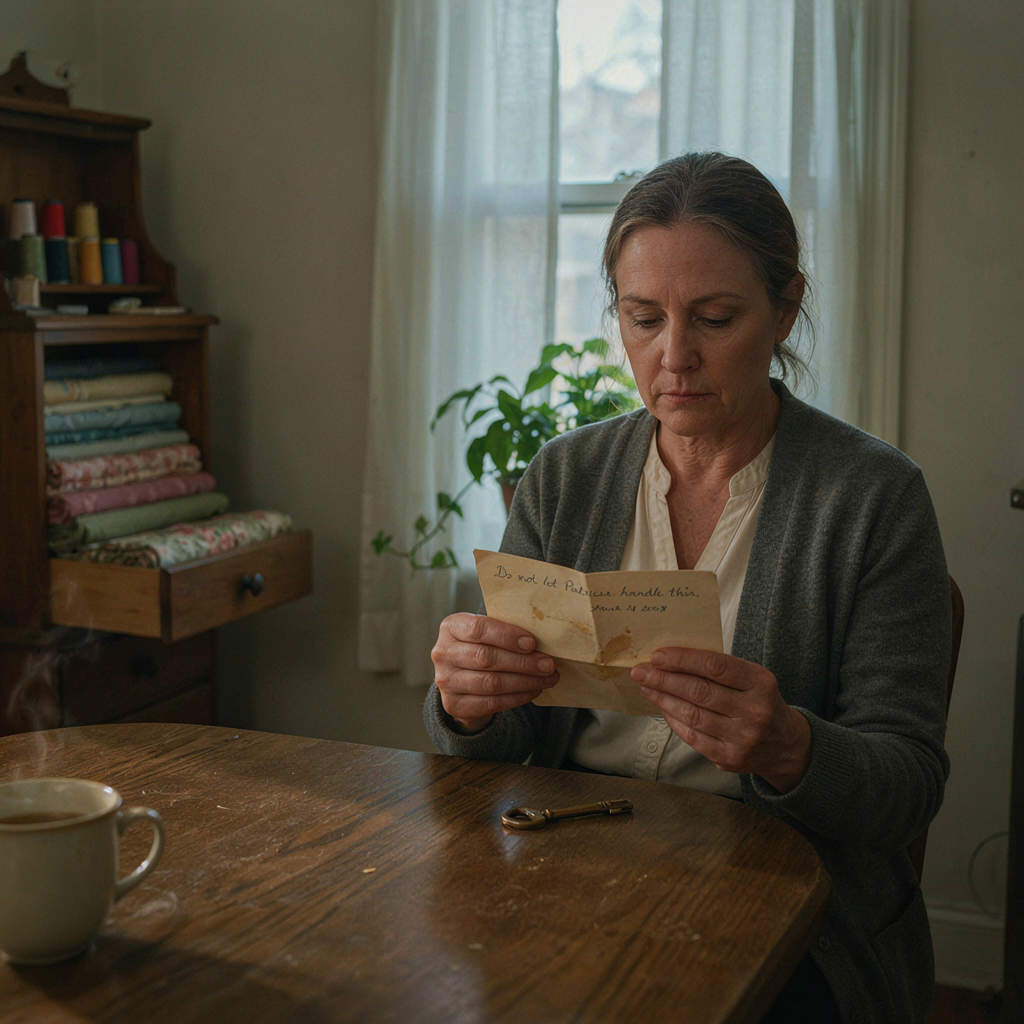
The first thing my sister said when Mom’s will was read was, “You always liked junk.”She said it with a laugh.Not a cruel laugh, exactly. Patricia had always been good at making cruelty sound like a joke.
We were sitting in the attorney’s conference room three weeks after Mom’s funeral.
Outside, rain streaked the windows, turning the downtown buildings into gray smears.
Inside, everything smelled like coffee, old carpet, and paper.
Mr. Callahan adjusted his glasses and continued reading.“To Patricia Elaine Miller, I leave my residence at 1847 Willow Lane, together with the 2018 Buick, and the sum of forty-two thousand dollars from my savings account.”
Patricia squeezed my hand.“Congratulations,” I whispered.She smiled.Then Mr. Callahan read my name.
“To Eleanor Marie Carter, I leave my mother’s antique sewing cabinet.”
Silence.Patricia stared at me.Then she laughed.“Oh, Ellie.”
I looked at the attorney.“Is that all?”“There are a few personal effects listed separately,” he said. “Photographs, clothing, kitchen items, books. But yes. The principal bequest to you is the sewing cabinet.”
Patricia leaned back in her chair.“You always liked junk.”I looked down at my hands.Mom’s sewing cabinet.Fifty-one years old.
A battered wooden thing with brass handles, water stains along one side, and a faint smell of starch and cedar.
I had loved it since I was a child.
Mom bought it in 1973, the year I was seven. She used to sit beside the kitchen window on winter evenings, repairing hems and replacing buttons while I did my homework at the table.
The cabinet had followed us through three houses.
Its drawers were filled with spools of thread, needles, measuring tape, old scissors, buttons in glass jars, scraps of fabric, and things Mom refused to throw away because she was certain they would someday be useful.
After Dad died, she moved the cabinet into the spare bedroom.
After her arthritis got worse, she stopped sewing.
But she kept the cabinet.
“It’s ugly,” Patricia said now. “You can finally take it.”
I didn’t answer.
Patricia had always been the practical one.
She had the bigger house.
The nicer clothes.
The newer car.
The successful husband.
The confidence to walk into a room and behave as though everything in it already belonged to her.
I had been the sentimental daughter.
The one who saved birthday cards.
The one who kept Dad’s old toolbox.
The one who cried when Mom gave away the Christmas tree ornaments.
So when we left the attorney’s office, Patricia drove away in her new Buick.
I drove behind a delivery truck in my twelve-year-old sedan.
And in the back of my car sat the sewing cabinet.
I nearly donated it the next morning.
I’m not proud of that.
I stood in my garage with one hand on the cabinet’s dusty wooden lid.
“Goodwill,” I muttered.
It would have been easier.
I had nowhere to put it.
The thing was enormous.
But when I opened the top, I saw the small indentation Mom had made decades earlier with a pair of scissors.
I remembered sitting beside her at seven years old.
“Mom?”
“Yes, sweetheart?”
“Will you teach me?”
“To sew?”
I nodded.
She smiled.
“Come here.”
That memory stopped me.
I closed the cabinet.
“Fine,” I whispered. “You win.”
I dragged it into my spare room.
For three weeks, nothing happened.
Then one Saturday morning, I decided to clean it.
I started with the top drawer.
Thread.
Buttons.
Old needles.
A packet of snaps.
A receipt from 1998.
Then the second drawer.
Fabric scraps.
A tape measure.
An envelope containing photographs.
I sat on the floor and looked through them.
Mom at twenty-four.
Dad in his Navy uniform.
Patricia at five.
Me at seven.
The four of us standing in front of our first house.
I smiled.
Then I noticed something.
One of the drawers wasn’t sliding properly.
I pulled harder.
The drawer came loose.
It tipped forward and spilled its contents across the floor.
Spools rolled everywhere.
A thimble bounced beneath the bed.
And something else fell.
A small brass key.
It landed on the carpet with a soft metallic click.
I picked it up.
Attached to it was a folded piece of paper.
The paper was yellowed.
I unfolded it carefully.
Mom’s handwriting was unmistakable.
My heart began to pound.
There were only six words.
“DO NOT LET PATRICIA HANDLE THIS.”
I read it twice.
Then a third time.
I sat completely still.
For several minutes, I couldn’t breathe normally.
What was “this”?
The cabinet?
The key?
Something else?
I turned the note over.
Nothing.
At the bottom was a date.
June 14, 2008.
I remembered that year.
Mom and Dad had been arguing constantly.
Dad had already been dead for five years.
Patricia had been going through a difficult divorce.
And there had been something else.
Something I hadn’t understood at the time.
Mom had asked me to visit her one evening.
She had been unusually quiet.
“Ellie,” she had said, “if something ever happens to me, don’t assume everything you hear is true.”
I had laughed.
“Mom, you’re talking like you’re ninety.”
She hadn’t laughed.
She died at eighty-two.
I looked at the brass key again.
There was a tiny number stamped into it.
I called the bank Monday morning.
“Does this key belong to a safe-deposit box?” I asked.
The woman on the phone asked for my mother’s name.
I gave it.
There was a pause.
Then she said, “Ms. Carter, you’ll need to come in with identification and the estate documentation.”
I hung up.
I barely slept that night.
The next morning, I went downtown.
The safe-deposit box was in the basement of the old bank building.
The manager checked my paperwork.
Then he looked at the key.
“Box 417,” he said.
He led me into a private room.
The key turned.
Inside was a single folder.
No jewelry.
No cash.
No family heirlooms.
Just a thick manila folder.
On the front, in Mom’s handwriting, were four words.
“FOR ELEANOR. ALONE.”
My hands shook.
I opened it.
The first page was a property appraisal.
My eyes moved down the page.
Property value:
$318,000.
Address:
92 Maple Street.
I knew the address.
Everyone in town knew it.
It was the old brick commercial building on Maple Street, across from the courthouse.
The building had been empty for years.
I turned the page.
A deed.
My mother’s name.
I stared at it.
Mom owned the property.
But why?
The next document explained everything.
She had purchased it in 2008.
Not publicly.
Not through a realtor.
She had used money from an inheritance Dad left her.
The documents showed the purchase price: $210,000.
I kept reading.
Then I found another document.
A handwritten letter.
This one was dated July 2, 2008.
“Ellie,
If you’re reading this, then I’m no longer able to explain what happened.
I need you to know something.
Your sister doesn’t know the whole truth.
She believes the money she receives from me is hers by right.
It isn’t.
For years, Patricia has been borrowing money from me.
I gave it because I was afraid she would lose her house.
But in 2008, I discovered that she had been using my money to cover debts I didn’t know about.
I confronted her.
She promised to change.
She didn’t.
I purchased 92 Maple Street because I wanted one thing that couldn’t be quietly sold, transferred, or spent.
I put it in your name through a trust.
Not Patricia’s.
Yours.”
I stopped.
I read the final sentence.
“Because you are the one person in this family who has never asked me for anything.”
My vision blurred.
I turned the page.
There were bank records.
Receipts.
Copies of checks.
Transfers.
For years, Mom had quietly given Patricia money.
Thousands at a time.
Medical bills.
Credit cards.
Mortgage payments.
Business debts.
Then I saw the total.
$127,400.
I covered my mouth.
Patricia had received more than $127,000 from Mom over fifteen years.
And she had still inherited the house, car, and $42,000.
I kept reading.
There was another envelope.
Inside was a letter addressed to Mr. Callahan.
Mom had written it six months before she died.
“Do not tell Patricia about the Maple Street property until after probate.”
Why?
The next line answered it.
“She will attempt to claim it.”
I sat back.
My mother’s words suddenly made sense.
The probate attorney had read the will exactly as written.
Patricia got the house.
The car.
The $42,000.
I got the cabinet.
Because the cabinet contained the key.
And the key led to everything else.
Mom had hidden her most important inheritance inside the thing Patricia had laughed at.
I called Mr. Callahan.
He answered on the third ring.
“Ellie?”
“I found something.”
His voice changed immediately.
“What did you find?”
“A property.”
Silence.
“Maple Street?”
I froze.
“You knew?”
“I knew there was a sealed trust,” he said. “Your mother instructed me not to discuss it until you came to me with the documents.”
“Why didn’t you tell me?”
“Because your mother specifically told me that if Patricia discovered the trust before the estate was settled, she would challenge it.”
I looked down at the folder.
“Is the property really mine?”
“Yes.”
“How?”
“Your mother established a revocable trust in 2008 and transferred ownership of the property into it. Upon her death, the trust became irrevocable. You are the beneficiary.”
I laughed.
Not because anything was funny.
Because suddenly the entire situation was absurd.
Patricia had laughed at my sewing cabinet.
She had called it junk.
She had driven away believing she had won.
Meanwhile, Mom had hidden a $318,000 property behind a drawer full of buttons.
“There’s more,” Mr. Callahan said.
My stomach tightened.
“What?”
“Your mother left instructions concerning the $42,000.”
“What about it?”
“She anticipated Patricia would spend it quickly.”
“That’s probably true.”
“Your mother transferred the remaining funds into another account before her death.”
I stared at the folder.
“How much?”
He hesitated.
“Approximately $84,000.”
I closed my eyes.
Of course.
Mom had left Patricia $42,000 in the will.
But she had separately protected another $84,000.
For me.
Not because she loved Patricia less.
Because she knew Patricia would destroy herself if someone kept rescuing her.
That afternoon, Patricia called.
“You got the cabinet, right?”
“Yes.”
“Good. I want you to take it out of the garage at Mom’s house.”
“Why?”
“I don’t want it there.”
“I already have it.”
“Oh.”
She paused.
“Ellie?”
“Yes?”
“You’re not upset about the will, are you?”
I almost laughed.
“No.”
“You know Mom loved us both.”
“I know.”
“And she always thought you were better with money.”
I said nothing.
Patricia continued.
“I might need a little help with the house.”
“What kind of help?”
“The taxes. Repairs. You know.”
“Didn’t Mom leave you $42,000?”
“Yes, but that won’t last.”
I looked at the folder sitting on my kitchen table.
“I’m sure you’ll figure it out.”
Her voice sharpened.
“That’s cold.”
I almost told her.
I almost said, You have no idea what Mom left me.
But I remembered the note.
Do not let Patricia handle this.
So I said nothing.
Two days later, Patricia came to my house.
She walked into the spare room and saw the cabinet.
“Still ugly.”
I smiled.
“Mom loved it.”
“She loved everything old.”
She opened a drawer.
“What’s this?”
My heart stopped.
She had found the empty compartment where the key had been.
“Nothing.”
Patricia looked at me.
“Why is there a false bottom?”
I felt cold.
“I don’t know.”
She reached toward it.
I stepped between her and the cabinet.
“Don’t.”
Her face changed.
“What are you hiding?”
“Nothing.”
“You’re lying.”
I stared at her.
For the first time in my life, I saw fear in my sister’s eyes.
Not anger.
Fear.
“What did Mom tell you?” she whispered.
“Nothing.”
“She told you something.”
“No.”
Patricia’s voice dropped.
“About Maple Street?”
My entire body went still.
“How do you know about Maple Street?”
She looked away.
That was answer enough.
“You knew.”
“No.”
“Patricia.”
She sat down.
For several seconds, neither of us spoke.
Then she began crying.
“I knew Mom owned it.”
I felt betrayed.
“You knew?”
“I knew she bought it.”
“Why didn’t you tell me?”
“Because she told me it was for me.”
“What?”
Patricia wiped her eyes.
“She said she was buying it because I needed a place for my business.”
“What business?”
“My catering company.”
“You never had a catering company.”
“I tried.”
“When?”
“In 2009.”
I shook my head.
“You told everyone you worked for a hotel.”
“I failed.”
I stared at her.
She looked smaller than she had ten minutes earlier.
“Mom gave you money,” I said.
“I know.”
“Over $127,000.”
Her face went pale.
“You found the records.”
“Yes.”
She looked at the floor.
“I was drowning.”
“So Mom kept rescuing you.”
“I didn’t ask her to.”
“You took it.”
“Yes.”
“And then you laughed when I got the cabinet.”
“I didn’t know.”
“You knew about the property.”
“I thought Mom changed her mind.”
I remembered the letter.
“She didn’t.”
Patricia looked up.
“What does that mean?”
I didn’t answer.
She stood.
“Ellie, what did she leave you?”
I looked at her.
“The truth.”
She flinched.
Three days later, Patricia challenged the trust.
Her attorney sent a letter claiming Mom had been mentally incompetent when the property transfer was made.
Mr. Callahan warned me.
“Don’t respond emotionally.”
“I won’t.”
The hearing was scheduled for six weeks later.
During those six weeks, I learned things I never wanted to know about my family.
I learned that Patricia had accumulated nearly $200,000 in debt.
I learned Mom had paid off her credit card twice.
I learned Patricia had once forged Mom’s signature on a loan application.
I learned Mom had discovered it.
And I learned something else.
Mom hadn’t disowned her.
She had forgiven her.
But forgiveness wasn’t the same as trust.
That was why she created the trust.
The hearing took place on a Tuesday morning.
Patricia arrived with her attorney.
I sat beside Mr. Callahan.
The judge reviewed the documents.
Patricia’s attorney argued that Mom had intended the Maple Street property to benefit Patricia.
Then Mr. Callahan presented the trust.
The signatures.
The bank records.
The appraisal.
The medical records from 2008 showing Mom was mentally competent.
Then came the letter.
My mother’s letter.
The judge read it silently.
When he finished, he looked at Patricia.
“Did your mother ever tell you she intended this property to be yours?”
Patricia hesitated.
“She said she was buying it for me.”
“That isn’t what the legal documents say.”
“I know.”
“Then why did you contest the trust?”
Patricia looked at me.
“Because she was my mother.”
The judge waited.
Patricia whispered, “And I thought she would choose me.”
Something inside me broke.
Not because I felt sorry for her.
Because I finally understood her.
Patricia had spent her entire life competing for Mom’s approval.
I had never realized it.
She thought every gift to me was a rejection of her.
Every compliment was a comparison.
Every success I had was something she had failed to achieve.
Even the sewing cabinet had become proof, in her mind, that Mom had given me something.
She just didn’t understand what.
The judge upheld the trust.
The property was mine.
The additional account was mine.
The challenge was dismissed.
Outside the courthouse, Patricia stood on the steps.
She didn’t look angry.
She looked exhausted.
“Ellie.”
I stopped.
“I hated that cabinet.”
I smiled faintly.
“I know.”
“No,” she said. “You don’t.”
She took a breath.
“Mom taught you how to sew.”
“Yes.”
“She taught me how to cook.”
I looked at her.
“I didn’t know that.”
“She did.”
Patricia laughed through tears.
“Do you remember the Christmas when we were kids? You got the blue dress.”
“Yes.”
“I got the red one.”
“I remember.”
“I was furious.”
“Why?”
“Because yours had little pearl buttons.”
I smiled.
“You were six.”
“I know.”
She wiped her cheek.
“I thought Mom loved you more.”
I didn’t know what to say.
Patricia looked toward the street.
“She didn’t.”
“No.”
“She loved us differently.”
“Yes.”
“I wish I’d understood that sooner.”
I reached into my purse.
I had brought something with me.
A small photograph.
Mom and Patricia in the kitchen.
Patricia was maybe nine.
Mom was standing behind her, guiding her hands as she rolled dough.
I handed it to her.
She stared at it.
“I forgot this.”
“I found it in the cabinet.”
She laughed softly.
“Of course you did.”
We stood there together.
Two sisters.
One inheritance.
A lifetime of misunderstanding between us.
Then Patricia said, “What are you going to do with Maple Street?”
“I don’t know yet.”
“You should sell it.”
“Maybe.”
“You could get over three hundred thousand.”
“I know.”
She looked at me.
Then she said something I didn’t expect.
“Don’t give me any of it.”
I frowned.
“What?”
“I mean it.”
“Patricia—”
“No.”
She looked directly at me.
“For once, let me fix my own mess.”
I nodded.
It was the first responsible thing I’d ever heard her say.
Months passed.
I eventually decided not to sell the property.
Instead, I renovated the old building.
The first floor became a small community sewing studio.
The second floor became affordable workspace for local artists.
I named it The Eleanor Workshop.
But I kept the original sewing cabinet in the front room.
I cleaned it carefully.
I repaired the loose drawer.
I polished the brass handles.
And I left one small scratch untouched.
Mom had made that scratch when I was seven.
The first time she let me use her scissors.
I also framed her note.
“Do not let Patricia handle this.”
Underneath it, I added another line.
“Sometimes the things we dismiss are the things that save us.”
Patricia eventually visited the workshop.
She stood in the doorway.
“You really kept it.”
“Of course.”
She touched the cabinet.
“Can I open it?”
I smiled.
“Yes.”
She opened the top.
Inside were spools of thread.
Buttons.
Needles.
A measuring tape.
And a small envelope.
Patricia pulled it out.
“What’s this?”
I shrugged.
“I don’t know.”
She opened it.
Inside was a note.
Mom’s handwriting.
Both of us read it together.
“My girls,
If you have found this, then I suppose the cabinet has done its job.
Remember this:
An inheritance isn’t measured by what someone leaves you.
It’s measured by what they teach you to carry.
Patricia, stop running from your mistakes.
Eleanor, stop carrying everyone else’s.
Love, Mom.”
Patricia began crying.
I did too.
She sat down beside the cabinet.
“I think she knew everything.”
“She probably did.”
“She knew I’d come after you.”
“Yes.”
“She knew you’d forgive me.”
I thought about it.
“Not immediately.”
Patricia laughed.
“That sounds more like you.”
We sat together for a while.
Then she said, “Do you remember what I called it?”
“The cabinet?”
“Junk.”
“Yes.”
She smiled.
“I was wrong.”
I looked at the cabinet.
“No.”
She shook her head.
“I was.”
And maybe that was the real inheritance.
Not the property.
Not the money.
Not the safe-deposit box.
Not the $318,000 building.
It was the truth.
My mother had known that money could divide two sisters.
She had known that property could create resentment.
She had known that a will could never repair years of jealousy.
So she left Patricia the things she believed Patricia could handle.
A house.
A car.
Cash.
And she left me the one thing I would almost throw away.
A sewing cabinet.
Because Mom knew me.
She knew I would see memories where other people saw old wood.
She knew I would open every drawer.
She knew eventually I would find the key.
And she knew the truth was worth more than any inheritance.
Years later, when people asked why I kept the cabinet in the workshop, I always gave them the same answer.
“My mother left it to me.”
Sometimes they would ask why.
I would smile.
“Because she knew I’d need it.”
And that was true.
I needed it to find the property.
I needed it to find the money.
I needed it to understand my sister.
But most of all, I needed it to understand my mother.
She hadn’t chosen one daughter over the other.
She had simply understood what each of us needed.
Patricia needed boundaries.
I needed courage.
And both of us needed to stop measuring love by what was written on a probate document.
The cabinet stayed with me for the rest of my life.
Its cedar smell never disappeared.
Every drawer still carried something from Mom.
A button.
A spool.
A piece of ribbon.
A tiny needle cushion.
And, hidden beneath the lining, the empty space where the brass key had once rested.
I never repaired that part.
I wanted it empty.
Because every time I looked at it, I remembered the day my sister laughed and said:
“You always liked junk.”
She had been right about one thing.
I did love old things.
Old furniture.
Old photographs.
Old letters.
Old memories.
But she had been wrong about the most important thing.
It wasn’t junk.
It was a message.
And my mother had spent fourteen years making sure I would eventually find it.
The strangest part is that if Patricia had received the cabinet, she probably would have thrown it away.
If I had inherited the house, I might have sold it.
If Mom had simply left me a check for $318,000, I might never have understood why.
Instead, she gave me a battered wooden cabinet worth perhaps fifty dollars.
And inside it, she left me everything that mattered.
Not just money.
Not just property.
A second chance with my sister.
A final conversation with my mother.
And the knowledge that sometimes the smallest inheritance can contain the biggest secret.
The cabinet is still in the workshop today.
Children use it to learn sewing.
Old women sit beside it and tell stories.
Teenagers open the drawers looking for buttons.
Sometimes someone asks me why one drawer has a tiny brass keyhole.
I tell them the truth.
“My mother put something important inside.”
“What was it?”
I smile.
“The key to the rest of my life.”
And then I close the drawer.
Because some things don’t need to be hidden anymore.
But they should always be remembered.:::