The Sweaters on the Thrift Store Rack
Jenny had always knitted with her whole heart.Not just with her hands.With her whole heart.Every stitch carried something.A little patience.A little hope.
A little piece of the woman she had been since the day we first met.
For thirty-eight years, I had watched my wife turn ordinary balls of yarn into things that made people feel loved.
Scarves.Blankets.Mittens.Baby hats.Christmas stockings.
But her favorite things to knit were sweaters for our grandchildren.She started when our oldest grandchild, Emily, was born.Jenny had stood beside the hospital crib holding a tiny pink sweater against her chest.
“It’s too big,” I had teased her.“She’ll grow into it.”“You said that about the last one.”“She’ll grow into that one too.”
That was Jenny.She never cared if something took months.
She never cared if nobody knew how long it had taken.
She just wanted to make something beautiful for someone she loved.Every birthday, there was a sweater.Every Christmas, another one.
For Emily, she knitted little flowers around the sleeves.For Noah, she made navy blue sweaters with tiny sailboats.
For Sophie, she used soft lavender yarn because Sophie once told her purple was the prettiest color in the world.
For little Lucas, she made a green sweater with a crooked dinosaur on the front because he loved dinosaurs.
Jenny remembered everything.Their favorite colors.Their favorite animals.The cartoons they watched.The sports teams they liked.
She would sit in her chair by the living room window late at night, glasses resting low on her nose, needles clicking softly in her hands.
Sometimes I’d wake up at two in the morning and find her still knitting.
“Jenny,” I’d say, “go to bed.”
“Just one more row.”
“You said that an hour ago.”
She’d smile.
“I’m almost finished.”
I knew what she was really saying.
I’m almost finished making something for someone I love.
And I never had the heart to stop her.
She never asked our children or grandchildren for money.
She never expected expensive gifts.
She never complained when the grandkids forgot to call.
She only wanted them to smile when they opened the box.
Maybe give her a hug.
Maybe say, “Grandma made this?”
That was enough.
Or at least I thought it was.
Then came Thursday.
Jenny and I had driven into town to buy some gardening supplies.
We needed new gloves, a few seed packets, and a replacement shovel because mine had somehow disappeared from the garage.
On the way home, Jenny noticed a thrift store.
“Let’s stop for a minute,” she said.
“You’re going to buy another flowerpot, aren’t you?”
“I don’t have enough flowerpots.”
“You have seventeen.”
“Exactly. I need one more.”
I laughed and parked.
We walked inside.
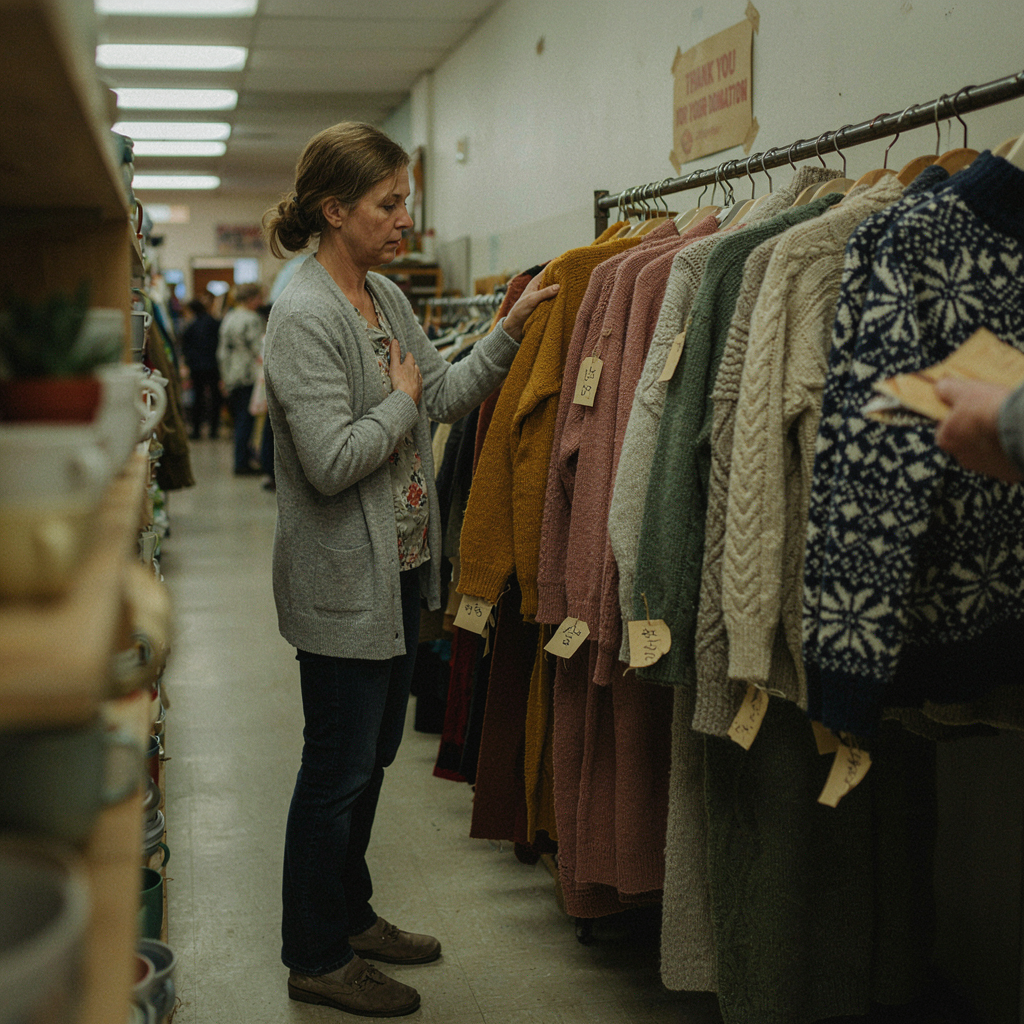
The store smelled like old books, furniture polish, and clothes that had belonged to people whose stories we would never know.
Jenny headed toward the household section.
I followed.
Then she stopped.
Completely still.
At first, I didn’t understand why.
Then I saw what she was looking at.
A rack of children’s clothing.
And hanging from that rack…
was a sweater.
Green.
With a crooked dinosaur stitched across the front.
I knew it instantly.
“Jenny…”
She didn’t answer.
She stepped closer.
Her fingers trembled as she touched the sleeve.
Then she pulled it off the rack.
There was a small white price tag pinned to it.
$3.99.
She stared at it.
I stared at her.
“That’s Lucas’s,” she whispered.
I knew.
There was a tiny yellow thread near the collar.
Jenny had told me about it the night she finished the sweater.
She had accidentally dropped a needle and pulled one stitch loose.
She’d spent twenty minutes fixing it.
I looked down the rack.
There was another sweater.
Lavender.
Tiny flowers around the sleeves.
Sophie’s.
And another.
Navy blue.
Sailboats.
Noah’s.
Then a pink one with flowers.
Emily’s.
Four sweaters.
Four grandchildren.
Four years of Jenny’s love hanging on a thrift-store rack.
Jenny stood there silently.
Her mouth tightened.
I could see tears gathering in her eyes.
“Maybe they outgrew them,” she said.
Her voice was soft.
I didn’t answer.
“Kids grow fast.”
Still nothing.
She put the green sweater back.
Then she picked up the lavender one.
“It’s okay,” she whispered.
I finally said, “Jenny…”
“It’s okay.”
But it wasn’t.
I could see that.
She smiled at me, and it was the kind of smile people use when they’re trying not to cry in public.
“Kids probably get embarrassed by Grandma’s things.”
She laughed softly.
But there was no humor in it.
I wanted to rip every sweater off that rack.
I wanted to find whoever had sold them and ask how they could put a price on years of love.
But I knew that wasn’t the answer.
Jenny wasn’t angry.
She was hurt.
And somehow that was worse.
We left the store without buying anything.
She didn’t mention the sweaters again.
Neither did I.
But that night, after dinner, Jenny went upstairs early.
“I’m tired,” she said.
She kissed my cheek.
Then she disappeared into the bedroom.
I stayed downstairs.
The house was quiet.
I sat in my chair and stared at the knitting basket beside me.
There were three unfinished sweaters inside.
One was yellow.
One was blue.
One was red.
Jenny had started them months ago.
For our grandchildren.
I picked up the yellow one.
And for the first time in all the years I’d known my wife, I wondered whether she had been giving too much to people who didn’t understand what they were receiving.
Then I thought about the four sweaters at the thrift store.
Something didn’t make sense.
Our children knew how much those sweaters meant to their mother.
Or at least they should have.
Jenny didn’t knit cheap clothes.
She didn’t knit things casually.
Every sweater took weeks.
Sometimes months.
And our grandchildren had always smiled when she gave them one.
So how had all four ended up at the same thrift store?
I didn’t sleep much that night.
The next morning, I made a plan.
I wasn’t going to yell.
I wasn’t going to accuse anyone.
I wasn’t going to embarrass Jenny or make her grandchildren feel guilty.
I wanted something more important.
I wanted them to understand.
So I started with the sweaters.
The next afternoon, I went back to the thrift store alone.
I bought all four.
The woman at the register put them into a plastic bag.
“Four dollars each,” she said.
I handed her the money.
I almost laughed.
Four dollars.
That was what they were worth to the store.
But they were worth thousands of hours of love to my wife.
I brought them home.
Then I called my son, Daniel.
“Can you bring the kids over Saturday?”
“Sure, Dad. Why?”
“Family dinner.”
“Everything okay?”
“Everything’s fine.”
I called our daughter, Melissa.
Same invitation.
Then I called our other daughter, Rachel.
Same thing.
Nobody knew why.
Saturday evening, the house filled with noise.
Emily arrived first.
She was sixteen now.
Headphones around her neck.
Noah was fourteen.
Sophie was eleven.
Lucas was nine.
They ran through the front door shouting hello.
Jenny smiled from the kitchen.
She had spent all afternoon cooking.
Chicken.
Mashed potatoes.
Corn.
Apple pie.
Her usual family dinner.
But I noticed something.
She didn’t mention knitting.
She didn’t ask anyone about the sweaters.
She simply served dinner.
After we ate, I stood up.
“Before dessert, I want to show everyone something.”
Jenny looked at me.
I could see the question in her eyes.
I nodded.
“Trust me.”
I brought four paper bags into the living room.
The grandchildren sat on the couch.
Their parents stood behind them.
I handed the first sweater to Emily.
She unfolded it.
Her eyes widened.
“Wait…”
She looked at her mother.
“Mom?”
Daniel’s face changed.
“What is that?”
I said quietly, “Your mother’s sweater.”
Emily looked at the pink sweater.
“I remember this.”
Jenny said nothing.
I handed Noah his.
The navy blue sweater.
He stared at the sailboats.
“I had this.”
“Yes,” I said.
Sophie took hers.
Her eyes immediately filled with tears.
“I loved this.”
Jenny looked down.
Then Lucas opened the green sweater.
His face lit up.
“Dinosaur!”
He hugged it.
Then he looked at Grandma.
“You made this.”
Jenny nodded.
Lucas smiled.
“I thought it got lost.”
That sentence changed everything.
I looked at Daniel and Melissa.
“Do you know where I found these?”
Nobody spoke.
“The thrift store.”
Silence.
Emily looked shocked.
“What?”
I nodded.
“All four.”
Daniel’s face went pale.
“Dad, I…”
I held up my hand.
“I’m not here to yell.”
I looked at the grandchildren.
“I want you to understand something.”
I held up the green sweater.
“This isn’t about a sweater.”
I held up the lavender one.
“It’s about what happens when someone gives you something made with love.”
I looked at Emily.
“Your grandmother spent almost three weeks making yours.”
Emily looked at Jenny.
“Really?”
Jenny smiled weakly.
“You were obsessed with flowers that year.”
Emily’s eyes filled with tears.
“I remember.”
I turned to Noah.
“Your grandmother restarted your sweater twice.”
“Why?”
“Because the first two shades of blue weren’t right.”
Noah stared at her.
“You did that?”
Jenny shrugged.
“You liked navy.”
Then I looked at Sophie.
“Your grandmother stayed up until one in the morning finishing those flowers.”
Sophie covered her mouth.
“I didn’t know.”
“That’s the point,” I said.
“Most people don’t see the time behind a gift.”
I turned to Lucas.
“Your grandmother knitted that dinosaur three times.”
Lucas looked horrified.
“Why?”
“The first one looked like a chicken.”
Everyone laughed.
Even Jenny.
For a moment, the heaviness lifted.
Then I continued.
“You don’t have to keep every gift someone gives you forever. You are allowed to grow up. You’re allowed to change. You’re allowed to stop liking things.”
I looked at the adults.
“But if you no longer want something someone made especially for you, there are ways to handle it.”
Daniel looked at the floor.
Melissa whispered, “Dad…”
I said, “You can give it back.”
Nobody spoke.
“You can ask Grandma if she wants it.”
Still silence.
“Or you can tell her you don’t need it anymore.”
I looked at the grandchildren.
“But don’t secretly sell someone’s love for four dollars.”
Emily started crying.
“I didn’t sell mine.”
I looked at her.
“I know.”
She turned toward her father.
“Dad?”
Daniel swallowed.
“I…”
He rubbed his forehead.
“I’m sorry.”
Jenny finally spoke.
“Daniel, it’s okay.”
“No, Mom.”
He shook his head.
“It isn’t.”
He looked at his children.
“I sold some of the old clothes.”
Emily looked shocked.
“Why?”
Daniel sighed.
“Because your closets were overflowing.”
He looked at Jenny.
“I thought the sweaters were outgrown. I didn’t realize…”
His voice cracked.
“I didn’t realize you were still keeping track of them.”
Jenny smiled sadly.
“I always keep track.”
Melissa stepped forward.
“I sold some too.”
Sophie looked at her mother.
“Mom…”
“I thought you didn’t wear them anymore.”
“I thought Grandma wouldn’t care.”
Jenny’s eyes filled with tears.
“I cared.”
Melissa covered her face.
“I’m sorry.”
Jenny stood.
For a moment, nobody moved.
Then Lucas jumped up and hugged her.
“I don’t want to sell anything Grandma makes.”
Jenny laughed through her tears.
“You don’t have to.”
He squeezed her tighter.
“I want another dinosaur sweater.”
That made everyone laugh.
Then Emily stood.
She walked over to Jenny.
“I was embarrassed.”
Jenny looked at her.
Emily started crying.
“Not because it was ugly. I just…”
She looked down.
“People at school don’t wear stuff like that.”
Jenny nodded slowly.
“I understand.”
“But I kept it.”
She wiped her face.
“Mom made me donate it.”
Jenny’s expression changed.
“You kept it?”
Emily nodded.
“It was in my closet.”
Daniel looked confused.
“But…”
Emily shook her head.
“I couldn’t tell you why.”
She hugged Jenny.
“I think I just didn’t want you to know I was embarrassed.”
Jenny held her tightly.
“Sweetheart…”
“I’m sorry.”
Jenny kissed her forehead.
“You never have to apologize for growing up.”
Then she whispered something only Emily could hear.
Emily nodded.
The room became quiet.
I thought the lesson was finished.
It wasn’t.
Because Noah suddenly stood.
“Dad.”
Daniel looked at him.
“I have Grandma’s old blanket.”
“What?”
“The blue one.”
Jenny gasped.
“You still have that?”
Noah nodded.
“It’s under my bed.”
Jenny smiled.
“Why?”
He shrugged.
“It smells like Grandma’s house.”
Everyone laughed.
Then Sophie said, “I have mine too.”
Lucas raised his hand.
“Me too.”
Emily smiled.
“I have the first sweater Grandma made me.”
Jenny stared at them.
“You do?”
They all nodded.
And suddenly my wife began to cry.
Not the sad tears from the thrift store.
These were different.
They were the kind that come when you realize something you thought was gone was still there.
The sweaters had not disappeared.
The love hadn’t disappeared.
It had simply been buried under embarrassment, growing up, busy lives, and misunderstandings.
After everyone left, Jenny and I sat together in the kitchen.
She was holding the green dinosaur sweater.
“I thought nobody cared,” she whispered.
I reached for her hand.
“They care.”
“Sometimes I wonder.”
“I know.”
She looked at me.
“Why did you bring them back?”
“Because they belonged to you.”
She smiled.
“No.”
She shook her head.
“They belonged to the kids.”
I thought about that.
“You’re right.”
She folded the sweater carefully.
“But I wanted them to know what it meant.”
Jenny nodded.
Then she looked toward the empty doorway.
“Do you think I should stop knitting?”
I knew she was asking seriously.
I squeezed her hand.
“Do you want to?”
She thought about it.
“No.”
“Then don’t.”
She smiled.
“But maybe I won’t knit them sweaters every Christmas.”
“Why?”
“Because they’re getting older.”
She looked at me mischievously.
“I might knit them something else.”
“What?”
“I haven’t decided.”
Three weeks later, the grandchildren came over again.
This time, they brought gifts.
Emily brought Jenny a small wooden box.
Noah brought a framed photograph.
Sophie brought a handwritten letter.
Lucas brought a drawing.
Jenny opened the box first.
Inside was a little silver thimble.
Emily explained, “I saw it at a craft store.”
Jenny touched it.
“I thought you might need one.”
Jenny hugged her.
Noah’s photograph showed Jenny sitting in her chair knitting.
It had been taken secretly.
She looked at it for a long time.
“You took this?”
He smiled.
“You always look happiest when you’re making something.”
Sophie handed over her letter.
Jenny read it silently.
Then she cried.
Lucas gave her the drawing.
It showed four children wearing sweaters.
And in the middle was Grandma.
Underneath, in crooked handwriting, were the words:
Grandma’s sweaters are worth more than money.
Jenny pressed the paper against her heart.
That night, after everyone left, I found her in her chair.
The knitting needles were moving.
Click.
Click.
Click.
I smiled.
“What are you making?”
She didn’t look up.
“Something.”
“For who?”
She smiled.
“Someone who needs it.”
I laughed.
“That sounds dangerous.”
She finally looked at me.
“It’s a secret.”
Months passed.
Christmas came.
The grandchildren were older.
Emily was preparing for college.
Noah had started driving.
Sophie had discovered music.
Lucas had become obsessed with soccer.
Life was changing.
But something else had changed too.
They started calling Jenny.
Not because they needed anything.
Just to talk.
Emily called her from college.
“Grandma, can you teach me how to knit?”
Jenny nearly dropped the phone.
Noah asked her how long it took to make a sweater.
Sophie asked for a scarf.
Lucas wanted another dinosaur.
Jenny laughed.
“You’re too big for a dinosaur sweater.”
“No, I’m not.”
“Yes, you are.”
“No!”
I listened from the kitchen as they argued.
And I smiled.
One afternoon, Jenny asked me to help clean the attic.
We found an old box.
Inside were photographs, letters, baby shoes, birthday cards…
and a stack of sweaters.
Not the thrift-store sweaters.
New ones.
She had been knitting them again.
Four sweaters.
One for each grandchild.
But this time, she had sewn a small label inside each one.
I picked one up.
The label said:
Made with love by Grandma.
I looked at her.
“You put labels in them?”
She smiled.
“So nobody forgets.”
I kissed her forehead.
“Nobody’s going to forget.”
She nodded.
Then she looked toward the window.
“You know what I learned?”
“What?”
“Giving doesn’t mean people will always understand what you’re giving them.”
I listened.
“But that doesn’t mean you stop loving.”
She folded the sweater.
“And sometimes people need time to grow old enough to understand.”
I smiled.
“That sounds like something you should put on a wall.”
She laughed.
“No.”
“Why not?”
“Because then everyone would know I was wise.”
I laughed.
She threw a ball of yarn at me.
Years later, I still remember that thrift store.
I remember the rack.
The price tags.
The way Jenny touched that little dinosaur sweater.
And I remember the night she almost decided that her love wasn’t worth giving anymore.
I’m glad she didn’t.
Because the lesson wasn’t really about sweaters.
It was about gratitude.
About recognizing the invisible hours someone spends loving you.
About understanding that a gift isn’t measured by its price.
And about realizing that sometimes the things we dismiss when we’re young become the things we treasure when we’re old.
A $3.99 sweater can be worthless to a stranger.
But to a grandmother who spent three weeks making it?
It can be priceless.
And sometimes, the greatest lesson a family can learn isn’t taught with anger.
It’s taught by reminding them what love looked like before they were old enough to recognize it.
Jenny still knits.
She still makes sweaters.
She still loses track of time.
And every Christmas morning, our grandchildren open a box from Grandma.
They no longer ask how much it cost.
They don’t ask whether it’s fashionable.
They don’t even ask whether it fits.
They put it on.
Then they hug her.
And that’s all she ever wanted.