The Announcement He Never Expected
I was sixty-four years old when my husband announced our divorce at my retirement party.Thirty-five years.That was how long I had spent inside the same company.
Thirty-five years of answering phones, calming angry clients, fixing schedules, finding missing documents, covering for people who called in sick,
training new employees, staying late, coming in early, and somehow knowing exactly what to do whenever something went wrong.
I had started as a receptionist.I retired as the person everyone called when things fell apart.
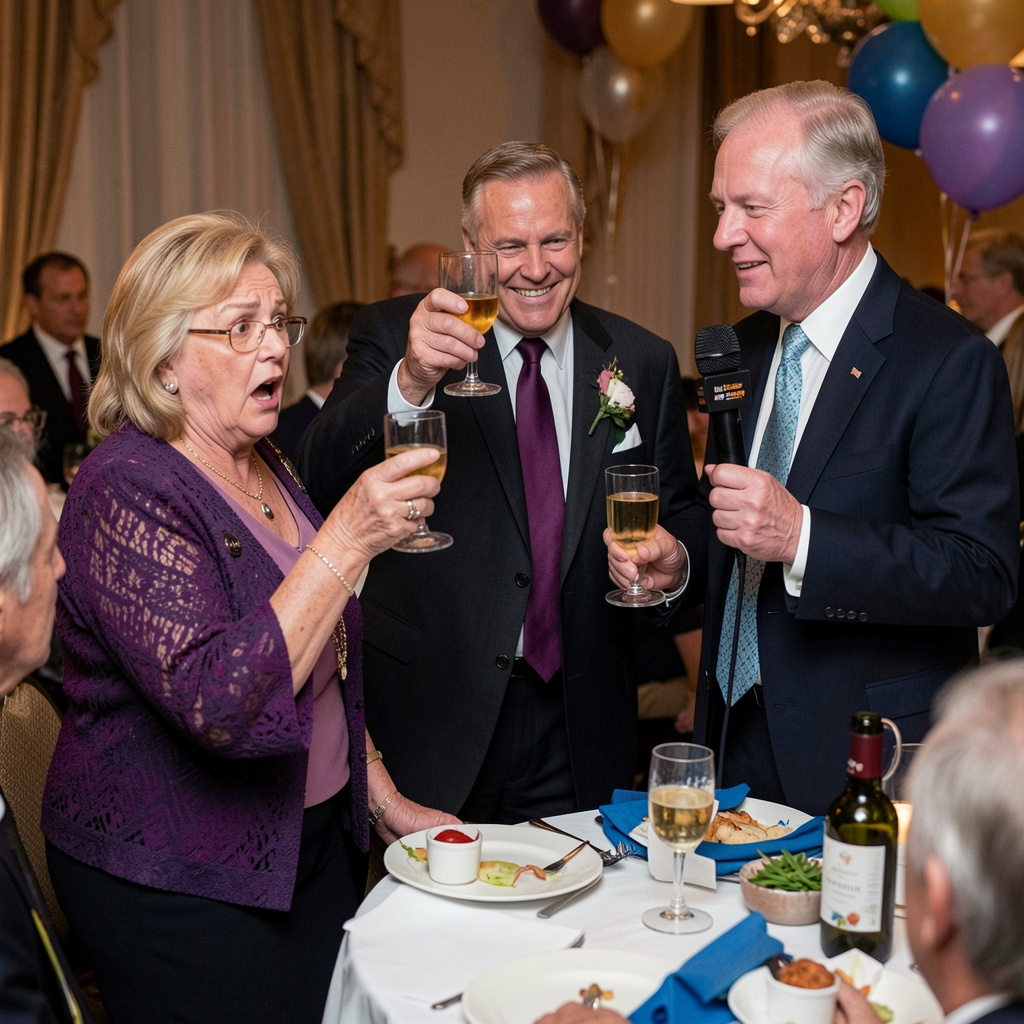
And on that Friday evening, for the first time in my life, I felt as if people were finally seeing me.The ballroom was filled with my coworkers, former employees, clients, managers, and friends I’d collected over three and a half decades.
There were photographs on a screen behind the head table.Me at twenty-nine, wearing enormous glasses and a nervous smile.
Me at forty, holding a birthday cake someone had decorated with the words Don’t Quit Yet, Marlene.
Me at fifty-three, standing beside Mr. Whitaker after our department won an industry award.
And me at sixty-four, wearing a navy-blue dress and trying not to cry as everyone applauded.My name is Marlene Hayes.
For thirty-five years, I had been the woman behind the scenes.That night, I was finally standing in the middle of the room.
My boss, Daniel Whitaker, had given a beautiful speech.
“Marlene,” he said, “there are people who have a job, and there are people who become part of the foundation of a company.
This place would not be what it is without you.”Everyone clapped.I wiped my eyes.
I looked across the room at Roy.
My husband of thirty-eight years.
I expected him to be smiling.
Instead, he was staring at his phone.
That should have been my first warning.
But I was too happy to notice.
I had spent so many years making excuses for Roy that I could have written a book about them.
He’s tired.
He’s stressed.
That’s just how he talks.
He doesn’t understand how much this means to me.
For years, Roy had treated my job like an amusing hobby.
Whenever someone asked what I did, he’d say, “Oh, Marlene? She works in an office.”
As if thirty-five years could be reduced to a building and a desk.
As if I hadn’t missed vacations because a major project needed finishing.
As if I hadn’t stayed overnight during the merger because nobody else knew how to reconstruct the company’s old records.
As if people hadn’t called me from airports, hospitals, hotels, and even their children’s school offices because they knew I’d somehow solve whatever problem they had.
But that night, I didn’t care.
I was proud.
Then Roy stood up.
He tapped his wineglass with a fork.
The room gradually quieted.
He smiled.
I smiled back.
I thought he was going to say something sentimental.
Maybe even something kind.
Instead, he said, “Since everyone’s celebrating new beginnings…”
He paused.
“…I’m filing for divorce.”
For three seconds, nobody moved.
I honestly thought I had misheard him.
Someone at the next table dropped a fork.
Roy continued.
“I figured this was as good a time as any to tell everyone.”
My heart began pounding.
I looked at him.
“Roy?”
He shrugged.
“I’ve already talked to an attorney.”
Someone whispered, “Oh my God.”
My face went hot.
I couldn’t breathe properly.
Roy lifted his glass again.
“Maybe now Marlene can stop pretending her little office job made her important.”
There it was.
The sentence that broke something inside me.
Not because he wanted a divorce.
Not even because he’d chosen my retirement party to announce it.
But because after thirty-eight years, he still thought the thing I had given my life to was little.
I stood.
I don’t remember making the decision.
I only remember thinking:
Get out.
Get out before you cry.
Get out before everyone sees you humiliated.
I reached for my purse.
Then Mr. Whitaker stood.
He walked toward the stage.
“Actually,” he said.
His voice wasn’t loud.
But everyone heard it.
He took the microphone from the trembling young employee holding it.
“I was saving this announcement for last.”
Roy’s smile disappeared.
Mr. Whitaker looked directly at him.
Then he looked at me.
And said:
“Marlene, please sit down.”
I froze.
“Because tonight isn’t the end of your career.”
He smiled.
“It’s the beginning of something much bigger.”
The room went silent.
Mr. Whitaker pressed a button on the remote.
The photographs behind him disappeared.
A new slide appeared.
It showed a building.
A beautiful brick building with large windows and a bronze plaque beside the entrance.
I didn’t recognize it.
Then the next slide appeared.
A blueprint.
Then a document.
Then a photograph of the company’s original headquarters from 1978.
Mr. Whitaker turned toward the audience.
“For the last two years, Marlene has been quietly helping us develop a new division.”
I stared at him.
“What?”
He smiled.
“Marlene thought she was helping us organize a retirement transition.”
A few people laughed softly.
“The truth is, we were preparing for something else.”
Roy was no longer smiling.
Mr. Whitaker continued.
“Our company has grown tremendously. We’ve opened offices in six states, expanded internationally, and hired hundreds of employees. But we’ve had one recurring problem.”
He looked at me.
“We’ve never been very good at taking care of the people who helped build all of it.”
My throat tightened.
He clicked again.
A title appeared.
THE MARLENE HAYES FOUNDATION FOR EMPLOYEE FAMILIES.
I stopped breathing.
The room erupted.
Applause.
People stood.
Some cried.
I couldn’t move.
Mr. Whitaker spoke over the applause.
“Last year, our board approved a $3.2 million initial endowment.”
I covered my mouth.
“And Marlene will serve as the founding director.”
The applause became deafening.
I shook my head.
“No.”
Mr. Whitaker laughed.
“Yes.”
I walked toward the stage.
“But I don’t understand.”
“You will.”
He handed me a folder.
Inside was a letter.
I read the first paragraph.
Then the second.
By the third, my vision blurred.
The foundation would provide emergency assistance to employees facing medical emergencies, housing crises, childcare problems, domestic emergencies, and other hardships.
And the most shocking part?
The foundation would be headquartered in the building shown on the screen.
The building had been purchased by the company.
But it had been named after me.
The Marlene Hayes Center.
I looked at Mr. Whitaker.
“You did all this?”
“We did,” he said. “But the idea was yours.”
I remembered.
Two years earlier, I’d complained to him about a young employee named Jasmine.
Jasmine’s husband had lost his job.
They were behind on rent.
Their daughter needed surgery.
Jasmine was considering quitting because she couldn’t afford childcare.
I had helped her find resources.
Then I had said to Mr. Whitaker:
“People shouldn’t have to choose between keeping their job and keeping their family afloat.”
He had looked at me strangely.
I thought he’d forgotten.
He hadn’t.
Roy suddenly laughed.
It was an ugly, nervous sound.
“This is ridiculous.”
Everyone turned toward him.
He stood.
“So she gets a building named after her because she answered phones for thirty-five years?”
Mr. Whitaker’s expression hardened.
“She did considerably more than answer phones.”
Roy shook his head.
“She’s retiring. This is just a publicity stunt.”
Mr. Whitaker calmly opened another folder.
“No, Roy.”
He held up a document.
“This is a legally established foundation with independent funding.”
Roy stared at him.
Mr. Whitaker continued.
“And Marlene’s position will be paid at an executive level.”
Roy’s face changed.
It was subtle.
But I saw it.
The moment he realized this wasn’t a retirement gift.
It was a new life.
My new life.
And suddenly, something occurred to me.
Roy hadn’t known.
He had no idea.
For the first time that evening, I wondered why.
Why hadn’t he known?
We’d been married thirty-eight years.
Surely I’d told him about the foundation.
Then I remembered.
Every time I talked about work, he changed the subject.
Every time I mentioned something important, he said, “Can we not talk about your office?”
Every time I came home excited, he barely looked up from the television.
I had mistaken his indifference for familiarity.
Maybe it had always been contempt.
Roy walked toward me.
“Marlene, we need to talk.”
I looked at him.
“No.”
He blinked.
“No?”
“Not tonight.”
His face reddened.
“You can’t just—”
“Actually,” I interrupted, “I can.”
The room became painfully quiet.
I had never spoken to Roy like that.
Not once.
He lowered his voice.
“You’re embarrassing me.”
I almost laughed.
“You announced our divorce in front of two hundred people.”
His mouth tightened.
“I was making a statement.”
“No,” I said. “You were trying to humiliate me.”
He didn’t answer.
And that was when I noticed something else.
He wasn’t wearing his wedding ring.
I looked at his hand.
He saw me looking.
“I took it off this morning.”
I nodded.
“How long have you been planning this?”
“Not long.”
“How long?”
He sighed.
“Months.”
I closed my eyes.
Months.
He had known for months.
Months while I planned retirement.
Months while I bought the dress for this party.
Months while I worried about whether my coworkers would miss me.
Months while he sat across from me at dinner and said nothing.
“Is there someone else?” I asked.
His silence answered.
I didn’t cry.
That surprised me.
Maybe I had already cried all the tears I had left over the years.
“Who?”
He looked away.
Then I heard a voice behind him.
“Roy.”
I turned.
A woman was standing near the back of the room.
She was younger than me.
Maybe fifty.
Elegant.
Confident.
And familiar.
My stomach dropped.
I knew her.
Linda Parker.
Roy’s financial advisor.
I had met her twice.
Once at a charity dinner.
Once at a Christmas party.
Roy had always called her “a friend.”
Linda walked over.
“I think we should leave.”
I looked at Roy.
“You were going to announce our divorce and then leave with her?”
He said nothing.
Linda looked embarrassed.
That was when Mr. Whitaker stepped beside me.
“Marlene, you don’t have to stay.”
I looked around the room.
At the people I’d worked with for decades.
At Jasmine crying in the front row.
At the young employees who had started only months earlier.
At the older employees who had watched me grow from a receptionist into something I had never realized I had become.
A leader.
A mentor.
A woman people trusted.
I picked up the microphone.
“My husband is right about one thing.”
Everyone looked at me.
“This is a new beginning.”
I looked directly at Roy.
“But not his.”
A few people gasped.
Roy’s face went pale.
I continued.
“Tonight, I was planning to thank everyone for thirty-five years.”
I smiled.
“But instead, I think I owe someone else thanks.”
I turned toward Mr. Whitaker.
“Thank you for seeing me when I stopped seeing myself.”
He nodded.
I handed him the microphone.
Then I walked off the stage.
I expected to feel devastated.
Instead, I felt strangely light.
The next morning, I woke up at seven.
For thirty-five years, I’d had an alarm set for 5:45.
I reached for my phone.
Then remembered.
I didn’t have to go anywhere.
I made coffee.
Sat on the porch.
And watched the sun come up.
At 8:15, my phone rang.
It was Roy.
I let it ring.
He called again.
Then again.
Finally, he sent a message.
We need to discuss the house.
I stared at it.
The house.
Of course.
For years, we’d fought about money without calling it fighting.
Roy handled investments.
I handled the household.
The mortgage had been paid off twelve years earlier.
The house was worth far more than either of us had imagined.
I called my attorney.
An hour later, I learned something that made me sit back in my chair.
The house wasn’t going anywhere.
Neither were my retirement accounts.
Neither was the money I’d earned.
But there was another issue.
Roy had apparently already transferred a portion of our joint investments into an account he’d opened six months earlier.
My attorney said, “We’ll investigate.”
I closed my eyes.
“Do it.”
For the first time in thirty-eight years, I was protecting myself.
Three weeks later, Roy came to the house.
He looked exhausted.
“What happened to you?” I asked.
He laughed bitterly.
“You happened.”
I said nothing.
“The divorce isn’t going the way I expected.”
“That’s unfortunate.”
He stared at me.
“You’ve changed.”
“No.”
I shook my head.
“I’ve stopped shrinking.”
He sat down.
“I made a mistake.”
I looked at him.
“With Linda?”
He hesitated.
“With everything.”
I almost felt sorry for him.
Almost.
“You wanted a new beginning,” I said. “You got one.”
“I don’t want this anymore.”
“You announced it.”
“I was angry.”
“You planned it for months.”
“I didn’t know about the foundation.”
I smiled sadly.
“That’s the problem, Roy.”
“What?”
“You stopped knowing me a long time ago.”
He looked down.
I thought about the young woman I had been when I married him.
Twenty-six.
Hopeful.
Terrified.
Certain love meant building a life together.
I had spent years becoming someone.
Roy had spent years assuming I would remain whoever he thought I was.
“I loved you,” I told him.
His eyes filled with tears.
“I know.”
“No,” I said softly. “You don’t.”
I stood.
“I loved you enough to make excuses for you.”
He looked up.
“I loved you enough to believe you when you told me I wasn’t important.”
His face crumpled.
“I was wrong.”
“Yes.”
“But I can fix it.”
I shook my head.
“Some things aren’t broken.”
He stared at me.
“They’re finished.”
The divorce was finalized six months later.
Roy lost more than he expected.
Not because I wanted revenge.
Because I stopped protecting him from consequences.
Linda left him before the divorce was complete.
The investments he had tried to hide were recovered.
The house remained mine.
And I never once felt guilty.
The Marlene Hayes Center opened the following spring.
The first person we helped was an employee named Marcus whose wife had been diagnosed with cancer.
Then a single father whose apartment burned down.
Then a receptionist whose child needed emergency surgery.
Then an older employee who needed help paying for a wheelchair ramp.
Every time someone came through those doors, I remembered the sentence I’d said years earlier:
People shouldn’t have to choose between keeping their job and keeping their family afloat.
The foundation grew.
So did I.
I traveled.
I took pottery classes.
I learned to swim properly.
I bought a ridiculous red convertible.
I had dinner with friends on Tuesday nights because I could.
I started sleeping until eight.
And every morning, I looked in the mirror and saw a woman I recognized.
One year after my retirement party, the company held another celebration.
This time, I was invited as the founder of the foundation.
Mr. Whitaker handed me the microphone.
“Marlene,” he said, “one year ago tonight, your husband announced your divorce.”
The room laughed softly.
“Most people would consider that a terrible retirement party.”
Everyone laughed louder.
He smiled.
“But I think we can all agree it turned out to be one of the best things that ever happened to her.”
I stepped toward the microphone.
I looked around the room.
Then I smiled.
“I used to think retirement meant stopping.”
I paused.
“Now I understand it can mean finally starting.”
The applause began.
I looked toward the back of the room.
For just a second, I imagined Roy standing there.
But he wasn’t.
And I realized something.
I didn’t need him to see me anymore.
Because I finally saw myself.
Not as someone’s wife.
Not as the receptionist I used to be.
Not as the woman who quietly solved everyone’s problems while asking for nothing in return.
I was Marlene Hayes.
Sixty-five years old.
Divorced.
Free.
And, for the first time in my life, completely unwilling to make myself smaller so someone else could feel important.
The night Roy announced our divorce, I thought he had destroyed the most important celebration of my life.
I was wrong.
He hadn’t ended my story.
He had accidentally announced the beginning of it.
And somewhere above the entrance to the building that carried my name, the bronze letters caught the afternoon sunlight:
THE MARLENE HAYES CENTER
I stood beneath them, smiled, and walked through the doors.
There was work to do.
And for once, it was work I had chosen for myself.