It Takes a Village
The baby was screaming.Not crying.Screaming.The kind of scream that made every head in the restaurant turn at once.
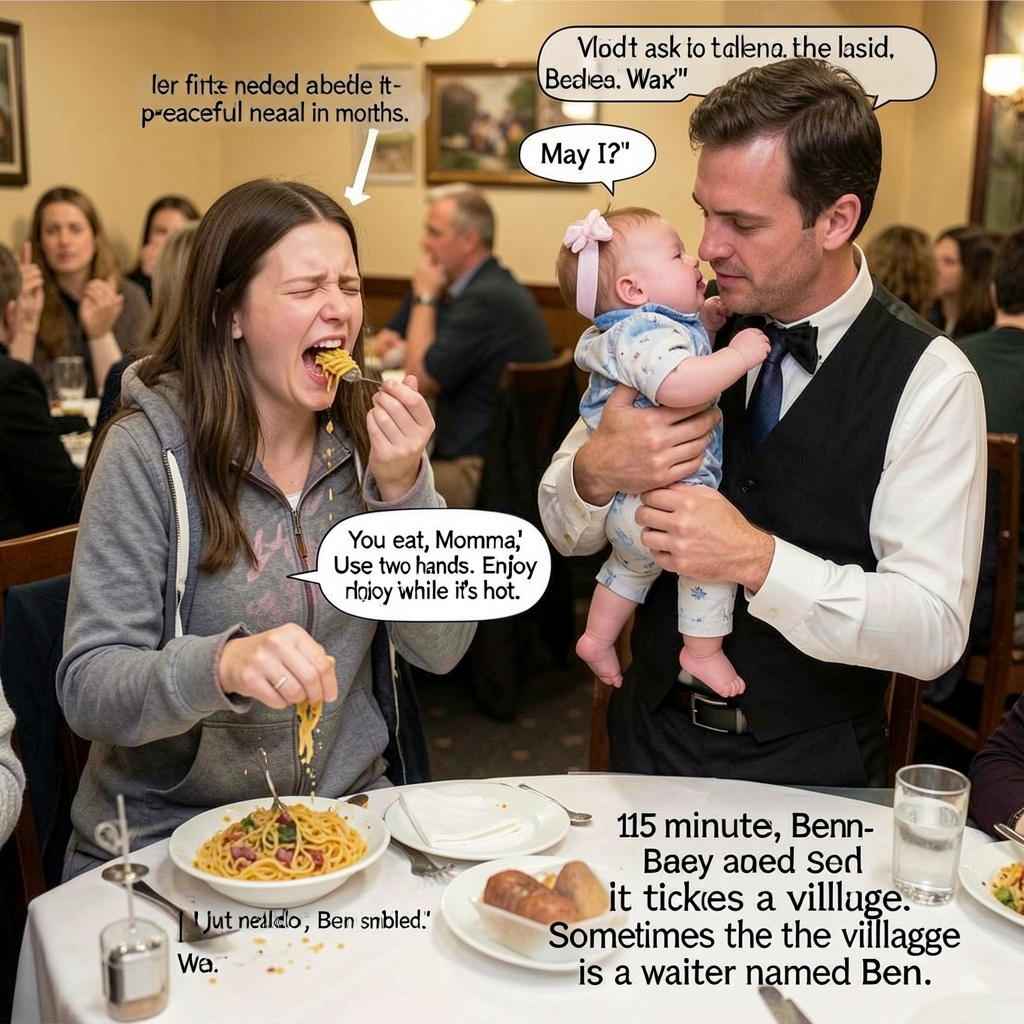
The young mother sat frozen in a corner booth, one hand gripping a plastic fork, the other trying desperately to keep the carrier from rocking too far.
Her dinner sat untouched except for a few cold noodles clinging to the edge of the plate.
She looked like she hadn’t slept in weeks.
Her hair was pulled into a messy knot. There were dark circles beneath her eyes. A stain from something—probably baby formula or spit-up—ran down the shoulder of her gray sweatshirt.
She was trying to eat.Not enjoy a meal.Just eat.
She scooped a bite of cold pasta into her mouth with one hand while bouncing the carrier with her foot.
The baby screamed louder.
At the table beside her, an older couple exchanged irritated looks.A man near the window sighed dramatically.Someone whispered, “Can’t they take that baby outside?”
The mother heard.Her shoulders tightened.She lowered her fork.
“I’m sorry,” she whispered to no one in particular.
The baby screamed again.
The mother closed her eyes.For one second, she looked like she might cry.Then a voice came gently from behind her.”May I?”She looked up.It was Ben.
Ben had been working at the restaurant for almost twelve years.
Most regular customers knew him.
He was the waiter who remembered people’s birthdays. The waiter who brought extra napkins before anyone asked.
The waiter who could carry three plates on one arm and refill four glasses without interrupting a conversation.
He was also a father.
A fact very few people knew.
The young mother stared at him.
“You… want to?”
Ben nodded.
“If you’re comfortable with it.”
She hesitated.
Then she carefully lifted the baby from the carrier and handed the screaming infant to him.
Ben tucked the baby against his shoulder.
He began bouncing gently.
The screaming stopped.
Not gradually.
Instantly.
The entire restaurant seemed to go silent.
Ben smiled.
“There we go.”
The baby’s tiny fist curled around the collar of his shirt.
Ben looked at the mother.
“You eat, Momma.”
She blinked.
“What?”
“Use two hands,” he said. “Enjoy it while it’s hot.”
She looked down at her plate.
Then back at him.
“But your tables…”
“I’ve got them.”
For the next fifteen minutes, Ben served drinks, carried plates, cleared dishes—and did every bit of it with one hand.
The other arm held a sleeping baby.
The young mother ate slowly at first.
Then faster.
Halfway through her meal, tears began running down her cheeks.
Ben noticed.
He didn’t mention them.
He simply walked past and refilled her water.
When he returned, she whispered, “I just needed a break.”
Ben smiled.
“We all do.”
She covered her face with both hands.
And that was the moment the story really began.
Because neither of them knew it yet, but that fifteen-minute act of kindness would change both their lives.
Three months earlier, Emily Carter had believed she could handle anything.
She was twenty-seven.
She had always been independent.
She worked as a receptionist at a dental office, paid her own bills, lived in a small apartment, and rarely asked anyone for help.
Then her daughter, Lily, was born.
Emily had expected exhaustion.
She hadn’t expected loneliness.
Her husband, Ryan, had promised everything would be different after the baby came.
“We’ll figure it out together,” he’d said.
“We’re a team.”
But three weeks after Lily’s birth, Ryan started staying late at work.
Then he started spending weekends away.
Then he stopped pretending.
One night, while Emily was sitting on the floor beside Lily’s crib, crying because she couldn’t get the baby to stop crying, Ryan stood in the doorway.
“I can’t do this anymore.”
Emily stared at him.
“Do what?”
“This.”
He gestured around the apartment.
“The crying. The diapers. You being exhausted all the time.”
Emily laughed once.
It was a broken sound.
“She’s three weeks old.”
“I know.”
“She’s our daughter.”
“I know.”
“Then what are you saying?”
Ryan looked away.
“I’m saying I made a mistake.”
He left two days later.
He took his clothes.
His laptop.
His toothbrush.
And somehow, the part of Emily’s heart that still believed people stayed when things got difficult.
He promised he’d visit Lily.
Sometimes he did.
Sometimes he didn’t.
Child support arrived late.
Messages went unanswered.
And Emily learned how heavy a baby could feel when you carried one alone.
She returned to work after eight weeks.
Her mother lived in another state.
Her closest friend had twins of her own.
Daycare cost almost as much as Emily’s paycheck.
So she did what millions of exhausted parents do.
She improvised.
She worked.
She came home.
She fed Lily.
She changed diapers.
She washed bottles at midnight.
She woke at one.
Two.
Three.
Four.
Then got up at six.
Some mornings she cried in the shower so Lily wouldn’t hear.
Some mornings she stared at herself in the mirror and wondered where the woman she’d been had gone.
And that Sunday afternoon, after a particularly brutal night, Emily decided she needed one thing.
A meal.
Just one.
She didn’t want anything fancy.
She wanted to sit somewhere where someone else cooked the food.
She wanted to use two hands.
She wanted to eat something while it was still warm.
So she packed Lily into the carrier, grabbed her diaper bag, and walked into the little neighborhood restaurant where she’d eaten with Ryan before Lily was born.
She hadn’t expected anyone to remember her.
But Ben did.
He recognized her immediately.
“You were here last year,” he said.
Emily smiled faintly.
“Before the baby.”
Ben glanced at Lily.
“Looks like things have changed.”
Emily looked down.
“Everything has.”
He didn’t ask questions.
He simply handed her a menu.
“Corner booth?”
She nodded.
“Perfect.”
She didn’t know it then, but Ben had already noticed something.
She looked tired in the way people looked when they had been tired for too long.
Ben had a daughter too.
Her name was Sophie.
She was twenty-two now.
When she was a baby, Ben had been twenty-five and newly married.
He remembered what it was like.
The sleepless nights.
The bottles.
The panic when a fever appeared.
The way his wife, Maria, sometimes cried because she hadn’t showered.
He remembered coming home from a double shift and finding Maria asleep on the couch with Sophie on her chest.
He remembered how helpless he’d felt.
So he’d learned.
Sometimes helping didn’t mean fixing anything.
Sometimes helping meant holding the baby while someone ate.
Ben had never forgotten that.
He had also learned another lesson.
You never knew what someone was carrying.
The angry customer might have just lost someone.
The rude man might be terrified.
The exhausted mother might be holding herself together with nothing but stubbornness.
So he tried to be gentle.
Even when the world wasn’t.
After fifteen minutes, Lily was asleep.
Emily had finished her meal.
For the first time in months, her hands weren’t shaking.
She looked at Ben.
“Thank you.”
“You’re welcome.”
“No, I mean…”
She swallowed.
“You don’t understand.”
Ben leaned against the booth.
“Maybe I do.”
Emily looked at him.
Ben smiled.
“My daughter is twenty-two now.”
“You have a daughter?”
“Had one.”
Emily frowned.
“Had?”
“I have one. I just don’t see her as much as I’d like.”
Emily smiled.
“She’s lucky.”
Ben looked down at Lily.
“Maybe.”
Then Emily said something that made him stop.
“I almost didn’t come in.”
“Why?”
“I thought people would be annoyed.”
Ben glanced around the restaurant.
Then back at her.
“People get annoyed by babies.”
“I know.”
“But babies don’t care.”
Emily laughed softly.
It was the first real laugh Ben had heard from her.
Then Lily stirred.
Emily reached for her.
Ben carefully handed the baby back.
“What’s her name?”
“Lily.”
“Pretty.”
“Thank you.”
Ben nodded.
Then he picked up his tray.
“Come back anytime.”
Emily smiled.
“I probably won’t.”
“Why?”
“Because I don’t want to be the crying-baby table.”
Ben shook his head.
“You’re not.”
“What am I?”
He smiled.
“A mom who needed lunch.”
Emily came back the following Sunday.
Then the Sunday after that.
Ben never made a big deal about it.
Sometimes Lily slept.
Sometimes she cried.
Sometimes Emily managed to eat with both hands.
Sometimes she didn’t.
But slowly, something changed.
Other customers began recognizing her.
An elderly woman named Mrs. Harris started bringing Lily little knitted hats.
A college student named Marcus would entertain Lily while waiting for his food.
The dishwasher, Carlos, began keeping a clean high chair ready.
Even the cook started making little pieces of soft bread for Lily when she got old enough to eat solids.
The restaurant became something Emily hadn’t realized she needed.
A village.
One Sunday, Emily arrived late.
Her face was pale.
Ben noticed immediately.
“Everything okay?”
She nodded.
Then shook her head.
“Daycare called.”
“What happened?”
“They’re closing.”
“Today?”
“For good.”
Emily stared at the floor.
“They lost their license.”
Ben’s expression changed.
“When?”
“Tomorrow.”
She started crying.
“I can’t miss work.”
Ben pulled out a chair.
“Sit.”
“I can’t afford another place.”
“Sit, Emily.”
She did.
Within ten minutes, half the restaurant knew.
Within twenty, Mrs. Harris had called her daughter, who worked at a daycare.
Marcus knew someone who babysat.
Carlos knew a woman who ran an in-home childcare center.
Even a customer who had been quietly eating in the corner offered to connect Emily with his sister.
Nobody gave her a speech.
Nobody told her she should have planned better.
They simply started solving the problem.
Emily sat there stunned.
“You all don’t even know me.”
Mrs. Harris smiled.
“Of course we do.”
“You do?”
“We know Lily.”
She reached across the table and squeezed Emily’s hand.
“That’s enough.”
A few months later, Emily found another job.
Better hours.
Better pay.
She also found an affordable daycare.
Things didn’t suddenly become easy.
But they became possible.
And Ben remained part of the story.
One evening, Emily walked into the restaurant carrying a large envelope.
Ben was at the counter.
“What’s that?”
She smiled.
“Something for you.”
He opened it.
Inside was a photograph.
Lily was sitting in a tiny chair, smiling with two little teeth showing.
On the back Emily had written:
Thank you for holding her when I couldn’t hold myself together.
Ben stared at the photograph for a long time.
“You didn’t have to do this.”
“I know.”
He smiled.
“Then why?”
“Because you taught me something.”
“What?”
Emily looked toward Lily.
“That asking for help doesn’t mean you’re weak.”
Ben nodded slowly.
“No.”
He looked at the photograph again.
“It means you’re human.”
Years passed.
Lily grew.
Emily rebuilt her life.
Ryan occasionally appeared and disappeared again, but Emily stopped measuring her happiness by whether he showed up.
She had learned something more important.
People who stayed mattered more than people who left.
Ben eventually retired from the restaurant.
His knees hurt.
His back hurt.
His manager told him he deserved to rest.
On his final night, the restaurant held a small celebration.
There were balloons.
Cake.
Photographs.
Mrs. Harris was there.
Carlos was there.
Marcus, now a teacher, came with his wife.
And Emily came too.
She walked through the door holding Lily’s hand.
Except Lily wasn’t a baby anymore.
She was eight years old.
She ran straight toward Ben.
“Mr. Ben!”
Ben laughed as she hugged his legs.
“Look at you!”
“I brought you something.”
She handed him a small gift.
Ben opened it.
Inside was a framed photograph.
It was an old picture Emily had taken years earlier.
Ben was holding baby Lily against his shoulder.
Emily sat at the table behind him, eating.
Both of them were smiling.
Ben stared at it.
“You kept this?”
Emily nodded.
“Of course.”
Lily looked up at him.
“Mom says you helped her when she was sad.”
Ben glanced at Emily.
“Your mom helped herself.”
Emily shook her head.
“No.”
She smiled.
“She was right there.”
Ben frowned.
“Who?”
Emily looked around the restaurant.
“All of them.”
She pointed toward Mrs. Harris.
“Cared.”
Toward Carlos.
“Helped.”
Toward Marcus.
“Stayed.”
Then she looked at Ben.
“And you started it.”
Ben shook his head.
“I just held a baby.”
Emily smiled.
“Sometimes that’s enough.”
But the story didn’t end there.
Years later, when Lily was sixteen, she asked Emily about the photograph.
“Why were you crying?”
Emily sat beside her on the couch.
“Because I was tired.”
“From taking care of me?”
“Yes.”
Lily looked down.
“Was I a difficult baby?”
Emily laughed.
“You screamed like you were being murdered.”
Lily gasped.
“Mom!”
“It’s true.”
They both laughed.
Then Lily became quiet.
“Did Dad leave because of me?”
Emily’s smile disappeared.
“No.”
“Are you sure?”
“Completely.”
“Then why?”
Emily thought for a moment.
“Some people leave because they’re not ready to become the person they promised they’d be.”
Lily looked at the photograph.
“Mr. Ben was.”
Emily smiled.
“Yes.”
When Lily turned eighteen, she received a scholarship.
The scholarship came from an unexpected source.
The restaurant.
Ben had started a small community fund after retiring.
He called it the Village Fund.
It helped single parents pay for childcare, meals, school supplies, and emergency expenses.
He never advertised it.
He never wanted praise.
But the fund grew.
Customers donated.
Former employees donated.
People who had heard the story donated.
Eventually, the fund helped hundreds of families.
At the first scholarship ceremony, Ben stood at the podium.
Lily was sitting in the front row.
Emily was beside her.
Ben looked at them and smiled.
“When people hear the word ‘village,’ they sometimes imagine a huge group of people.”
He paused.
“But a village doesn’t always look like that.”
He looked at Lily.
“Sometimes it’s one person holding a baby.”
Then he looked at Emily.
“Sometimes it’s one person saying, ‘You eat. I’ll hold her.'”
The room grew quiet.
“Sometimes it’s a stranger paying for someone’s groceries.”
“Sometimes it’s an old woman knitting a hat.”
“Sometimes it’s a cook making an extra piece of bread.”
“Sometimes it’s simply sitting beside someone and saying, ‘I know you’re tired.'”
He smiled.
“We spend so much time asking what we can do to change the world.”
He looked around the room.
“Maybe we should start by changing someone’s afternoon.”
The room applauded.
Lily wiped her eyes.
Emily reached for her hand.
After the ceremony, Lily walked up to Ben.
“Can I ask you something?”
“Anything.”
“Why did you help Mom that day?”
Ben smiled.
“Because she needed help.”
“That’s it?”
“That’s it.”
Lily shook her head.
“No.”
She pointed toward the photograph in his hand.
“You could’ve ignored her.”
“Yes.”
“You could’ve asked her to leave.”
“Yes.”
“You could’ve told her to take the baby outside.”
“Yes.”
“So why didn’t you?”
Ben looked at the photograph.
Then at Lily.
“Because somebody once held my daughter while my wife ate.”
Lily smiled.
“And you remembered?”
“I never forgot.”
That night, Emily and Lily drove home together.
They stopped at a red light.
Lily looked out the window.
“Mom?”
“Yeah?”
“When I have kids…”
Emily laughed.
“You’re sixteen.”
“I know.”
“Let’s wait.”
Lily smiled.
“But when I do…”
“What?”
“I want to be like you.”
Emily looked at her.
“Like me?”
“Yeah.”
“Why?”
Lily shrugged.
“Because you kept going.”
Emily’s eyes filled with tears.
She reached over and squeezed her daughter’s hand.
“You know what?”
“What?”
“I didn’t do it alone.”
Lily smiled.
“I know.”
She looked out the window again.
“That’s what the picture is about.”
Years later, Emily became a mother of two.
Lily grew up to become a pediatric nurse.
And whenever she saw an exhausted young mother sitting alone in a hospital cafeteria, struggling to eat while holding a baby, she remembered Ben.
She remembered the restaurant.
She remembered the cold pasta.
She remembered her mother’s tears.
And she remembered the lesson.
People don’t always need advice.
They don’t always need money.
They don’t always need someone to solve their entire life.
Sometimes they just need somebody to say:
“Give me the baby.”
“Eat.”
“Rest.”
“I’ve got you for a minute.”
And Lily began doing exactly that.
One afternoon, a young mother sat alone in the hospital cafeteria where Lily worked.
Her baby was crying.
The woman looked overwhelmed.
A few people stared.
One person sighed.
The mother tried to eat with one hand.
Lily walked over.
She smiled.
“May I?”
The woman looked surprised.
“Do you want to?”
Lily nodded.
“If you’re comfortable with it.”
The mother hesitated.
Then handed her the baby.
Lily tucked the infant against her shoulder.
She began bouncing gently.
The baby quieted.
Lily smiled.
“You eat, Momma.”
The woman stared at her.
“What?”
“Use two hands.”
The mother took a bite.
Then another.
Then tears rolled down her cheeks.
“I just needed a break.”
Lily smiled.
“We all do.”
And for fifteen minutes, she held that baby.
Because somewhere years earlier, a waiter named Ben had taught her mother something simple.
Kindness didn’t have to be grand.
It didn’t need applause.
It didn’t require money.
Sometimes kindness was nothing more than noticing someone was drowning and reaching out a hand.
Sometimes it was carrying a baby so another person could breathe.
Sometimes it was sitting beside someone who thought they were completely alone and quietly reminding them:
You aren’t.
Not here.
Not today.
Not while we’re around.
Because it takes a village.
And sometimes the village is a waiter named Ben.
Sometimes it’s a nurse named Lily.
Sometimes it’s a stranger.
Sometimes it’s you.
And sometimes, when you’re exhausted and convinced nobody sees you, the smallest act of kindness becomes the thing you remember for the rest of your life.
Emily never forgot that fifteen-minute meal.
Not because the pasta was good.
It wasn’t.
It had gone completely cold before Ben arrived.
She remembered it because, for the first time in months, someone saw her.
Not as an inconvenience.
Not as the woman with the screaming baby.
Not as a tired employee.
Not as a single mother who was barely keeping everything together.
Someone simply saw another human being who was exhausted.
And instead of judging her…
He helped.
Years later, when someone asked Emily what changed her life, she never mentioned the divorce.
She never mentioned the daycare.
She never mentioned the job she lost or the bills she couldn’t pay.
She always told them about the restaurant.
About a baby screaming.
About cold pasta.
About a waiter who didn’t ask her to leave.
And about the fifteen minutes when someone else carried the weight.
Then she’d smile and say:
“That was the day I learned I didn’t have to carry everything alone.”
And whenever she finished telling the story, she’d add one more thing.
Something Ben had told her all those years ago.
“We all do.”
We all need a break.
We all need help.
We all need someone to hold us up sometimes.
And if we’re lucky, when our turn comes to be the strong one, we’ll remember what it felt like when somebody held us.
Then we’ll hold someone else.
Because that’s how a village grows.
One baby.
One meal.
One exhausted parent.
One small act of kindness at a time.
And sometimes…
That’s how one person changes everything.