The Thing Beneath the Sheet
My stepfather, Dale, made it clear from the day he married my mother that I was an inconvenience he’d agreed to tolerate.He never said it exactly that way.
Men like Dale rarely do.They prefer the little comments that can be denied later.
“You’re old enough to understand that this is a blended family now.”
Or:“My kids need stability. I hope you won’t make things difficult.”
Or, my personal favorite:“Your mother and I have to think about the future.”As if I wasn’t part of that future.I was eleven when Dale moved into our house.
My father had died two years earlier, and my mother was lonely. I understood that.
I even liked Dale at first. He was quiet, hardworking, and brought my mother flowers every Friday.
Then I discovered he had two children of his own.
A son named Eric, thirteen, and a daughter named Melissa, ten.They spent every other weekend with us at first.Those weekends taught me exactly where I stood.
Eric got the bedroom with the attached bathroom.Melissa got the larger closet.
I was moved into the tiny room at the back of the house.
When I complained, Dale looked at me as though I’d asked for something outrageous.
“You’ve had that room long enough,” he said.“It was my room.”“Things change.”My mother tried to smooth it over.“Sweetheart, it’s just a room.”I nodded.
“Okay, Mom.”That became my answer to everything.Okay.
Okay when Dale bought Eric a new bicycle and told me my old one was “perfectly serviceable.”
Okay when Melissa needed braces and Dale said they couldn’t afford the art classes I’d been begging to take.
Okay when family photographs suddenly included Dale’s children standing beside Mom while I was placed on the end.
Okay when Christmas morning became a parade of gifts for Eric and Melissa, followed by a small envelope for me.
Twenty dollars.
I learned not to expect anything.
By the time I was nineteen, I had become very good at being invisible.
Then my mother got sick.
It happened quickly.
Cancer.
Three months.
That’s all we had.
I remember the hospital room.
I remember the smell of antiseptic.
I remember holding her hand while she slept.
And I remember Dale standing at the window, looking exhausted and angry.
One night, my mother woke up.
“Promise me something,” she whispered.
“Anything.”
“Don’t let anybody make you feel like you don’t belong.”
I started crying.
She squeezed my hand.
“You are my daughter.”
Those were the last words she ever said to me.
She died two days later.
I was nineteen.
And within a month, Dale told me I had to leave.
He didn’t even wait for the funeral flowers to wilt.
“You need to start your own life,” he said.
I stared at him.
“Where am I supposed to go?”
“You’re an adult.”
“Dale, Mom just died.”
His jaw tightened.
“I know.”
“Then why are you doing this?”
He looked away.
“My children are coming back full-time.”
That was his explanation.
Not that he didn’t have room.
Not that he couldn’t help.
His children needed the house.
I packed two suitcases.
That’s all I owned.
I called an old friend from school, and she let me sleep on her couch.
Dale never called.
Not once.
I didn’t call him either.
Years passed.
Then decades.
I built a life.
I went to college at night while working during the day. I became an elementary school teacher. Eventually, I became a principal.
I married a kind man named Robert.
We had one daughter, Hannah.
Robert died when Hannah was thirty-two.
Cancer again.
Apparently life had a cruel sense of repetition.
Through all of it, Dale remained a blank space in my life.
I heard things occasionally.
Eric had started a construction company.
Melissa had married a lawyer.
Dale had retired.
He’d bought a lake house.
He’d traveled.
He’d become wealthy.
I didn’t care.
At least that’s what I told myself.
Then, last fall, my phone rang.
“Is this Evelyn Carter?”
“Yes.”
“My name is Martin Hayes. I’m an attorney in Colorado. I’m calling regarding the estate of Dale Mercer.”
For a moment, I couldn’t speak.
Dale.
I hadn’t heard his name spoken aloud in years.
“Is he dead?”
“Yes. He passed away six weeks ago.”
I sat down.
Not because I was grieving.
I wasn’t.
I was remembering.
The tiny bedroom.
The twenty-dollar envelope.
My mother’s hand in mine.
The front door closing behind me at nineteen.
Martin continued.
“Mr. Mercer left a will.”
“I assume everything went to Eric and Melissa.”
There was a pause.
“Mostly.”
“Mostly?”
“There is something you need to know.”
I almost laughed.
“What?”
“Mr. Mercer specifically named you.”
My heart stopped.
“Me?”
“Yes.”
“What did he leave me?”
“A storage unit.”
I blinked.
“A storage unit?”
“Yes. He paid the rental fee twelve months in advance. The will states that the contents are to go exclusively to you.”
“Does his family know?”
“No.”
“Why?”
“That,” Martin said, “is something I believe you’ll understand after you see what’s inside.”
I almost told him to throw the key away.
Instead, I drove six hours the following Saturday.
The storage facility was outside a small mountain town.
The manager handed me an envelope.
Inside was a key.
Unit 214.
I walked down the row of concrete buildings, listening to my footsteps echo.
I found 214.
The little padlock looked almost absurdly small.
I unlocked it.
The metal door groaned upward.
Inside was almost nothing.
A concrete floor.
Bare walls.
Dust.
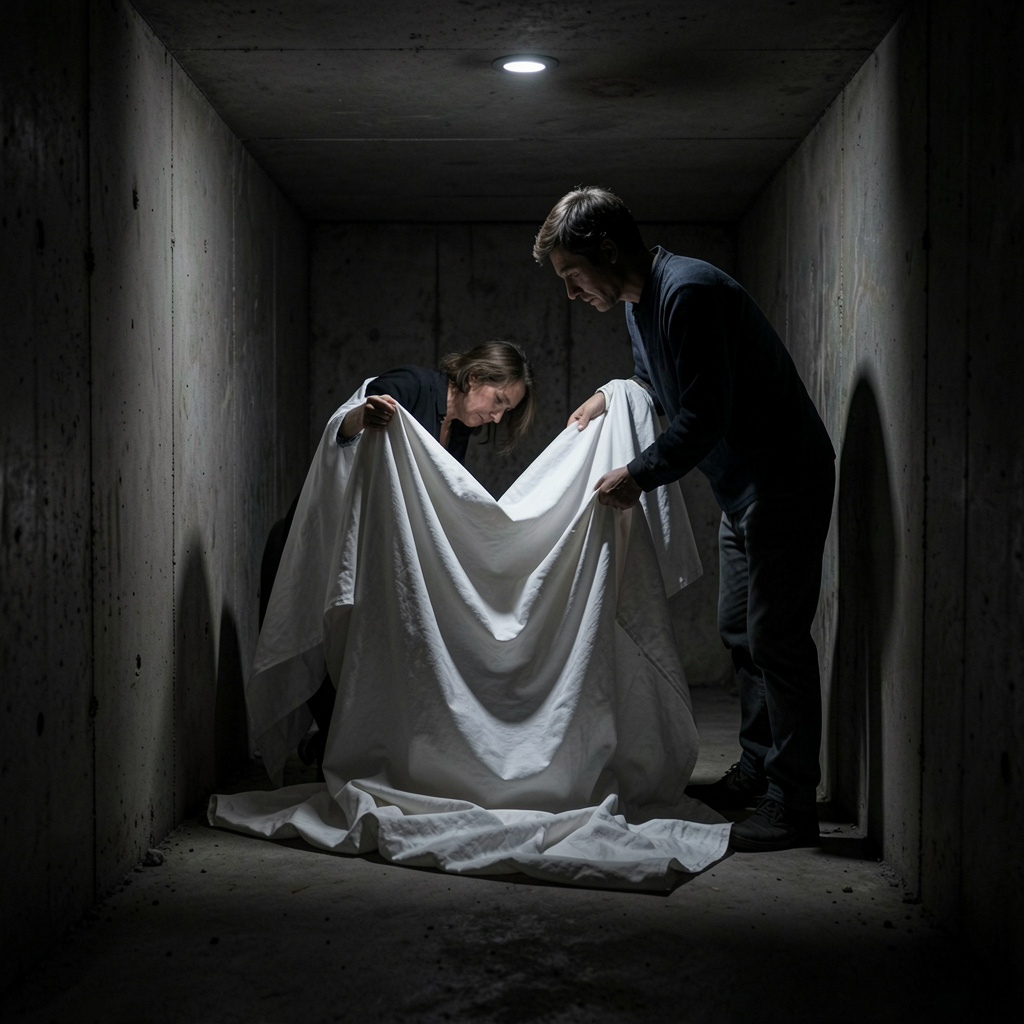
And one object in the center.
Something covered by a white sheet.
I stood there for a long time.
Then I stepped inside.
My hands trembled as I grabbed the edge of the sheet.
I pulled.
And froze.
It was a piano.
Not just any piano.
My mother’s piano.
I knew it instantly.
The little brass plate above the keys.
The scratches on the left side.
The tiny burn mark on the wooden top.
I had spent years sitting at that piano while my mother cooked dinner.
She taught me to play “Moon River” on it.
She used to sing while I practiced.
I hadn’t seen it since I was nineteen.
I touched the keys.
One made a soft, broken note.
I began to cry.
Not because of Dale.
Because suddenly my mother was there.
Her voice.
Her hands.
Her perfume.
The way she used to lean against the piano and watch me play.
I sat on the bench.
And then I noticed something.
The bench was locked.
There was a small brass keyhole underneath.
My hands went cold.
I searched the storage unit.
Nothing.
Then I remembered the envelope.
I turned it over.
There was a second key taped to the back.
I unlocked the bench.
Inside was a stack of envelopes.
Thirty-one of them.
One for every year since my mother died.
Each envelope had a date.
And on the first one, in Dale’s handwriting, were four words:
For Evelyn. When ready.
I stared at it.
My first instinct was anger.
Thirty years of silence.
Thirty years of nothing.
And now letters?
I opened the first.
“Evelyn,
I don’t expect you to forgive me.
I don’t even know if you’ll ever read this.
But your mother asked me to make sure this piano stayed yours.
I failed her in many ways.
I won’t fail her in this one.”
I stopped reading.
I couldn’t breathe.
I opened the second.
Then the third.
Then the fourth.
The letters continued through the years.
He wrote about my birthdays.
He wrote about my college graduation.
He wrote about the day he learned I had married Robert.
He wrote about Hannah’s birth.
He knew.
Somehow, he knew everything.
I read until sunset.
The truth came slowly.
And it was more complicated than I expected.
Dale hadn’t simply forgotten me.
He had been ashamed.
After my mother died, he’d discovered that she had left a separate trust for me.
Not a fortune.
But enough money to pay for college and help me start my life.
Dale had been responsible for administering it.
And he had been pressured by his own children.
Eric and Melissa had been furious that their mother was gone and that money was being set aside for me.
They wanted the house.
They wanted the investments.
They wanted everything.
And Dale had given them most of it.
But he had never touched my trust.
Not a dollar.
Instead, he’d moved it into an account in my name.
I found a bank statement in the bottom of the bench.
There was still money in it.
More than $184,000.
My mother’s money.
My money.
But there was more.
The letters revealed something else.
Dale had been sending anonymous checks to me.
For years.
Not huge amounts.
$500 here.
$1,000 there.
Tuition assistance.
A birthday gift.
A contribution toward my daughter’s college fund.
He had never signed his name.
I’d always assumed they came from Robert’s family.
They hadn’t.
They came from Dale.
I sat on the piano bench until the sun disappeared.
Then I found the final letter.
It was dated three weeks before his death.
“Evelyn,
If you’re reading this, I’m gone.
I wish I could tell you why I waited so long.
The truth is that I was a coward.
When your mother died, I convinced myself that pushing you away would make things easier for everyone.
It didn’t.
It made me a man who spent thirty years regretting one decision.
Eric and Melissa never knew about the piano.
They never knew about your trust.
They never knew about the letters.
They believe I left them everything.
I did.
But I kept one thing for you.
Not because you were my stepdaughter.
Because you were your mother’s daughter.
And because I finally understood what she meant when she told me, before she died, that loving her meant loving you too.
I couldn’t undo what I did.
So I preserved what I could.
The piano.
The letters.
The truth.
I hope someday you understand that my silence was never because you weren’t worth loving.
It was because I didn’t know how to face what I’d done.
I’m sorry.
Dale.”
I folded the letter.
For the first time in thirty years, I said his name aloud.
“Dale.”
It sounded strange.
Not like my stepfather.
Not like my enemy.
Just a tired old man’s name.
I took the piano home.
It took three movers and a crane to get it into my house.
When Hannah saw it, she stared.
“Mom?”
I nodded.
“It’s Grandma’s.”
She ran her fingers over the wood.
“You’ve never told me about this.”
“I wasn’t ready.”
I told her everything.
She listened without interrupting.
When I finished, she asked:
“Do you forgive him?”
I looked at the piano.
“I don’t know.”
“That’s okay.”
I smiled sadly.
“Yes.”
We opened the final box together.
There was another envelope inside.
Not for me.
For Eric and Melissa.
I hesitated.
Then I opened it.
It contained copies of the trust documents.
Bank records.
Proof of the anonymous payments.
And a final note.
“Your father made mistakes.
So did I.
Do not punish Evelyn for the consequences of my choices.
She was a child.
You were children too.
I hope one day you understand that love is not something you can divide like property.
There was enough for all of you.
I simply didn’t have the courage to say it when it mattered.”
A week later, Eric called.
His voice was angry.
“You got the piano.”
“Yes.”
“And the trust.”
“Yes.”
“He left you money?”
“It was Mom’s money.”
“You knew about this?”
“No.”
He went silent.
Then he said something I never expected.
“I didn’t know Dad felt that way.”
Neither did I.
Melissa called the next day.
She cried.
Not because she wanted the money.
Because she’d spent thirty years believing I had abandoned them.
She thought I hated them.
I told her the truth.
“I didn’t hate you. I was nineteen.”
She cried harder.
“I was ten,” she whispered.
“I know.”
“I thought you left because you didn’t love us.”
“I left because your father told me to.”
Silence.
Then she said:
“I’m sorry.”
I closed my eyes.
“Me too.”
We didn’t suddenly become a happy family.
Life isn’t a fairy tale.
Thirty years don’t disappear because someone says sorry.
But something changed.
The silence ended.
Months passed.
Then one Sunday, Eric and Melissa came to my house.
We stood awkwardly in the driveway.
Nobody knew what to say.
Finally, Melissa pointed toward the living room.
“Can we see it?”
“The piano?”
She nodded.
I opened the door.
They walked inside.
When Melissa saw the piano, she covered her mouth.
“I remember this.”
Eric looked at her.
“You do?”
“Mom used to play it.”
I smiled.
“She taught me.”
Melissa touched the keys.
Then, unexpectedly, she sat down.
She played three notes.
Wrong notes.
We laughed.
It was the first time all three of us had laughed together.
Then Eric noticed something on top of the piano.
A framed photograph.
My mother.
Young.
Smiling.
Standing beside the piano.
All three of us stared at her.
“She really loved you,” Melissa said.
I nodded.
“I know.”
Eric swallowed.
“She loved us too.”
“I know.”
And for the first time, none of us needed to compete over who had been loved more.
Because the answer was obvious.
She had loved all of us.
The adults had simply failed to make that love feel equal.
Before they left, Eric asked me something.
“Do you think Dad loved you?”
I looked toward the piano.
“I think he learned too late that love isn’t measured by what you leave someone.”
Eric nodded.
“What is it measured by?”
I thought about my mother.
Then I answered.
“What you refuse to take away from them.”
That night, Hannah and I sat at the piano.
I played “Moon River.”
The notes weren’t perfect.
My fingers were older.
My hands shook.
But halfway through the song, I heard my mother in my memory.
And I realized something.
Dale had spent thirty years trying to preserve a piece of my past.
But he had also given me something else.
Not an inheritance.
Not $184,000.
Not a piano.
He had given me the truth.
The truth that my mother had remembered me until the very end.
The truth that even the man who threw me out had carried regret for thirty years.
And the truth that sometimes people hurt us so deeply that forgiveness doesn’t mean forgetting.
It means refusing to let their worst decision become the final sentence of our story.
I finished the song.
Hannah wiped her eyes.
“Grandma would have loved hearing that.”
I smiled.
“I think she did.”
And for the first time in thirty years, the house didn’t feel haunted by what I’d lost.
It felt filled with what remained.
A piano.
A photograph.
A daughter beside me.
And somewhere in the quiet, the memory of a woman who had once placed my fingers gently on these keys and whispered:
“Again, sweetheart.
You almost have it.”
So I played it again.
And this time, I didn’t miss a note.