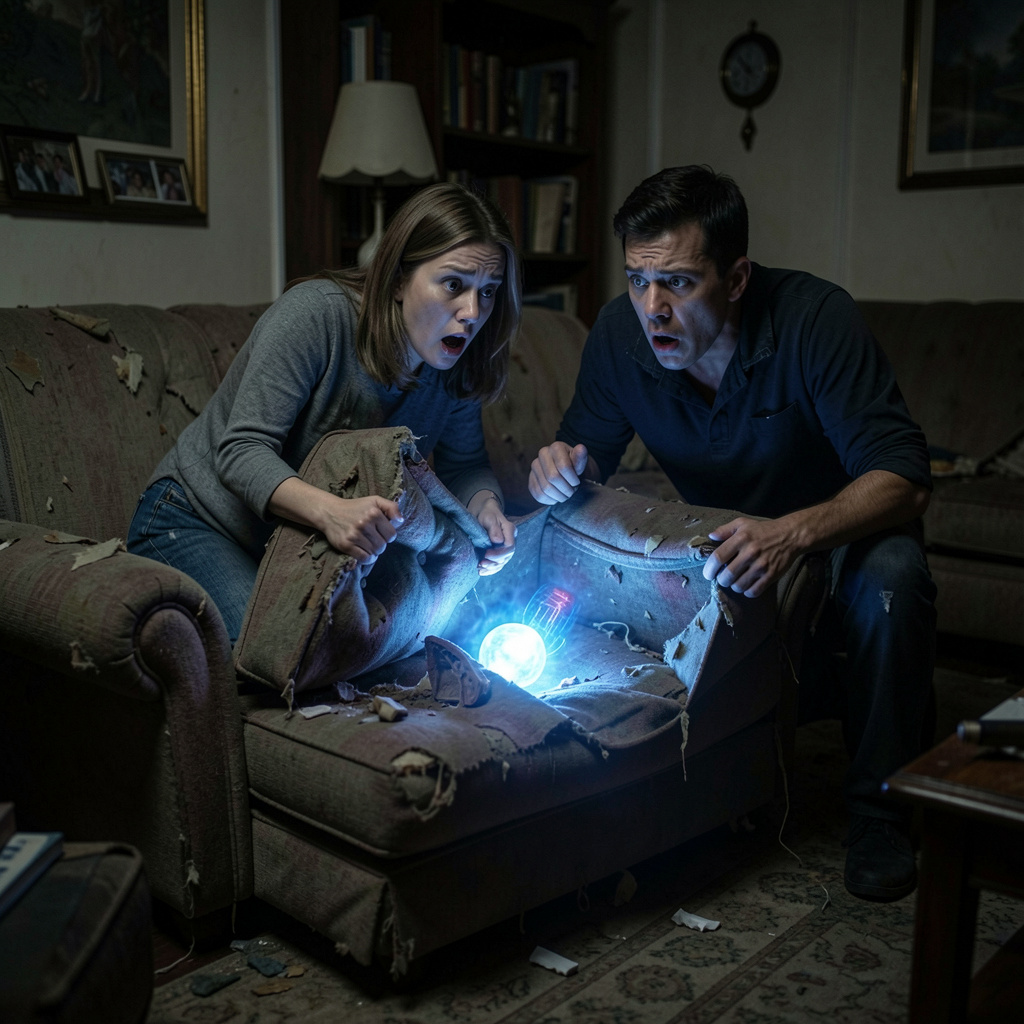
My wife and I found $10,000 in cash inside a used couch we bought for $75.It was one of those ugly, brown couches nobody wanted.
The fabric was faded in places. One arm had a cigarette burn.
The cushions didn’t match because someone had apparently replaced two of them years earlier.
The estate sale company had put a handwritten sign on it:COUCH — $75
We bought it because $75 was all we could afford.Our car had died three days earlier.Not “needs a repair” died.Dead.
The mechanic had looked under the hood, looked at us, and given us the kind of expression people reserve for funerals.
“Transmission’s gone,” he’d said.
The estimate was more than the car was worth.
So there we were, two parents with two kids, an overdue rent payment, a refrigerator that seemed to contain nothing except mustard and half a carton of milk, and a dead car sitting in our driveway.
The $75 couch was supposed to be a temporary solution.
Our old couch had finally collapsed in the middle, leaving anyone who sat on it leaning toward the floor like they were sliding down a hill.
We’d been looking at used furniture online when my wife, Sarah, found the estate sale.
“Come on,” she said.“Why?”“Because there’s a couch.”“You want to spend money on a couch when we don’t have money?”“It’s seventy-five dollars.”
“That is still seventy-five dollars.”She smiled sadly.“Exactly.”So we went.
The estate sale was at a large brick house on the edge of town. The place looked like someone had simply stopped living there one day.
There were dishes in the cabinets, framed photographs on the walls, books on the shelves.
And that couch.We tested it.It didn’t collapse.That was enough.
We paid the woman running the sale, borrowed her dolly, and somehow wrestled the couch into the back of our friend’s pickup truck.
When we got home, we discovered the first problem.
The couch wouldn’t fit through the front door.
After twenty minutes of swearing, sweating, and nearly divorcing each other, we finally got it inside through the back patio doors.
We pushed it against the living-room wall.
Sarah dropped onto it.
“See?” she said.
“Luxury.”
She laughed.
For the first time in days, I saw her genuinely smile.
Then I noticed something.
The left cushion was crooked.
I reached down to straighten it.
My fingers disappeared into a gap.
“There’s something stuck under here.”
I pulled out an envelope.
It was thick.
Very thick.
Brown paper.
No name.
No address.
I looked at Sarah.
She looked at me.
“Open it,” she whispered.
I did.
Money.
Hundred-dollar bills.
A stack of them.
I counted once.
Then again.
Ten thousand dollars.
We just stared at each other.
Neither of us spoke.
Ten thousand dollars.
It could have been the answer to every problem we’d been pretending wasn’t becoming a crisis.
The car.
The rent.
The kids’ school supplies.
The electricity bill.
The credit card we’d stopped opening because we were afraid of what we’d see.
Sarah sat down at the kitchen table.
I carried the envelope with me.
We put the money between us.
For a few minutes, neither of us touched it.
Finally I said, “This changes everything.”
Sarah looked at me.
“No.”
I frowned.
“What?”
“This doesn’t belong to us.”
I leaned back.
“Sarah.”
“I know.”
“We paid for the couch.”
“Not for the money.”
“We didn’t steal it.”
“No.”
“We found it.”
“Yes.”
“Then technically—”
“No.”
She didn’t raise her voice.
She didn’t need to.
Sarah had a way of saying one word that ended an argument before it started.
“We need to find the owner,” she said.
I looked at the money again.
I thought about our rent.
I thought about the mechanic.
I thought about our son, Noah, who had been asking for new sneakers because his toes were starting to poke through the old ones.
I thought about our daughter, Lily, who needed a list of school supplies that seemed to get longer every year.
Then I looked at my wife.
She was right.
I picked up the phone.
The estate sale company answered after two rings.
I explained what we’d found.
There was a long silence.
Then the woman said, “You’re sure it’s ten thousand?”
“Yes.”
“Okay. Give me a minute.”
She put me on hold.
When she came back, she gave me the name of the family that had owned the house.
The original owner had been an elderly woman named Eleanor Whitmore.
Her daughter, Margaret, had handled the estate.
I found a phone number.
My finger hovered over it.
Sarah touched my hand.
“Call.”
I did.
A woman answered.
“Hello?”
“Is this Margaret Whitmore?”
“Yes.”
“My name is Daniel Carter. My wife and I bought a couch from your mother’s estate sale today.”
There was a pause.
“Yes?”
“We found something inside it.”
Another pause.
Then I said:
“Ten thousand dollars in cash.”
The woman inhaled sharply.
And then she started crying.
Not politely.
Not quietly.
She sobbed.
“That was my mother’s.”
Sarah looked at me.
I put the phone on speaker.
“I figured it might be,” I said.
“She hid cash everywhere,” Margaret said through tears. “We looked for months. We thought we’d found everything.”
“I’m sorry.”
“No. No, don’t apologize.”
I glanced at Sarah.
“I’ll bring it back.”
Margaret was silent.
Then she said something that made my stomach tighten.
“Wait.”
“What?”
“How much did you find?”
“Ten thousand dollars.”
She stopped breathing for a moment.
Then she whispered:
“That’s not right.”
“What do you mean?”
“There should be one hundred thousand dollars.”
Sarah’s face changed.
Margaret continued.
“My mother had exactly one hundred thousand dollars in cash.”
I stared at the envelope.
“What?”
“She told me about it years ago. She said it was emergency money. She didn’t trust banks. We knew she had it somewhere in the house.”
“Maybe she spent some.”
“No.”
“How do you know?”
“Because I found her ledger.”
Her voice cracked.
“She wrote everything down.”
I looked around our living room.
Margaret said:
“There should be $100,000.”
I swallowed.
“Where?”
“I don’t know.”
“Then why are you saying it was in the couch?”
“Because she told me.”
“What exactly did she say?”
Margaret took a breath.
“She said, ‘When I’m gone, don’t let them find the blue room.’”
I glanced at Sarah.
“The blue room?”
“My mother’s bedroom. She painted it blue.”
“And the money was there?”
“I thought so.”
“Then how did $10,000 get into the couch?”
“I don’t know.”
Neither did we.
Margaret’s voice became quieter.
“Daniel, please.”
“Yes?”
“Keep looking.”
I promised I would.
We hung up.
Sarah and I stared at each other.
Then we stared at the couch.
We turned it upside down.
We removed every cushion.
We ripped open the bottom lining.
We pulled out staples.
We found old coins.
A child’s marble.
Two buttons.
A dried piece of candy that had apparently survived three presidential administrations.
But no more money.
Then Sarah noticed something.
“Wait.”
She pointed at the wooden frame.
There was a small metal plate underneath.
It wasn’t part of the couch.
It had been screwed into the frame.
I removed it.
Behind it was a narrow compartment.
Inside was a folded piece of paper.
I opened it.
It wasn’t money.
It was a photograph.
An old black-and-white photograph of Eleanor Whitmore standing beside a young man.
On the back someone had written:
Eleanor & Thomas — 1972.
Sarah looked at me.
“Who is Thomas?”
I called Margaret.
She answered immediately.
“Did you find something?”
“A photograph. Your mother and a man named Thomas.”
Silence.
Then:
“Oh.”
“You know him?”
“Yes.”
“Who was he?”
“My father.”
I looked at Sarah.
“Your father?”
“My mother married him when she was nineteen. He disappeared before I was born.”
“Disappeared?”
“He was presumed dead.”
“Presumed?”
“I don’t want to talk about this over the phone.”
We agreed to meet the next morning.
Margaret arrived at our house at nine.
She was in her late sixties, with silver hair and tired eyes.
The moment she saw the couch, she stopped.
“That was my mother’s.”
“Yes.”
She ran her hand over the armrest.
“She loved this thing.”
Then she saw the photograph.
Her face went pale.
“My father.”
She sat down.
For several minutes she didn’t speak.
Finally she said:
“My mother told me he abandoned her.”
Sarah asked gently, “But you don’t believe that?”
“I did.”
Margaret stared at the photograph.
“Until three years ago.”
She reached into her purse and pulled out a folded document.
“My mother wrote me a letter.”
She handed it to me.
I didn’t read it.
I looked at her.
“It’s okay,” she said.
The letter explained everything.
Thomas hadn’t abandoned Eleanor.
He had been involved with a construction company that had uncovered evidence of financial fraud.
He had discovered that the company’s owner was stealing money from employees’ retirement accounts.
Thomas planned to expose him.
But before he could, he disappeared.
Eleanor spent years believing he had been murdered.
She raised Margaret alone.
Then, decades later, a lawyer contacted Eleanor.
Thomas had left behind something.
A safety deposit box.
Inside was evidence.
And money.
A lot of money.
But Eleanor didn’t trust anyone.
So she withdrew the money and hid it herself.
“Why?” I asked.
Margaret smiled sadly.
“Because my mother was terrified.”
“Of what?”
“People coming for it.”
I looked at the couch.
“Did she put the money in here?”
Margaret nodded.
“She told me once that she had divided it into ten envelopes.”
“Ten?”
“Ten thousand dollars each.”
Sarah and I looked at each other.
“Then why did we only find one?”
Margaret stood.
“Because the others are still hidden.”
We spent the next four hours searching.
The couch was only the beginning.
We returned to the estate house with Margaret.
She had keys.
The house was empty now.
Dust covered everything.
The blue bedroom was at the end of the hallway.
Margaret opened the door.
The walls were pale blue.
There was an old bed.
A dresser.
A rocking chair.
And a large painting of a lighthouse.
Margaret stared at it.
“My mother loved that painting.”
I walked closer.
There was something strange about the frame.
I touched it.
It moved.
We pulled it from the wall.
Behind it was a small safe.
Margaret gasped.
“I never knew that was there.”
The safe was locked.
We called a locksmith.
Inside were three envelopes.
Each contained $10,000.
Thirty thousand dollars.
Margaret began crying again.
But then she looked disappointed.
“That means sixty thousand is still missing.”
We searched until evening.
Nothing.
Then Sarah noticed the rocking chair.
“Did your mother ever sit there?”
“All the time.”
“Could we take it apart?”
Margaret nodded.
We turned it over.
Underneath the seat was a handwritten message:
If you found this, you found the money. But not the truth.
Margaret froze.
“What does that mean?”
I removed the seat cushion.
Nothing.
Sarah examined the chair’s wooden arms.
“There’s a hollow space here.”
I drilled a tiny hole.
The wood was empty.
We removed the arm.
Inside was another envelope.
$10,000.
Then another.
And another.
We found three more.
That brought the total to $70,000.
Still missing $30,000.
By then it was dark.
Margaret sat on the floor.
“She told me there were ten.”
Sarah said, “Maybe the last three are somewhere else.”
I looked around the room.
Then I noticed the floorboards.
One board was newer than the others.
I knelt.
Pried it up.
Underneath was a metal box.
Inside were three envelopes.
$30,000.
Margaret covered her mouth.
We had found all of it.
One hundred thousand dollars.
But there was something else in the box.
A letter.
And a small key.
Margaret opened the letter.
She read it silently.
Then she handed it to me.
It was from Eleanor.
It said:
Margaret, if you’re reading this, then I am gone and someone finally found what I hid.
The money is yours. Every dollar. But the money was never the most important thing.
Thomas did not abandon us. He spent the rest of his life protecting us.
He died in 1981.
Margaret gasped.
“He died?”
I kept reading.
He had been living under another name because the men he exposed were still looking for him. He sent money to us through a lawyer for years. I never told you because I was afraid they would use you to find him.
The money is what he left me. The truth is what I leave you.
Margaret sat down.
She cried for a long time.
Not because of the money.
Because her entire childhood had been built around a lie.
Her father hadn’t abandoned her.
He had protected her.
We later learned that the evidence Thomas had left behind had eventually helped investigators uncover one of the largest financial fraud schemes in the region.
But the case had been buried for decades.
The money had survived.
So had the truth.
Margaret insisted on giving us a reward.
I refused.
She insisted again.
I refused again.
Finally she said, “Your wife returned something that could have changed your life.”
Sarah smiled.
“We’re okay.”
Margaret looked at us.
“You’re not okay.”
We laughed.
She wasn’t wrong.
Our car was still dead.
Our rent was still overdue.
Our kids still needed school supplies.
But something had changed.
We hadn’t become rich.
We hadn’t won the lottery.
We had simply been reminded of something.
There are moments when you discover exactly what kind of person you are.
And sometimes the hardest part isn’t doing the right thing.
It’s doing the right thing when doing the wrong thing would be so much easier.
Three weeks later, Margaret called us.
She had sold the house.
Before she closed the estate, she had one last thing to give us.
She handed Sarah an envelope.
Inside was $5,000.
“We can’t accept this,” Sarah said.
Margaret shook her head.
“This isn’t payment for the money.”
“Then what is it?”
“My mother’s way of saying thank you.”
Sarah looked at me.
I nodded.
We accepted it.
That $5,000 fixed our car.
We paid the rent.
We bought Noah new sneakers.
We bought Lily every school supply on her list.
And we put the rest toward the bills.
But that wasn’t the end.
Six months later, Margaret invited us to a small ceremony.
She had placed a plaque at a local historical building honoring Thomas Whitmore.
She asked me to speak.
I stood at the microphone beside Sarah.
Behind us was a photograph of Thomas and Eleanor from 1972.
I looked at the crowd.
Then I said:
“Six months ago, my wife and I bought a couch for $75.”
Everyone laughed.
“We thought we were buying furniture.”
I looked at Margaret.
“But we found something more valuable.”
The room became quiet.
“We found money, yes. But more importantly, we found a story that had been buried for nearly fifty years.”
I looked at the photograph.
“And we learned that sometimes people leave things behind without knowing who will find them.”
I paused.
“Money can change your circumstances.”
I looked at Sarah.
“But the truth can change your entire understanding of your life.”
Margaret wiped her eyes.
After the ceremony, she came to us.
She handed me a small box.
“What is this?”
“Something else my mother left.”
Inside was the original $75 receipt from the estate sale.
On the back Eleanor had written something in tiny handwriting.
Some things are only lost until the right people find them.
Sarah smiled.
I folded the receipt carefully.
We kept it.
The couch stayed with us too.
Even after we could afford a better one, Sarah refused to replace it.
“It has history,” she said.
I told her it was ugly.
She told me I was ugly.
We kept the couch.
Years later, when our children were grown, we still had it.
The fabric was more faded.
The cigarette burn was still there.
The left cushion still leaned slightly.
But whenever I looked at it, I remembered the night we sat at the kitchen table with $10,000 between us.
I remembered wanting to keep it.
I remembered my wife saying, “We need to find the owner.”
And I remembered how close I had come to convincing myself that finding something meant owning it.
It didn’t.
Sometimes finding something means being trusted with it.
Sometimes doing the right thing costs you.
And sometimes, strangely enough, doing the right thing brings something back to you that money never could.
A few years later, Margaret passed away peacefully.
She left us a letter.
In it she wrote:
Daniel and Sarah,
You once found my mother’s money. But what you really found was my father.
You gave me back a piece of my family that I thought I had lost forever.
I hope you understand what that means.
Thank you for choosing honesty when you desperately needed money.
There are people who would say you were foolish.
I don’t.
I think my mother knew exactly what she was doing when she hid that first envelope in the couch.
At the bottom she had written:
Maybe she was waiting for you.
Sarah cried when she read it.
I did too.
Because maybe she was right.
Maybe Eleanor had hidden the money because she was afraid.
Maybe she had forgotten where she put some of it.
Maybe the couch was simply an accident.
Or maybe, after all those years, two people who needed $10,000 but needed something else even more had been the ones who were supposed to find it.
We never knew.
But every time I sat on that old $75 couch, I remembered one simple lesson:
You can measure the value of a thing by its price.
But you can measure the value of a person by what they do when nobody is watching.
We needed that $10,000.
Desperately.
And walking away from it wasn’t easy.
But the day we returned it, we discovered something worth far more.
We discovered that sometimes the greatest treasure hidden inside an old piece of furniture isn’t money.
It’s a truth someone has been waiting decades to tell.
And sometimes, the people who find that truth become part of the family that lost it.