Understood
The rain in Portland that afternoon wasn’t the gentle kind.It came down sideways, driven by a sharp November wind that rattled the bare branches of the maple trees lining our street.
By four o’clock, the sky had turned the color of wet concrete, and the temperature had dropped enough that every breath looked like smoke.
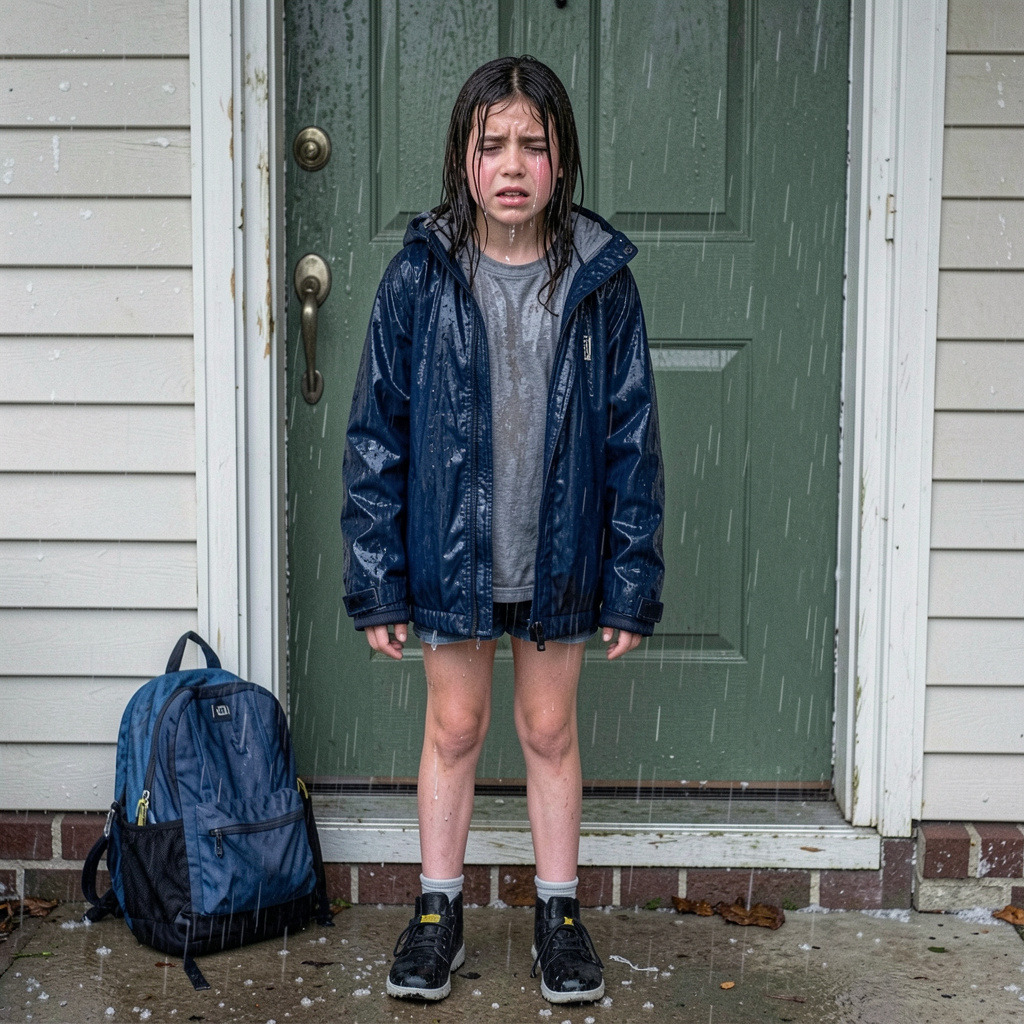
My eleven-year-old daughter, Lily, had spent the last twenty minutes walking home from school with her backpack pulled over her head.
She was used to rain.
Portland children learned early that rain wasn’t a reason to stay home. But that afternoon was different. Her fingers were numb inside her gloves, her sneakers squished with every step,
and the cuffs of her jeans were soaked nearly to her knees.
She was thinking about the hot chocolate I’d promised her when she got home.
She was also thinking about the science project sitting inside her backpack.A volcano made from cardboard, paper towels, and an unreasonable amount of red paint.
She turned onto our street and smiled when she saw the familiar porch.
Then she stopped.
Something looked wrong.
The porch light was off.That wasn’t unusual.What was unusual was the car in the driveway.My mother’s silver sedan was parked there.So was my sister Claire’s SUV.And my stepfather’s truck.
Lily frowned.Grandma hadn’t told her she was coming over.
She climbed the porch steps and pulled her key from her coat pocket.
She slid it into the lock.
It wouldn’t turn.
She tried again.
Nothing.
She pulled the key out and looked at it as if it had betrayed her.
Then she tried the handle.
Locked.
She knocked.
“Mom?”
Nothing.
She knocked harder.
“Grandma?”
Still nothing.
Finally, she heard footsteps.
The door opened.
My mother stood there wearing her beige cardigan and a perfectly dry expression.
She looked at Lily.
Then at the rain dripping from her daughter’s hair.
Then at the soaked backpack.
She didn’t step aside.
She simply said, “We’ve decided you won’t be living here anymore.”
Lily stared at her.
“What?”
My mother sighed.
“You need to go.”
“Where?”
“That’s not my problem.”
Lily’s face changed.
It wasn’t anger.
It was confusion.
The kind of confusion that belongs to children when adults suddenly break rules children thought were permanent.
“But this is my house.”
My mother shook her head.
“No. It’s not.”
Behind her, Claire appeared.
My sister crossed her arms.
My stepfather stood farther back in the hallway.
Neither of them said anything.
Lily looked past my mother.
“Can I call Mom?”
My mother’s expression hardened.
“She isn’t answering.”
“She always answers.”
“Apparently not today.”
Lily pulled out her phone.
The screen was nearly dead.
She called me.
My phone had been sitting in the bottom of my purse while I was inside a meeting across town.
I didn’t hear it.
She called again.
No answer.
She sent a message.
Mom, the key doesn’t work.
Then another.
Grandma says I can’t live here.
Then:
Please call me.
She waited.
For ten minutes.
Twenty.
Forty.
The rain continued.
Eventually, my mother closed the door.
Not slammed.
Closed.
Calmly.
As if she were ending a conversation.
Lily sat beneath the porch roof.
She hugged her backpack to her chest.
She stayed there for nearly three hours.
When I finally left work, I had no idea what was waiting for me.
I arrived home at 8:17 p.m.
The first thing I noticed was the new lock.
The second was Lily’s backpack.
It was lying against the wall inside the entryway.
Soaked.
I froze.
“Lily?”
She wasn’t there.
I called her name again.
Then my mother stepped out of the kitchen.
My sister was sitting at the table.
My stepfather was beside her.
My mother looked at me.
“You finally came.”
I looked at the lock.
Then at my daughter’s backpack.
“Where is Lily?”
My mother shrugged.
“She left.”
My stomach dropped.
“With whom?”
“No one.”
“What do you mean, no one?”
“She went to a hotel.”
I stared at her.
“She’s eleven.”
My sister interrupted.
“She’s with you now, isn’t she?”
I looked at Claire.
“What?”
My mother sighed.
“She called your friend Marissa. Marissa picked her up.”
I pulled out my phone.
There were seventeen missed calls.
Messages.
Voicemails.
My heart cracked when I listened to the first one.
Lily’s voice was small.
“Mom, please call me.”
The second was worse.
“Mom, I don’t know what I did.”
I closed my eyes.
I couldn’t breathe.
“Where is she?”
My mother gave me the hotel name.
I didn’t ask another question.
I walked toward the door.
My stepfather said, “You should really think about what you’re doing.”
I stopped.
Then I looked back.
“What exactly did you do?”
No one answered.
I left.
Marissa was waiting in the hotel lobby.
Lily was curled up on a chair beside her, wearing an oversized sweatshirt.
The moment she saw me, she ran.
I dropped to my knees.
She crashed into my arms.
“I’m sorry,” she whispered.
I held her tighter.
“You have nothing to be sorry for.”
“I didn’t do anything.”
“I know.”
“Grandma said—”
“I know.”
“They changed the lock.”
“I know.”
“I waited.”
Her voice broke.
“I waited so long.”
I closed my eyes.
“I’m sorry.”
“I called you.”
“I know.”
“I thought you didn’t want me anymore.”
That sentence nearly destroyed me.
I pulled back and held her face between my hands.
“Listen to me. There is nothing you could ever do that would make me stop wanting you.”
She nodded.
But she didn’t believe it yet.
That night, after Lily finally fell asleep beside me, I sat at the tiny hotel desk.
I opened my laptop.
I had spent years believing that if I worked hard enough, stayed reasonable enough, and avoided family conflict, things would eventually settle themselves.
I was wrong.
Because my mother hadn’t simply locked my daughter out.
She had made a decision.
And I was beginning to understand why.
Three months earlier, my mother had called me.
She said she was having trouble with the mortgage.
I knew my parents had owned the Portland house for nearly thirty years.
After my biological father died, my mother married Frank.
Frank was a decent man, but he had never been particularly good with money.
My mother had asked me for help.
So I helped.
For two years, I had quietly paid $2,100 every month toward the household expenses.
Mortgage.
Property taxes.
Insurance.
Utilities.
Repairs.
I never told anyone.
Not even Lily.
I didn’t do it because I expected gratitude.
I did it because it was my mother.
And because she had once helped me when I was young.
But things changed.
Claire moved back home.
Then Claire’s husband lost his job.
Then their two children started spending more time at my mother’s house.
Suddenly, the house wasn’t just my mother’s.
It became Claire’s future.
I began hearing comments.
“Claire needs stability.”
“The children need space.”
“You’re doing fine.”
“You can afford an apartment.”
Then, one month earlier, my mother asked me to stop paying the mortgage.
She said Claire had “a plan.”
I asked what plan.
She wouldn’t tell me.
I didn’t push.
That had always been my mistake.
I trusted silence.
That night in the hotel, I opened my bank records.
I pulled up every payment I’d made.
Then I opened the county property records.
I stared at the screen.
And finally understood.
The house wasn’t fully paid off.
But something else had happened.
A new deed had been filed.
Six weeks earlier.
The ownership had been changed.
My mother had transferred the property into a family trust.
The beneficiaries were my sister Claire’s children.
Lily wasn’t included.
Neither was I.
I leaned back in the hotel chair.
My hands were shaking.
Then I found something else.
A scanned document attached to the property record.
It was a notice from an attorney.
My mother had been attempting to claim that I was merely a tenant.
She wanted me out.
Not just from the house.
From the financial arrangement entirely.
But there was a problem.
I had paid the mortgage for two years.
And I had something my mother apparently didn’t know existed.
A written agreement.
Three years earlier, when my mother had been close to foreclosure, she had asked me for a loan.
I had given her $48,000.
In return, she signed an agreement acknowledging the debt and granting me a secured interest in the property.
I had never enforced it.
I never intended to.
Until that night.
I opened another folder.
There were bank statements.
Receipts.
Emails.
Texts.
Everything.
I wasn’t interested in revenge.
I wanted my daughter protected.
So I called an attorney.
His name was Daniel Mercer.
He answered on the second ring.
“What’s going on?”
I explained.
He was silent for several seconds.
Then he said, “Do you have the original agreement?”
“Yes.”
“Bring it tomorrow.”
“What do you think?”
“I think your family made a serious mistake.”
The next morning, Daniel confirmed what I had suspected.
The transfer of the house couldn’t simply erase the debt.
My mother had obligations.
And if she had deliberately transferred the property while attempting to avoid those obligations, the situation could become considerably worse for her.
But Daniel said something else.
“Don’t threaten them.”
“I’m not going to.”
“Don’t argue.”
“I’m not.”
“Don’t tell them what you have.”
I smiled bitterly.
“I wasn’t planning to.”
Three days later, a courier stepped onto my mother’s porch carrying a certified envelope.
I knew because I was watching from my car parked half a block away.
The courier rang the bell.
My mother opened the door.
She looked irritated.
Then confused.
Then pale.
She signed for the envelope.
Claire came into the doorway.
My mother opened it.
Her hands started trembling.
Inside was a formal notice.
It stated that the debt was being enforced.
The property interest was being asserted.
And the transfer of the property would be challenged.
But that wasn’t all.
There was a second page.
A request for accounting.
Every payment I had made.
Every dollar.
Every expense.
Every transfer.
Every document.
My mother had believed she was removing me from her house.
Instead, she had triggered a complete financial examination.
I drove away.
I didn’t feel victorious.
I felt tired.
That evening, my mother called.
I didn’t answer.
She called again.
Then Claire.
Then Frank.
Finally, a text appeared.
Please come home. We need to talk.
I stared at it.
Then I typed:
There is nothing to discuss until Lily is safe.
My mother replied:
She is safe.
I wrote:
She was left outside in freezing rain for hours.
No response.
Then another message.
We didn’t know you would react like this.
I almost laughed.
React?
I hadn’t screamed.
I hadn’t insulted anyone.
I had simply stopped protecting them from the consequences of their decisions.
The following week, my mother asked to meet.
I agreed.
We met at a coffee shop.
My mother looked older.
Claire looked angry.
Frank looked exhausted.
My mother placed a folder on the table.
“We made a mistake.”
I said nothing.
Claire leaned forward.
“We thought you were going to take the house.”
“I never said that.”
“You were paying the mortgage.”
“Because you asked me to.”
“You could have told us.”
“I did.”
She looked confused.
I reminded her of the emails.
The payment records.
The conversations.
Claire looked at my mother.
My mother stared at the table.
Then I asked the question that had been sitting inside me since that rainy afternoon.
“Why did you lock Lily out?”
My mother finally looked up.
“Because we thought if you lost the house, you’d stop controlling everything.”
I frowned.
“I wasn’t controlling anything.”
“You were always making decisions.”
“I was paying bills.”
“You were making us dependent on you.”
I stared at her.
Then quietly said, “You asked me to.”
Silence.
My mother wiped her eyes.
“We wanted Claire to have the house.”
“There it is.”
My sister looked away.
I nodded.
“I understand now.”
My mother whispered, “I’m sorry.”
I believed she was sorry.
But I didn’t believe she understood what she had done.
I stood.
“We’re done.”
Claire grabbed my wrist.
“Wait.”
I looked at her.
“I didn’t know Lily would be there.”
“You knew she lived there.”
“I thought someone would pick her up.”
“Who?”
She had no answer.
I gently removed her hand.
“You don’t get to make my daughter an afterthought.”
I walked away.
The legal battle lasted four months.
In the end, the house was sold.
The debt was settled.
My mother received what remained after the mortgage and obligations were paid.
Claire and her family moved into an apartment.
And Lily and I moved into a small house on the other side of Portland.
It wasn’t large.
The kitchen was tiny.
The backyard was mostly mud.
The living room had one crooked window.
But Lily had her own key.
I gave it to her on moving day.
She stared at it.
Then looked at me.
“Is this really mine?”
I smiled.
“It’s yours.”
She put the key around her neck on a little silver chain.
“I’ll never lose it.”
“I hope you do.”
She looked shocked.
I laughed.
“Because if you lose it, I’ll make you another one.”
She hugged me.
For the first time in months, she laughed.
Weeks later, my mother sent a letter.
Not a text.
Not an email.
A real letter.
She apologized.
She admitted she had favored Claire.
She admitted she had convinced herself that Lily would be better off without “all the tension.”
She wrote that she regretted the moment she closed the door.
I read the letter twice.
Then I put it away.
Forgiveness wasn’t the same as forgetting.
And reconciliation wasn’t something anyone was entitled to.
Especially not after hurting a child.
A year passed.
Lily turned twelve.
Her science project that had been ruined in the rain became a family joke.
She rebuilt the volcano.
It was bigger this time.
Much bigger.
She entered it into a school competition.
It won first place.
When she came home, she held the ribbon over her head.
“I did it!”
I hugged her.
“You did.”
She smiled.
Then she said, “Mom?”
“Yes?”
“Do you remember that day?”
I knew exactly which day she meant.
“Yes.”
“Are you still mad at Grandma?”
I thought for a moment.
“No.”
“Really?”
“I’m not mad.”
“Do you forgive her?”
I looked at my daughter.
“I think forgiveness is something you give when you’re ready.”
“Are you ready?”
I smiled.
“I think I’m getting there.”
She nodded thoughtfully.
Then she asked, “Can I see her?”
My heart tightened.
“Do you want to?”
“Maybe.”
So we arranged a meeting.
My mother came to our house.
She stood at the door holding a small wrapped box.
Lily opened it.
Inside was a silver keychain shaped like a house.
My mother began to cry.
“I’m sorry,” she said.
Lily looked at her for a long time.
Then she said something I had not expected.
“I forgive you.”
My mother covered her mouth.
“But,” Lily continued, “you can’t ever lock me out again.”
My mother nodded through her tears.
“Never.”
Lily handed her the keychain.
“Then you can keep this.”
My mother looked at it.
“What is it?”
“A reminder.”
She smiled.
And for the first time in years, something between us felt honest.
Not perfect.
Not repaired completely.
But honest.
That night, after my mother left, Lily stood at the front door.
She pulled out her own key.
She unlocked it.
Then locked it.
Then unlocked it again.
She looked at me.
“Mom?”
“Yeah?”
“I like our house better.”
I smiled.
“Me too.”
She closed the door.
The rain had started again outside.
Soft this time.
Almost gentle.
I stood beside my daughter and listened.
I remembered that terrible afternoon.
The soaked backpack.
The locked door.
The hours she spent waiting.
And the single word I had spoken when I saw that new lock.
“Understood.”
At the time, my family thought it meant I was giving up.
They thought I was defeated.
They thought they had finally pushed me out.
They were wrong.
“Understood” meant something else.
It meant I finally understood who my family was.
It meant I understood what I needed to protect.
It meant I understood that love did not require me to accept disrespect.
And most importantly, it meant I understood that sometimes the quietest answer can be the beginning of the loudest change.
Lily slipped her hand into mine.
“Mom?”
“Yes?”
“Can we make hot chocolate?”
I smiled.
“Absolutely.”
We walked into the kitchen.
Behind us, the door locked securely.
Not because we were afraid someone would throw us out.
But because, for the first time, the home behind that door truly belonged to us.
And no one was ever going to make my daughter stand outside in the rain again.