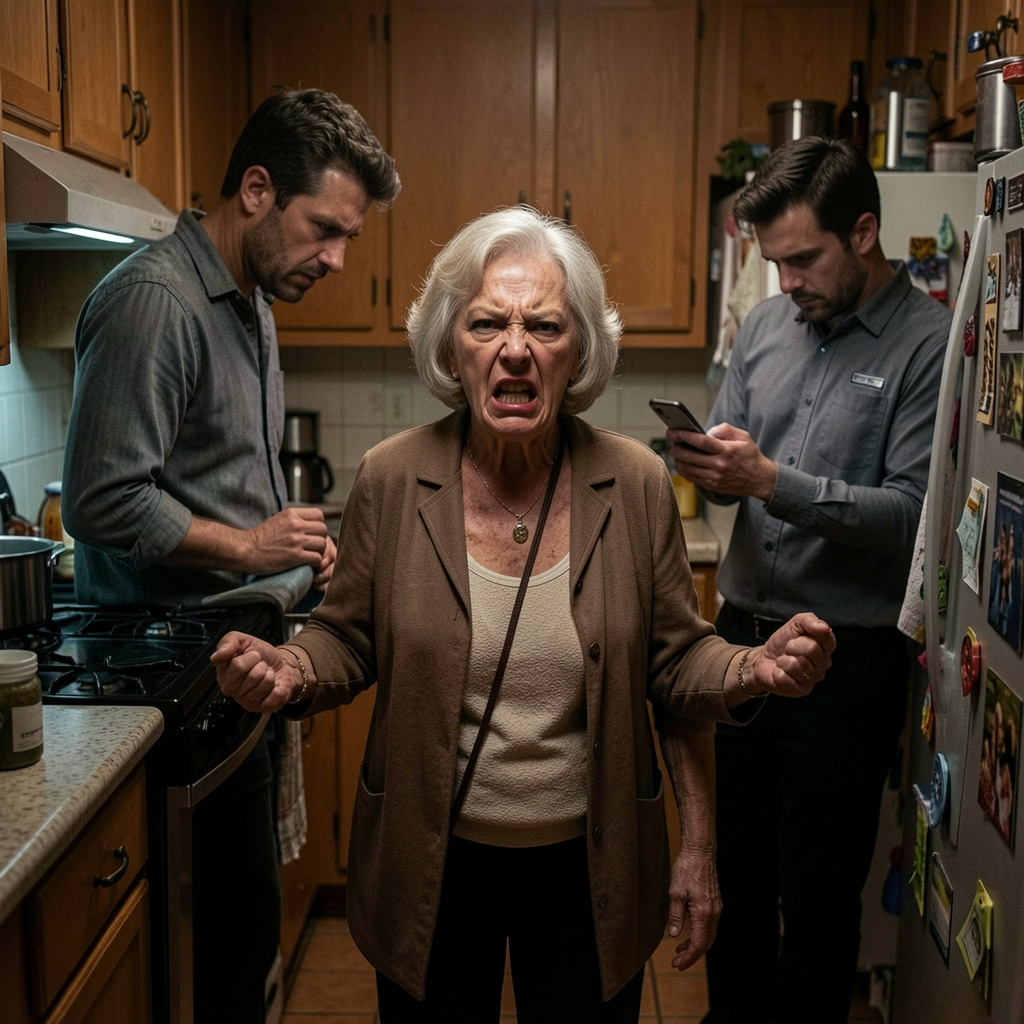
The first thing Diane did was wipe a nonexistent crumb from the kitchen counter.She stood in the center of my kitchen as though she owned it, one hand resting on the back of a dining chair, the other holding a folder against her chest.
Then she looked directly at me.“You have fourteen days to move out.”For a moment, I thought I had misunderstood her.
The refrigerator hummed behind me. A pot of coffee sat untouched on the counter.
Outside the window, rain tapped softly against the glass.
I glanced at my husband.“Daniel?”He stood beside the refrigerator, staring down at his phone.He didn’t look surprised.That was when something inside me went completely still.
Diane continued.“I’ve discussed everything with Daniel. This house is too small for what our family needs.
Emily and the children deserve stability. They deserve a real family home.”
I stared at her.“This is a real family home.”
She smiled without warmth.“Not anymore.”I looked around the kitchen.The cabinets had been installed eight years earlier, after the old ones began falling apart.
I had paid for them.The roof had been replaced after a storm.
I had paid for that too.The mortgage came out of my checking account every month.
So did the electricity.The water.The insurance.The property taxes.The groceries.The repairs.The children’s school supplies.The emergency plumber.The broken washing machine.
The new furnace.Everything.
For years, Daniel’s salary had been enough for him to contribute occasionally, but whenever something serious happened, I covered it.
I hadn’t complained.
That was my mistake.
I had believed that marriage meant building something together.
Apparently, Diane believed marriage meant deciding who got to keep the house.
“Fourteen days?” I repeated.
“Yes.”
“And where exactly am I supposed to go?”
Diane shrugged.
“I’m sure you’ll figure something out.”
Daniel finally put his phone in his pocket.
“Claire, let’s not make this ugly.”
I laughed once.
It wasn’t a happy sound.
“I’m not the one standing in someone’s kitchen giving them an eviction notice.”
Diane’s face hardened.
“You’ve always been controlling about money.”
I stared at her.
“Controlling?”
“You made Daniel feel dependent on you.”
I looked at my husband.
“Did I?”
He said nothing.
That silence hurt more than anything Diane could have said.
I had met Daniel twelve years earlier.
He was funny then.
Kind.
Ambitious.
He worked long hours and talked constantly about the future.
We married three years later.
When he lost his job during a company restructuring, I told him not to panic.
I covered the mortgage.
When he found another job that paid less, I adjusted our budget.
When Emily divorced her first husband and moved back home with her two children, I welcomed them.
When Diane began spending more time at our house, I welcomed her too.
I had thought I was helping my family.
Now I was being told that my family had apparently been living inside my wallet.
Diane opened the folder.
“There are some arrangements you need to understand.”
I held up my hand.
“No.”
She blinked.
“No?”
“No.”
I pointed toward the folder.
“I don’t want your arrangements. I want to know why my husband is standing there while his mother tells me to leave the house I’ve paid for.”
Daniel sighed.
“Claire, this isn’t what you think.”
“Then tell me what it is.”
He opened his mouth.
Nothing came out.
Diane stepped forward.
“Daniel has already agreed that Emily and the children will stay here permanently.”
I looked at him.
“Permanently?”
He nodded slowly.
“We thought it made sense.”
“We?”
His eyes dropped.
“I didn’t know how to tell you.”
That sentence finally broke something.
Not my heart.
Something else.
The last piece of trust I had been carrying for him.
I nodded.
“Okay.”
Diane frowned.
“Okay?”
“Yes.”
She seemed disappointed.
She had probably expected tears.
An argument.
Maybe me begging.
Instead, I picked up my coffee mug and poured the cold coffee down the sink.
Then I walked out of the kitchen.
Behind me, I heard Diane say, “See? She’s always dramatic.”
I didn’t answer.
I went upstairs.
I closed our bedroom door.
And for the first time in twelve years, I locked it.
I sat on the edge of the bed and stared at my hands.
They were shaking.
But I wasn’t crying.
I opened my laptop.
The first thing I did was log into our bank account.
The second thing I did was download every statement from the last seven years.
Then I downloaded the mortgage records.
Insurance payments.
Property taxes.
Utility bills.
Repair invoices.
Everything.
I created a folder.
I named it simply:
HOUSE.
By midnight, it contained 147 documents.
I sat there staring at the screen.
Then I noticed something strange.
There were several transfers from our joint account that I didn’t recognize.
They weren’t large.
$300.
$500.
$700.
One for $2,000.
I opened the details.
Every transfer had gone to an account ending in 8421.
I knew that account.
It belonged to Daniel.
The money had been transferred during months when he had told me he was struggling to cover his share of household expenses.
I kept scrolling.
There were more.
Dozens.
My stomach tightened.
I called the bank.
After answering security questions, I asked for copies of all transactions involving that account.
The representative told me it would take a few days.
“That’s fine,” I said.
Then I called the mortgage company.
I asked for the original loan documents.
The woman on the phone pulled up the account.
“Are you Claire Bennett?”
“Yes.”
“You’re listed as the primary borrower.”
My heartbeat slowed.
“And Daniel?”
“Co-borrower.”
I thanked her.
Then I asked one more question.
“Has there been any request to modify ownership?”
There was a pause.
“Yes.”
My entire body went cold.
“When?”
“Approximately three weeks ago.”
“Who requested it?”
She wouldn’t give me details over the phone.
But she told me there was an appointment scheduled with a title office.
Three days from now.
I sat perfectly still.
Suddenly, Diane’s folder made sense.
The fourteen days.
Emily.
The house.
The confidence.
This wasn’t an argument.
It was a plan.
And they were already executing it.
The next morning, I called an attorney.
Her name was Rebecca Shaw.
I had never met her before.
She listened without interrupting while I explained everything.
When I finished, she asked one question.
“Claire, whose name is on the deed?”
“Both of ours.”
“And who has made the mortgage payments?”
“Mostly me.”
“Do you have proof?”
“I have seven years of bank records.”
She paused.
“Good.”
Then she asked something that surprised me.
“Do you want to save your marriage?”
I looked out the window.
Daniel was downstairs laughing with Emily.
I heard my grandchildren running through the hallway.
Once, that sound had made me feel lucky.
Now it sounded like evidence.
“I don’t know,” I whispered.
Rebecca said gently, “That’s okay. You don’t have to decide today.”
She told me not to move out.
Not to sign anything.
Not to transfer money.
Not to confront Diane about the title appointment.
And most importantly, she told me to preserve every document.
So I did.
For the next three days, I became very quiet.
Diane interpreted my silence as surrender.
She started making plans openly.
Emily measured rooms.
The children argued over bedrooms.
Someone ordered new furniture.
One afternoon, I walked into the living room and found a real estate agent taking photographs.
I stared at him.
He looked embarrassed.
Diane didn’t.
“We’re documenting the property.”
“For what?”
“Future planning.”
I smiled.
“Of course.”
That evening, Daniel came upstairs.
He closed the door behind him.
“Claire.”
I kept folding laundry.
“What?”
“I know this is hard.”
I laughed softly.
“You don’t know anything.”
He sat down.
“My mother thinks Emily needs the house.”
“Your mother?”
“She’s been helping us.”
“With what?”
He hesitated.
“Planning.”
I looked at him.
“Planning what?”
He stared at the floor.
“I was going to tell you.”
“When?”
“After everything was finalized.”
I stopped folding.
“So you planned to transfer my interest in the house before telling me?”
“No. It wasn’t like that.”
“What was it like?”
He didn’t answer.
I walked toward the closet.
“Why did you send money to your personal account?”
His face changed.
“What?”
“I saw the transfers.”
He stood.
“Claire—”
“How much?”
He said nothing.
“How much did you take?”
“It’s not like I stole it.”
I stared at him.
“Then what is it?”
He rubbed his face.
“I was saving it.”
“For what?”
“For Emily.”
I nodded slowly.
“So while I was paying the mortgage, you were secretly moving our money into an account for your sister?”
“She needed help.”
“And I didn’t?”
“You have your career.”
That sentence landed like a slap.
I looked at him for a long time.
Then I said quietly, “Get out of the bedroom.”
“Claire—”
“Get out.”
He left.
I locked the door.
The following morning, Rebecca called.
“I reviewed the documents.”
“And?”
“You have a problem.”
My heart sank.
Then she continued.
“But so do they.”
She explained that the deed could not simply be changed without my consent.
The mortgage couldn’t be transferred without the lender’s approval.
And because I had documented years of financial contributions, their story about me being merely a spouse living in Daniel’s house was going to be difficult to sell.
But there was something else.
Rebecca had discovered that Daniel had recently signed a document stating that I had agreed to give up my interest in the property.
I stared at the screen.
“I never signed that.”
“I know.”
“Then whose signature is it?”
She sent me a copy.
I looked at the page.
The signature looked like mine.
Almost.
But not quite.
The handwriting was too careful.
Too deliberate.
I zoomed in.
There it was.
The letter C.
Mine always curved inward.
This one curved outward.
Rebecca said, “We need to act immediately.”
I didn’t feel angry.
I felt strangely calm.
That afternoon, I went to the title office.
I walked inside carrying a folder.
The receptionist looked at me.
“Can I help you?”
“I believe there is a property transfer scheduled involving my home.”
She checked the system.
Her face changed.
“Yes.”
“I am one of the owners.”
She called a manager.
Twenty minutes later, the appointment was canceled.
The manager apologized.
He explained that they had received paperwork claiming I had authorized the transfer.
I handed him the evidence.
He stared at the documents.
“This will need to be investigated.”
“Please do.”
I walked back to my car.
My phone rang.
Daniel.
I didn’t answer.
Then Diane.
I didn’t answer.
Then Emily.
I didn’t answer.
Finally, I received a message from Daniel.
What did you do?
I looked at it.
Then typed:
Protected what was mine.
His reply came immediately.
You are destroying this family.
I stared at the words.
Then I wrote:
No. You did.
I turned off my phone.
The next morning, Rebecca filed the necessary notices.
The title company began an investigation.
And then everything started unraveling.
The forged signature wasn’t the only problem.
The bank records showed that Daniel had transferred more than $28,000 from our joint finances over four years.
Some had gone to Emily.
Some had gone toward credit-card debt.
Some had simply disappeared.
But the most damaging discovery came from Diane herself.
She had emailed Daniel repeatedly about the house.
One message read:
Once Claire is out, Emily can refinance and you can finally stop living under her control.
Another said:
She won’t fight if we make her feel guilty enough.
I read the emails twice.
Then I closed my eyes.
The woman who had once called me “the daughter I never had” had been planning my removal from my own home.
Daniel had known.
And he had allowed it.
The confrontation happened on Sunday.
All of them were in the living room.
Diane.
Daniel.
Emily.
Even the children were nearby.
I walked in carrying my folder.
Diane looked annoyed.
“What now?”
I placed the folder on the coffee table.
“You should sit down.”
She laughed.
“You don’t get to give orders here.”
I looked at her.
“Actually, I do.”
Daniel stood.
“Claire, please.”
“No.”
I opened the folder.
“The title transfer is canceled.”
Diane froze.
“The mortgage remains exactly as it is.”
Emily’s face went pale.
“And the document claiming I gave up my ownership interest has been submitted for investigation.”
Nobody spoke.
Diane looked at Daniel.
Then at me.
“You’re bluffing.”
I placed the copy of the forged document on the table.
“No.”
Her mouth opened.
Then closed.
Daniel whispered, “Mom…”
I turned toward him.
“You knew.”
He shook his head.
“I didn’t know she forged anything.”
“But you knew about the transfer.”
“Yes.”
“You knew about the plan to force me out.”
He looked down.
“Yes.”
“And you let me believe I was still your wife.”
His eyes filled with tears.
“I was scared.”
I nodded.
“That doesn’t make it better.”
Emily suddenly started crying.
“Claire, I didn’t know about the signature.”
“I believe you.”
She looked surprised.
“But you did know they wanted me out.”
She wiped her eyes.
“I thought you were leaving anyway.”
“Why?”
“Because Mom told me you were planning to divorce Daniel.”
I looked at Diane.
She stared at the floor.
For the first time, I saw fear on her face.
The entire story had been built on lies.
Diane had told Emily I hated her.
She had told Daniel I was planning to leave.
She had told everyone the house was becoming a problem because I was “controlling.”
Meanwhile, they were quietly preparing to take it.
I took a breath.
“I spent twelve years trying to make this family comfortable.”
I looked around the room.
“I paid for birthdays nobody thanked me for. I paid medical bills. School fees. repairs. groceries. vacations. I drove people to appointments. I covered emergencies. I never kept score.”
My voice trembled.
“But you did.”
I looked at Diane.
“You kept score the entire time.”
She said nothing.
“I was useful when I paid the bills.”
Then I looked at Daniel.
“And disposable when I stopped being useful.”
He started crying.
“I love you.”
I believed him.
That was the saddest part.
I believed he loved me.
But love without loyalty wasn’t enough.
Love without honesty wasn’t enough.
Love that required me to disappear so everyone else could be comfortable wasn’t love I could live inside anymore.
“I don’t hate you,” I said.
Daniel looked up.
“But I’m done.”
The room went silent.
I had already spoken to Rebecca about the next steps.
I wasn’t moving out.
Daniel was.
For the first time since we bought the house, he packed a suitcase.
He stayed with a friend.
Emily found another apartment.
Diane refused to apologize.
She said she had only been trying to protect her daughter.
But protecting someone doesn’t require destroying someone else.
The investigation into the forged document continued.
Daniel eventually admitted he had known about it.
He hadn’t signed it.
But he had accepted it.
And that was enough to change everything.
Our divorce took almost a year.
There were arguments.
Lawyers.
Financial disclosures.
Documents.
A painful amount of truth.
I learned that Daniel had debts I knew nothing about.
I learned that Diane had convinced him I was eventually going to leave him because I “thought I was better than everyone.”
I learned Emily had believed her mother for years.
And I learned that the family I had spent twelve years protecting had never been nearly as secure as I thought.
Eventually, the house became mine through a settlement.
Daniel received his share of the equity.
I did not fight to destroy him.
I simply stopped protecting him from the consequences of his choices.
A year after Diane’s announcement, I stood in the same kitchen.
The same counters.
The same refrigerator.
But everything felt different.
The house was quiet.
Peaceful.
Mine.
I replaced the dining table.
I painted the walls.
I planted flowers along the back fence.
One Saturday morning, there was a knock at the door.
I opened it.
Emily stood there.
Alone.
She looked nervous.
“Can I come in?”
I stepped aside.
She entered slowly.
“I wanted to apologize.”
I nodded.
She sat at the kitchen table.
“I believed everything Mom told me.”
“I know.”
“I was wrong.”
“Yes.”
She looked at me.
“I don’t expect you to forgive me.”
I poured two cups of coffee.
“Good.”
She almost smiled.
We sat in silence.
After a while, she said, “The kids miss you.”
My chest tightened.
“I miss them too.”
“Can they visit?”
I looked at her.
“Yes.”
She nodded.
Then she started crying.
“I should have defended you.”
I reached across the table.
Not because everything was forgotten.
Not because the betrayal hadn’t happened.
But because sometimes forgiveness isn’t about reopening a door.
Sometimes it’s about deciding which doors deserve a smaller lock.
Three weeks later, the children came over.
They ran through the house laughing.
For the first time in months, the rooms sounded alive again.
I watched them from the kitchen doorway.
And I realized something.
Diane had been right about one thing.
A home wasn’t just walls.
It was supposed to be family.
But she had misunderstood what family meant.
Family wasn’t the person who demanded the biggest bedroom.
It wasn’t the person who paid the most.
It wasn’t the person whose name appeared on the deed.
Family was the person who stood beside you when nobody was watching.
The person who told you the truth even when the truth was uncomfortable.
The person who didn’t quietly plan your disappearance while calling it love.
That night, after Emily picked up the children, I sat alone at the kitchen table.
My phone buzzed.
A message from Daniel.
I hope someday you can forgive me.
I stared at it for a long time.
Then I typed:
I already have.
I paused.
Then added:
But forgiveness doesn’t mean I have to come back.
I sent it.
Then I placed my phone face down.
Outside, the rain had stopped.
The kitchen window reflected my face back at me.
I looked older than I had a year before.
But I also looked lighter.
For years, I had believed keeping a family together meant carrying everything.
The bills.
The responsibilities.
The secrets.
The disappointments.
The people.
I had confused sacrifice with love.
That night, for the first time, I understood the difference.
Love can ask you to give.
It should never require you to disappear.
And fourteen days after Diane told me I had to leave my home, I made a decision she never expected.
I didn’t leave.
I simply stopped living like a guest in the life I had built.
And once I stopped asking permission to belong there, nobody could make me feel homeless again.