I was the son who never left the gas station.That was how my brother liked to describe me whenever somebody asked what I did for a living.“Eddie stayed back home,” he’d say, smiling as if he were being generous.
My sister would usually add, “He works with Dad.”Not at the shop.
With Dad.
That little distinction mattered.
Because my brother, Daniel, had gone to law school in another state. He became an attorney, bought a house with columns out front, married a woman whose family owned half a dozen businesses, and eventually started introducing himself as a partner at his firm.
My sister, Rachel, married a real-estate developer.
She had a kitchen bigger than the entire apartment I rented above Dad’s garage for years.
And me?I stayed.I turned wrenches.
I changed oil, rebuilt transmissions, replaced brake lines, pulled engines, patched exhausts, and learned to identify a bad fuel pump by the sound it made three seconds after ignition.
My hands became permanently stained with grease.
The skin across my knuckles thickened.
My fingernails always had a black line beneath them no matter how hard I scrubbed.Dad used to joke that if I ever got married, my wife would have to take me to the altar in a bucket of degreaser.
I laughed every time.Because Dad was laughing too.But my brother and sister never really laughed with me.
They laughed at me.
“Here comes the grease monkey.”
That was Daniel.
“Don’t forget to put your mechanic clothes on before Thanksgiving,” Rachel once said. “Wouldn’t want anyone thinking we’re a family of laborers.”
She said it like a joke.
I smiled like it was one.
Dad always looked at me afterward.
Not angry.
Just quiet.
That quiet became something I remembered years later.
Something I finally understood.
Dad opened the gas station in 1978.
It started as a two-pump station with a tiny service bay and an office that smelled permanently of coffee and gasoline.
By the time I was born, he had expanded it into a full repair shop.
He could fix almost anything with an engine.
Cars.
Trucks.
Motorcycles.
Generators.
Once, he even repaired an old riding mower for a woman who couldn’t afford to replace it.
She offered him fifty dollars.
He charged her ten.
When I asked why, he shrugged.
“She’s got kids.”
That was Dad.
He wasn’t rich.
But he was proud.
And there was one thing he loved more than anything mechanical.
Cars.
Not new cars.
Old ones.
Cars with stories.
Cars that had survived decades because somebody cared enough to keep them alive.
The greatest mystery of my childhood was the car beneath the tarp.
It sat in the back bay, behind stacks of tires and cardboard boxes.
Dad never let me see it.
Whenever I asked, he’d wave me away.
“Not yet.”
“What is it?”
“Something old.”
“How old?”
“Older than you.”
“Is it yours?”
He’d smile.
“Maybe.”
When I was twelve, I tried sneaking a look.
Dad caught me lifting the tarp.
He didn’t yell.
He simply placed his hand on my shoulder.
“Leave it alone, Eddie.”
“Why?”
“Because some things aren’t ready to be seen.”
I thought he was talking about the car.
I didn’t know he was talking about everything.
The tarp stayed there for decades.
So did the car.
And so did the distance between me and my brother and sister.
Daniel came home for Christmas.
Rachel came home for Thanksgiving.
They stayed two nights.
I stayed thirty years.
When Dad’s heart began failing, I was the one who took him to the VA.
Three days a week, sometimes four.
I’d close the shop early.
Dad would complain.
“You’re losing money.”
“I’ll make it back.”
“You’re not a charity.”
“You’re my dad.”
He’d stare out the passenger window.
“That’s not a good business decision.”
“Good thing I’m not a businessman.”
He’d laugh.
Then he’d turn the radio up.
Some afternoons, after his appointments, we’d stop at the diner.
Dad always ordered the same thing.
Meatloaf.
Mashed potatoes.
Black coffee.
He’d eat half and push the plate toward me.
“You’re getting too skinny.”
“I weigh two hundred pounds.”
“That’s skinny.”
“You’re eighty.”
“Exactly. I’ve earned the right to be wrong.”
I miss those conversations more than I miss anything else.
Dad passed in the fall.
A cold October morning.
The trees around the gas station were turning orange.
I found him in his chair in the office.
His coffee was still warm.
The funeral was crowded.
People I’d never met told me stories about him.
A truck driver said Dad once fixed his brakes at two in the morning and refused payment.
An old woman said Dad had driven forty minutes to help her when her car broke down on a winter highway.
A Vietnam veteran said Dad had given him a job when nobody else would.
I stood there listening.
And for the first time, I realized my father had belonged to more people than just us.
After the funeral, the lawyer read the will.
The house went to Daniel and Rachel.
The savings were divided between them.
The shop property was sold and split.
I received the contents of my father’s apartment and the equipment he had personally purchased over the years.
Then the lawyer cleared his throat.
“There is one additional item.”
Daniel leaned back.
Rachel crossed her legs.
I looked up.
“To Edward,” the lawyer said, “your father leaves the vehicle located under the tarp in the rear service bay.”
Daniel actually laughed.
A short, sharp laugh.
“You’ve got to be kidding.”
The lawyer continued.
“A 1967 Shelby GT500.”
The room went silent.
I looked at him.
“The what?”
Daniel smiled.
“Dad’s rust bucket?”
Rachel laughed.
“I remember that thing.”
The lawyer nodded.
“Your father specifically identified it in the will.”
Daniel leaned toward me.
“Well, congratulations, Eddie.”
He grinned.
“You got yourself a hunk of rust.”
Then he added the words that stayed with me for the next year.
“At least you’ll feel right at home under it.”
I didn’t answer.
I took the keys.
The car stayed beneath the tarp.
For twelve months.
I couldn’t touch it.
Every time I walked into the back bay, I saw it.
The shape beneath the canvas.
The same shape I’d wondered about as a child.
Sometimes I’d stand there for ten minutes.
Sometimes twenty.
I couldn’t pull the cover off.
Because that car was Dad.
It was his hands.
His smell.
His voice.
It was every morning he’d said, “Hand me the twelve-millimeter.”
Every night he’d said, “Lock up before you go.”
It was the last thing in the world my father had deliberately left to me.
And I was terrified that when I finally looked underneath, I’d find exactly what Daniel had called it.
A rust bucket.
Maybe I was afraid of being disappointed.
Maybe I was afraid Dad hadn’t meant anything by it.
Or maybe I already knew he had.
One rainy Saturday morning, exactly a year after the funeral, I finally pulled the tarp.
Dust exploded into the air.
I coughed.
Then I froze.
The car wasn’t rusted.
It wasn’t even close.
The body was flawless.
The primer-gray shell I’d remembered from childhood was gone.
Underneath was deep midnight-blue paint that looked almost black until the light hit it.
Every panel was straight.
The chrome was polished.
The wheels were immaculate.
The interior was restored in black leather.
The dashboard gleamed.
I stepped backward.
“No.”
I walked around it.
There wasn’t a single dent.
No rust.
No cracked glass.
No missing trim.
The tires looked new.
The engine bay was spotless.
I opened the hood.
There it was.
A beautifully restored 428 Cobra Jet engine.
My hands began shaking.
Dad had never restored that car.
Not publicly.
He’d been restoring it quietly.
For years.
Maybe decades.
I ran my fingers along the fender.
Then I noticed something.
The driver’s seat didn’t sit quite right.
I crouched.
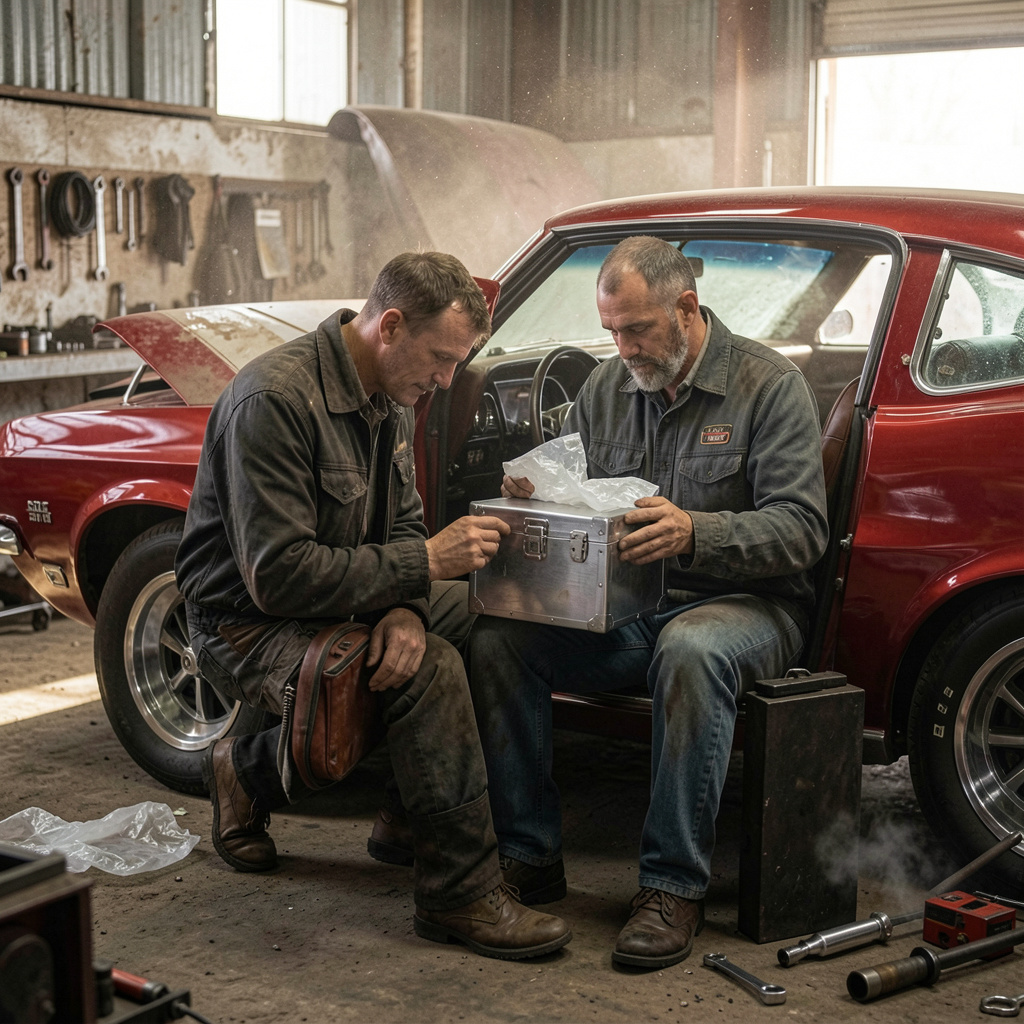
There was a small steel box bolted to the frame underneath it.
No Ford ever came with that.
I grabbed a wrench.
Twenty minutes later, I had the box loose.
It was heavy.
I carried it to the workbench.
The lid was secured with an old brass latch.
My hands trembled as I opened it.
Inside was an oil rag.
I unfolded it.
And underneath was a stack of photographs.
The first one showed me as a boy.
I was standing beside Dad at the gas station.
I had a wrench in one hand and a grin on my face.
On the back, Dad had written:
“Eddie, age seven. Already thinks he knows everything.”
I laughed.
Then I cried.
The next photograph showed me at fifteen.
Then seventeen.
Then twenty-one.
Then twenty-eight.
Then thirty-five.
Every photograph was of me.
At work.
At the shop.
Beside Dad.
Changing tires.
Rebuilding engines.
Eating lunch on the hood of a truck.
Sleeping in a chair after working late.
There were dozens of them.
Under the photographs was a handwritten letter.
My name was on the envelope.
“Eddie.”
I sat down.
The handwriting was unmistakable.
I opened it.
“My son,
If you’re reading this, then I’m gone.
And if you’re reading this, I know you probably waited a long time before opening the box.
You always were stubborn.”
I laughed through my tears.
Then I kept reading.
“I owe you an apology.
For years, I let you believe that your brother and sister were the successful ones.
I let them call you the grease monkey.
I let you believe that staying here meant you hadn’t gone anywhere.
That wasn’t true.
You didn’t stay because you were incapable of leaving.
You stayed because somebody had to carry this place forward.
And somebody had to carry me.”
I stopped.
My vision blurred.
I wiped my eyes.
The letter continued.
“I watched your brother leave for law school.
I watched your sister build a beautiful life.
I was proud of both of them.
But I was proud of you in a different way.
You gave me something neither of them ever could.
Time.
You gave me mornings.
You gave me afternoons.
You gave me rides to the hospital.
You gave me years.
And I know I never said thank you enough.”
I pressed the paper against my chest.
There was more.
“I didn’t want to give you the house.
I didn’t want to give you money.
Because I knew what would happen.
They’d call it inheritance.
You’d call it guilt.
And neither would understand what I actually wanted to leave you.”
I looked at the Shelby.
The final pages were folded behind the letter.
“The car was my dream when I was twenty-three.
I bought it wrecked.
I couldn’t afford to restore it then.
So I kept it.
Every year I fixed another piece.
Eventually I realized I wasn’t restoring the car for myself.
I was restoring it for the boy who stayed beside me when everyone else left.
Your mother used to ask me why I spent so much time on it.
I told her I was rebuilding an old car.
But that wasn’t the truth.
I was building something that would outlive me.
Something you could take with you when the shop was gone.
Something that would remind you that the work you did mattered.”
I stared at the engine.
My father had been building it for me.
All those years.
While I thought he had forgotten about it.
The final paragraph was short.
“There’s one more thing.
The car isn’t your inheritance.
The papers underneath this letter are.
Read them before you talk to your brother or sister.
And remember this:
You were never the son who stayed behind.
You were the son who stayed with me.”
Under the letter were documents.
Property records.
Bank statements.
A corporate agreement.
I didn’t understand all of it.
So I called the attorney who had handled Dad’s estate.
He came to the shop that afternoon.
He read everything.
Then he looked at me.
“Your father changed the structure of the business two years ago.”
“What does that mean?”
“He transferred ownership of the gas station property into a trust.”
“Whose trust?”
He smiled.
“Yours.”
I stared at him.
“My what?”
“Your father had been planning this for years.”
He explained that Dad had created a trust naming me as the sole beneficiary of the business property, the equipment, and the restored Shelby.
Daniel and Rachel had received the house and savings because Dad wanted them to have something immediately.
But the gas station?
That belonged to me.
All of it.
The attorney handed me another document.
The property was worth far more than I had imagined.
The shop sat on a major road that had developed dramatically over the previous decade.
A developer had already approached Dad.
The land was worth nearly three million dollars.
I sat down.
Three million.
The attorney wasn’t finished.
“Your father also left instructions regarding the shop.”
“What instructions?”
“He wanted you to decide what happens to it.”
I looked around.
The old lifts.
The tool cabinets.
The office.
The coffee machine.
The faded sign above the bay.
My father’s entire life.
“What would you do?” I asked.
The attorney smiled.
“I think your father knew you’d figure it out.”
That evening, Daniel called.
“Hey, little brother.”
I knew immediately.
He never called me little brother.
Not unless he wanted something.
“You’ve had the car for a while,” he said.
“Yeah.”
“Any chance it’s worth anything?”
I looked at the Shelby.
“Yes.”
“How much?”
“I don’t know.”
“Get it appraised.”
“Why?”
“Because if Dad left you something valuable, we should make sure everything was fair.”
I almost laughed.
“Everything was fair.”
There was silence.
Then Daniel said, “What does that mean?”
“Exactly what it means.”
He hung up.
Two days later, he showed up at the shop with Rachel.
They stood outside the garage.
Daniel wore an expensive suit.
Rachel carried a designer handbag.
Neither looked comfortable around the smell of oil.
Daniel glanced at the Shelby.
“That’s actually beautiful.”
“Yeah.”
“Dad restored this?”
“Yeah.”
He looked at me.
“Why didn’t he tell us?”
I shrugged.
“Maybe he didn’t want to.”
Rachel walked around the car.
“So this is what he left you?”
“No.”
She stopped.
“What?”
I looked at both of them.
“This isn’t what he left me.”
Daniel’s expression changed.
“What do you mean?”
I took the trust documents from the office.
“This.”
I handed them over.
He read the first page.
His face went pale.
Rachel grabbed it.
“What is this?”
“The shop.”
“What about it?”
“Dad put it in a trust.”
“For who?”
“Me.”
Daniel stared at me.
“No.”
I said nothing.
“No,” he repeated. “That can’t be right.”
“It is.”
Rachel looked at the property value.
Then at me.
“You’re worth millions?”
I shook my head.
“Not exactly.”
She looked confused.
“The property is worth millions.”
Daniel’s face hardened.
“So Dad gave you everything.”
“No.”
I looked at him.
“He gave you the house.”
“You got the business.”
“You got the savings.”
“He gave me responsibility.”
Daniel laughed bitterly.
“Responsibility?”
I nodded.
“That’s what he left me.”
Then I pointed at the shop.
“Not money.”
“This.”
For a long time, nobody spoke.
Finally Daniel said, “You know we could challenge this.”
“I know.”
“You’d spend years in court.”
“I know.”
“And we’d win.”
I looked at him.
“Would you?”
He didn’t answer.
Because Dad had made the documents airtight.
The attorney had explained that he’d spent years preparing everything.
Dad had even recorded a statement.
The attorney played it.
My father’s voice filled the office.
“I know my children may disagree with my decision.
That’s why I’m explaining it myself.
Daniel and Rachel have both built lives away from here.
I love them.
But this business was built with Eddie.
He knows it.
He understands it.
He earned it.
If they believe Eddie inherited a business, they’re wrong.
He inherited a responsibility he already spent thirty years carrying.”
Daniel looked away.
My father’s voice continued.
“Eddie never asked me for money.
He never asked me for recognition.
He only asked if I needed anything.
So I’m leaving him the one thing I know he will protect.
Not because he’s my favorite.
Because he is the right person to carry it forward.”
The recording ended.
Nobody spoke.
Rachel began crying.
Daniel stared at the floor.
I expected anger.
Instead, he whispered, “He never told me he was proud of me.”
I looked at him.
“He was.”
Daniel looked up.
“How do you know?”
“Because he told me.”
My brother’s face crumpled.
For the first time in my life, he looked less like the successful lawyer and more like the little boy who used to race me down the driveway.
“I thought he was disappointed in me,” he said.
“He wasn’t.”
“He never said anything.”
“Dad wasn’t good at saying things.”
I smiled sadly.
“He was better at doing them.”
Rachel wiped her eyes.
“What are you going to do with the shop?”
I looked around.
For the first time, I knew.
“I’ve decided.”
I opened the office drawer.
Inside was Dad’s old sign.
I had found it years ago behind a stack of boxes.
It read:
HARPER’S SERVICE STATION
I took it outside.
We hung it above the entrance.
Then I did something Dad would never have expected.
I renamed the shop.
Not after myself.
Not after Dad.
I called it:
Harper & Sons Garage.
Daniel laughed when he saw it.
“There are only daughters and sons here.”
I smiled.
“Then I guess it’s about time we became a family again.”
Rachel hugged me.
Daniel stood awkwardly for a moment.
Then he stepped forward.
He hugged me too.
It was the first time my brother had hugged me since we were children.
Months later, the Shelby was finished.
I drove it out of the garage on a bright spring morning.
The engine roared so loudly that people stopped on the road.
I drove to the VA.
I parked where Dad and I used to sit after his appointments.
I turned off the engine.
The silence felt enormous.
I put my hand on the steering wheel.
“Made it, Dad.”
The wind moved through the trees.
For a second, I imagined him sitting beside me.
“Not bad, kid.”
I laughed.
Then I cried.
I stayed there for a long time.
When I returned to the shop, Daniel was waiting.
He had rolled up his sleeves.
There was grease on his expensive shirt.
“What are you doing?” I asked.
He held up a wrench.
“Learning.”
“You don’t know anything about cars.”
“I know.”
I smiled.
“That’s never stopped you before.”
He laughed.
Rachel came through the office carrying three coffees.
“I brought lunch.”
I stared at them.
My brother with a wrench.
My sister with coffee.
For the first time in decades, all three of us were standing in Dad’s shop.
Together.
Not competing.
Not comparing.
Just standing there.
Daniel looked at the Shelby.
“Dad really built that for you.”
I nodded.
“He did.”
“He must’ve loved you a lot.”
I looked at him.
“He loved all of us.”
Daniel lowered his head.
“I know.”
I put my hand on his shoulder.
“But he trusted me with something.”
“What?”
I looked around the shop.
“The part of him that needed someone to stay.”
Years passed.
The gas station became a full-service restoration shop.
We kept the original pumps.
We kept Dad’s old office.
We even kept his coffee mug exactly where he had left it.
I never sold the property.
People offered.
A lot of people.
Millions.
I said no.
Because some things aren’t measured by money.
Every October, on the anniversary of Dad’s death, I took the Shelby out before sunrise.
I’d drive the old roads he used to take.
Sometimes Daniel came.
Sometimes Rachel.
Sometimes all three of us.
And every year, before I started the engine, I’d open the glove box.
Inside was Dad’s letter.
The photographs.
And one final thing I had almost missed.
A small folded note.
I found it months after opening the steel box.
It had only one sentence.
Written in Dad’s shaky handwriting.
“Eddie, if you ever wonder whether staying was worth it, look at what you helped me build.”
For years, I thought Dad had been talking about the garage.
Then I realized he wasn’t.
He was talking about me.
I wasn’t the grease monkey.
I wasn’t the son who failed to leave.
I wasn’t the one without a real career.
I was the son who stayed.
The son who drove him to the VA.
The son who opened the shop every morning.
The son who learned his father’s hands.
And when Dad’s heart finally stopped, I understood something I’d been too young to see.
My brother inherited money.
My sister inherited property.
But I inherited my father’s trust.
And in the end, that was worth more than everything else.
Because some fathers leave behind houses.
Some leave bank accounts.
Some leave expensive cars.
My father left me something much harder to inherit.
A life he believed was worth continuing.
And every morning, when I unlock the garage and smell gasoline, coffee, and cold metal, I can almost hear him behind me.
“Come on, Eddie.
We’re opening.”
So I turn on the lights.
I roll up the doors.
And I get to work.
Just like I always did.
Just like he taught me.
With my hands looking more and more like his.