What Grandma Kept in the Locked Room
I started noticing my four-year-old son becoming terrified whenever my mother-in-law came over to babysit.At first, I thought I was imagining it.Children went through phases.
My son, Ethan, had always been sensitive. He cried when characters in cartoons raised their voices.
He hated thunderstorms.
Once, when a cashier at the grocery store sneezed loudly beside us, he hid behind my legs for almost ten minutes.
So when he started acting strangely around his grandmother, I tried to explain it away.My mother-in-law, Linda, adored him.At least, that was what everyone believed.
She brought him little gifts every time she visited. She knew exactly how he liked his pancakes.
She remembered the names of all his stuffed animals.
She had even turned one of the spare bedrooms in her house into a playroom for him.
But over the previous month, something had changed.Whenever Linda came through our front door, Ethan became quiet.Not shy.Terrified.He would stop playing.
Stop talking.Sometimes, he would stare at her without blinking.
And whenever I told him, “Grandma is going to stay with you while Mommy works,” his face would immediately fall.
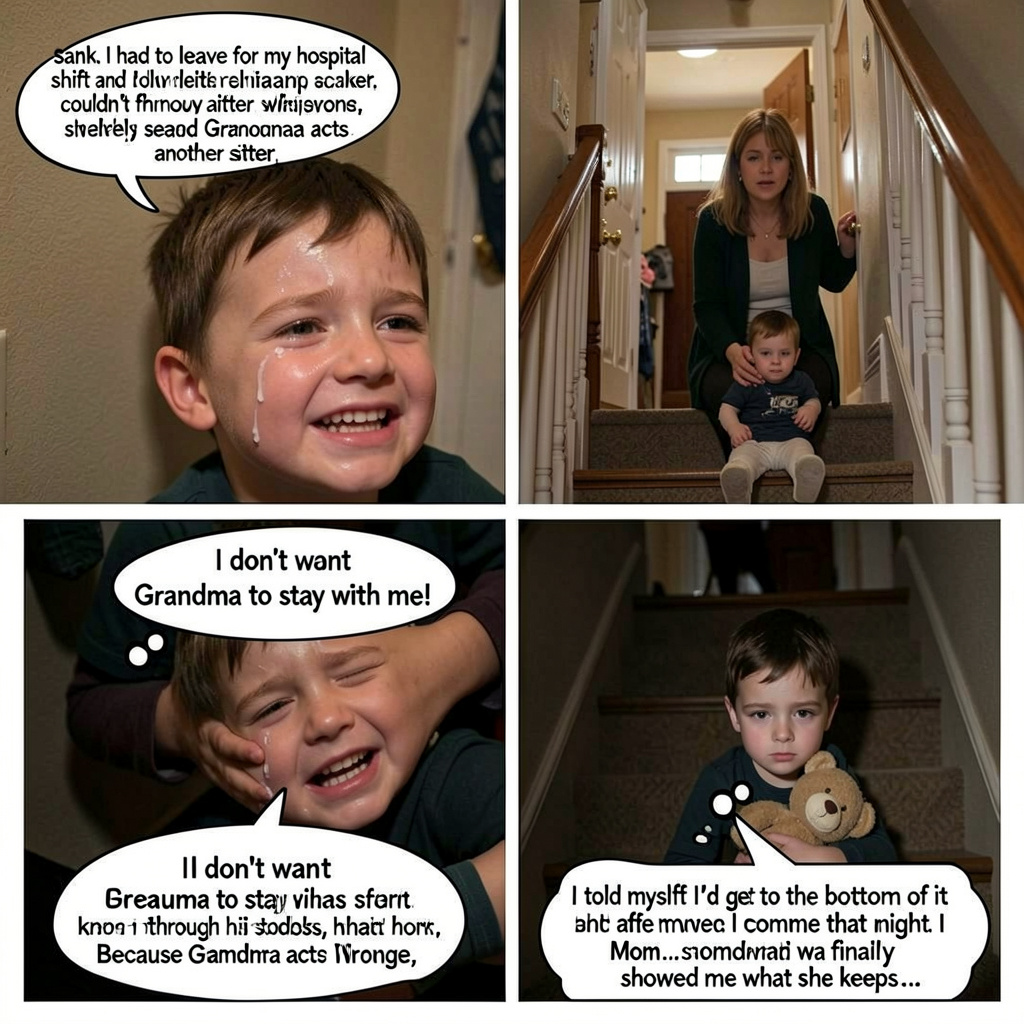
One evening, I was getting ready for my hospital shift when I heard him crying in the hallway.
I found him sitting on the floor, clutching his favorite teddy bear so tightly that his knuckles had turned white.
“Ethan?”
He looked up at me.
His cheeks were wet.
“Mommy, please don’t go.”
My heart tightened.
“I have to work, sweetheart. I’ll be back tonight.”
He shook his head violently.
“I don’t want Grandma to stay with me.”
I knelt in front of him.
“Why?”
He looked toward the front door.
Then toward the stairs.
Then back at me.
His voice dropped to a whisper.
“Because Grandma acts strange.”
I frowned.
“What do you mean?”
He opened his mouth.
But before he could answer, the doorbell rang.
Ethan froze.
Linda walked in carrying a grocery bag.
“Hello, my little man!”
Ethan immediately ran upstairs.
I stood there, stunned.
Linda laughed awkwardly.
“Well, someone is shy today.”
I forced a smile.
“He’s been a little emotional lately.”
“Kids are like that.”
She put the grocery bag on the kitchen counter.
Inside were cookies, fruit snacks, and a new toy truck.
Everything looked completely normal.
That somehow made it worse.
I kissed Ethan goodbye before leaving.
He wouldn’t come downstairs.
I heard him crying quietly behind his bedroom door.
“Mommy will be home soon,” I whispered.
He didn’t answer.
I went to work with a knot in my stomach.
I tried calling Linda during my break.
No answer.
I called again.
Still nothing.
At midnight, I finally drove home.
The house was dark except for the hallway light.
I opened the front door.
“Linda?”
No answer.
Then I heard something upstairs.
A faint creak.
I climbed the stairs.
Ethan was sitting at the top step.
He was still wearing the clothes he’d had on that morning.
His teddy bear was in his lap.
His eyes looked exhausted.
“Baby?”
He looked straight at me.
Then he whispered:
“Mom… Grandma finally showed me what she keeps.”
My stomach dropped.
“What does she keep?”
He looked toward the hallway.
“The room.”
“What room?”
He pointed toward the spare bedroom.
“Grandma’s secret room.”
I felt a chill run through me.
Linda had already left.
I checked the guest room.
Nothing seemed unusual.
The bed was made.
The curtains were closed.
The closet was empty except for some blankets.
“Ethan, what did Grandma show you?”
He climbed into my arms.
“A box.”
“What was in the box?”
He buried his face against my shoulder.
“Pictures.”
“What kind of pictures?”
He started crying again.
“I don’t know them.”
My heart began pounding.
“What people?”
He whispered something I could barely hear.
“Kids.”
I carried him into his bedroom.
I didn’t sleep that night.
The next morning, I called Linda.
She answered on the third ring.
“Good morning.”
“Linda, we need to talk.”
There was a pause.
“About Ethan?”
“Yes.”
“What happened?”
“He told me you showed him something.”
Her voice changed.
“What did he say?”
“That you showed him a box with pictures of children.”
Silence.
A long silence.
Then she laughed.
“He’s four. You know how children are.”
“Did you show him pictures?”
“No.”
“Linda.”
“I showed him some old family photographs.”
“Of children?”
“Of course. There are pictures of my nephews, your husband when he was little, family friends…”
“Why did he say they were strangers?”
Another pause.
Then she said, “Maybe he misunderstood.”
I didn’t like her answer.
But I had no proof of anything.
My husband, Daniel, was away for work that week.
When I told him what Ethan had said, he immediately defended his mother.
“Mom would never hurt him.”
“I didn’t say she hurt him.”
“But you’re acting like she did.”
“I’m telling you our four-year-old is afraid of her.”
“He’s four.”
“Daniel.”
He sighed.
“Mom practically raised me. She would never do anything to Ethan.”
I wanted to believe him.
More than anything.
Because the alternative was terrifying.
Still, I stopped letting Linda babysit.
She wasn’t happy.
Not remotely.
She called me that evening.
“I don’t appreciate being treated like a criminal.”
“I’m not treating you like a criminal.”
“You’re keeping my grandson away from me.”
“I just need some time.”
“Because of something a four-year-old said?”
I didn’t answer.
Her voice became cold.
“You’ll regret turning him against me.”
Then she hung up.
I stared at the phone.
That sentence bothered me more than anything else.
Two days later, I noticed something strange.
Ethan was drawing at the kitchen table.
He drew our house.
Then himself.
Then me.
Then a woman standing outside a black door.
“Who’s that?”
“Grandma.”
“And what’s behind the door?”
He shook his head.
“Don’t draw that.”
“Why?”
“She says I’m not supposed to tell.”
My blood ran cold.
“What does she say?”
He looked at me.
“She says secrets keep families safe.”
That night, Daniel came home.
I showed him the drawing.
His expression changed.
“Where did he get this?”
“I don’t know.”
He stared at the black door.
Then he said something I wasn’t expecting.
“My mom has a room like that.”
I looked at him.
“What?”
“At her house.”
“What kind of room?”
“I don’t know.”
“You’ve never been inside?”
He shook his head.
“It’s always locked.”
My hands became cold.
“Daniel, how long has it been locked?”
He thought for a moment.
“Since Dad died.”
That was eight years earlier.
I remembered Linda’s husband.
He had died suddenly from a heart attack.
Afterward, Linda became extremely private.
She rarely talked about his death.
But there had always been one strange thing about their house.
A room at the end of the upstairs hallway.
The door was always locked.
Daniel had told me once that his father used to keep paperwork there.
Nothing more.
But now I couldn’t stop thinking about it.
The next morning, I asked Daniel to come with me to his mother’s house.
Linda wasn’t home.
We had a key because Daniel occasionally checked on the property.
We entered.
Everything looked normal.
Too normal.
The house smelled like lavender.
Photographs lined the walls.
Ethan’s birthday pictures.
Daniel’s graduation.
Family Christmases.
Then we reached the upstairs hallway.
The locked door was there.
Daniel tried the handle.
Locked.
He looked at me.
“Mom never gave me a key.”
“Can we open it?”
He hesitated.
Then he noticed something.
A tiny camera.
Mounted above the door.
I stared at it.
“Is that a security camera?”
“I’ve never seen it before.”
We looked around.
There was another one facing the stairs.
And another pointed toward the living room.
Linda had cameras throughout the house.
But why?
We left without touching anything.
That evening, Daniel confronted his mother.
She became furious.
“How dare you question me?”
“What are the cameras for?”
“Security.”
“Why is the upstairs room locked?”
“My personal belongings are in there.”
“Why is there a camera outside it?”
Linda didn’t answer.
Then she said quietly:
“Because people steal things.”
“What things?”
“My things.”
Daniel stared at her.
“Mom, Ethan is afraid of you.”
Her expression hardened.
“That’s because his mother is poisoning him against me.”
I stepped forward.
“Nobody is poisoning anyone.”
Linda looked directly at me.
“Then why did he tell you about the room?”
I froze.
She knew.
She knew exactly what Ethan had seen.
“Because you showed him something.”
“I showed him nothing.”
“Then what was he talking about?”
She smiled.
It wasn’t a warm smile.
It was the first time I’d ever seen something unsettling in her face.
“Children remember what adults tell them to remember.”
Then she walked away.
That night, Daniel and I barely spoke.
I decided to take Ethan to a child psychologist.
Not because I wanted to accuse Linda.
I wanted to understand what was happening.
The psychologist told us not to pressure him for details.
“Let him speak naturally,” she said. “Don’t suggest answers.”
So we stopped asking direct questions.
We simply listened.
A week later, while Ethan was playing with toy cars, he suddenly said:
“Grandma has lots of names.”
I looked at him.
“What do you mean?”
“On the boxes.”
“What boxes?”
“The ones in the room.”
I stayed quiet.
He continued playing.
“She says some kids have to go away.”
My heart stopped.
“Did Grandma say that?”
He nodded.
“Where do they go?”
“To new families.”
Daniel looked at me.
We said nothing.
The psychologist later told us something important.
Children sometimes misinterpret adult conversations.
But repeated fear, especially involving a specific person and location, should never be dismissed.
She recommended we keep Ethan away from Linda until we understood the situation.
We did.
Then, three days later, Daniel received a phone call from his mother.
She had been admitted to the hospital.
Nothing life-threatening.
A severe panic attack.
Daniel wanted to visit her.
I stayed home with Ethan.
That evening, Daniel returned carrying an old cardboard box.
He put it on the table.
“I found this in Mom’s garage.”
I stared at it.
“What is it?”
He opened it.
Inside were dozens of photographs.
Children.
Different children.
Some were toddlers.
Some were older.
Every photograph had a date written on the back.
And a name.
None of the names meant anything to us.
There were also newspaper clippings.
Missing-child stories.
Old adoption notices.
Handwritten notes.
My hands started shaking.
“Daniel…”
He picked up one photograph.
“This girl disappeared in 1999.”
He picked up another.
“That boy disappeared in 2004.”
I looked at him.
“Why would your mother have these?”
“I don’t know.”
We called the police.
They took everything.
For the first time, I allowed myself to consider the possibility that our family had been standing beside a secret for years.
But the truth was stranger than anything I imagined.
The police searched Linda’s house.
They opened the locked room.
Inside, they found shelves.
Boxes.
Folders.
Photographs.
Thousands of them.
But they also found something else.
A wall covered in newspaper articles about missing children.
And beneath every article was a handwritten note.
Not by Linda.
By her husband.
Daniel’s father.
The police discovered records showing that he had secretly operated an illegal adoption network decades earlier.
He had been connected to people who arranged fraudulent adoptions.
Children were taken from unstable homes, undocumented families, and, in some cases, families that had simply been manipulated.
Linda had discovered it after her husband’s death.
But she hadn’t gone to the police.
Instead, she had spent years collecting evidence.
Tracking names.
Photographs.
Addresses.
Dates.
She had become obsessed with finding the children and proving what happened to them.
The locked room wasn’t a place where Linda kept children.
It was an archive.
A horrifying archive.
But that wasn’t the end.
One photograph stopped everyone in the room.
A little boy.
Four years old.
Brown hair.
A small scar above his eyebrow.
Daniel stared at it.
Then he whispered:
“That’s me.”
My heart stopped.
The photograph was dated thirty-two years earlier.
Daniel was four.
His father had taken the picture.
On the back was written:
“Daniel — transfer completed.”
Daniel couldn’t breathe.
“Transfer?”
The police investigator looked at him.
“We need to ask you some questions.”
But Daniel was staring at his mother.
At the hospital, Linda finally told us the truth.
She hadn’t been protecting herself.
She had been protecting evidence.
Her husband had been involved in illegal adoptions.
Daniel himself had been used as a cover.
His father had fabricated records around Daniel’s birth and had tried to conceal where he came from.
Linda discovered the truth only after her husband’s death.
She spent years trying to uncover everything.
But she had never known how to tell Daniel.
She feared that if she went public without enough evidence, the people involved would destroy the remaining records.
“So why did you show Ethan?” I asked.
Linda looked down.
“I didn’t mean to frighten him.”
“Then why?”
“Because he followed me.”
She explained that Ethan had wandered upstairs during one of their visits.
He had found the door partly open.
Linda was sorting photographs inside.
Ethan had seen the wall.
He had seen photographs of children.
He had seen the names.
And Linda, panicking, told him not to tell anyone.
She thought she was protecting him.
Instead, she terrified him.
But there was one detail she hadn’t told us.
Ethan had seen something else.
A photograph of a little girl.
Linda said she had spent twenty years looking for her.
The girl’s name was Sarah.
Sarah had disappeared from a hospital in 1998.
Her parents had been told she died.
But there was no death certificate.
No body.
No medical record.
Only one photograph.
And the photograph had been found among Daniel’s father’s papers.
The investigation widened.
Months passed.
Eventually, investigators traced the old adoption network.
Several people were arrested.
Some children were found alive.
Some families finally received answers.
And some mysteries remained unsolved.
But one discovery changed everything for Daniel.
His biological parents were alive.
They had spent decades believing their four-year-old son had died.
Daniel met them six months later.
I stayed nearby with Ethan.
When Daniel returned, he was crying.
Not the quiet kind of crying.
The kind that comes from years of grief you didn’t know you were carrying.
He held Ethan tightly.
Then he said:
“Mommy, Grandma wasn’t trying to hurt me.”
Ethan looked confused.
“Grandma scared me.”
“I know.”
“Why?”
Daniel hugged him.
“Because Grandma had a secret she didn’t know how to explain.”
Ethan thought about it.
Then he asked:
“Is Grandma bad?”
Daniel looked at me.
Then back at him.
“No.”
He paused.
“She made mistakes.”
That became our family lesson.
Secrets don’t protect children.
Silence doesn’t protect families.
And fear should never be dismissed simply because the person causing it seems loving.
Linda eventually apologized to Ethan.
She got down on her knees in front of him.
“I scared you,” she said.
Ethan nodded.
“You did.”
“I’m sorry.”
“Are you going to show me the scary pictures again?”
“No.”
“Promise?”
“I promise.”
Ethan considered her answer.
Then he held out his teddy bear.
“Want to see Teddy?”
Linda smiled through tears.
“Yes.”
For the first time in months, Ethan walked toward her voluntarily.
Not because anyone forced him.
Not because we told him he had to forgive her.
Because he finally understood that the strange behavior he’d seen wasn’t a secret threat waiting to hurt him.
It was the broken behavior of an adult carrying a terrible history.
But the most shocking part of the entire story came almost a year later.
I was cleaning the attic when I found an envelope tucked inside an old photo album.
It had my name on it.
Inside was a single photograph.
A little girl.
Standing outside a hospital.
On the back was written:
“Sarah. Age four. Last known photograph.”
I stared at it.
Then I noticed something.
The little girl was wearing a silver bracelet.
A tiny heart-shaped charm hung from it.
I had seen that bracelet before.
Not in the photograph.
In a picture Linda had shown us months earlier.
It was on the wrist of a woman standing beside Daniel’s biological parents.
A woman who had helped them search for their son.
A woman I had never met.
I called Daniel.
He came upstairs.
I showed him the photograph.
His face went pale.
“That’s Sarah.”
“What?”
“She’s alive.”
We contacted the investigator.
The woman in the photograph was identified.
She was living three states away.
Her name was different.
Her life was completely different.
But the bracelet was the same.
And after a DNA test, the truth was confirmed.
Sarah had been found.
After twenty-eight years.
Her biological parents finally learned what happened to their daughter.
And Linda’s locked room, the room that had terrified my four-year-old son, became evidence that helped reunite another family.
Still, I never forgot that night when Ethan sat at the top of the stairs clutching his teddy bear.
I never forgot his little voice.
“Mom… Grandma finally showed me what she keeps.”
At the time, I thought those words were the beginning of a nightmare.
In a way, they were.
But they were also the beginning of the truth.
And sometimes the most important warning a child can give isn’t something complicated.
It’s simply this:
“I’m scared.”
When a child says that, listen.
Don’t laugh.
Don’t dismiss it.
Don’t tell them they’re imagining things.
Listen.
Because children may not understand the secrets adults carry.
But they often notice the fear those secrets leave behind.
Years later, Ethan still remembered that night.
He was eight when he asked me about it.
“Mom?”
“Yes?”
“Was Grandma a bad person?”
I thought about my answer carefully.
“No.”
“Was Grandpa bad?”
I sighed.
“Some of the things he did were very bad.”
“Then why didn’t Grandma stop him?”
I looked at my son.
“Sometimes people are afraid. Sometimes they don’t know what to do. And sometimes they make the wrong choice because they’re trying to survive.”
Ethan nodded thoughtfully.
Then he asked:
“Did she fix it?”
“She tried.”
“Did she fix everything?”
“No.”
He was quiet.
Then he smiled.
“Nobody can fix everything.”
I smiled back.
“You’re right.”
He hugged me.
And as he ran downstairs, I looked toward the old family photographs on the wall.
There were smiling faces.
Birthdays.
Christmas mornings.
Graduations.
Weddings.
And somewhere among those photographs were people whose stories had been hidden for decades.
I finally understood something.
Families aren’t defined by the secrets they keep.
They’re defined by what they choose to do once the truth comes out.
Some people hide the truth because they’re ashamed.
Some hide it because they’re afraid.
Some hide it because they want to protect themselves.
But eventually, secrets have a way of finding the smallest crack.
Sometimes that crack is a locked door.
Sometimes it’s an old photograph.
And sometimes…
it’s a frightened four-year-old child sitting at the top of the stairs, clutching a teddy bear, waiting for his mother to come home.
That night, Ethan had not known what he’d uncovered.
Neither had I.
But his fear had opened a door that adults had kept locked for more than thirty years.
And behind that door wasn’t the monster I had imagined.
It was something more complicated.
A history of lies.
A family destroyed by silence.
And the evidence that finally gave lost children a chance to be found.
I still think about that first evening sometimes.
The doorbell ringing.
Linda walking inside.
Ethan running upstairs.
His tiny hands gripping my leg.
His trembling voice saying, “Grandma acts strange.”
If I had ignored him, the locked room might have stayed closed.
The photographs might have remained hidden.
The families might never have learned the truth.
And Sarah might have remained a missing child forever.
So whenever someone tells me, “He’s just a kid,” or “She’s just being dramatic,” I remember Ethan.
Children don’t always know how to explain what they see.
But that doesn’t mean they aren’t seeing something.
Sometimes they see the truth long before the adults are ready to open the door.