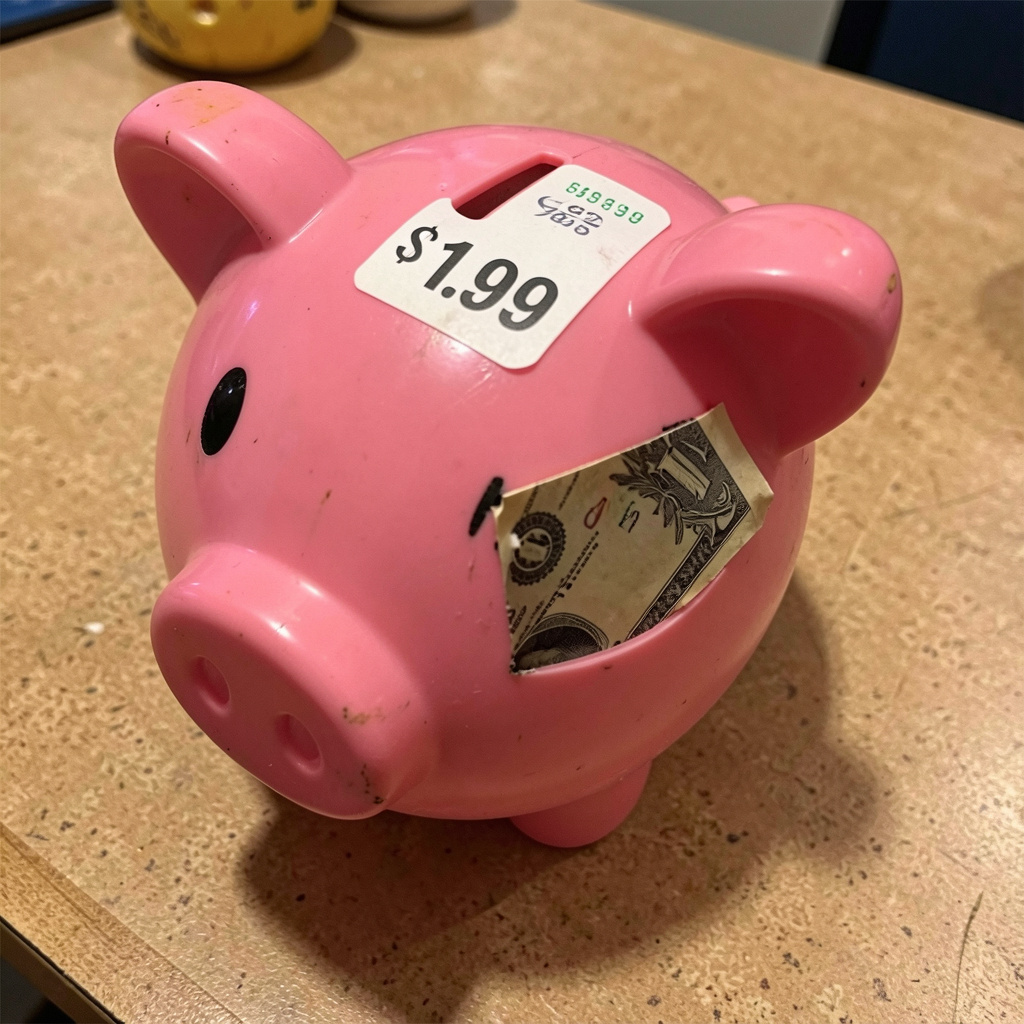
My sister got a $60,000 BMW for Christmas.I got a plastic piggy bank with a $1.99 price tag still stuck to the bottom.There were two dollars inside.For a few seconds, I just stared at it.
Not because I expected my parents to spend $60,000 on me. I hadn’t. I was thirty-four years old.
I had a career, a house, a retirement account, and a life I’d built without asking my parents for much of anything.
But I had spent months buying thoughtful gifts for everyone sitting around that Christmas tree.
I bought Mom the antique-style sewing machine she’d been talking about since summer.I bought Dad a new set of professional woodworking tools because his old ones were rusting.
For my sister, Emily, I had bought a designer watch she’d shown me three different times in three different stores.
For my brother, Daniel, I had paid for a new laptop because he was starting a business.
I hadn’t done it because I expected something equal in return.
I did it because that was what our family had always taught me.
Give.Help.Show up.Love people through your actions.Apparently, those rules had never applied to me.Dad stood beside the tree, smiling as he watched me open the piggy bank.
“Well,” he said, chuckling, “that’s the start of your future home fund.”Mom laughed.Emily laughed.Daniel laughed.
Even Uncle Ray, who barely understood what was happening, laughed because everyone else did.
I looked down at the piggy bank.
It was shaped like a pink pig with a crooked smile.The price sticker said:$1.99I turned it over.”Two dollars,” I said quietly.Dad grinned.”Every little bit helps.”Emily walked over, jingling the keys to her brand-new BMW.
“Come outside,” she said. “You have to see it in the driveway.”I followed her.
The BMW sat beneath a silver bow, sparkling under the Christmas lights.
“Mom and Dad said it was time I had something reliable,” Emily said proudly.
I looked at the car.
Then at the piggy bank in my hand.
“Congratulations,” I said.
She smiled.
“Thanks.”
Then she leaned closer.
“You know, you shouldn’t take it personally. They said they wanted to keep your gift practical.”
I looked at her.
“Practical?”
She shrugged.
“You’re already doing well.”
That sentence stayed with me.
You’re already doing well.
As if success meant I no longer deserved kindness.
As if being financially responsible had somehow made me less worthy of generosity.
I went back inside.
Nobody noticed when I put the piggy bank on the kitchen counter.
Nobody noticed when I stopped smiling.
And nobody noticed when I walked upstairs and began packing.
I had been thirty-four years old for exactly eleven days.
I was a senior structural engineer at a respected engineering firm.
I designed bridges, reviewed high-rise structures, and spent my days making sure buildings didn’t collapse.
People trusted me with things that weighed thousands of tons.
Yet my own family treated me like an inconvenience.
The favoritism hadn’t started with the BMW.
The BMW was simply the moment I could no longer pretend I hadn’t noticed.
When I was eight, Emily wanted a bicycle.
She got one.
I wanted one too.
Dad told me we couldn’t afford another.
So I saved birthday money for almost a year and bought a used bicycle myself.
When Emily was sixteen, Mom threw her a huge birthday party.
There were balloons, a rented hall, a DJ, and nearly a hundred guests.
For my sixteenth birthday, Mom bought me a grocery-store cake because “you’ve never cared much about parties.”
I had.
I just learned early that asking was useless.
When I graduated high school, I received a scholarship and worked weekends to cover everything else.
Emily went to college in another state.
My parents paid her tuition, rent, books, food, and even her spring-break trips.
When I asked Dad if he could help me with a used car, he told me:
“You’re the responsible one. You’ll figure it out.”
I did.
I always did.
When Emily got married, my parents paid for the wedding.
When Daniel got divorced, Dad paid his legal bills.
When Emily wanted to start a boutique, Mom gave her $35,000.
When Daniel needed help with his business, Dad gave him equipment.
And whenever I said anything, they had the same answer.
“You don’t need help.”
It was true.
I didn’t.
But needing nothing was never the same as needing nobody.
That Christmas night, I packed quietly.
Clothes.
Laptop.
Important documents.
My passport.
A few photographs.
The old watch my grandfather had left me.
I didn’t take much because I had my own house.
The house my parents had helped me buy?
No.
I’d bought it myself.
Every payment.
Every repair.
Every tax bill.
Every improvement.
My name was on the deed.
My name was on everything.
Before leaving, I walked downstairs.
The house was quiet.
Everyone was asleep.
I picked up my house key.
Then I placed it on the kitchen counter.
I didn’t know whether I was leaving forever.
I only knew I couldn’t stay another night pretending I was part of a family that had spent thirty-four years teaching me I wasn’t.
I drove away at 4:47 in the morning.
I didn’t cry.
Not until I reached a hotel two hours away.
Then I sat on the edge of the bed and finally let myself break.
Not because of the two dollars.
Because I suddenly understood that the two dollars weren’t an insult by themselves.
They were a symbol.
Thirty-four years of being told to understand.
Thirty-four years of being expected to give.
Thirty-four years of being praised for being “strong” whenever everyone else was allowed to be cared for.
I slept for three hours.
Then I made a decision.
I was done auditioning for my family’s love.
Three weeks passed.
I didn’t call.
They didn’t call either.
At first, I thought they were giving me space.
Then I realized something painful.
They probably hadn’t noticed I was gone.
I spent those weeks staying with a friend while looking for a temporary apartment closer to work.
Then, one Tuesday afternoon, my phone rang.
Dad.
I stared at the screen.
I almost ignored it.
But something made me answer.
“Hello?”
His voice was cold.
“Where is the Toyota?”
I frowned.
“My car?”
“Yes. Your car.”
“It’s at the apartment.”
There was a pause.
“You need to bring it back.”
I laughed.
Actually laughed.
“Bring it back where?”
“Home.”
“Why?”
“Because I bought that car.”
I sat down.
“No, Dad. You didn’t.”
“I absolutely did.”
“You contributed $8,000 toward the down payment five years ago.”
“Exactly.”
“That doesn’t make it yours.”
“You wouldn’t have been able to buy it without me.”
I closed my eyes.
That was the problem.
My parents had turned every act of assistance into ownership.
Every birthday gift became a debt.
Every favor became leverage.
Every dollar became a claim.
“Dad,” I said carefully, “my name is on the title.”
“I don’t care whose name is on the title.”
“That’s not how ownership works.”
His voice hardened.
“Return the car immediately, or I’ll report it stolen.”
For a moment, I couldn’t speak.
Then I laughed again.
Not because it was funny.
Because it was so absurd that anger couldn’t find anywhere to go.
“You want to report my car stolen?”
“Yes.”
“Go ahead.”
He went silent.
Then he said, “You think you’re smarter than us now?”
“No.”
“You’ve always been ungrateful.”
I felt something inside me finally go still.
“I’ve spent my entire life being grateful,” I said. “I’m just not willing to confuse gratitude with obedience anymore.”
Then I hung up.
That evening, I called an attorney.
I brought every document I had.
The purchase agreement.
The bank records.
The title.
The insurance policy.
The maintenance receipts.
Everything.
The attorney reviewed them carefully.
“Your father has no ownership interest in this vehicle.”
“I know.”
“You also have evidence showing that the $8,000 was a gift.”
I nodded.
“Can he actually report it stolen?”
“Anyone can make a report. But that doesn’t make it true.”
“What should I do?”
“Don’t argue with him. Keep everything documented. If the police contact you, provide the paperwork.”
I thanked him.
Then I went home.
Not to my parents’ house.
To mine.
The house I’d left three weeks earlier.
I had avoided it because I was afraid of the memories.
But when I unlocked the door, I realized something.
It was quiet.
Peaceful.
Mine.
I walked into the kitchen.
The Christmas tree was still there.
The lights were unplugged.
On the counter sat the pink piggy bank.
I picked it up.
I turned it over.
The $1.99 sticker was still there.
I smiled sadly.
Then I did something I should have done years earlier.
I opened the piggy bank.
I took out the two dollars.
I put them in my wallet.
I kept the piggy bank.
Not as a reminder of humiliation.
As a reminder of where I finally stopped.
The next morning, Dad called again.
I didn’t answer.
Then Mom called.
Then Emily.
Then Daniel.
My phone wouldn’t stop vibrating.
Finally, Emily texted:
Dad says you stole the Toyota. What’s wrong with you?
I replied:
It’s my car.
She answered immediately.
Dad paid for it.
I sent her a picture of the title.
No response.
Five minutes later:
That doesn’t matter. Family doesn’t treat each other this way.
I stared at those words.
Family.
That word had been used against me for years.
Family meant forgiving everything.
Family meant giving money.
Family meant accepting insults.
Family meant staying silent.
Family meant allowing people to hurt you because they shared your blood.
I typed:
You’re right. Family shouldn’t treat each other this way.
Then I stopped responding.
Two days later, two police officers came to my house.
My heart pounded when I saw them.
One officer asked whether I owned a Toyota.
I said yes.
He explained that a theft report had been filed.
I calmly handed him the title.
He studied it.
Then the registration.
Then the insurance.
Then the purchase agreement.
Finally, he looked at me.
“Your father contributed to the purchase?”
“Yes.”
“Was it a loan?”
“No.”
“Do you have records?”
I handed him the bank statement.
He looked at it.
Then he sighed.
“This is pretty clear.”
I nodded.
“Am I under arrest?”
He almost smiled.
“No.”
Then he looked uncomfortable.
“Your father shouldn’t have filed this.”
I said nothing.
Before leaving, the officer said something I’ll never forget.
“Whatever is happening in your family, you should probably keep all your records.”
“I will.”
After they left, I sat on the porch.
For the first time, I felt something other than anger.
I felt free.
The confrontation came a week later.
My parents showed up at my house.
Emily and Daniel came with them.
Dad stood at the front door.
“You’re really going to do this?”
I looked at him.
“Do what?”
“Cut us off.”
“I didn’t cut you off.”
“You stopped answering.”
“Because every conversation became an accusation.”
Mom stepped forward.
“We’re your parents.”
“I know.”
“After everything we’ve done for you.”
I almost smiled.
“That’s exactly the problem.”
Dad’s face reddened.
“You think we didn’t help you?”
“You did.”
“We gave you money for your car.”
“You gave me $8,000.”
“Exactly!”
“As a gift.”
“Because you were our daughter!”
“And now you’re using that gift to claim ownership of my car.”
He had no answer.
I looked at Emily.
“Do you know what I spent on your Christmas present?”
She looked uncomfortable.
“No.”
“Three thousand two hundred dollars.”
Her eyes widened.
Daniel looked at me.
“Seriously?”
I nodded.
“And Mom’s sewing machine was $1,700. Dad’s tools were $2,400. Your laptop was $1,900.”
Nobody spoke.
“I didn’t mention those numbers because I didn’t give those gifts expecting repayment.”
Dad looked away.
“That’s different.”
“Why?”
“Because you’re doing better financially.”
There it was again.
You’re doing better.
I took a breath.
“I earn more because I worked for it. I worked through college. I worked weekends. I paid my own bills. I built my career. I bought this house. I paid for this car.”
Emily crossed her arms.
“And?”
I looked at her.
“You got a $60,000 BMW.”
She frowned.
“What does that have to do with anything?”
“Everything.”
I walked into the kitchen and returned with the piggy bank.
I placed it on the table.
Mom stared at it.
Dad looked confused.
“This was my Christmas present.”
Emily’s expression changed.
I turned the pig upside down.
“It had a $1.99 price sticker on it.”
No one spoke.
“There were two dollars inside.”
Mom whispered, “We thought you’d laugh.”
“I did.”
Dad said, “It was a joke.”
“No.”
I looked directly at him.
“It wasn’t a joke. It was the clearest gift you ever gave me.”
He frowned.
“What does that mean?”
“It showed me exactly what you thought I was worth.”
Mom started crying.
“I never meant—”
“I know.”
My voice softened.
“I don’t think you woke up one morning and decided to hurt me. I think you got so used to treating me as the strong one that you stopped noticing when you were hurting me.”
That silenced everyone.
“I became the child who didn’t need anything. Emily became the child who needed everything. Daniel became the child who needed rescuing.”
I looked at my siblings.
“And somewhere along the way, nobody noticed that the child who needed nothing still wanted to feel loved.”
Emily’s eyes filled with tears.
“I love you,” Mom said.
“I believe you.”
Dad looked at me.
“Then come home.”
I shook my head.
“I am home.”
Three months later, something unexpected happened.
Emily sold the BMW.
Not because my parents demanded it.
Because she finally understood what had happened.
She came to my house one Sunday morning.
She carried the pink piggy bank.
“I thought you kept this.”
“I did.”
She placed it on the table.
“I want you to have it.”
“I already have one.”
She shook her head.
“No.”
Then she opened her purse.
Inside were two dollar bills.
She placed them beside the piggy bank.
“I know this doesn’t fix anything.”
“No.”
“But I want to start somewhere.”
I looked at her.
She sat down.
“I was spoiled.”
I didn’t answer.
“I knew Mom and Dad treated me differently.”
I raised an eyebrow.
She sighed.
“I knew.”
That hurt more than anything.
“I thought you didn’t care.”
“I cared.”
“Then why didn’t you say something?”
“Because I was afraid if I admitted it, I’d have to admit I benefited from it.”
She looked down.
“I was selfish.”
I didn’t tell her she wasn’t.
Because sometimes forgiveness begins with allowing someone to tell the truth.
“I sold the BMW,” she said.
I stared at her.
“Why?”
“Because I didn’t earn it. And because every time I looked at it, I remembered you holding that pig.”
I shook my head.
“You don’t have to punish yourself.”
“I’m not.”
She smiled faintly.
“I’m finally trying to grow up.”
A year passed.
My relationship with my parents changed slowly.
There were still difficult conversations.
There were still old wounds.
But for the first time, there were boundaries.
Dad never threatened me again.
Mom started asking instead of assuming.
Daniel got a second job instead of asking Dad for another bailout.
Emily started working full-time and eventually opened a smaller business using her own savings.
And me?
I kept working.
I became a principal engineer.
I bought another property.
I traveled.
I laughed more.
I stopped measuring my worth by how much I could give other people.
One Christmas, we all gathered again.
There was no $60,000 BMW.
No extravagant gifts.
No competition.
Mom gave everyone homemade cookies.
Dad gave me a small wooden box he’d built himself.
Emily gave me a framed photograph of the four of us as children.
Daniel gave me a coffee mug that said:
“The responsible one finally learned to say no.”
We laughed.
Then Dad stood up.
He looked nervous.
“I owe you an apology.”
The room became quiet.
“I spent years telling myself that you were strong, independent, and capable.”
He swallowed.
“But somewhere along the way, I used those words as an excuse not to take care of you.”
I looked down.
“I gave Emily things because she asked.”
He glanced at her.
“I helped Daniel because he complained.”
Then he looked at me.
“And I ignored you because you never complained.”
His voice broke.
“That wasn’t strength.”
I didn’t know what to say.
So I said the only thing that felt honest.
“I needed you too.”
Dad nodded.
“I know.”
For a moment, nobody spoke.
Then he reached into his pocket.
He pulled out a small envelope.
He handed it to me.
Inside was a two-dollar bill.
I looked at him.
He smiled sadly.
“I know it’s not much.”
I laughed through my tears.
“No.”
He nodded toward the piggy bank sitting on the shelf.
“But I wanted to give you something you could put in there.”
I stared at the bill.
Then I hugged him.
Not because everything was fixed.
It wasn’t.
But because sometimes healing doesn’t mean forgetting what happened.
It means finally seeing the people who hurt you acknowledge it.
Years later, I still have that piggy bank.
The $1.99 sticker has faded.
The plastic has a crack near one ear.
And inside are two dollars.
Not the original two.
Those are still in my wallet.
The piggy bank now holds a collection of coins and bills my family has added over the years.
Five dollars from Mom.
Ten from Dad.
A quarter from Daniel.
A twenty from Emily.
They call it the “future fund.”
But it’s not for a house anymore.
It’s for something more important.
Every Christmas, we each put something inside.
Not because anyone needs the money.
Because it’s our reminder.
A reminder that love isn’t measured by the price of a car.
It’s not measured by who gets the biggest gift.
It’s not measured by who needs the most help.
And it certainly isn’t measured by how much one person can tolerate before finally walking away.
Sometimes the smallest gift can expose the biggest truth.
For thirty-four years, I thought I was the forgotten daughter.
The reliable one.
The strong one.
The one who didn’t need anything.
But leaving that Christmas morning taught me something I should have learned much earlier.
Being independent doesn’t mean you don’t deserve to be cared for.
Being successful doesn’t mean you stop needing love.
And being family doesn’t give anyone permission to hurt you.
My parents thought two dollars were the beginning of my future home fund.
They were wrong.
Those two dollars bought me something worth far more.
They bought me the courage to finally build a future where I didn’t have to beg anyone to see my worth.
And when I drove away before dawn that Christmas morning, I thought I was leaving my family behind.
I wasn’t.
I was leaving behind the version of myself that had spent thirty-four years waiting for them to choose me.
For the first time in my life, I chose myself.
And that was worth more than any BMW ever could be.:::