The Knife Under Her Bed
My mother was sentenced to die for killing my father.For six years, I believed she had done it.That was the part I would carry for the rest of my life—not the courtroom, not the prison gates, not even the execution chamber.
It was the fact that my mother had looked at me through the glass of a visiting room and said, “I didn’t kill him, sweetheart.”
And I had looked away.
Six years later, with less than an hour left before her execution, my little brother finally whispered the words that would destroy everything we thought we knew.
“Mom… I know who hid the knife under your bed.”My mother’s head lifted.For the first time that morning, the tiredness disappeared from her face.“What did you say?”Matthew was only eleven when our father died.
He was seventeen when our mother was sentenced.I was seventeen when everything happened.
Six years later, I was twenty-three, and Matthew was seventeen.
We had grown up in the shadow of a murder neither of us understood.
Our father, Daniel Harper, had been found dead on the kitchen floor one rainy Thursday night.He had been stabbed once.The murder weapon—a long kitchen knife from our own knife block—wasn’t found beside his body.
It was found under my mother’s bed.There was blood on my mother’s robe.The police said it was our father’s blood.
There were no signs of forced entry.
No broken windows.
No stolen valuables.No witnesses.And my mother had been home.That was enough for everyone.Especially the jury.My mother had insisted she was innocent from the beginning.She said she’d been upstairs when she heard something crash.
She ran downstairs and found Dad lying on the kitchen floor.She remembered kneeling beside him.She remembered touching his shoulder.
She remembered screaming.
But she didn’t remember seeing the knife.
She said someone must have taken it from the kitchen and hidden it under her bed afterward.
Nobody believed her.
Not the detectives.
Not the prosecutor.
Not our neighbors.
Not our relatives.
And eventually…
not me.
The prosecution painted my mother as a jealous wife.
They told the jury Dad had been planning to leave her.
They said she’d discovered his supposed affair and confronted him.
Then she’d killed him in a fit of rage.
There was one problem.
My father wasn’t having an affair.
At least, not that we knew.
But the prosecutor didn’t need the truth.
He needed a story that made sense.
And my mother’s robe had blood on it.
The knife was under her bed.
She had no alibi.
The story practically wrote itself.
I remember sitting in the courtroom behind the prosecutor’s table.
My mother turned toward me when the verdict was read.
Guilty.
The word seemed to echo forever.
Then came the sentence.
Death.
My knees stopped working.
I fell into my aunt’s arms.
My little brother cried beside me.
My mother didn’t cry.
She simply stared at us.
When the guards took her away, she mouthed four words.
I love you. Believe me.
I didn’t.
That was my sin.
Six years passed.
Our lives became a collection of before and after.
Before Dad died.
After Dad died.
Before Mom went to prison.
After Mom went to prison.
Before the trial.
After the trial.
Every birthday became painful.
Every Christmas had an empty chair.
Every family photograph had someone missing.
Matthew stopped talking about our parents.
I became obsessed with trying to rebuild a life that had been shattered.
I went to college.
I worked two jobs.
I paid bills.
I visited Mom when I could.
But I never told her I believed her.
Because I didn’t.
Every time she said she was innocent, something inside me hardened.
“Mom,” I finally told her during one visit, “the evidence…”
She stared at me.
“What about it?”
“The knife was under your bed.”
“I know.”
“And your robe had Dad’s blood.”
“I know.”
“You were the only one in the house.”
She closed her eyes.
“I know all of that.”
“Then what am I supposed to believe?”
She looked at me for a long time.
“The truth.”
I hated that answer.
Because I wanted certainty.
I wanted my mother to give me something that would make the nightmare simple.
Instead, she gave me the truth as she knew it.
“I didn’t kill your father.”
I never answered her.
For six years, she wrote letters.
Dozens of them.
Some were long.
Some were only a page.
Sometimes she wrote about Matthew.
Sometimes she wrote about me.
Sometimes she wrote about Dad.
And sometimes she wrote about ordinary things.
The weather.
A book she’d read.
A bird she saw through the prison window.
She never wrote about dying.
Until the final year.
Then her letters changed.
If the day comes, don’t be afraid.
Take care of Matthew.
Don’t let him grow up believing the worst thing that happened to us was our mother’s death.
That sentence stayed with me.
I didn’t understand it then.
I do now.
Three weeks before her execution, my mother’s final appeal was denied.
The date was set.
August 18.
At 7:00 that morning, we were allowed our last visit.
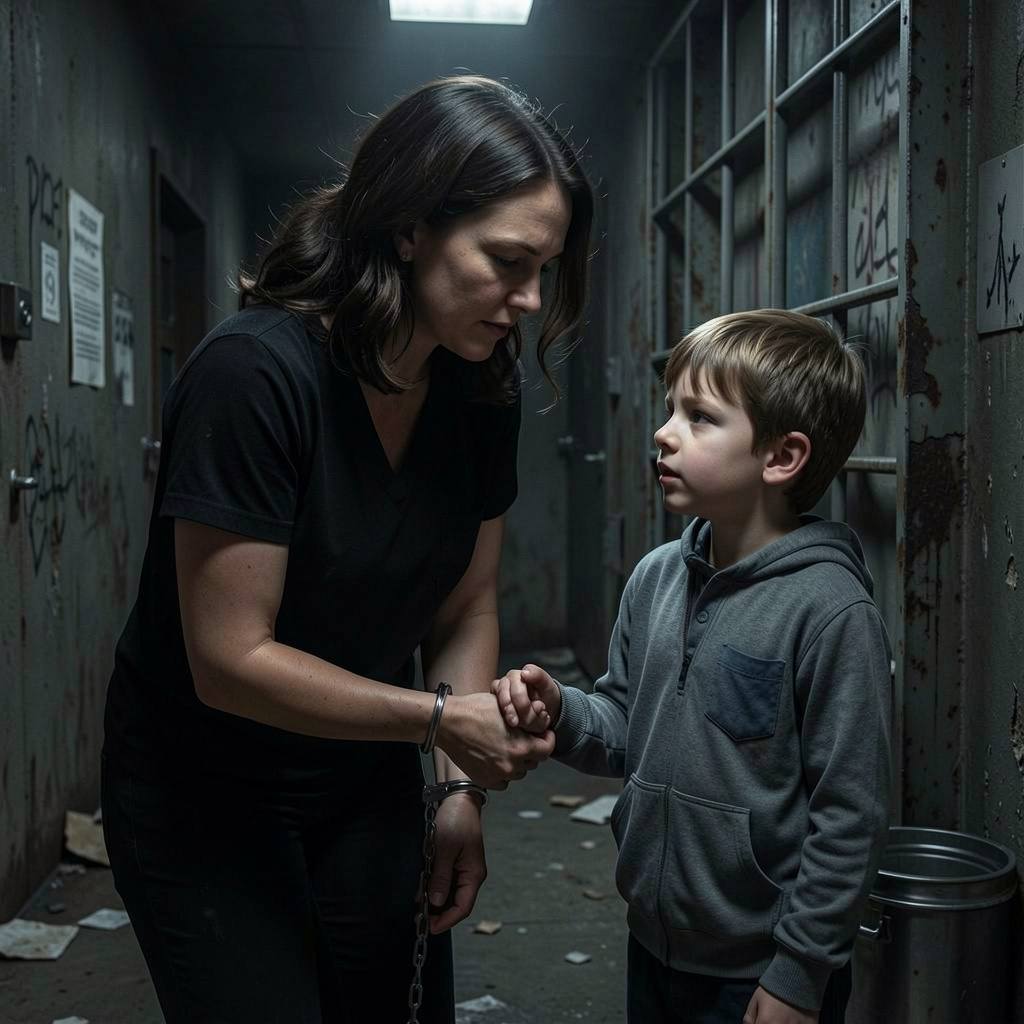
Matthew and I were taken into a small room.
My mother entered wearing a gray prison uniform.
Her hands were already cuffed.
She looked smaller than I remembered.
But when she saw us, she smiled.
“My babies.”
Matthew ran to her.
I stood frozen.
My mother hugged him.
Then she opened one arm toward me.
I stepped into it.
She held me tightly.
I could smell the same soap she used when I was a child.
For a few seconds, I was seventeen again.
Then I was ten.
Then five.
Then I was a little girl climbing into her bed after nightmares.
“I’m sorry,” I whispered.
“For what?”
“For not believing you.”
She pulled back.
“You were seventeen.”
“I should have known.”
“You were a child.”
“I wasn’t.”
“To me, you were.”
My eyes filled.
She wiped my cheek with her thumb.
“Don’t cry for me.”
“Mom…”
“Just take care of Matthew.”
She looked at him.
He was sitting in the corner, staring at the floor.
“Matthew?”
He didn’t answer.
“Sweetheart?”
He looked up.
His face was pale.
“Mom,” he whispered.
“Yes?”
“I need to tell you something.”
She smiled sadly.
“You can tell me anything.”
He stood.
Walked toward her.
Then he wrapped both arms around her waist and buried his face against her chest.
His voice came muffled through her prison uniform.
“I know who hid the knife under your bed.”
My mother’s body went rigid.
I stopped breathing.
“What?”
Matthew lifted his head.
“I know who did it.”
“Who?”
He looked at me.
Then at Mom.
“Uncle Richard.”
The room went silent.
Richard was our father’s younger brother.
He had been one of the loudest people demanding justice six years earlier.
He’d testified at the trial.
He’d told the jury that my mother had always been possessive.
That she had threatened Dad.
That she once screamed, “If I can’t have you, nobody will.”
He’d sounded convincing.
I’d believed him.
Mom stared at Matthew.
“Why would you say that?”
“Because I saw him.”
I felt the room tilt.
“You saw Uncle Richard?”
Matthew nodded.
“The night Dad died.”
I grabbed the edge of the table.
“Matthew, you never told me.”
“I was scared.”
“Scared of what?”
He looked at our mother.
“Mom getting killed.”
Then he whispered something that made my blood run cold.
“I saw Uncle Richard come upstairs.”
Six years earlier, Matthew had been eleven.
Everyone assumed he’d been asleep when Dad died.
But that wasn’t entirely true.
He’d been awake.
He had been playing a handheld game in his bedroom when he heard shouting downstairs.
He said he opened his door.
He saw our father in the kitchen.
He saw our mother kneeling beside him.
Then he saw Uncle Richard.
“He was coming up the stairs,” Matthew said.
“He had something in his hand.”
“What?”
“I don’t know.”
“Why didn’t you tell anyone?”
“Because he saw me.”
Matthew’s voice cracked.
“He put his finger over his mouth.”
Then came the part that changed everything.
“He told me if I said anything, he’d make sure Mom went to prison forever.”
I stared at my brother.
“Why wait six years?”
“Because I was eleven.”
His eyes filled.
“I didn’t know what to do.”
My mother pulled him into her arms.
“You should have told someone.”
“I tried.”
“When?”
“After the trial.”
He looked at me.
“I tried to tell you.”
I frowned.
“What are you talking about?”
“You wouldn’t listen.”
I remembered.
Six years earlier, after the verdict, Matthew had asked me something strange.
He’d asked if the police ever checked the upstairs hallway.
I’d told him to stop talking about the murder.
I thought he was confused.
I thought grief was making him imagine things.
I had forgotten.
He hadn’t.
Matthew continued.
“Uncle Richard came to my room the night before the trial started.”
My stomach tightened.
“He told me everyone already knew Mom did it.”
“And?”
“He said if I changed my story, they’d think I was lying because I was a kid.”
I felt sick.
“What story?”
“The truth.”
My mother looked toward the guard.
“Please,” she said. “You need to stop the execution.”
The guard frowned.
“What?”
“My son says he witnessed something connected to my husband’s murder.”
The guard called for his supervisor.
Within minutes, the room filled with people.
A lawyer.
A prison administrator.
Two officers.
Matthew told the story again.
This time, everything was recorded.
Then something happened none of us expected.
The lawyer asked Matthew one question.
“Why are you certain it was your uncle?”
Matthew reached into his pocket.
“I have proof.”
He pulled out a small plastic bag.
Inside was an old cassette tape.
I stared at it.
“Where did you get that?”
“Dad’s workshop.”
“What is it?”
“Dad recorded everything.”
My heart stopped.
Our father had been paranoid about business disputes.
He kept an old cassette recorder in his workshop.
Matthew had found it months earlier.
He’d been afraid to listen.
Until the night before.
The lawyer played the tape.
At first there was only static.
Then Dad’s voice.
Clear.
Angry.
“Richard, this is the last time I’m telling you. Stay away from my family.”
Another voice answered.
Uncle Richard.
“You think you can take everything and leave me with nothing?”
Dad said, “The money was never yours.”
“You promised me.”
“I promised you a job.”
“You promised me half.”
“I changed my mind.”
There was a long silence.
Then Richard said something that made the room freeze.
“If you don’t give it to me, I’ll take it.”
The recording ended.
But it wasn’t enough.
A threat wasn’t a murder confession.
The execution could still happen.
Then the lawyer asked Matthew about the knife.
“I saw Uncle Richard holding it.”
“Did you see him stab your father?”
Matthew shook his head.
“No.”
“Then what did you see?”
“I saw Dad standing.”
“Then?”
“Mom came into the kitchen.”
“She wasn’t there before?”
“No.”
“She saw Dad?”
“Yes.”
“What happened?”
“They argued.”
“About what?”
“I don’t know.”
“And then?”
“Dad fell.”
Matthew swallowed.
“I think he was already hurt.”
“Did you see the knife?”
“Yes.”
“Where?”
“In Uncle Richard’s hand.”
My mother covered her mouth.
I could barely breathe.
“What happened next?”
“He saw Mom.”
“And?”
“He dropped the knife.”
“Where?”
“In the kitchen.”
“Then?”
“He ran upstairs.”
Matthew’s voice trembled.
“I followed him.”
“Why?”
“I don’t know.”
“And what did he do?”
“He went into Mom’s bedroom.”
The lawyer leaned forward.
“Why?”
“He opened the door.”
“What happened?”
“He put the knife under Mom’s bed.”
Every piece of the case suddenly made horrifying sense.
The blood on Mom’s robe came from kneeling beside Dad.
The knife had been planted.
The lack of forced entry meant nothing.
Richard had been inside the house because he was family.
And the supposed motive?
Money.
Our father had discovered Richard was stealing from his company.
Dad had planned to expose him.
Richard had killed him to stop that.
Then he’d framed our mother.
But there was still one question.
Why had the police never considered Richard?
Because Richard had created the perfect story.
He had been the grieving brother.
The concerned uncle.
The witness who “knew” my mother was capable of murder.
And I’d helped him.
My testimony had been small, but damaging.
I’d told prosecutors my mother and father had argued frequently.
I’d said she sometimes became angry.
I’d said Dad had talked about leaving.
All true.
But stripped of context, it sounded like motive.
I suddenly remembered something else.
A week before the murder, Dad had taken me aside.
He had said, “If anything happens to me, don’t trust Richard.”
I had forgotten.
Or perhaps I’d buried it because I couldn’t understand it.
Now I remembered exactly.
The blue shirt Dad had been wearing.
The smell of coffee.
The way he had looked over his shoulder before speaking.
“Don’t trust Richard.”
I told the lawyer.
He immediately called investigators.
The execution was postponed.
Not canceled.
Postponed.
That distinction terrified me.
For the next forty-eight hours, everything happened at once.
The old tape was authenticated.
Investigators searched Richard’s property.
They found financial records proving he’d been stealing from Dad’s company.
Then they found something worse.
A pair of gloves.
Blood traces.
And an old box containing photographs of our house.
Photographs taken before Dad’s death.
Someone had been watching us.
Richard denied everything.
Until they found his fingerprints on the cassette recorder.
Then his story changed.
He said Dad had been threatening him.
He said the killing was an accident.
But he admitted moving the knife.
He admitted entering Mom’s bedroom.
And finally, after hours of questioning, he confessed to planting the weapon.
He claimed he hadn’t expected Mom to be sentenced to death.
He said he’d only wanted police to suspect her.
That was his defense.
As if that made anything better.
He had murdered his brother.
Destroyed our family.
Sent an innocent woman to death row.
And watched six years pass.
While we suffered.
While my mother wrote letters.
While I blamed her.
While Matthew lived with a secret that had nearly killed him.
Richard was arrested.
My mother’s conviction was vacated.
But freedom did not come immediately.
There were hearings.
New evidence.
A new investigation.
A judge finally ruled that the original conviction had been fundamentally compromised.
On a rainy morning six weeks later, my mother walked out of prison.
There were reporters everywhere.
Cameras.
Microphones.
People shouting questions.
She ignored all of them.
She looked only at us.
Matthew ran first.
Then I did.
The three of us held each other in the parking lot.
My mother cried.
Not the quiet tears I’d seen in prison.
These were different.
They were the tears of someone who had been told for six years that her life was ending.
And had finally been given it back.
That night, we stayed in a hotel because reporters surrounded our house.
We ordered pizza.
For the first time in six years, we sat at a table together.
My mother laughed when Matthew stole the last slice.
“Some things never change,” she said.
I smiled.
Then I looked at her.
“Mom?”
“Yes?”
“I need to tell you something.”
She waited.
“I read all your letters.”
“I know.”
“No. I mean all of them.”
She smiled.
“I hoped you would.”
“I still have them.”
Her eyes softened.
“I kept every letter you sent me too.”
I looked down.
“I was afraid to answer because I didn’t know if I believed you.”
She reached across the table.
“You don’t have to punish yourself anymore.”
“But I should have believed you.”
“You were seventeen.”
“I was your daughter.”
“You were a frightened girl who had just lost her father.”
“I accused you.”
“You didn’t accuse me.”
“I doubted you.”
“That isn’t the same thing.”
“It feels like it is.”
She squeezed my hand.
“Then let me tell you something.”
“What?”
“I never stopped believing in you.”
I cried.
She pulled me into her arms.
“I knew one day you’d come back to me.”
I buried my face against her shoulder.
“I should have come sooner.”
“You came.”
That was enough.
Months later, the house was sold.
My mother couldn’t bear living there.
Neither could I.
But Matthew wanted to visit the old property once before it was gone.
We stood in the kitchen where Dad had died.
The walls had been repainted.
The floor replaced.
But I could still remember.
Matthew walked upstairs.
I followed.
He stopped outside Mom’s old bedroom.
“This is where he hid the knife.”
I nodded.
For a moment, neither of us spoke.
Then Matthew said, “Do you think Dad knew?”
“Knew what?”
“That Uncle Richard was going to hurt him.”
“I think he knew Richard was dangerous.”
“Why didn’t he tell us?”
“Maybe he thought he could handle it.”
Matthew looked at me.
“Adults always think they can handle everything.”
I smiled sadly.
“Sometimes.”
He looked toward the bedroom.
“I still dream about that night.”
“I know.”
“How?”
“Because I do too.”
We stood there together.
Then Matthew said something I’d never forget.
“I’m glad I told Mom.”
“So am I.”
“I almost didn’t.”
“I know.”
“What if I’d waited another five minutes?”
I looked at him.
“Then we’d never forgive ourselves.”
He nodded.
I put my arm around him.
“We don’t have to live in that night anymore.”
He looked at me.
“Do you really believe that?”
I thought about our mother.
About the prison.
About the letters.
About the knife beneath the bed.
About the six years stolen from us.
“Yes,” I said.
“I think we can.”
A year after Mom’s release, we visited Dad’s grave.
It was early morning.
The cemetery was quiet.
My mother stood between Matthew and me.
She placed flowers on the grave.
For a long time, she said nothing.
Then she whispered, “I loved you.”
I watched her face.
There was sadness there.
But no hatred.
No desire for revenge.
Just exhaustion.
And peace.
We turned to leave.
I stopped.
“Mom?”
She looked back.
“What?”
“Do you ever wish we’d never found out?”
She considered the question.
“No.”
“Why?”
“Because the truth hurt.”
She looked at Matthew.
“Waiting for it hurt more.”
Then she took our hands.
And together, we walked away.
Years later, people would ask me what the hardest part had been.
Was it losing my father?
Was it watching my mother sentenced to death?
Was it learning that my uncle had betrayed us?
No.
The hardest part was realizing how easily the truth could disappear when everyone believed the wrong story.
The knife under my mother’s bed looked like proof.
The blood on her robe looked like proof.
Her silence looked like guilt.
And my own fear turned doubt into certainty.
But evidence can lie.
People can lie.
Fear can lie.
And sometimes the person you are certain is guilty is the person who has been screaming the truth all along.
My mother kept every letter she wrote.
So did I.
Years later, I opened the first one again.
The paper was yellow.
The ink had faded.
But one sentence remained perfectly clear.
I didn’t kill your father, sweetheart.
I finally understood why she had written it so many times.
She wasn’t trying to convince the world.
She was trying to leave a path back to her.
For me.
For Matthew.
For the family she knew was still somewhere beneath all that grief.
I folded the letter carefully.
Then I placed it in the box with the others.
The same box where I kept the photograph of my mother walking free.
The day she came home.
The day the truth finally won.
And underneath the photograph, I kept one final thing.
A small newspaper clipping.
The headline read:
INNOCENT WOMAN SPARED MINUTES BEFORE EXECUTION AFTER NEW EVIDENCE EXPOSES FAMILY MURDER PLOT.
I used to hate that headline.
Now I don’t.
Because every time I read it, I remember my little brother walking into that room.
His arms around our mother.
His voice trembling.
And the six words that changed all our lives:
“Mom… I know who hid the knife.”
Sometimes the truth arrives too late.
Sometimes it arrives just in time.
And sometimes it comes from the person everyone thought was too young to understand what happened.
Matthew was eleven when he saw the truth.
He was seventeen when he finally found the courage to speak it.
And my mother was minutes away from dying for a crime she never committed.
I was twenty-three when I finally learned the lesson my mother had been trying to teach me for six years:
Believing someone is innocent isn’t weakness.
Sometimes it is the bravest thing you can do.
Especially when the whole world is telling you they’re guilty.
And especially when that person is your mother.