Three weeks before Christmas, my son texted me.I was standing in my kitchen, stirring a pot of soup I had made mostly because the house felt too quiet without something simmering on the stove.
My phone buzzed on the counter.
I wiped my hands on a dish towel and picked it up.
The message was from Daniel.
Dad, we already filled your seat. Jessica thinks it’ll be less awkward if dinner is just for immediate family. Please don’t make this a thing. We’ll see you another time.I read it twice.
Then a third time.My eyes stopped on four words.
Just for immediate family.
I looked around my kitchen.There were Christmas presents stacked beneath the tree in the living room. I had spent the previous Saturday wrapping them.
A dollhouse for Emma.A bicycle helmet and soccer ball for Noah.A science kit for little Lucas.
And for Daniel and Jessica, a set of expensive crystal wineglasses Jessica had admired six months earlier.
I had even bought the ingredients for the prime rib Daniel loved.
I had planned to arrive early on Christmas Eve, help carry food into the kitchen, play with the grandchildren, and sit in the same chair I had sat in for years.
Apparently, someone had filled that seat.
I put the phone down.
For several minutes, I didn’t move.
Then I turned off the stove.
I didn’t cry.
That surprised me.
I had cried when my wife died.
I had cried the first time Daniel called me “Dad” after her funeral because I realized I was the only parent he had left.
I had cried quietly in the bathroom at work when I couldn’t afford to miss another shift but his school called because he had a fever.
I had cried when he graduated high school.
When he got married.
When he held Emma for the first time.
But this time?
Nothing came.
Just a strange emptiness.
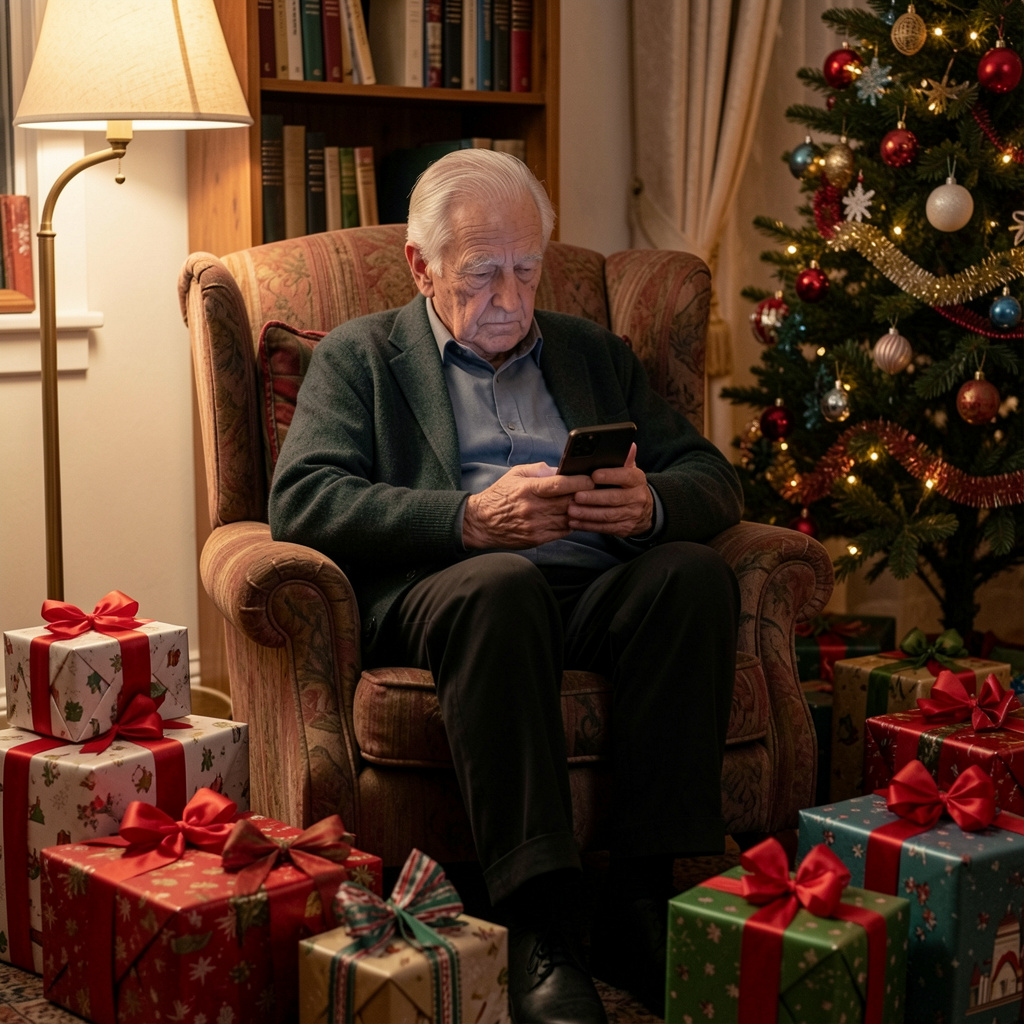
I walked into the living room and sat in my armchair.
The chair had belonged to my wife, Margaret.
She had bought it at a furniture store twenty-two years before she died.
“That’s your chair,” she used to tease me.
After she passed, I kept it.
Now I sat there beneath the glow of Christmas lights and stared at the presents.
For the first time, I wondered whether I had confused being needed with being loved.
Because for twelve years, I had paid their bills.
Not occasionally.
Not when they were in an emergency.
Almost everything.
Their mortgage.
Their car insurance.
Daycare.
Vacation deposits.
Medical expenses.
Utility bills when they were short.
School tuition.
Home repairs.
When Daniel lost his job, I covered six months of mortgage payments.
When Jessica wanted to stay home with their first child, I helped make up the difference.
When their second child was born, I paid the hospital balance they couldn’t cover.
When they wanted to take the kids to Disney World, I quietly paid for the hotel.
I never kept a spreadsheet.
But I knew the approximate total.
More than $320,000 over twelve years.
I had never once said, “After everything I’ve done for you…”
I believed fathers weren’t supposed to keep score.
But apparently, they had been.
They had simply been keeping a different kind of score.
How useful was Dad?
How much could Dad provide?
And now someone had decided that Dad wasn’t necessary at Christmas.
I looked at the presents again.
Then I stood up.
I walked into my office.
Opened my banking app.
And began looking at the automatic payments.
Mortgage contribution.
Car insurance.
Daycare transfer.
Family phone plan.
Vacation savings account.
I stared at them for a long time.
Then I canceled the first one.
The mortgage payment.
My finger hovered over the screen.
I could still hear Margaret’s voice.
“Be careful, Frank. Don’t let helping become the only way people know how to love you.”
I had laughed when she said it.
I didn’t laugh now.
I canceled the rest.
One by one.
No announcement.
No angry text.
No speech.
No warning.
Just silence.
Then I closed the app.
I went back to the living room.
And for the first time in twelve years, I felt completely free.
The next morning, Daniel called.
I watched his name appear on my screen.
I didn’t answer.
A minute later, he texted.
Dad? You okay?
I replied:
I’m fine.
Three dots appeared.
About Christmas…
I waited.
Jessica just thinks it would be more comfortable this year. Don’t take it personally.
I stared at that sentence.
Don’t take it personally.
How do you not take being excluded by your own child personally?
But I typed:
I understand. Merry Christmas.
He responded with a thumbs-up emoji.
That hurt more than the original message.
A thumbs-up.
After thirty-four years of being his father.
I put my phone away.
Then I did something I hadn’t done in years.
I made plans for myself.
I booked a room at a small coastal resort in Florida.
I wasn’t going to spend Christmas alone.
I would spend it somewhere warm, with the ocean outside my window.
I paid for everything myself.
No guilt.
No explanation.
Just a quiet Christmas.
Three days later, Daniel called again.
This time, I answered.
“Hey, Dad.”
“Hey.”
“You canceled the mortgage transfer.”
I looked out the window.
“Yes.”
There was silence.
“What happened?”
“Nothing happened.”
“Then why did you cancel it?”
“Because I decided to stop paying it.”
“Dad, you can’t just do that.”
“I can.”
“But we have automatic payments based on that.”
“I understand.”
“You’re putting us in a terrible position.”
I almost laughed.
“Daniel, I didn’t know my absence at Christmas was going to put you in such a difficult position.”
His voice changed.
“That’s not fair.”
“Neither was your message.”
Another silence.
Then he said, “Jessica didn’t mean it like that.”
“Maybe she didn’t.”
“She just wanted a smaller Christmas.”
“Then she got one.”
“Dad.”
“I don’t want to fight with you.”
“Neither do I.”
“Good.”
“Can we talk about the money?”
I closed my eyes.
There it was.
Not “Are you hurt?”
Not “I’m sorry.”
Not “I didn’t realize how that sounded.”
Money.
Always money.
“I think we’re done talking about money,” I said.
“What does that mean?”
“It means you and Jessica are adults. You’ll figure it out.”
“Dad, you can’t abandon us.”
The word stopped me.
Abandon.
I remembered being twenty-nine years old, standing beside Margaret’s hospital bed.
I remembered Daniel, twelve years old, asleep in the waiting room.
I remembered the doctor telling me there was nothing more they could do.
I remembered driving home alone.
I remembered opening the front door and hearing silence.
I raised that boy alone.
I worked double shifts.
I learned how to braid hair because Daniel had decided that his school play required him to wear his hair a certain way.
I learned to cook seven meals.
I attended parent-teacher conferences after night shifts.
I went to every soccer game I could.
I missed birthdays because rent was due.
I drove an hour and a half to his college campus when he called me crying.
I never abandoned him.
Not once.
And now he was using that word because I had stopped paying his mortgage.
“Daniel,” I said quietly, “I think you need to learn the difference between being abandoned and being responsible for yourself.”
Then I hung up.
Christmas Eve arrived.
I woke up in my hotel room to the sound of waves.
For the first time in years, I didn’t have a list of things to do.
No grocery shopping.
No wrapping presents.
No driving across town.
No carrying gifts through a crowded doorway.
I walked along the beach.
At noon, I sat at a small restaurant and ordered seafood.
At dinner, I watched families laughing together.
For a moment, I felt the familiar ache.
Then I remembered the text.
We already filled your seat.
I went back to my room.
I almost called Daniel.
Instead, I opened my phone and saw six missed calls.
Three from Daniel.
Two from Jessica.
One from an unknown number.
Then another message arrived.
Dad, please call me.
I didn’t.
An hour later:
We need to talk.
I still didn’t.
At 10:17 p.m., my phone rang again.
Daniel.
This time, I answered.
“Dad?”
“Yes.”
His voice sounded exhausted.
“Christmas isn’t going well.”
I said nothing.
“We’re short on the mortgage.”
“I know.”
“Jessica is upset.”
“I imagine she is.”
“Can you please transfer the money just for this month?”
“No.”
“Dad…”
“No.”
“Please.”
“No.”
He was quiet.
Then I heard something in the background.
A child’s voice.
“Grandpa?”
My heart cracked.
It was Emma.
Daniel came back on the line.
“She wants to talk to you.”
I closed my eyes.
“Put her on.”
“Dad?”
“Hi, sweetheart.”
“Are you coming?”
My throat tightened.
“No, honey.”
“Why?”
I didn’t know how to explain adult cruelty to a seven-year-old.
“Grandpa is spending Christmas somewhere else this year.”
“Mom said you’re mad.”
“I’m not mad at you.”
“Did we do something?”
“No.”
She sniffled.
“Mom said Christmas was for family.”
I swallowed.
“You’re my family, Emma.”
“Then why aren’t you here?”
I had no answer that a child should have to hear.
So I said, “I love you.”
“I love you too.”
When the call ended, I sat on the edge of the bed.
That was the moment I finally cried.
Not because Daniel had excluded me.
Not because Jessica had filled my seat.
Because my granddaughter had asked me why I wasn’t there.
And she deserved a better answer.
Two days after Christmas, I returned home.
There was a knock on my door that evening.
Daniel stood outside.
He looked older.
Tired.
Behind him was Jessica.
Neither spoke.
I opened the door wider.
“Come in.”
They entered.
Jessica sat on the couch.
Daniel remained standing.
“I owe you an apology,” he said.
I nodded.
“Yes, you do.”
He looked down.
“The Christmas message was my idea.”
Jessica looked at him.
“What?”
Daniel sighed.
“I told Dad Jessica wanted immediate family only because I was embarrassed.”
“Embarrassed about what?”
He finally looked at me.
“Our finances.”
I said nothing.
“The mortgage is higher than we can handle now. Jessica quit her job last year. Daycare increased. We have credit card debt.”
“How much?”
He hesitated.
“Almost $48,000.”
I wasn’t surprised.
“But that wasn’t why you excluded me,” I said.
“No.”
“Then why?”
He sat down.
“Because Jessica said something.”
Jessica’s eyes filled with tears.
“I told him,” she whispered, “that we’d become dependent on you.”
I looked at her.
She continued.
“I said we couldn’t build our own life if you kept rescuing us.”
I waited.
“And I was right,” she said. “But I said it cruelly.”
Daniel nodded.
“I should have told you the truth.”
“You should have invited me.”
“I know.”
“You should have told me you were struggling.”
“I know.”
“You shouldn’t have made me feel like I wasn’t family.”
Daniel’s eyes filled.
“I know.”
For several seconds, nobody spoke.
Then Jessica said something I wasn’t expecting.
“Your grandchildren weren’t involved in the decision.”
“I know.”
“They thought you were coming.”
“I know.”
“We made a mistake.”
“Yes.”
Daniel reached into his pocket and pulled out an envelope.
“What is that?”
“The amount we owe you.”
I opened it.
Inside was a handwritten list.
Not $320,000.
They couldn’t repay that.
It was a payment schedule.
Two hundred dollars a month.
“What’s this?”
“It’s a start.”
I looked at my son.
“You don’t owe me a lifetime of gratitude.”
“I know.”
“You owe yourself the dignity of standing on your own feet.”
He nodded.
“That’s what I’m trying to do.”
I handed the paper back.
“Keep it.”
He looked confused.
“I’m not asking you to repay me.”
“Dad…”
“But I’m also not paying your bills anymore.”
His shoulders dropped.
“I understand.”
“And that doesn’t mean I don’t love you.”
He nodded slowly.
“I know.”
“Does Jessica know?”
She looked at me.
“Yes.”
I stood.
“Then there’s one more thing.”
They both looked at me.
“I bought Christmas presents for the kids.”
Daniel smiled sadly.
“They’d love to see you.”
“I’d love to see them.”
Jessica began crying.
“I’m sorry,” she said.
I nodded.
“I know.”
The following Sunday, my grandchildren came over.
Emma ran through the front door.
“Grandpa!”
She threw herself into my arms.
I held her tightly.
Noah tackled my legs.
Lucas showed me a toy he’d gotten for Christmas.
For the first time in weeks, the house felt alive.
We made hot chocolate.
We played cards.
We built a train set across the living room floor.
Then Emma climbed onto my lap.
“Grandpa?”
“Yes?”
“Are you coming next Christmas?”
I smiled.
“If I’m invited.”
She frowned.
“Of course you’re invited.”
I laughed.
“Then I’ll be there.”
Across the room, Daniel heard her.
Our eyes met.
He smiled.
Not the awkward smile he’d given me over the phone.
A real one.
Months passed.
Daniel found a second job.
Jessica returned to work part-time.
They sold one of their cars.
They stopped taking expensive vacations.
They created a budget.
For the first time, they lived according to what they earned instead of what I could provide.
It wasn’t easy.
There were arguments.
There were months when they struggled.
Once, Daniel called me and said, “Dad, we’re really short this month.”
I asked, “What are you going to do?”
There was a long pause.
Then he said, “We’ll figure it out.”
I smiled.
“Good.”
“You’re not going to help?”
“I didn’t say that.”
He laughed.
“But you want us to try first.”
“Exactly.”
“I think I understand now.”
A year later, Christmas came again.
This time, I didn’t receive a text saying my seat was filled.
I received an invitation.
It was handwritten.
Not a group message.
Not a quick text.
A card.
Inside, Daniel had written:
Dad,
Last Christmas, I made you feel like you weren’t family. I’ll regret that for the rest of my life.
I thought I was protecting my family from depending on you, but instead I treated the person who had sacrificed the most for us like he was disposable.
You weren’t a wallet. You were my father.
I’m sorry.
Your seat is waiting.
I read it twice.
Then I put the card beside Margaret’s photograph.
“Looks like our boy finally grew up,” I whispered.
Christmas Eve arrived.
I drove to Daniel’s house.
There were cars in the driveway.
Christmas lights covered the roof.
I walked toward the front door carrying only one gift.
It was for Daniel.
He opened the door.
For a moment, neither of us spoke.
Then he hugged me.
Hard.
The kind of hug I hadn’t received from my son in years.
“I’m glad you’re here,” he whispered.
“So am I.”
Inside, Emma came running.
“Grandpa!”
Noah and Lucas followed.
Jessica stood behind them.
She smiled.
“Welcome home.”
I looked around.
There was a chair at the table.
My chair.
A small handwritten card sat on the plate.
Dad.
I sat down.
Daniel raised his glass.
“I want to say something.”
I groaned.
“Please don’t make a speech.”
Everyone laughed.
But Daniel continued.
“Last year, I thought losing Dad’s money was the worst thing that could happen to us.”
He looked at me.
“I was wrong.”
The room became quiet.
“Losing his money forced me to realize how much I’d taken for granted. But more importantly, it forced me to realize I almost lost something money could never buy back.”
He paused.
“My father’s trust.”
I looked down.
My eyes burned.
Daniel raised his glass.
“To Dad.”
Everyone lifted theirs.
I raised mine too.
“To family,” I said.
And this time, I meant it.
Later that night, after dinner, I stepped outside.
Snow was falling lightly.
Daniel joined me.
“Can I ask you something?”
“Sure.”
“Did you really cancel everything that night?”
“Everything.”
“Without telling me?”
“Yes.”
He nodded.
“Why?”
I thought about it.
“Because I finally realized that if I kept paying for everything, you’d never know whether you loved me or needed me.”
He looked at the ground.
“I loved you.”
“I know.”
“But I didn’t show it.”
“No.”
“I’m sorry.”
“I know.”
He stood beside me.
Then he said, “Dad?”
“Yeah?”
“Thank you for stopping.”
I turned toward him.
“What?”
“Thank you for stopping before I became the kind of man who thought your money was the same thing as your love.”
I smiled.
“That was the whole point.”
He hugged me again.
And for the first time, I understood something.
Sometimes loving your children means giving everything you have.
But sometimes loving them means finally giving something else.
A boundary.
A responsibility.
A chance to stand on their own.
I had spent twelve years paying their bills because I thought that was what a good father did.
But I learned that Christmas.
Being a father wasn’t about paying for a seat at the table.
It was about knowing that even when you stopped paying, you still belonged there.
The next morning, I woke up to a message from Daniel.
Merry Christmas, Dad. Love you.
No request.
No bill.
No question about money.
Just love.
I stared at the screen for a long time.
Then I smiled.
Merry Christmas, son. Love you too.
And this time, I knew he meant it.
Because my seat hadn’t been bought.
It had been earned.
And I would never again mistake the two.