The Summer Mabel Came Home
I almost said no.That is the part I will probably be ashamed of for the rest of my life.My daughter, Claire, called me on a Sunday afternoon in June. I was standing in the kitchen, sorting coupons at the table, when she said, “Mom, could you keep Mabel for the summer?”
I looked toward the refrigerator, where a handwritten grocery list was already taped beneath a magnet.
Milk. Eggs. Bread. Chicken. Fruit.
I did the math in my head.
“Claire, sweetheart, that’s almost three months.”“I know.”“And she eats like a growing kid.”There was a silence.Then Claire said quietly, “I can help with groceries.”I closed my eyes.
That was when I heard myself say, “It’s not about the money.”But it was, at least partly.
The other part was uglier.
Mabel was my daughter’s stepdaughter.
Not my granddaughter.Not technically.She was eight years old, the daughter of Claire’s husband, Daniel, from his first marriage.
I loved Claire. I loved Daniel well enough. But Mabel had always occupied some strange category in my mind—close enough to family to buy birthday presents for, but somehow not close enough for me to call her my granddaughter without feeling like I was pretending.
And now I was being asked to rearrange my entire summer for her.
“I just thought,” Claire said, “that since Daniel’s working double shifts and I’m covering extra hours at the clinic, she’d be safer with you than bouncing between sitters.”
I sighed.
“Fine. Bring her Friday.”
Claire sounded relieved.
“Thank you, Mom.”
After we hung up, I stared at the grocery list.
Then I whispered to the empty kitchen, “Three months. Three months of groceries.”
I wish I could go back to that moment.
I wish I could grab that version of myself by the shoulders and shake her.
Because three months later, I would have given anything to take back those words.
On Friday afternoon, Claire pulled into my driveway.
Mabel climbed out of the back seat carrying a pink backpack.
She was tiny.
Smaller than I remembered.
Her brown hair was pulled into two uneven braids, and she wore a yellow T-shirt and jeans despite the heat.
Claire walked her to the porch.
“Mabel, Grandma Ruth is going to take very good care of you.”
Mabel looked at me.
Then at Claire.
Then at the house.
“Okay.”
That was all.
No smile.
No excitement.
No “Hi, Grandma.”
Just okay.
I bent down and hugged her.
She stood stiffly in my arms.
I told myself she was shy.
I told myself she was nervous.
I told myself children sometimes took time to adjust.
I didn’t know then that she was studying me.
Trying to figure out what kind of adult I was.
The kind who kept children?
Or the kind who eventually sent them away?
That first week was quiet.
Mabel ate small portions.
She never asked for seconds.
She apologized when she spilled milk.
She asked permission before taking a banana.
“Can I have this?”
“You don’t have to ask.”
She nodded.
The next morning, she asked again.
“Can I have cereal?”
“Mabel, you live here for the summer. You can eat cereal.”
“Oh.”
She took one bowl.
Never more.
At night, she slept in the spare bedroom.
I bought her new sheets covered with little stars.
She thanked me three times.
On Wednesday, I found her sitting on the floor of the laundry room, folding her pajamas.
“You don’t have to do laundry,” I said.
“I know.”
“Then what are you doing?”
She shrugged.
“I don’t like leaving things around.”
I smiled.
“Well, I certainly do.”
She looked confused.
I laughed.
“Your grandma is a professional at leaving things around.”
That finally made her smile.
It was tiny.
But it was the first one.
The next day, I took her for ice cream.
She chose vanilla.
When I asked if she wanted sprinkles, she shook her head.
“Those cost extra.”
I laughed.
“Baby, I can afford sprinkles.”
She looked at me seriously.
“Are you sure?”
Something inside me shifted.
“I’m sure.”
She chose rainbow sprinkles.
And when we sat outside the ice cream shop, she ate them slowly, as if someone might take the cone away.
I began noticing things.
Mabel always kept her backpack close.
She didn’t like closed doors.
She woke up from nightmares but never cried out.
She hated kitchen timers.
The first time I set one to remind me about a casserole, she froze.
The beep sounded.
Mabel dropped her spoon.
Her face went white.
“Mabel?”
She didn’t answer.
The timer beeped again.
She stood up.
“I’m sorry.”
“For what?”
“I didn’t mean to.”
“Mean to what?”
She looked toward the garage door.
Then she shook her head.
“Nothing.”
I turned off the timer.
She sat back down.
I didn’t push.
Not yet.
That night, I lay awake thinking about it.
Children don’t react to ordinary things that way without a reason.
But I convinced myself I was imagining it.
Then came the night everything changed.
It was late July.
The air conditioner hummed softly, and rain tapped against the windows.
Mabel had finished her bath and was sitting at the kitchen table in pajamas, coloring.
I was making tea.
She suddenly looked up.
“Grandma?”
“Hmm?”
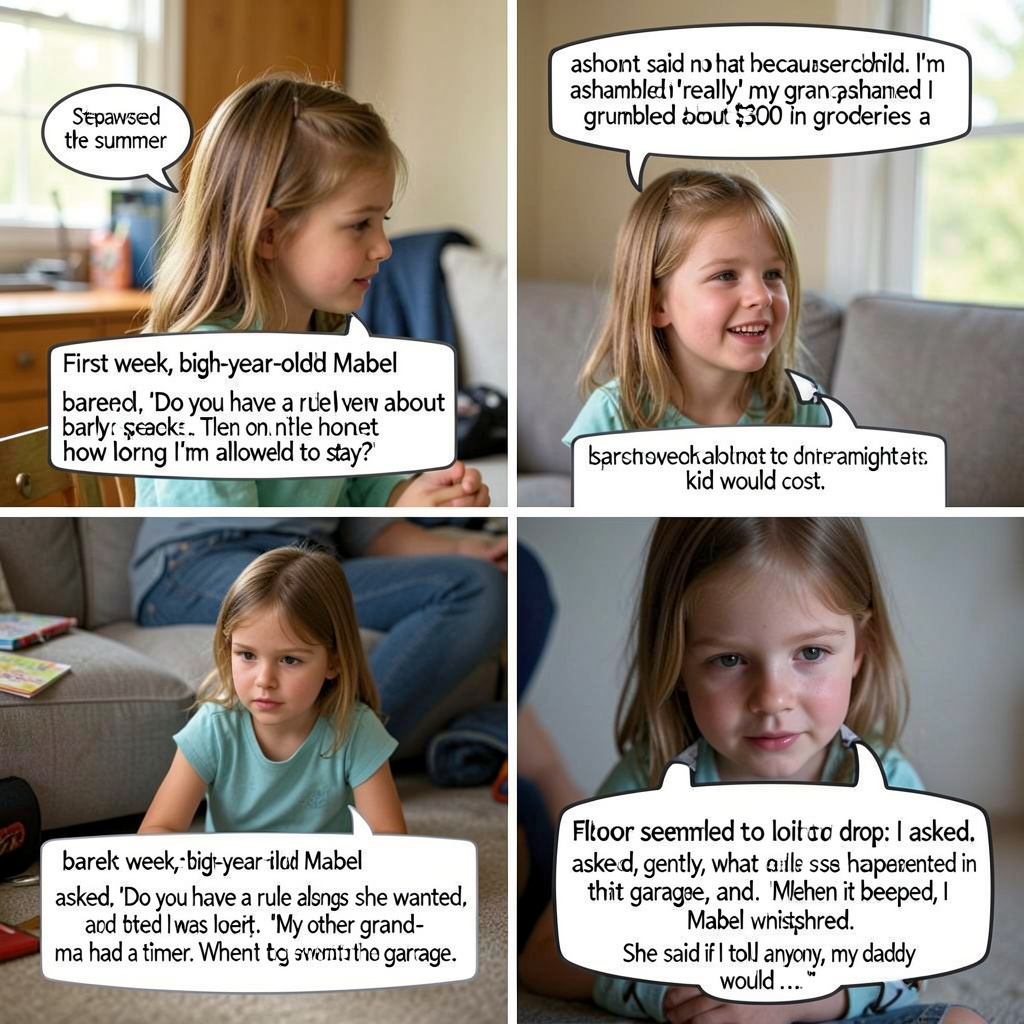
“Do you have a rule about how long I’m allowed to stay?”
My hand stopped around the kettle.
“What?”
“Here.”
“In my house?”
She nodded.
I turned toward her.
“You can stay all summer.”
She looked down.
“What if summer ends?”
I smiled.
“Then we figure out what happens next.”
“What if I want to stay?”
I put the kettle down.
“Mabel, you can stay as long as you need to.”
Her lower lip trembled.
I walked around the table.
“I mean it.”
She started crying.
Not the loud kind.
The silent kind.
Tears simply rolled down her cheeks.
I knelt beside her.
“Sweetheart, what’s wrong?”
She whispered, “My other grandma had a timer.”
I felt cold.
“A timer?”
Mabel nodded.
“When it beeped, I went to the garage.”
I stared at her.
“Why?”
She wiped her cheeks.
“Because she said I was bad.”
My stomach tightened.
“What happened in the garage?”
Mabel looked toward the hallway.
Then toward the locked back door.
Her voice became almost inaudible.
“She said if I told anyone, my daddy would…”
She stopped.
“Would what?”
Mabel’s shoulders shook.
“She said Daddy would go to jail.”
My heart slammed against my ribs.
“Why would your daddy go to jail?”
“I don’t know.”
“What did she tell you?”
“She said I was the reason everything was bad.”
I reached for her hand.
She flinched.
I immediately pulled mine back.
“I’m sorry.”
Mabel stared at me.
Then she whispered, “She said nobody would believe me because she was Grandma.”
I sat down beside her.
For several seconds, neither of us spoke.
Then I asked, very carefully, “Mabel, did your grandmother hurt you?”
She nodded.
Once.
My whole body went cold.
“Where?”
She pointed toward her upper arm.
“She squeezed really hard.”
I swallowed.
“Anything else?”
Mabel looked at the floor.
“She made me stand in the garage when Daddy was working nights.”
“For how long?”
“Until the timer beeped.”
“And what happened when it beeped?”
“I had to go inside and say I was sorry.”
“For what?”
“Being difficult.”
I closed my eyes.
Suddenly all those strange little details made sense.
The small meals.
The apologies.
The fear of timers.
The way she asked permission to eat.
The way she watched adults’ faces before answering questions.
This child had learned survival.
And somehow, I had been worrying about groceries.
I stood and took my phone from the counter.
Mabel looked frightened.
“Are you calling my daddy?”
“No.”
“Are you sending me away?”
“No.”
“Promise?”
I knelt again.
“I promise.”
“What are you doing?”
“Getting help.”
Her eyes widened.
“Please don’t.”
“I won’t let anyone hurt you.”
“But she’ll be mad.”
“Who?”
“Grandma.”
I looked at that little girl and understood something.
Mabel wasn’t afraid of being punished.
She was afraid of being disbelieved.
So I didn’t make promises I couldn’t keep.
I simply said, “You’re not alone anymore.”
That night, I called Claire.
She arrived twenty minutes later.
Daniel came with her.
When Mabel saw him, she ran into his arms.
“Daddy.”
Daniel dropped to his knees.
“What happened?”
Mabel cried into his shirt.
Claire looked at me.
I didn’t need to explain.
I told them everything Mabel had said.
Daniel’s face changed.
“I knew she didn’t like going to my mother’s,” he whispered. “But I thought it was because they didn’t get along.”
Claire sat down hard.
“She never told us.”
“She was threatened,” I said.
Daniel looked at Mabel.
“Baby, Grandma would never make Daddy go to jail.”
Mabel pulled away from him.
“She said you would.”
Daniel’s eyes filled with tears.
“I believe you.”
Mabel stared at him.
“You do?”
“Yes.”
The next morning, Daniel contacted the authorities.
There were interviews.
There were questions.
There were doctors.
There were people we didn’t know coming into our lives and asking things no child should ever have to explain.
Mabel was terrified.
But she told the truth.
And eventually, more truth came out.
Her father’s mother had been verbally abusing her for months.
She isolated Mabel during visits.
She punished her for ordinary childhood behavior.
She used fear to control her.
The garage wasn’t the only place.
There had been nights when Mabel was locked outside for short periods.
There had been threats.
There had been recordings.
And there was something else.
The old woman had told Mabel that if she complained, Daniel would lose his job, lose his home, and go to prison.
Mabel had believed every word.
Because children believe adults.
Especially children who are afraid.
For weeks, our family was consumed by meetings and paperwork.
Mabel stayed with me.
And slowly, she began to change.
She started asking for second helpings.
She stopped apologizing for dropping things.
She learned that doors could be closed because someone wanted privacy, not because someone wanted to trap her.
And I learned to never use a timer without warning her.
One afternoon, I found her sitting on the porch.
“Grandma?”
“Yes?”
“Can I ask you something?”
“Anything.”
“Am I really your granddaughter?”
The question hit me harder than anything else.
I sat beside her.
“Do you want to know the truth?”
She nodded.
“You weren’t born my granddaughter.”
Her face fell.
I continued quickly.
“But families aren’t only made by blood.”
She looked at me.
“You’re my granddaughter because I love you.”
“But I’m Daddy’s daughter.”
“Yes.”
“And Mom married Daddy.”
“Yes.”
“So you’re not really…”
I took her hand.
“Mabel, listen to me.”
She looked up.
“The first week you came here, I made a terrible mistake.”
“What?”
“I worried about how much groceries would cost.”
She blinked.
“I thought about money instead of thinking about you.”
She looked confused.
“I wasn’t sure whether I should call you my granddaughter.”
Her eyes filled with tears.
“Why?”
“Because I was foolish.”
She leaned against me.
“I thought maybe you didn’t want me.”
My throat tightened.
“I wanted you. I just didn’t understand how much.”
She was quiet.
Then she said, “I want you too.”
I wrapped my arms around her.
That was the first time she hugged me without hesitation.
The summer ended.
But Mabel didn’t leave.
Not permanently.
The court eventually decided that visits with her grandmother would stop while the investigation continued.
Daniel and Claire rearranged their schedules.
Mabel stayed with me during the school week.
Some weekends she went home.
Sometimes she slept in my bed after nightmares.
Sometimes she called me from her room just to ask if I was still awake.
“I am.”
“Okay.”
Ten seconds later:
“Grandma?”
“Yes?”
“Are you sure?”
“Sure about what?”
“That I’m allowed to stay.”
I would smile in the darkness.
“Yes, baby.”
One evening, months after everything began, I was making dinner when Mabel came running into the kitchen.
“Grandma!”
“What?”
“Look!”
She held up a piece of paper.
It was a drawing.
Four people stood in front of a yellow house.
Mabel.
Her father.
Her mother.
And me.
Above us she had written:
MY FAMILY.
I stared at it.
“You put me in your family?”
She rolled her eyes.
“Of course.”
“Even though I’m not your real grandma?”
She frowned.
“You are my real grandma.”
I smiled.
“That’s right.”
She grabbed my waist.
Then she whispered, “You know what I like about your house?”
“What?”
“There are no timers.”
I hugged her tighter.
“No timers.”
“And nobody makes me go to the garage.”
“Never.”
“And I can eat two pieces of cake.”
I laughed.
“Two?”
She nodded seriously.
“Maybe three.”
“Now you’re pushing your luck.”
She giggled.
Then she ran back toward the living room.
I stood there listening to her laughter.
And I thought about that first Sunday.
About the grocery list.
About the $300 I had worried about.
Three hundred dollars.
That was what I had thought I might lose by opening my home to a child.
Instead, I gained something I didn’t know I had been missing.
A granddaughter.
Not by blood.
By choice.
By trust.
By every breakfast where she asked for seconds.
By every nightmare when she called my name.
By every drawing taped to my refrigerator.
By every time she walked into my kitchen without asking permission.
Mabel taught me that family isn’t always the person whose blood runs through your veins.
Sometimes family is the little girl who arrives at your door carrying a pink backpack and wondering how long she’s allowed to stay.
Sometimes love begins with a mistake.
Sometimes forgiveness begins when you admit you were wrong.
And sometimes the greatest blessing of your life is the child you almost convinced yourself wasn’t yours.
Years later, Mabel still remembered that summer.
So did I.
She was seventeen when she asked me to drive her to college orientation.
We were sitting in the car when she suddenly said, “Grandma?”
“Hmm?”
“Do you remember when I asked you if I could stay?”
“I remember.”
“I was really scared.”
“I know.”
She looked out the window.
“I thought every house had a timer.”
I reached over and squeezed her hand.
“Not this house.”
She smiled.
Then she pulled a small object from her backpack.
A kitchen timer.
Old and scratched.
I stared at it.
“What is that?”
“I found it at a thrift store.”
My heart tightened.
“Why did you buy it?”
She smiled.
“To remind myself.”
“Of what?”
She turned it over in her hands.
“That the timer doesn’t control me anymore.”
Then she set it on the dashboard.
The timer was silent.
No ticking.
No countdown.
Just a little piece of plastic sitting between us.
Mabel looked at me.
“I think I finally understand something.”
“What?”
“You didn’t save me that summer.”
I frowned.
“I didn’t?”
She shook her head.
“You gave me a place where I could save myself.”
Tears filled my eyes.
I reached for her hand.
“You were always worth saving.”
She squeezed my fingers.
“And you were always my grandma.”
I laughed through my tears.
“Even when I was being stupid?”
“Especially then.”
We both laughed.
The light turned green.
I drove toward the college campus, toward the future waiting for her.
And for the first time, I realized something.
I had spent my whole life thinking that being a grandmother meant sharing blood.
Mabel taught me otherwise.
Being a grandmother meant showing up.
It meant opening the door.
It meant making room at the table.
It meant saying, “Stay as long as you need.”
And most of all, it meant making sure a frightened child never again had to wonder whether she was wanted.
Because she was.
She always had been.
And she always would be.
My granddaughter.
My Mabel.
My family.