Three weeks after my stepfather Mark died, I was still expecting to hear his keys in the front door.It was ridiculous.I knew he was gone. I had stood beside his coffin. I had watched them lower it into the ground.
I had listened to my mother sob so hard that two relatives had to hold her upright.But grief doesn’t care what you know.
Sometimes the mind keeps waiting for a person long after reality has taken them away.
Mark had died suddenly of a heart attack at fifty-six.
There had been no warning.No long hospital stay. No final conversation. No chance to say goodbye.One minute he had been in the garage, complaining about a stubborn lawn mower. The next, he was on the floor, and my mother was screaming for someone to call an ambulance.
He never made it to the hospital.I was thirty-two years old, and I was grieving a man who had never really been my father.
That was the strange part.
I wasn’t supposed to be this devastated.
At least, that’s what I told myself.Mark had never called me his daughter.Not once.I was my mother’s daughter from her first marriage. When I was five, Mom married Mark. A year later, my stepsister Ava was born.
And from the moment Ava entered the world, it was obvious who Mark considered his little girl.
Ava was his princess.
He had pictures of her everywhere.
Ava at six months old.
Ava on her first day of kindergarten.
Ava wearing a pink dress at age seven.
Ava holding her first trophy.
Ava at prom.
Ava graduating high school.
Ava on the day she got her first job.
Ava on her twenty-first birthday.
There were photographs of Ava everywhere.
I had some too.
But they were mostly family pictures.
Never just me and Mark.
Never him kneeling beside me with his arm around my shoulders.
Never him looking at me with the kind of pride I saw in his eyes whenever he looked at Ava.
When I was little, I understood it.
At least, I thought I did.
I told myself that Mark wasn’t my real father.
I told myself he didn’t have to love me.
I told myself that some families were simply like that.
Still, there was one thing I secretly wanted.
Just once.
I wanted him to look at me and say, “I love you, daughter.”
I never told anyone that.
Not even my mother.
Especially not my mother.
Because saying it aloud would have made the hurt real.
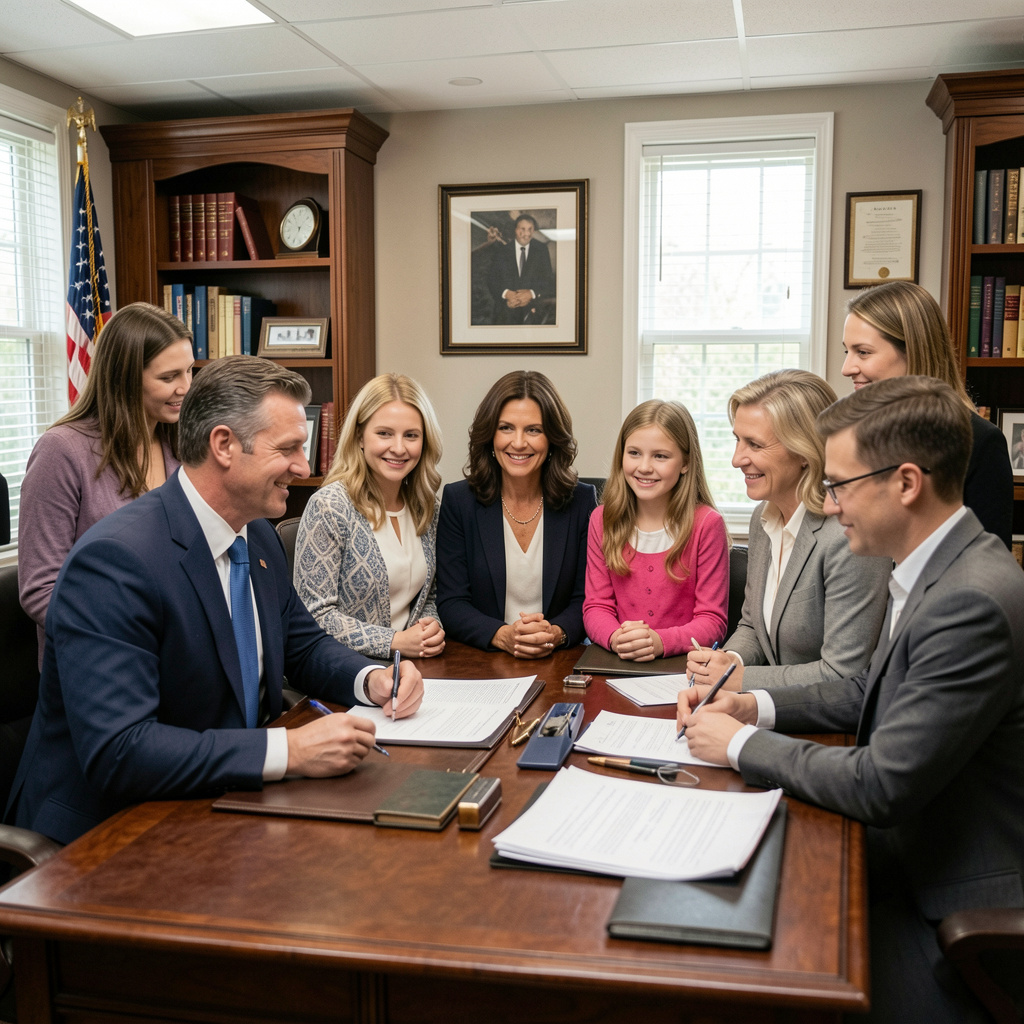
Three weeks after Mark’s funeral, we gathered in his lawyer’s office.
There was my mother.
Ava.
Me.
Two of Mark’s cousins.
His older brother, Daniel.
And Mr. Harris, the family attorney.
I sat in the corner with my hands folded tightly in my lap.
I wasn’t expecting anything.
Mark had always made it clear that Ava was his daughter.
So when Mr. Harris opened a thick folder and adjusted his glasses, I assumed this would be quick.
“A few of you already know that Mark left a formal will,” he said.
My mother reached for a tissue.
Ava sat beside her.
I stared at the carpet.
Mr. Harris began reading.
“To my wife, Linda, I leave the house, all household furnishings, and the balance of our joint savings account.”
Mom began crying.
Then came several smaller bequests.
To Daniel.
To Mark’s brother.
To a charity he supported.
Then Mr. Harris paused.
He looked directly at me.
“To my daughter, Emily…”
My heart stopped.
For a second, nobody moved.
I actually looked behind me.
There was no one.
He had said my name.
My daughter.
Ava’s head snapped toward me.
Mom covered her mouth.
I stared at the lawyer.
“I’m sorry,” I whispered.
Mr. Harris looked confused.
“I said, ‘To my daughter, Emily…'”
My eyes filled with tears.
Mark had never called me that.
Not even when I was five.
Not even when I graduated college.
Not even at my wedding.
Not even once.
Mr. Harris continued.
“I leave the contents of the blue wooden chest stored in my workshop, along with a sealed letter.”
I blinked.
“The chest?” I asked.
Mr. Harris nodded.
“Yes.”
“Why?”
He smiled faintly.
“Mark specifically instructed me not to answer that question until you had the letter.”
My stomach tightened.
Ava stared at me.
Mom looked completely stunned.
Mr. Harris handed me a white envelope.
My name was written on it.
Emily.
Just Emily.
But underneath it, in Mark’s handwriting, were four words.
“My daughter, Emily.”
I couldn’t breathe.
My hands shook as I opened it.
Inside was a single sheet of paper.
Emily,
If you’re reading this, then I’m gone.
I’m sorry.
I know those words aren’t enough.
I know I wasn’t the father you deserved.
I know there were times you probably wondered whether I even cared about you.
The truth is, I cared more than I ever knew how to explain.
I was afraid.
And I let that fear turn into distance.
Please open the blue chest.
Everything I was too cowardly to say is inside.
Love,
Mark.
I read it three times.
Then I started crying.
Not the quiet kind of crying.
The kind that hurts your chest.
The kind that makes you feel five years old again.
Mom reached for my hand.
I pulled away.
“Why didn’t he ever tell me?” I whispered.
She didn’t answer.
Because she didn’t know.
Or maybe she did.
We went home in silence.
That afternoon, I found the blue wooden chest.
It was tucked beneath an old workbench in Mark’s garage.
Dust covered the lid.
There was a brass lock.
Mr. Harris had given me the key.
I stood there alone for several minutes before opening it.
Inside were boxes.
Dozens of them.
Photographs.
Birthday cards.
School certificates.
Old drawings.
Report cards.
And journals.
My name appeared on almost everything.
Emily — Age 6.
Emily — Age 8.
Emily — First Day of School.
Emily — Soccer.
Emily — Middle School.
Emily — High School.
My hands trembled as I picked up the first journal.
The first page was dated twenty-seven years earlier.
I was six.
Mark had written:
“Today Emily asked me if I was her dad.
I didn’t know what to say.
She looked so hopeful.
I told her I was her stepfather.
Her face fell.
I hated myself for that.
I wanted to tell her yes.
I wanted to say, ‘Of course I’m your dad.’
But I was afraid of taking a place that wasn’t mine.
I thought I was respecting her biological father.
I didn’t realize I was breaking her heart.”
I sat down on the garage floor.
I turned the page.
Another entry.
“Emily lost her first tooth today.
She ran into the kitchen screaming.
She showed everyone.
I wanted to hug her.
I didn’t.
Why?
Because I keep telling myself I’m not her father.
But what if she doesn’t need me to be her biological father?
What if she just needs me to be there?”
Another page.
“Emily asked me to come to her school play.
I promised I would.
I will not miss it.”
I remembered that day.
I had looked into the audience and seen Mark sitting in the back.
I had been so happy.
Afterward, he gave me flowers.
I had thought he was only being polite.
Now I knew.
He had driven two hours home from work just to see me perform.
I kept reading.
There were hundreds of entries.
Some were only a few sentences.
Others were pages long.
He had written about every birthday.
Every school achievement.
Every argument.
Every time I cried.
Every time I left home angry.
Every time he worried about me.
There was one entry from when I was seventeen.
“Emily told me today she hates me.
She doesn’t.
She’s hurting.
I know because I used to be seventeen too.
I wanted to hug her.
She wouldn’t let me.
I stood outside her bedroom door for twenty minutes.
I hope she knows I stayed.”
I covered my mouth.
I remembered that night.
I’d slammed my bedroom door after an argument.
I had assumed Mark went downstairs and forgot about me.
He hadn’t.
He had stayed outside my door.
Waiting.
Another entry.
“Emily got accepted into college.
I wanted to scream with pride.
Instead, I told her I knew she could do it.
She smiled.
That smile will stay with me forever.”
Then I found something unexpected.
A photograph.
It was from my college graduation.
I was standing in my cap and gown.
Mom was beside me.
Ava was on my other side.
And behind us was Mark.
I had never noticed him before.
His eyes were fixed on me.
Not the camera.
Me.
He was smiling.
Proudly.
I cried so hard I couldn’t see the photograph anymore.
Then I found a second envelope.
This one was marked:
“Emily — Read When You’re Ready.”
Inside was a letter.
I sat on the garage floor and began reading.
“Emily,
There are things I should have said while I was alive.
I’m sorry I didn’t.
When I married your mother, I was twenty-nine.
You were five.
I thought being a good stepfather meant respecting boundaries.
I thought I shouldn’t call you my daughter because you already had a father.
I thought saying it would somehow erase him.
But as the years passed, you became part of every thought I had.
You were there when I planned vacations.
When I bought birthday presents.
When I worried about money.
When I couldn’t sleep because you were driving home late.
When you got sick.
When you graduated.
When you got married.
When you moved away.
You were my daughter long before I ever had the courage to admit it.
Ava was never more important than you.
I know it looked that way.
And for that, I am deeply sorry.
I loved Ava loudly.
I loved you quietly.
That was my mistake.
You deserved both.”
I stopped reading.
Because that sentence broke something inside me.
I loved Ava loudly.
I loved you quietly.
For thirty-two years, I had interpreted his silence as indifference.
It had never occurred to me that his silence might have been fear.
I kept reading.
“There is something else you should know.
When you were ten, your biological father stopped sending child support.
Your mother never told you because she didn’t want you to feel rejected.
I began paying it.
Not because I had to.
Because I wanted to.
I never told you because I didn’t want you to think you owed me anything.
When you went to college, I paid the remaining tuition that your scholarship didn’t cover.
Your mother thought you knew.
You didn’t.
When you bought your first apartment, I gave your mother money for the down payment.
She told you she had saved it.
I let her.
I didn’t need credit.
I only needed to know you were safe.
That’s all I’ve ever wanted.”
I couldn’t read anymore.
I put the letter down.
Then I heard footsteps.
Mom stood at the garage entrance.
She was crying.
“You knew,” I whispered.
She nodded.
“I knew some of it.”
“Some?”
She came closer.
“Mark made me promise not to tell you.”
“Why?”
“Because he was afraid you’d think he was trying to buy your love.”
I laughed through my tears.
“After thirty-two years, he finally tells me he loved me, and he’s still worried about what I think.”
Mom sat beside me.
“He was always like that.”
I looked at her.
“Why did he love Ava differently?”
She took a long breath.
“He didn’t.”
“Mom…”
“I know what you saw.”
She wiped her eyes.
“Mark had one fear his entire life. He was terrified you would think he was replacing your biological father. With Ava, there was no question. She was his biological child. He never had to wonder if loving her would hurt someone.”
I looked down.
“That sounds like an excuse.”
“It is,” Mom said.
I looked up.
She was crying.
“It was a terrible excuse.”
For the first time, Mom told me everything.
She told me about the night Mark had held newborn Ava.
He had cried.
Not because she was his first child.
Because he had been terrified that loving Ava would make Emily feel less loved.
“He asked me,” Mom said, “‘How do I make sure Emily never feels like she lost me?'”
I stared at her.
“You never told me that.”
“I know.”
“Why?”
“Because I thought I was protecting you.”
I shook my head.
“Everyone was protecting me from the truth.”
Mom looked at the chest.
“Mark kept everything.”
I nodded.
“Everything.”
Then she said something that made me freeze.
“There’s one more thing.”
“What?”
“He recorded a video.”
My heart jumped.
“What video?”
“Mr. Harris has it.”
The next morning, I went back to the lawyer’s office alone.
Mr. Harris was waiting.
He placed a small USB drive on the desk.
“Mark asked me to give you this only after you read the letters.”
I stared at it.
“What’s on it?”
“A video.”
“How long?”
“About twenty minutes.”
I swallowed.
“Why didn’t you tell me yesterday?”
“Because Mark’s instructions were very specific.”
I took the drive.
That night, I sat in my living room with my laptop.
My hand hovered over the mouse.
Then I clicked.
Mark appeared on the screen.
He was sitting in his workshop.
The same workshop where I had found the blue chest.
He looked tired.
Older than I remembered.
But his eyes were the same.
He looked directly into the camera.
“Hi, Emily.”
I burst into tears immediately.
He smiled.
“I don’t know when you’re watching this.”
He paused.
“But if you’re watching it, I’m probably not around anymore.”
He took a breath.
“I’ve practiced this a dozen times, and I still don’t know how to say it.”
He looked down.
“Emily, I love you.”
I covered my mouth.
There it was.
The sentence I’d spent my entire childhood waiting to hear.
“I love you, daughter.”
I fell apart.
Mark continued.
“I should have said that when you were five.
I should have said it when you lost your first tooth.
I should have said it when you graduated.
I should have said it at your wedding.
I should have said it yesterday.
But I didn’t.
And I’m sorry.”
He wiped his eyes.
“I know you probably think Ava was always my favorite.
She wasn’t.
Ava was easier for me.
With Ava, I knew exactly what I was allowed to be.
With you, I was always afraid of crossing a line.
I was afraid your biological father would somehow be erased.
I was afraid you’d resent me.
I was afraid your mother would think I was taking over.
I was afraid of everything.
And because I was afraid, I became distant.”
He smiled sadly.
“That’s the worst thing about fear.
Sometimes you think you’re protecting people when you’re actually hurting them.”
I couldn’t stop crying.
Then Mark leaned closer to the camera.
“There’s something I need you to understand.
You never had to earn my love.
Not when you were five.
Not when you were fifteen.
Not when you were twenty-five.
Not now.
You were my daughter because I chose you.
Not by blood.
By every ordinary day.
By every birthday.
By every ride to school.
By every argument.
By every Christmas.
By every time I waited up for you.
By every time I worried.
By every time I was proud.
That’s what made you my daughter.”
He paused.
“And Emily?”
He smiled.
“You were the first child who ever taught me what it meant to be a father.”
I pressed my hand against my heart.
Mark looked down at something on the table.
Then he held up a small wooden box.
“I want you to have this.”
He opened it.
Inside was a necklace.
A tiny silver pendant.
A heart.
“I bought this for you years ago.”
He laughed.
“I kept waiting for the right moment.”
His smile faded.
“There was always another birthday.
Another Christmas.
Another time.
I thought there would always be another time.”
That sentence destroyed me.
He set the necklace down.
“So if you’re watching this after I’m gone, please don’t spend your life regretting what we didn’t say.”
He took a breath.
“Remember what we did say.
Even when we said it without words.”
Then he looked directly into the camera.
“I love you, Emily.”
He smiled.
“My daughter.”
The screen went black.
I sat there for a long time.
I didn’t move.
I didn’t breathe.
I simply stared at my reflection in the dark screen.
Then my phone rang.
It was Ava.
“Can I come over?”
“Yes.”
Twenty minutes later, she walked through the door.
Her eyes were swollen.
She had been crying too.
She sat beside me.
“Mom showed me the video,” she whispered.
I looked at her.
“You watched it?”
She nodded.
“She sent it to me.”
Neither of us spoke.
Then Ava said, “I thought he loved me more.”
I swallowed.
“So did I.”
She looked down.
“I spent my whole life thinking you were lucky because he didn’t expect anything from you.”
I stared at her.
“What?”
She gave a sad laugh.
“I thought he was easier on you.”
I shook my head.
“I thought he loved you more.”
We looked at each other.
And suddenly, everything we’d believed about our family began falling apart.
We had both been children interpreting silence.
Both of us had been wrong.
Ava leaned against my shoulder.
“He loved us both.”
“Yeah.”
“But he didn’t know how to show you.”
“No.”
She started crying.
“I’m sorry.”
“For what?”
“For all the times I made you feel like you weren’t part of the family.”
I hugged her.
For the first time in years, we cried together.
Not as stepsisters.
Not as the biological daughter and the stepdaughter.
Just as two women who had lost their father.
A few weeks later, I went back to the workshop.
The blue chest was still there.
I opened it again.
At the very bottom was another photograph.
It was old.
I was five years old.
Mark was standing behind me.
I was holding a stuffed rabbit.
He had one hand resting awkwardly on my shoulder.
I remembered that day.
I had been nervous.
It was the first photograph after Mom married him.
I had hated the picture because I thought Mark looked uncomfortable.
Now I saw something else.
His face.
He wasn’t uncomfortable.
He was terrified.
Terrified of doing something wrong.
Terrified of loving a little girl who wasn’t biologically his.
Terrified that one wrong move could make her hate him.
And yet he had stayed.
For twenty-seven years.
He had stayed.
Maybe that was the part I had missed.
Love wasn’t always a grand declaration.
Sometimes it was a man sitting outside a teenage girl’s bedroom door because he didn’t know what else to do.
Sometimes it was secretly paying a college bill.
Sometimes it was driving two hours to watch a school play.
Sometimes it was keeping every drawing a little girl had ever made.
Sometimes it was buying a necklace years before you knew when you’d give it to her.
Sometimes love was quiet.
Too quiet.
But still love.
I found the necklace exactly where Mark had said it would be.
I put it around my neck.
The heart rested against my chest.
That night, I sat with Mom and Ava at the kitchen table.
We talked about Mark for hours.
For the first time, we didn’t talk about him as a husband, or a stepfather, or a father.
We talked about him as a complicated human being.
A man who loved deeply but didn’t always know how to express it.
A man who made mistakes.
A man who carried guilt.
A man who spent his life trying to do the right thing and sometimes got it completely wrong.
Mom eventually looked at me.
“Do you forgive him?”
I touched the necklace.
“I don’t know.”
She nodded.
“You don’t have to.”
I thought about that.
Then I smiled faintly.
“I think I already did.”
Mom began crying again.
Ava reached across the table and squeezed my hand.
And for the first time since Mark died, I didn’t feel like I had lost something I had never had.
I felt like I had finally discovered something that had been there all along.
The next morning, I went to the cemetery alone.
I stood in front of Mark’s grave.
The wind moved through the trees.
I touched the silver heart around my neck.
“I wish you’d told me sooner,” I said.
My voice cracked.
“I wish you’d hugged me more.”
I smiled through my tears.
“I wish you’d called me your daughter while you were still here.”
The cemetery was silent.
But somehow, I didn’t feel alone.
“I was angry at you for so long.”
I took a breath.
“But I understand now.”
I looked at his name carved into the stone.
“You were scared.”
I laughed softly.
“You were such an idiot.”
For a moment, I could almost imagine him laughing.
Then I whispered the words I had wanted to say since I was five.
“I love you too, Dad.”
The word felt strange.
Then it felt natural.
“Dad.”
I said it again.
“Dad.”
And suddenly I understood.
He had never needed blood to make him my father.
He had needed courage.
And even though he hadn’t found enough of it while he was alive, he had finally found a way to tell me after he was gone.
I placed my hand over the necklace.
“Thank you for choosing me.”
Then I walked away.
Not healed.
Not completely.
Grief doesn’t disappear because you learn the truth.
But the emptiness inside me was different now.
It wasn’t the empty space left by a father who never loved me.
It was the ache left by a father who had loved me quietly for twenty-seven years.
A father who had been too afraid to say it.
A father who had finally found the words.
And as I walked through the cemetery gates, I realized something I wished I’d understood much earlier:
Sometimes the people we think loved us least were simply the ones who didn’t know how to speak their love.
And sometimes, if we’re lucky, they leave behind enough evidence for us to hear it anyway.
Mark had never called me his daughter while he was alive.
But in the end, he left me the one thing I had wanted my entire life.
Not money.
Not property.
Not an inheritance.
He left me the truth.
I was his daughter.
I always had been.
And for the first time, I believed it.