The Night They Stopped Laughing
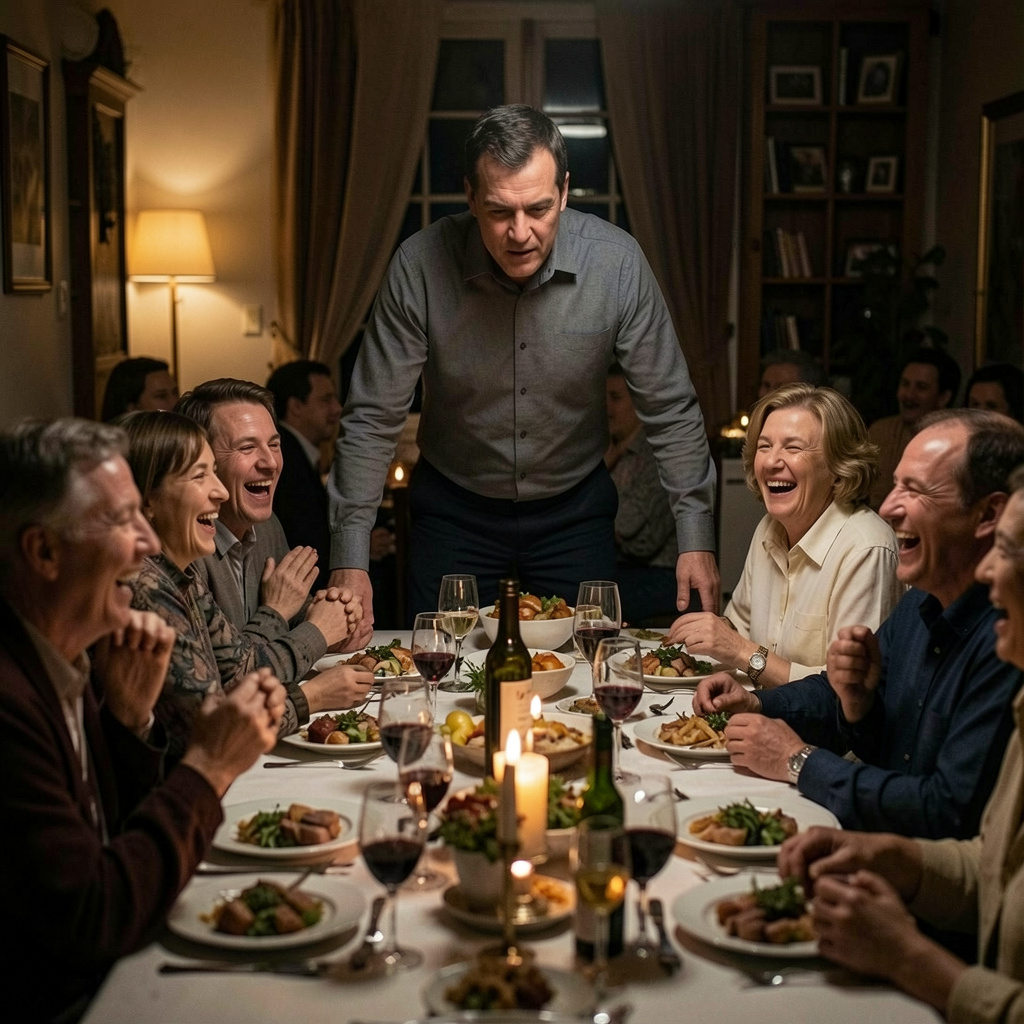
The fork was still in my hand when my nephew reached across the dinner table.At first, I thought he wanted the bread.“Pass me the rolls, Uncle Daniel,” he said.I smiled and reached toward the basket.
Then he grabbed the glass of red wine beside my plate.Everything happened so quickly that nobody had time to react.
He tipped the glass.
The wine poured across my white shirt, my lap, and the plate of food in front of me.
Mashed potatoes, gravy, roasted vegetables, and wine spilled everywhere.For one frozen second, the room went completely silent.Then my brother laughed.A loud, careless laugh.
My sister-in-law covered her mouth, but she was laughing too.Someone at the other end of the table snorted.
And my nephew, twelve-year-old Ethan, leaned back in his chair with a grin.
“Dad told me you deserve it,” he said.
That was when everyone laughed harder.I looked around the table.These were people I had loved for years.People I had helped.People I had defended.People I had quietly sacrificed for.
And now they were watching me like I was the entertainment between dinner and dessert.
I looked down at my ruined meal.
Then I looked at Ethan.
He wasn’t laughing anymore.
He was watching me carefully, waiting for me to explode.
I could have shouted.
I could have demanded an apology.
I could have reminded everyone exactly how much I had done for this family.
Instead, I slowly placed my fork on the table.
I wiped my hands with a napkin.
Then I stood.
“Enjoy dinner,” I said quietly.
My brother frowned.
“Daniel, don’t be dramatic.”
I didn’t answer.
I walked out of the dining room.
I went upstairs, changed my shirt, collected my coat, and left through the front door without saying another word.
Nobody followed me.
That hurt more than the wine.
But by the time I reached my car, I had made a decision.
And it was a decision that would change my family forever.
For twenty-three years, I had been the person everyone called when something went wrong.
My name was Daniel Carter.
I was forty-six years old, unmarried, and had no children of my own.
My younger brother, Marcus, was forty-one.
We had never been particularly close growing up.
He was the charming one.
The reckless one.
The one who could walk into a room with no money in his pocket and somehow leave with three people offering to help him.
I was different.
I planned.
I saved.
I worked.
I believed that if you made a promise, you kept it.
After our father died, Marcus inherited his confidence.
I inherited his responsibilities.
Mom couldn’t manage the mortgage alone, so I helped.
Marcus was between jobs, so I helped.
His car broke down, so I helped.
His business failed, so I helped.
When Ethan was born, Marcus and his wife, Claire, were struggling.
I paid for the baby’s hospital bill that insurance didn’t cover.
I bought the crib.
I paid for daycare for six months.
When their kitchen flooded, I paid for the repairs.
I never made a big deal about it.
That was probably my mistake.
People don’t always appreciate sacrifices they never see.
They simply start expecting them.
Over the years, Marcus began treating my help like an obligation.
If I paid a bill, he said, “That’s what family does.”
If I bought Ethan a birthday present, he said, “You spoil him.”
If I refused to lend money, he said, “You’ve changed.”
I hadn’t changed.
I had simply started noticing.
Then, two years earlier, I made the biggest mistake of all.
I invested in Marcus’s landscaping company.
He told me he needed $60,000 to buy equipment and expand.
He promised to repay me within eighteen months.
I believed him.
The company grew.
But I never saw my money again.
Every time I asked, he had an excuse.
“Business is seasonal.”
“Payroll was higher than expected.”
“We’re reinvesting.”
“Next quarter.”
Eventually, I stopped asking.
Not because I didn’t care about the money.
Because I cared about my brother.
At least, I thought I did.
Then came the dinner.
And one sentence changed everything.
“Dad told me you deserve it.”
I kept hearing those words as I drove home.
Not because Ethan had poured wine on me.
Children do foolish things.
What hurt was that he believed his father had the right to teach him cruelty.
And what hurt even more was that Marcus had apparently decided I was no longer family.
I drove home without turning on the radio.
My house was quiet when I entered.
Too quiet.
I stood in the kitchen and looked at the refrigerator.
There was a photograph of Ethan stuck beneath a magnet.
He was eight years old in the picture, missing a front tooth and smiling at the camera.
I had taken that photograph.
I remembered the day.
Marcus had been working.
Claire had been exhausted.
Ethan wanted someone to watch him ride his bicycle.
I had spent the entire afternoon running behind him.
“Don’t let go!” he’d shouted.
“I won’t.”
He had trusted me completely.
I stared at that photograph for a long time.
Then I opened my laptop.
For the first time in years, I stopped thinking like a brother.
I started thinking like a businessman.
I pulled up every bank transfer I had made to Marcus.
Then every loan document.
Every email.
Every text.
Every receipt.
Every payment.
I created a folder.
I named it simply:
Family.
By midnight, I had calculated the total.
$214,780.
That was how much I had given Marcus and his family over eleven years.
Some of it had been gifts.
Some loans.
Some expenses I had never expected to see again.
But one amount stood out.
The $60,000 investment in Marcus’s company.
I opened the original agreement.
I read it three times.
Then I noticed something I had completely forgotten.
Marcus had signed a clause guaranteeing my ownership percentage if the business expanded beyond a certain valuation.
I had never enforced it.
I hadn’t wanted to.
But things had changed.
I called my attorney the next morning.
“Do you remember the investment agreement with my brother?” I asked.
“Yes.”
“I want to activate my rights.”
There was a pause.
“Are you sure?”
“Yes.”
“Something happened?”
I looked at the photograph of Ethan on my desk.
“Yes,” I said.
“Something happened.”
The next day, Marcus called.
I didn’t answer.
He called again.
Then Claire.
Then my mother.
Finally, I received a text from Marcus.
You seriously walked out because of a little joke?
I stared at the screen.
A little joke.
That phrase told me everything.
I typed a response.
Then deleted it.
I typed another.
Deleted that too.
Eventually, I wrote only:
I’ll see you tomorrow.
That evening, I received another message.
Don’t make this bigger than it is. Ethan feels terrible.
I almost laughed.
Ethan had felt terrible?
Maybe.
But I knew children.
They often felt guilty after consequences appeared.
They didn’t always understand the cruelty of what they had done.
The adults were supposed to teach them.
Marcus hadn’t.
The next morning, I met my attorney.
We reviewed the business agreement.
Marcus’s landscaping company had grown significantly.
The equipment I had helped finance had been paid off.
The company had contracts with several commercial properties.
Its estimated value was now over $900,000.
My original investment entitled me to a meaningful ownership stake.
I had never demanded it.
Now I would.
Not to punish Marcus.
Not exactly.
I simply refused to keep pretending that my generosity meant I had no rights.
My attorney prepared the documents.
That afternoon, I delivered them.
Marcus was furious.
“You’re kidding.”
“No.”
“You want ownership of my company?”
“You agreed to it.”
“That was years ago!”
“Yes.”
“You were helping your brother!”
“I was investing in a business.”
“You’re really going to do this because Ethan spilled a drink?”
I looked at him.
“No.”
His face relaxed.
Then I continued.
“I’m doing this because I finally understood something.”
“What?”
“That you stopped seeing my help as love a long time ago.”
He stared at me.
I continued.
“You started seeing it as something you were entitled to.”
Marcus scoffed.
“That’s ridiculous.”
“Is it?”
I pulled out a folder.
“Here’s every payment I’ve made for you since 2015.”
His face changed.
I placed another folder on the table.
“Here’s the original investment agreement.”
Then another.
“Here’s every request you’ve made for money in the last five years.”
He didn’t touch them.
“You kept records?”
“I finally started.”
He stood.
“You’re threatening me.”
“No.”
I looked him directly in the eyes.
“I’m setting boundaries.”
That night, the family group chat exploded.
Marcus told everyone I was trying to destroy his business.
Claire said I was bitter.
My mother called me selfish.
My sister accused me of holding money over everyone’s heads.
Nobody asked why I had been willing to give so much in the first place.
Nobody asked why I had left dinner without defending myself.
They simply decided I was the villain.
Then Ethan sent a message.
Uncle Daniel, I’m sorry.
I stared at it for a long time.
I finally replied privately.
Thank you for saying that.
A minute later, he wrote:
Dad said you were going to stop helping us anyway.
My heart sank.
I typed:
Why did he say that?
Ethan answered:
He said you think you’re better than everyone because you have money. He said you like making people feel small.
I closed my eyes.
There it was.
The story Marcus had been telling.
For years.
Maybe even to himself.
I wasn’t the generous brother.
I was the arrogant brother.
I wasn’t helping because I loved them.
I was helping because I wanted control.
It was easier for Marcus to believe that than to admit he had taken advantage of me.
I wrote one final message to Ethan.
You don’t need to carry your father’s anger for him. You’re still my nephew, and I love you. But adults sometimes have to learn from their choices.
He replied with a single sentence.
I’m sorry, Uncle Daniel.
I didn’t respond.
Not because I was angry.
Because I didn’t want him to think my love depended on whether he behaved perfectly.
The following evening, everyone gathered at Mom’s house.
Marcus had called a family meeting.
I knew what that meant.
He wanted an audience.
I arrived at seven.
Everyone was already there.
Marcus sat beside Claire.
Mom was in the center.
My sister, Laura, sat on the couch.
Ethan was upstairs.
Marcus stood when I entered.
“You’re really going through with this?”
“Yes.”
“You’re taking part of my company.”
“You signed the agreement.”
Mom shook her head.
“Daniel, your brother needs that company to support his family.”
“I know.”
“Then why would you do this?”
I looked at her.
“Because he needs to understand that support isn’t the same thing as unlimited access to me.”
Claire crossed her arms.
“You’re punishing a child.”
“No.”
“You’re doing all this because Ethan made one mistake.”
“No.”
I looked around the room.
“I’m doing this because the mistake didn’t happen in isolation.”
Nobody spoke.
I continued.
“For years, I’ve paid your bills. I’ve covered your emergencies. I’ve lent you money. I’ve invested in your business. I’ve bought things for Ethan. I’ve helped Mom. And every time I did it, I told myself it was family.”
Marcus rolled his eyes.
“And?”
“And I realized something.”
I took a breath.
“Family isn’t supposed to be a one-way transaction.”
Laura looked down.
Mom’s eyes filled with tears.
Marcus said, “So what? You want us to beg?”
“No.”
I shook my head.
“I want you to stop.”
“Stop what?”
“Expecting me to rescue you.”
Silence.
Then I placed a document on the table.
“This is the final thing I’m doing.”
Marcus stared at it.
“What is it?”
“The $60,000 investment conversion.”
His face tightened.
“What does that mean?”
“It means I’m taking the ownership percentage I was contractually promised.”
He picked up the document.
His eyes moved across the page.
Then he stopped.
“Twenty percent?”
“Yes.”
“You can’t be serious.”
“I am.”
“You’ll cripple the company.”
“No. The company can afford it.”
“How do you know?”
“Because I’ve been reviewing the financial statements.”
Marcus looked at me with something close to fear.
For the first time, he realized I wasn’t bluffing.
I had always been the brother who signed the check.
Now I was the brother reading the paperwork.
Then something unexpected happened.
Ethan came downstairs.
He walked slowly into the room.
“Dad?”
Marcus turned.
“What?”
Ethan looked at him.
“Why did you tell me Uncle Daniel deserved it?”
The room went silent.
Marcus froze.
“Ethan, go upstairs.”
“No.”
His voice shook.
“But you said Uncle Daniel was selfish.”
Marcus stood.
“I said go upstairs.”
Ethan looked at me.
“You said he was going to take everything away from us.”
I felt my chest tighten.
Marcus snapped, “Enough.”
Ethan’s eyes filled with tears.
“I thought you were telling the truth.”
That sentence broke something in the room.
Not me.
Marcus.
He sat down.
For the first time, he looked tired.
Not angry.
Not defensive.
Just tired.
“I was angry,” he whispered.
Ethan said, “But Uncle Daniel always helps us.”
Nobody answered.
Ethan wiped his eyes.
“I shouldn’t have done that.”
I stood.
I walked toward him.
Then I crouched beside him.
“You made a bad choice,” I said.
He nodded.
“And your father made a bad choice too.”
Marcus looked at me.
I continued.
“But you are not responsible for fixing his mistakes.”
Ethan hugged me.
I hugged him back.
And for the first time since dinner, I felt the anger leave my body.
The next few weeks were difficult.
Marcus had to restructure the company.
My ownership stake became official.
I didn’t interfere with daily operations.
I didn’t want his job.
I didn’t want his company.
I wanted the boundary that should have existed years ago.
The money I had given as gifts stayed gifts.
The legitimate loans were documented.
And I stopped making emergency transfers.
At first, everyone called it cruelty.
Then something strange happened.
People learned to solve their own problems.
Marcus negotiated with suppliers.
Claire returned to work part-time.
They sold an expensive car.
They canceled a vacation.
They learned to live within their means.
It wasn’t easy.
But they survived.
Three months later, Marcus came to my house.
He stood on my porch holding a folder.
“I brought something.”
I invited him inside.
He placed the folder on the kitchen table.
Inside were payment schedules.
“What is this?”
“I’m paying back what I can.”
I looked at him.
“You don’t have to repay every gift.”
“I know.”
He swallowed.
“But I want to repay the loans.”
I nodded.
Then he said something I never expected.
“I was jealous of you.”
I didn’t answer.
“You always seemed stable. You had money. You didn’t have kids screaming. You didn’t have business problems. You could walk away from anything.”
I smiled sadly.
“You thought that made me happy?”
“I don’t know.”
He looked down.
“I thought if I made you look selfish, I wouldn’t feel so guilty about needing you.”
That was probably the most honest thing Marcus had ever said to me.
I sat down.
“So what happens now?”
“I don’t know.”
He looked at me.
“But I want to find out without asking you for money.”
I laughed softly.
“That would be a good start.”
Six months after the dinner, I hosted Thanksgiving at my house.
I almost canceled.
I wasn’t sure I wanted everyone around the same table again.
But Mom asked.
Laura asked.
Even Marcus asked.
So I agreed.
The table was smaller than the one from that terrible dinner.
But somehow it felt warmer.
Ethan arrived carrying a pie.
He placed it carefully on the counter.
Then he looked at me.
“Uncle Daniel?”
“Yes?”
“I brought something.”
He reached into his backpack.
It was a small wooden picture frame.
Inside was the old photograph of him riding his bicycle.
The same picture that had been on my refrigerator.
I looked at it.
“You kept this?”
He nodded.
“I found another copy.”
He smiled.
“I wanted you to have it.”
I felt my throat tighten.
“Thank you.”
He hugged me.
Across the room, Marcus watched.
His eyes were wet.
Later, after dinner, Marcus pulled me aside.
“I never apologized properly.”
“You don’t have to keep apologizing.”
“I do.”
He took a breath.
“I shouldn’t have taught Ethan to disrespect you.”
“No.”
“I shouldn’t have made you feel like your kindness was something we were entitled to.”
“No.”
“And I definitely shouldn’t have laughed when you were humiliated.”
I looked at him.
“That one hurt.”
“I know.”
There was a long silence.
Then he said:
“Can you forgive me?”
I thought about the dinner.
The wine.
The laughter.
The ruined plate.
The years of helping.
The anger.
The documents.
The family meeting.
The boy who had learned cruelty from his father.
Then I nodded.
“I can forgive you.”
Marcus exhaled.
“But things won’t go back to the way they were.”
“I understand.”
“And that’s not punishment.”
“I know.”
I smiled.
“It’s just different now.”
He nodded.
“Different is okay.”
A year after the dinner, Marcus’s business was doing better than ever.
Not because of me.
Because he finally learned to run it himself.
My twenty-percent ownership remained.
He repaid the legitimate loans.
We stopped mixing family and money.
Mom moved into a smaller house she could afford.
Laura started her own business.
Claire and I became surprisingly close.
And Ethan?
He grew into a thoughtful young man.
One afternoon, he called me.
“Uncle Daniel?”
“What’s up?”
“Can I ask you something?”
“Sure.”
“Why didn’t you yell that night?”
I smiled.
“Because I was angry.”
“So why didn’t you?”
“Because sometimes when people hurt you, they expect you to react. They want your anger because it gives them something to fight.”
He was quiet.
“So you just left?”
“Yes.”
“Why?”
“Because I needed to decide what kind of person I wanted to be next.”
He didn’t say anything for several seconds.
Then he asked:
“Were you going to stop loving me?”
That question nearly broke my heart.
“No.”
“Even after what I did?”
“Especially then.”
“Why?”
“Because love isn’t a reward for good behavior.”
He was quiet again.
Then he said:
“I think I understand.”
I smiled.
“I hope you do.”
People sometimes think revenge is about making someone hurt as much as they hurt you.
It isn’t.
Sometimes revenge is simply refusing to participate in the same cycle anymore.
For years, I had believed being a good brother meant saying yes.
Yes to the loan.
Yes to the emergency.
Yes to the business investment.
Yes to the family vacation.
Yes to the unpaid bill.
Yes to being the person everyone called when their choices finally caught up with them.
I thought saying no would make me selfish.
Then one twelve-year-old boy poured wine across my dinner plate and repeated the lesson his father had taught him.
You deserve it.
That sentence changed my life.
Not because it made me angry.
Because it made me finally see the truth.
I had spent years confusing being needed with being loved.
They weren’t the same.
The night I walked away from that dinner, everyone thought I had lost.
They laughed because they believed silence meant weakness.
They were wrong.
Silence gave me time to think.
And thinking gave me the courage to make one simple decision.
I stopped paying for a family that had stopped valuing me.
I stopped rescuing people who never learned how to stand on their own.
I stopped buying peace with my own money.
And strangely enough, once I did that, my family didn’t fall apart.
It got better.
Because for the first time, everyone had to take responsibility for themselves.
And I discovered something I wish I had understood much earlier:
You can love people without funding their choices.
You can forgive someone without trusting them blindly.
You can walk away from disrespect without becoming cruel.
And sometimes the most powerful thing you can do after someone humiliates you is not to humiliate them back.
It’s to quietly change the rules.
The next night, when everyone gathered at Mom’s house and I revealed my decision, the same people who had laughed at me the night before stopped smiling.
They expected anger.
They expected revenge.
What they got was something far more frightening.
A man who had finally learned his worth.
And once I understood that my worth wasn’t measured by how much I was willing to sacrifice, nobody could use my kindness against me again.