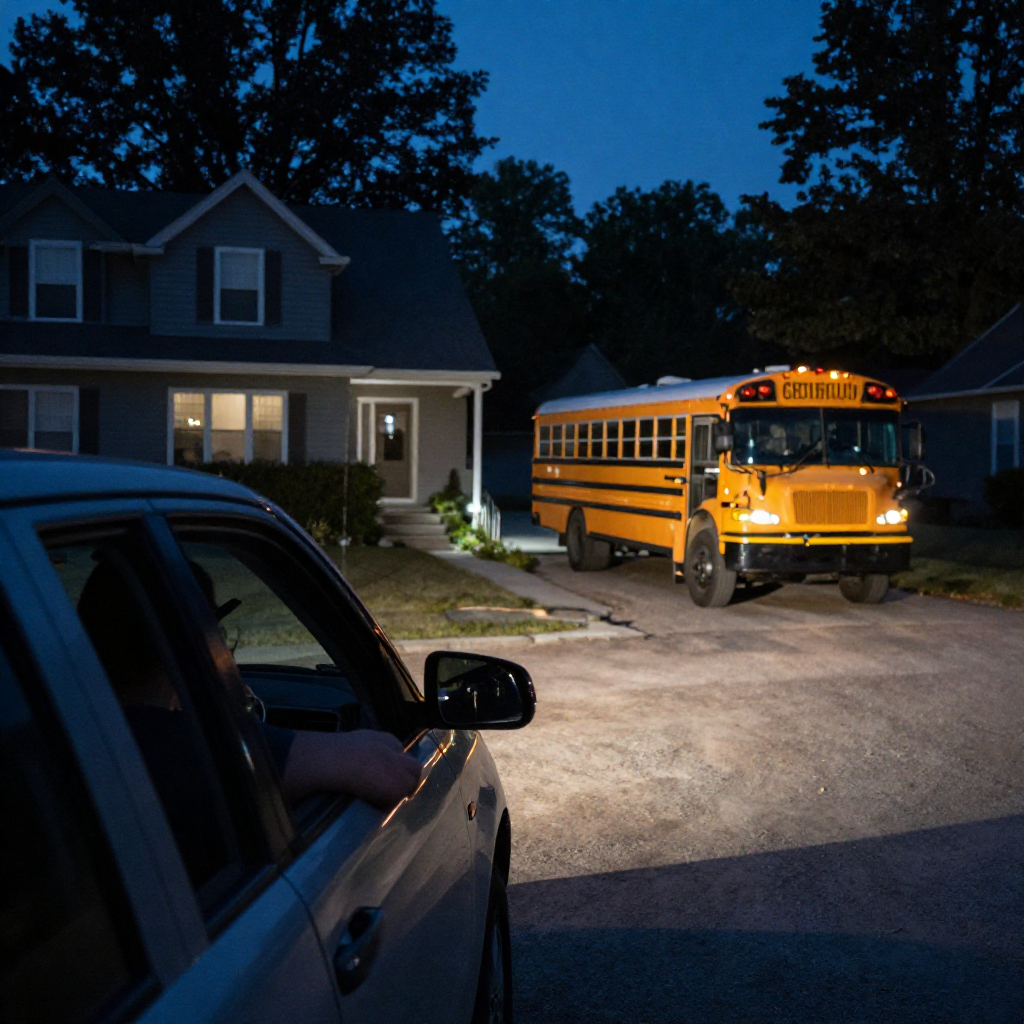
My seven-year-old daughter whispered it at bedtime.“Mommy, the bus driver stops at a house sometimes.”I was halfway through pulling her blanket up when I froze.“What house?”
She looked toward the bedroom door, as if she was afraid someone might be standing on the other side.
“A gray house.”
“What happens there?”
She lowered her voice.“He tells us to stay quiet. Then he goes inside.”“Who does?”“Mr. Doyle.”Our school bus driver.I tried to smile.“Maybe he has to check something.”She shook her head.
“He tells us not to look out the windows.”That smile disappeared.“How long does he stay?”
“Sometimes ten minutes.”
“Does he take anyone with him?”
“No. We stay on the bus.”“Does he ever bring someone back?”My daughter thought for a moment.“Sometimes.”My stomach tightened.“Who?”“I don’t know.”She pulled the blanket up to her chin.“Mommy?”“Yes?”
“Are we supposed to tell?”I sat beside her.“You can tell me anything.”She nodded.“Okay.”
Then she whispered something that kept me awake until morning.
“He always looks scared when he comes back.”
The next morning, I called the school.I expected the answer to be simple.Instead, the secretary laughed.“Mr. Doyle? He’s been driving Route 12 for eighteen years.”“Does he make unauthorized stops?”
“Absolutely not.”“I mean off the route.”There was a pause.“No. Why?”
I told her what my daughter had said.
Her voice changed immediately.
“I’ll have the transportation supervisor call you.”
Twenty minutes later, a man named Mr. Harris called.
He was polite.
Professional.
And completely unconcerned.
“Mrs. Carter, I spoke with Mr. Doyle. He says there is no regular stop at a gray house.”
“My daughter says there is.”
“He’s been driving for eighteen years. He’s one of our most reliable drivers.”
“Could you check the GPS?”
Another pause.
“We don’t generally track every turn in real time.”
That answer bothered me.
“Could you check anyway?”
“I’ll look into it.”
I hung up.
I should have left it there.
Instead, I kept thinking about my daughter’s words.
Stay quiet.
Don’t look out the windows.
He looks scared.
That afternoon, I sat in my car two blocks from the school.
I told myself I was only going to follow the bus for a few minutes.
I wasn’t spying.
I wasn’t accusing anyone.
I was simply trying to understand what my daughter had seen.
At 3:18, the yellow bus pulled away.
I followed.
Route 12 traveled through the usual neighborhoods.
Elementary school.
Grocery store.
Church.
Three residential streets.
Then, about four miles into the route, Mr. Doyle did something I hadn’t expected.
He turned left.
Onto a dirt road.
I slowed down.
There was no sign.
No intersection marker.
Nothing.
The bus disappeared behind a row of trees.
I followed.
The dirt road was narrow and uneven.
Then I saw it.
A gray ranch house.
One story.
Old.
The paint was peeling around the windows.
There was no mailbox.
No visible house number.
The bus stopped in front.
Six children were sitting inside.
Mr. Doyle opened the folding door.
He stepped down.
Then he looked around.
Not casually.
Carefully.
Like someone checking whether he was being watched.
I ducked lower in my driver’s seat.
He walked toward the house.
I started the timer on my phone.
One minute.
Two.
Five.
The children remained completely silent.
At seven minutes, one little boy stood up.
The older girl beside him grabbed his arm and pulled him back into his seat.
Even from my car, I could see her shaking her head.
Stay quiet.
My daughter’s words echoed in my mind.
At ten minutes, Mr. Doyle still hadn’t returned.
At thirteen minutes, the front door opened.
He came out.
But he wasn’t alone.
A woman followed him onto the porch.
She looked pale.
She was wearing a long gray sweater and had dark hair tied loosely behind her head.
Mr. Doyle said something to her.
She shook her head.
Then he walked back to the bus.
The woman stayed on the porch.
I lifted my phone and recorded.
Mr. Doyle climbed aboard.
The bus pulled away.
I stayed where I was.
I stared at the house.
There was something wrong about it.
I called the police.
A patrol officer arrived about fifteen minutes later.
His name was Officer Reed.
I showed him the video.
He watched it twice.
Then he asked, “Do you know who owns the property?”
“No.”
He ran the address through his computer.
His expression changed.
“What?”
He didn’t answer immediately.
He looked at me.
Then back at the screen.
“This house is registered to a woman named Elena Doyle.”
My heart stopped.
“Doyle?”
“Yes.”
“Is she related to the bus driver?”
“That’s what I’m trying to determine.”
He typed for another few seconds.
Then his face became even more serious.
“She filed a missing-person report two years ago.”
I stared at him.
“What?”
“Your bus driver is Daniel Doyle, correct?”
“Yes.”
Officer Reed leaned back.
“Mrs. Elena Doyle disappeared two years ago.”
I looked toward the gray house.
“But I just saw her.”
Officer Reed looked at the video again.
“Are you certain that’s the woman?”
“Yes.”
“Absolutely?”
“Yes.”
He called another officer.
Within twenty minutes, there were three police cars outside the house.
I watched from my vehicle as Officer Reed and another officer approached the front door.
They knocked.
Nothing.
They knocked again.
Still nothing.
Then the door opened.
Mr. Doyle stood there.
His face went white when he saw the police.
Officer Reed said something.
Mr. Doyle looked toward my car.
Our eyes met.
For a moment, he looked angry.
Then terrified.
Officer Reed stepped inside.
The other officer followed.
Several minutes passed.
Then I heard shouting.
A woman screamed.
The officers came back outside.
One of them was supporting the woman I’d seen on the porch.
She was crying.
Mr. Doyle came out behind them.
Officer Reed turned toward him.
“What is in the house?”
Mr. Doyle stared at the ground.
“Please.”
“What is in the house?”
“You don’t understand.”
“Then explain it.”
Mr. Doyle looked toward me.
His voice broke.
“That woman in there is my wife.”
Officer Reed stared at him.
“She was reported missing two years ago.”
“I know.”
“Then why didn’t you report that she’s here?”
Mr. Doyle closed his eyes.
“Because she didn’t want to be found.”
That was when everything became even stranger.
The police searched the house.
They found no weapons.
No drugs.
No stolen property.
But they found a bedroom that looked untouched.
Photographs.
Clothes.
Medical records.
And dozens of handwritten notes.
All addressed to a woman named Elena.
The story came out slowly.
Two years earlier, Elena Doyle had been diagnosed with an aggressive form of early-onset dementia.
She was only forty-three.
At first, the symptoms were mild.
Forgetfulness.
Confusion.
Sudden panic.
Then she began forgetting where she lived.
Who Daniel was.
Who their children were.
One evening, she wandered away.
Daniel found her six hours later near a highway.
She didn’t recognize him.
She was terrified of him.
The doctors recommended assisted living.
But Elena refused.
She became convinced that strangers were trying to take her away.
She would run whenever anyone mentioned a hospital.
Daniel tried to get her help.
Then one morning, she disappeared again.
This time, Daniel didn’t find her for three days.
When he finally did, she was living inside an abandoned house several miles away.
She believed it belonged to her.
She had somehow obtained the key from the previous owner.
Daniel brought her home.
But she became violent.
Not because she wanted to hurt anyone.
Because she didn’t know him.
She saw him as a stranger.
The doctors told Daniel that if he forced her into institutional care, she might never forgive him.
But Elena was no longer capable of making safe decisions.
So Daniel made one of the worst choices of his life.
He bought the gray house.
He turned it into a private refuge.
He told the school nothing.
He told his coworkers nothing.
He told the police nothing.
Every afternoon, he drove Route 12 past the house.
And when Elena was having a good day, he would stop.
The children stayed on the bus because he couldn’t leave them alone.
But there was another part of the story.
The police discovered something Daniel hadn’t mentioned.
The six children on the bus weren’t supposed to be there during the stop.
They had been instructed by Daniel to remain quiet.
Why?
Because Elena believed children were dangerous.
She had once attacked a neighbor’s daughter after mistaking her for someone else.
Daniel was terrified that if Elena saw the children, she’d panic.
So every few days, he stopped at the house.
He checked on Elena.
He brought her food.
He brought medication.
He cleaned the house.
And he went back to driving the bus.
He had been doing it for nearly two years.
But the most shocking discovery came from Elena herself.
Officer Reed found a notebook in the bedroom.
The first pages were written in Daniel’s handwriting.
The last twenty pages were written by Elena.
Most were incoherent.
But one sentence appeared repeatedly.
“I am not missing.”
Another appeared beneath it.
“Daniel is protecting me.”
And another.
“I don’t want my children to see me like this.”
That sentence explained why Daniel had never told anyone.
They had two adult children.
Both lived out of state.
Neither knew their mother was alive.
Daniel had told them she had died.
At first, the lie seemed unforgivable.
But when the police asked why, he finally confessed.
Elena had begged him.
She knew she was losing herself.
She knew her children remembered her as strong, funny, and independent.
She didn’t want them to watch her disappear piece by piece.
So Daniel promised.
He would let them believe she was gone.
He would care for her himself.
Until he couldn’t.
But there was one thing Daniel hadn’t expected.
The bus route.
He couldn’t afford to quit.
And he couldn’t afford full-time care.
So the gray house became Elena’s world.
And Route 12 became Daniel’s lifeline.
Every afternoon, he checked on her.
Thirteen minutes.
Sometimes ten.
Sometimes twenty.
Sometimes longer.
My daughter had noticed because she was observant.
But there was one detail she had gotten wrong.
Daniel wasn’t telling the children to stay quiet because he was hiding something criminal.
He was telling them because Elena was sleeping.
And if she woke up confused, she might wander outside.
The children didn’t know that.
All they knew was that their driver disappeared into a strange gray house.
For two years.
That should have been the end.
But it wasn’t.
Because Officer Reed found something else.
A locked cabinet in the basement.
Inside were medical documents.
Hospital discharge papers.
Medication bottles.
And a stack of photographs.
The photographs were of Elena and Daniel.
But the newest photograph was dated three days before my daughter told me about the house.
In it, Elena was sitting on the porch.
She was smiling.
And beside her was a little girl.
My daughter.
I felt the room disappear around me.
I grabbed the photograph.
“That isn’t possible.”
Officer Reed frowned.
“Do you recognize the child?”
“That’s my daughter.”
He looked at the photograph.
Then at me.
The date was real.
Three days earlier.
I looked at Daniel.
“What happened?”
He said nothing.
I demanded an answer.
Finally, Elena stepped forward.
She looked at me with tears in her eyes.
“I remember her.”
My daughter had apparently seen Elena before.
Not just from the bus.
One afternoon, while waiting for another child to get on, she had looked through the window.
Elena had been standing outside.
My daughter had waved.
Elena waved back.
Daniel had panicked.
He told the children to stay quiet because Elena was confused.
But my daughter kept looking.
And Elena remembered her face.
“She looks like my daughter,” Elena whispered.
I looked at Daniel.
“Your daughter?”
He nodded.
Their daughter had died when she was six.
A childhood illness.
Thirty years ago.
Elena’s dementia had begun blending the past with the present.
Sometimes she believed the children on Route 12 were students she used to teach.
Sometimes she believed they were her grandchildren.
Sometimes she believed they were strangers.
But my daughter looked enough like her daughter that Elena had begun recognizing her.
That was why Daniel kept stopping.
Not only to care for Elena.
But because Elena wanted to see the little girl.
The police eventually arranged for Elena to receive professional care.
Daniel was placed on administrative leave while the school investigated his unauthorized route deviation.
The parents of the other children were furious.
Some called him a criminal.
Others called him a hero.
I couldn’t decide.
Because what he had done was wrong.
He had endangered children by leaving the bus.
He had lied to the school.
He had hidden his wife from authorities.
But he had also spent two years trying to protect a woman who was slowly losing herself.
There were no clean answers.
A month later, my daughter asked about him.
“Is Mr. Doyle coming back?”
“I don’t know.”
“Is the gray house still there?”
“Yes.”
“Is the lady okay?”
I hesitated.
“She has doctors helping her now.”
My daughter nodded.
Then she asked the question I wasn’t prepared for.
“Did she remember me?”
I smiled.
“Yes.”
My daughter smiled too.
“Good.”
That night, I tucked her into bed.
Before I left, she whispered,
“Mommy?”
“Yes?”
“Sometimes people disappear even when they’re still alive, right?”
I sat beside her.
“Yes.”
“Because they forget?”
“Sometimes.”
She thought about it.
“Then maybe remembering someone is like finding them.”
I kissed her forehead.
“Maybe it is.”
Months passed.
The school eventually changed Route 12.
Mr. Doyle never returned to driving.
Elena moved into a specialized care facility.
Her children were finally told the truth.
They came home.
They spent weeks sitting beside their mother.
Sometimes she recognized them.
Sometimes she didn’t.
But according to Daniel, there was one person she almost always remembered.
My daughter.
One Saturday, I took my daughter to visit her.
Elena was sitting near a window.
When she saw us, she smiled.
Then she said my daughter’s name.
Perfectly.
No hesitation.
My daughter ran to her.
Elena held her hand.
For several minutes, they didn’t speak.
Then Elena looked at me.
“Thank you.”
I shook my head.
“I didn’t do anything.”
“You noticed.”
She squeezed my daughter’s hand.
“Most people don’t notice when someone disappears.”
That sentence stayed with me.
Because she was right.
We think missing people vanish suddenly.
Sometimes they don’t.
Sometimes they disappear slowly.
Behind a diagnosis.
Behind a locked door.
Behind a lie told out of love.
Behind someone’s desperate attempt to protect them.
And sometimes, all it takes to find them is a seven-year-old child paying attention on a school bus.
Years later, my daughter still remembers Route 12.
She remembers the gray house.
She remembers Mr. Doyle.
But she remembers one thing most clearly.
The afternoon she looked through the bus window and saw an old woman standing on the porch.
Everyone else had looked away.
My daughter waved.
And the woman waved back.
That tiny moment became the reason a missing woman was finally found.
Not because the police had a breakthrough.
Not because a detective solved a mystery.
Because a child noticed something adults had stopped seeing.
A person.
Still alive.
Still waiting.
Still hoping someone would remember her.
And sometimes, that is enough to bring someone home.