The first time my six-year-old daughter asked me about the lunch lady, I laughed.Not because it was funny.Because I was tired.It was Wednesday evening, only three days into her first week of first grade,
and I was standing at the kitchen counter trying to cut grapes in half while answering an email from work with one hand.
My daughter, Lily, sat at the table with her legs swinging beneath her chair.
“Mommy?”“Hmm?”
“Why does the lunch lady keep me in the classroom when everybody goes outside?”My knife stopped.I looked at her.“What?”She shrugged.“The lunch lady. She keeps me in the classroom.”
I put my phone down.“Maybe you mean your teacher?”“No.”“Mrs. Carter?”Lily shook her head.
“The lunch lady.”
“What does she look like?”
Lily thought for a moment.“She wears a blue shirt.”“That sounds like someone who works in the cafeteria.”“She has a little silver thing on her shirt.”“A name tag?”“Yes.”I smiled.
“Maybe she came to your classroom to get something.”“She comes every day.”That smile disappeared.“Every day?”Lily nodded.
“What happens?”
“She tells everyone to go outside. Then she tells me I have to stay.”
“Why?”“She doesn’t say.”“Does your teacher stay?”“No.”“Does your teacher know?”Lily looked down at her hands.“I don’t know.”I crouched beside her.“Sweetheart, did you do something wrong?”
She shook her head quickly.“No.”“Did someone tell you that you were in trouble?”“No.”
“Did the lunch lady touch you?”
Lily’s eyes widened.
“No.”
“Okay.”
I kissed her forehead.
“Then maybe everybody just got mixed up. We’ll ask your teacher tomorrow.”
She nodded.
Then she went back to coloring.
I told myself it was nothing.
Kids misunderstand things.
Teachers change routines.
Maybe Lily had been confused about recess.
Maybe she’d been kept inside for unfinished work.
Maybe there was a completely ordinary explanation.
I wanted there to be.
The next evening, she asked again.
“The lunch lady kept me inside today.”
I felt something tighten in my chest.
“Did she?”
“Yes.”
“Did your teacher say why?”
“No.”
“Did you ask?”
Lily shook her head.
“Why not?”
“She told me not to.”
My stomach dropped.
“What exactly did she say?”
Lily stared at the table.
“She said, ‘Don’t ask questions, honey.’”
I stood there very still.
That night, I emailed Lily’s teacher.
Mrs. Carter responded the next morning.
She said Lily had not been assigned detention or any special recess restriction. She also said she hadn’t noticed Lily missing recess.
I read that sentence three times.
Hadn’t noticed?
I called the school.
The receptionist assured me everything was normal.
I almost believed her.
Then Friday came.
I left work early.
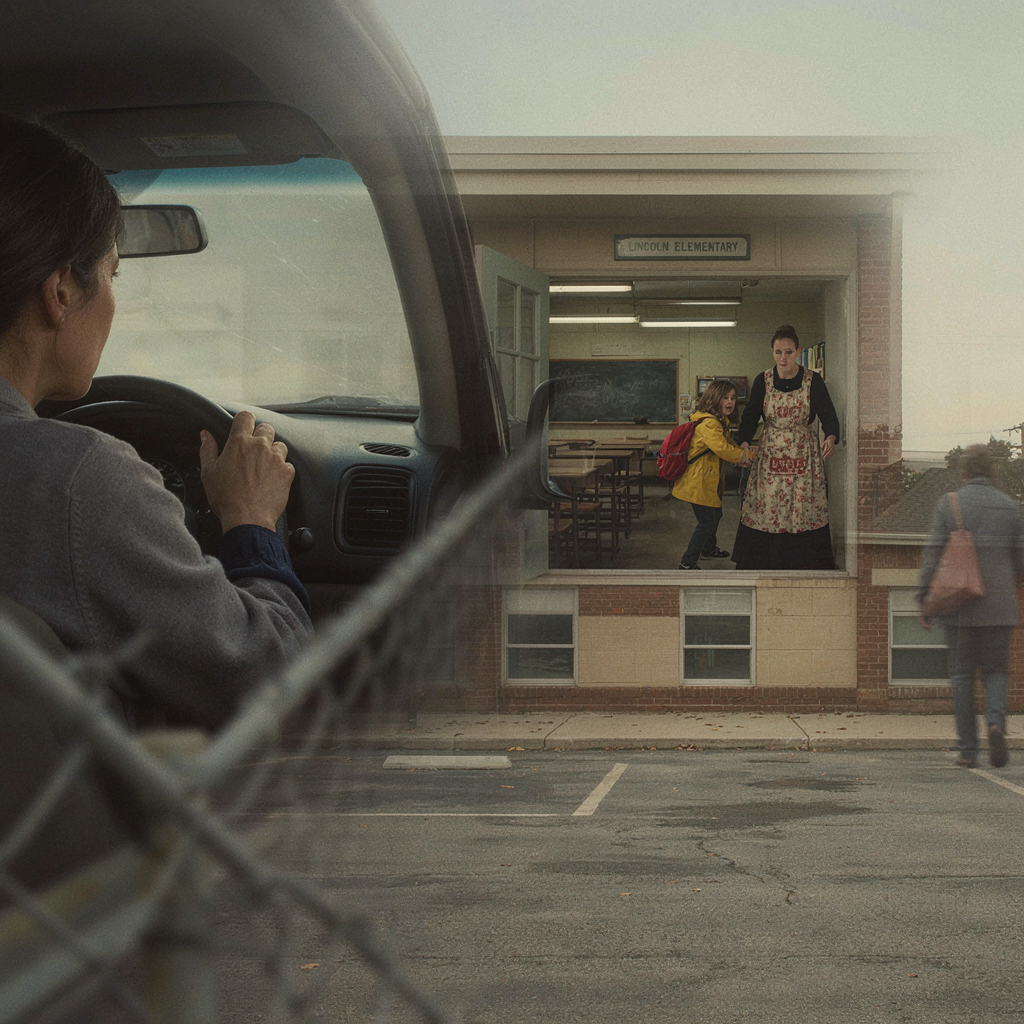
Instead of going home, I drove to Lily’s school and parked across the street.
I told myself I was being an overprotective mother.
I told myself I was going to watch recess for five minutes, see Lily run outside with her friends, and feel embarrassed about the whole thing.
At 12:35, the bell rang.
The classroom door opened.
Children poured into the hallway.
Then the playground filled with noise.
I watched through the windshield.
One child after another ran outside.
Twenty-three.
Twenty-four.
Then the door closed.
I waited.
My daughter hadn’t come out.
My heart started pounding.
A minute later, the door opened again.
A woman stepped into the hallway.
Blue shirt.
Dark pants.
Hair pulled into a bun.
Silver name tag.
She looked toward the playground.
Then she turned back into the classroom.
And shut the door.
I was out of my car before I could think.
I crossed the street.
I pushed through the front doors of the school.
“Ma’am,” the receptionist called.
I didn’t answer.
I reached the hallway.
The classroom door was closed.
I grabbed the handle.
Locked.
I knocked once.
No response.
“Lily?”
Nothing.
I knocked harder.
“Lily!”
The door opened.
The woman in the blue shirt stood there.
She looked startled.
Behind her was my daughter.
Sitting alone at a desk.
My daughter looked at me.
And instead of running into my arms, she whispered:
“Mommy, you’re not supposed to be here.”
The woman’s face went pale.
I looked at her.
“Who are you?”
She swallowed.
“I’m Denise. I work in the cafeteria.”
“Why is my daughter here?”
“I was asked to—”
“By whom?”
She stopped.
“By whom?”
“I can’t discuss—”
“You absolutely can.”
Lily stood up.
I crossed the room and took her hand.
“Come here.”
She ran to me then.
Her fingers wrapped around mine.
They were ice cold.
I turned back to Denise.
“Why have you been keeping my daughter in this room during recess?”
Denise looked toward the hallway.
“I haven’t been keeping her.”
“Then why is she here?”
“I was told to bring her.”
“Who told you?”
She opened her mouth.
Then closed it.
And that hesitation told me everything.
Someone had told her.
But she didn’t want to say who.
I took Lily home.
I called the principal.
He insisted there had been a misunderstanding.
A “communication issue.”
He said there was a temporary behavior-support procedure being piloted in first grade.
I asked why I hadn’t been informed.
He said Lily wasn’t being punished.
I asked why a cafeteria employee was involved.
He said he would investigate.
I asked who authorized it.
Silence.
That was when I stopped listening.
I picked Lily up from school every day after that.
For the next week, nothing happened.
No lunch lady.
No locked classroom.
No unexplained recesses.
I thought maybe it really had been a bizarre mistake.
Then, on Thursday night, Lily woke me at 2:17 a.m.
“Mommy?”
I turned on the lamp.
She stood beside my bed holding something.
“What is it?”
She handed it to me.
A small yellow envelope.
My name was written on it.
Not “Mom.”
My full name.
“Where did you get this?”
“From my backpack.”
I opened it.
Inside was a photograph.
It showed Lily sitting at a desk in her classroom.
Alone.
The date was printed across the bottom.
It was from the previous week.
The photograph had been taken from the hallway through the narrow glass panel beside the classroom door.
On the back were four words.
SHE REMEMBERS MORE NOW.
I couldn’t breathe.
“Lily,” I whispered.
“Who gave you this?”
She shook her head.
“The lunch lady.”
I immediately called the principal.
Then I called the police.
By morning, the school was surrounded by investigators.
The woman named Denise was questioned.
She cried.
But she kept saying the same thing.
“I didn’t take the picture.”
“Who did?”
“I don’t know.”
“Who told you to keep Lily inside?”
She wouldn’t answer.
Then one investigator asked her a different question.
“Did you ever see Lily before this school year?”
Denise looked at him.
And nodded.
“Yes.”
“When?”
She looked at me.
“Six years ago.”
The room went silent.
I felt my knees weaken.
“Where?”
Denise wiped her face.
“At the hospital.”
I stared at her.
“What hospital?”
She gave the name.
It was the hospital where Lily had been born.
The hospital where I’d spent three days after an emergency delivery.
The hospital where I’d been told there had been complications.
The hospital where my husband had died two years later.
I didn’t understand.
“What were you doing there?”
Denise hesitated.
“I wasn’t working in the cafeteria then.”
“What were you doing?”
She whispered:
“I was a nurse.”
My heart stopped.
The investigator leaned forward.
“You cared for the baby?”
Denise nodded.
“I was on the night shift.”
“Why would you recognize her?”
Denise looked at Lily.
“Because I was there the night her mother was told she was dead.”
I stared at her.
“My daughter wasn’t dead.”
“I know.”
“Then what are you talking about?”
Denise reached into her bag.
She pulled out a folded piece of paper.
“It was supposed to be destroyed.”
She handed it to the investigator.
He read it.
Then his expression changed.
“What is it?”
He looked at me.
“It’s a neonatal transfer record.”
I didn’t understand.
Denise explained.
“The night Lily was born, another baby was born in the room next to yours.”
I shook my head.
“So?”
“The other baby’s mother died during childbirth.”
My throat tightened.
“What does that have to do with Lily?”
Denise looked down.
“The babies were switched.”
The room spun.
“No.”
“I was there,” Denise said. “I saw it happen.”
The investigator asked, “Who switched them?”
Denise looked terrified.
“The doctor.”
Everything I thought I knew about my daughter’s life fractured in a single second.
The investigator continued.
“Why?”
Denise’s voice trembled.
“Because the other baby’s father had money.”
I couldn’t speak.
Lily was six years old.
Six years.
Every birthday.
Every fever.
Every scraped knee.
Every first word.
Every night I’d held her while she slept.
And now someone was telling me she might not be biologically mine.
But then Denise said something that made the blood drain from my face.
“Your daughter wasn’t the only thing that was switched.”
“What else?”
“The records.”
She explained that the doctor had falsified the paperwork.
The baby born to the wealthy family had been declared mine.
My biological daughter had been declared theirs.
But there was a problem.
The wealthy family never took the baby.
Because their mother was dead.
And their father had disappeared.
So Lily remained with me.
I stared at her.
“Then why now?”
Denise looked at the floor.
“Because someone recently found out.”
“Who?”
She didn’t answer.
The investigator did.
“Let’s start with the doctor.”
They found him that afternoon.
He was retired.
Living in another state.
And he had no idea the records still existed.
But he wasn’t the person who had been watching Lily.
That became clear when investigators searched the school’s security footage.
There was a man entering the building three days before school started.
He wasn’t a teacher.
He wasn’t staff.
He wasn’t a parent.
He had used an old access card.
And he had been standing outside Lily’s classroom for eleven minutes.
The footage showed him holding a folder.
On the folder was Lily’s name.
The investigators traced the access card.
It belonged to a former school administrator who had died two years earlier.
But someone had copied it.
And then they found the same man on another camera.
He was leaving the school in a blue sedan.
The license plate belonged to a woman named Rebecca Hale.
I didn’t know the name.
Until the police showed me her photograph.
I recognized her immediately.
She was the woman who had lived across the street from us for nearly a year.
The woman I thought was simply an older neighbor.
The woman who had waved at Lily.
The woman who had once asked me how old my daughter was.
She was also the daughter of the wealthy family.
And she had spent six years searching for the baby she believed had been stolen from her family.
But there was another twist.
Rebecca wasn’t trying to take Lily.
She was trying to protect her.
She told investigators that she’d discovered the records months earlier.
She learned that the doctor had switched the babies.
She learned that her biological sister had been raised by another family.
But she also discovered something else.
The doctor hadn’t acted alone.
Someone at the school had been helping him hide the records.
Someone who still worked there.
That person was the principal.
The same principal who had told me there was a “communication issue.”
The same principal who had refused to tell me who ordered Lily’s recess isolation.
He had known about the records.
He had known about the photograph.
And he had ordered Denise to keep Lily inside.
But why?
Because someone was trying to determine whether Lily remembered something from when she was younger.
Something impossible.
A memory from the day she was born.
The principal believed Lily might have overheard adults discussing the switch when she was still an infant.
It sounded absurd.
Until Denise explained the real reason.
Lily had been born with a distinctive medical bracelet.
The bracelet had been placed around her ankle.
It carried a number.
That number matched the other baby’s records.
The bracelet had disappeared.
For six years, nobody knew where it was.
Until Lily brought it home from school.
She pulled it out of her backpack.
I stared at the tiny plastic band.
I had never seen it before.
On it was a number.
The same number listed on the original hospital record.
The investigator stared at it.
“Where did you get this?”
Lily pointed toward the school.
“Mrs. Carter gave it to me.”
My blood ran cold.
Mrs. Carter.
Lily’s teacher.
The woman I had trusted.
The woman who had told me she knew nothing about Lily being kept inside.
She was arrested the next morning.
She confessed.
She had found the bracelet in an old storage box while cleaning out a cabinet.
She recognized the number.
She knew what it meant.
But she didn’t know who Lily really was.
So she watched her.
She photographed her.
She tested her.
And the recess isolation was part of that.
She wanted to see whether Lily would mention the bracelet.
She wanted to know if Lily remembered the hospital.
And Denise had been ordered to help because Denise had been there that night.
But Denise eventually became frightened.
That’s why she’d secretly given Lily the photograph.
She wanted me to investigate.
She just hadn’t known how to tell me.
Three weeks later, the DNA results came back.
Lily was not biologically related to me.
I thought I would collapse.
Instead, I sat very still.
Because there was something else I had learned during those three weeks.
Biology wasn’t the same thing as motherhood.
Lily was my daughter.
She had been my daughter every morning she climbed into my bed.
Every night I checked for monsters under hers.
Every birthday candle.
Every scraped knee.
Every school picture.
Every terrible drawing I’d proudly taped to the refrigerator.
DNA didn’t get to erase six years.
But we still had to find her biological family.
The investigation revealed that Rebecca was, in fact, Lily’s biological aunt.
Her biological father had died before Lily was born.
Her biological mother had died during childbirth.
Rebecca had spent years believing her family had lost the baby forever.
When she finally learned the truth, she didn’t come for Lily.
She came to make sure nobody could hurt her.
That explained the blue sedan.
The photographs.
The strange woman watching from across the street.
She had been afraid to approach us.
Afraid that whoever had hidden the records might hurt Lily if they knew Rebecca had found her.
And the lunch lady?
Denise had been trying to help.
She had kept Lily inside because she knew someone was watching the school.
She thought she was protecting her.
She had never imagined I would discover the truth by watching through a windshield.
Months later, Lily asked me if she had done anything wrong.
We were sitting together on the porch.
“No,” I told her.
“Then why did everybody keep secrets?”
I looked at her.
“Because grown-ups sometimes make terrible choices.”
“Are you mad at me?”
My heart broke.
“Never.”
“Even though I’m not really your daughter?”
I pulled her into my arms.
“You are my daughter.”
“But I’m someone else’s daughter too.”
I smiled through my tears.
“Yes.”
She thought about that.
“Can I have two families?”
“You can have as many people who love you as you want.”
She leaned against me.
“Does that mean I still get pancakes on Saturday?”
I laughed.
“Every Saturday.”
She smiled.
Then she asked:
“Can Rebecca come?”
I looked toward the street.
A woman stood beside a blue sedan.
Rebecca.
She waved.
I waved back.
Lily jumped up.
She ran toward her.
I watched them embrace.
And for the first time since that terrible Friday, I didn’t feel afraid.
I thought back to the moment I had seen the classroom door close.
The moment I had gotten out of my car.
The moment I had run inside.
If I had stayed home that day, maybe the truth would have remained buried.
Maybe another photograph would have appeared.
Maybe someone else would have decided what happened to my daughter.
But I hadn’t stayed home.
I had watched.
I had asked questions.
And when my daughter told me something felt wrong, I believed her.
Six-year-olds don’t always understand what adults are hiding.
But sometimes they understand that something is wrong long before we do.
And sometimes the smallest voice in the room is the one telling you the truth.
Lily came running back to me.
“Mommy!”
I opened my arms.
She crashed into them.
“I forgot something!”
“What?”
She whispered into my ear.
“The lunch lady said one more thing.”
I froze.
“What did she say?”
Lily grinned.
“She said you’re a really good mommy.”
I looked across the yard.
Denise was standing beside her car.
She gave me a small smile.
I smiled back.
Then Lily grabbed my hand.
“Come on.”
“Where?”
“Pancakes.”
I laughed.
And we walked inside together.
This time, there were no locked doors.
No secrets.
No photographs taken from hallways.
Just my daughter holding my hand.
And for the first time, I understood something I should have known all along:
Sometimes protecting a child doesn’t mean knowing all the answers.
Sometimes it simply means believing them when they say,
“Mommy, something isn’t right.”