They Called Me Worthless—Then Came Begging at My Door
For years, I sent my brother $5,000 every month.Not because he asked nicely.Not because he always thanked me.And certainly not because I had money to waste.I sent it because he was my brother.Because my mother always told me, “Family takes care of family.”
Because when my father died, my mother had looked at me through tear-filled eyes and said, “Your brother needs you now more than ever.”
So I helped.
Month after month.
Year after year.$5,000.That was $60,000 every year.Over eight years, I had sent him nearly half a million dollars.I never kept track.At least, I never wanted to.I told myself that keeping score would make my kindness feel like a transaction.
My brother, Daniel, said he needed the money for his business.Then it was for his mortgage.Then for medical bills.
Then for his children’s school.
Then for “temporary cash-flow problems.”
There was always a reason.And every time, I believed him.I had built a successful consulting company in my thirties. I worked hard, lived below my means, and invested carefully.Daniel had always been different.
He was charming.Confident.The kind of man who could walk into a room with nothing and leave with everyone believing he owned the building.
My mother adored that about him.
She called him “the strong one.”
I was the responsible one.
The quiet one.
The one who could be counted on.
And somehow, being the one who could be counted on had become my punishment.
I never complained.
Until my birthday.
That was the day everything changed.
My mother had invited everyone to her house for dinner.
My brother arrived late, as usual.
He walked through the front door wearing an expensive watch I had never seen before.
He hugged my mother.
She smiled proudly.
Then he looked at me.
“Happy birthday,” he said.
“Thank you.”
He sat down and began eating.
For almost an hour, everything was normal.
Then my mother brought out the cake.
Everyone sang.
I smiled.
I blew out the candles.
And for a few seconds, I felt genuinely happy.
Then Daniel laughed.
“What?” I asked.
He leaned back in his chair.
“I was just thinking about how funny life is.”
“What do you mean?”
He looked directly at me.
“You spend all this time pretending you’re successful.”
The room became quiet.
I smiled awkwardly.
“Daniel, it’s my birthday.”
“I know.”
“So maybe don’t ruin it.”
He laughed again.
My mother didn’t say anything.
Daniel took a sip of his drink.
“You know what your problem is?”
I stared at him.
“You actually think you made it on your own.”
My stomach tightened.
“What are you talking about?”
“You couldn’t survive without me.”
I almost laughed.
“Excuse me?”
He leaned forward.
“You heard me.”
My mother finally spoke.
“Daniel…”
But there was no warning in her voice.
Only irritation.
Not toward him.
Toward me.
Daniel continued.
“All these years, you’ve been sending me money like you’re some kind of savior.”
I froze.
“You asked me for that money.”
“So?”
“So don’t pretend I forced it on you.”
He smiled.
“That money didn’t make you important.”
I stared at him.
“You’ve received nearly half a million dollars from me.”
“And?”
“And you just called me worthless?”
He shrugged.
“You are.”
The words landed harder than I expected.
My mother sighed.
“Enough.”
I looked at her.
Finally, I thought.
Finally, she was going to defend me.
Instead, she looked at me and said:
“You’re making this into something it isn’t.”
I couldn’t believe it.
“Mom, he just called me worthless.”
“He’s upset.”
“He’s been insulting me for years.”
“You’re his sister.”
“And he’s my brother.”
“Exactly.”
I shook my head.
“No. That’s not an excuse.”
Daniel slammed his hand on the table.
“You think you’re better than us because you have money!”
“No,” I said quietly.
“I never thought that.”
“Then stop acting like it.”
Something inside me finally broke.
I stood.
“You know what, Daniel? You’re right about one thing.”
He smirked.
“What?”
“I do have money.”
His smile faded.
“And I earned it.”
I pointed toward him.
“You didn’t earn the $5,000 I sent you every month.”
His jaw tightened.
“You didn’t earn the money for your house.”
I continued.
“You didn’t earn the money for your business.”
My mother’s expression hardened.
“And you certainly didn’t earn the right to call me worthless.”
Daniel stood.
“Get out.”
I looked at my mother.
She didn’t stop him.
Instead, she said:
“Maybe you should leave.”
I stared at her.
“This is your home?”
“Yes.”
“And I’m not welcome?”
She hesitated.
Then said:
“Not if you’re going to disrespect your brother.”
I laughed softly.
It wasn’t a happy laugh.
It was the kind of laugh that comes when something inside you has finally died.
I picked up my purse.
“Fine.”
I walked toward the door.
Behind me, my mother called out.
“And don’t come back until you apologize.”
I stopped.
I turned around.
“For what?”
“For causing this.”
I looked at Daniel.
Then at my mother.
And for the first time in my life, I didn’t beg.
I didn’t explain.
I didn’t defend myself.
I simply said:
“Okay.”
Then I walked away.
That night, I went home and sat alone in my kitchen.
I opened my banking app.
My finger hovered over Daniel’s monthly transfer.
Five thousand dollars.
Scheduled for the first of every month.
I stared at it for almost a minute.
Then I canceled it.
Not temporarily.
Permanently.
I also canceled the automatic payment for his mortgage.
The tuition payment for his oldest daughter.
The car payment I had quietly been making.
And the monthly transfer to my mother.
I sat there staring at the screen.
I expected to feel guilty.
Instead, I felt strangely calm.
The next morning, Daniel called.
I didn’t answer.
He called again.
Then again.
Finally, I received a text.
Are you seriously doing this because of yesterday?
I didn’t respond.
Another message arrived.
You are being childish.
Then:
Mom says you’re still angry.
I put my phone down.
A few hours later, my mother called.
I answered.
“Hello.”
“What did you do?”
“I canceled the payments.”
Silence.
Then:
“You can’t do that.”
“Why not?”
“Because your brother depends on that money.”
“That isn’t my responsibility anymore.”
“He’s your brother.”
“I know.”
“You’ve always helped him.”
“I know.”
“You can’t suddenly abandon your family.”
I closed my eyes.
“Mom, you told me I wasn’t welcome in your home.”
“That was because you were angry.”
“No. You meant it.”
“You’re being dramatic.”
I laughed.
“Maybe.”
Then I hung up.
For three days, nothing happened.
Then, on the fourth night, someone knocked on my door.
It was almost midnight.
I wasn’t expecting anyone.
I looked through the window.
And froze.
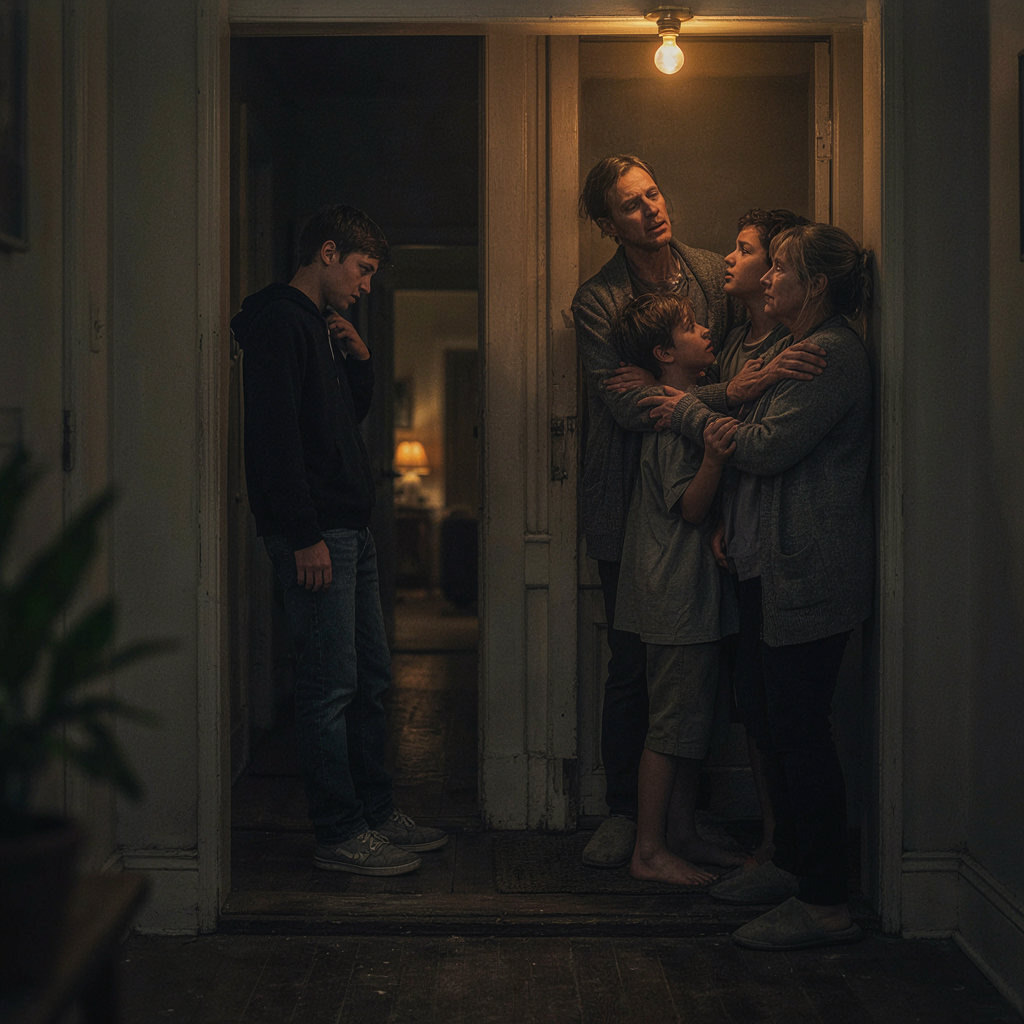
My mother stood outside.
Beside her was Daniel.
And behind them was his wife, Emily.
All three looked terrified.
I opened the door.
My mother stepped forward.
“Please.”
I had never heard her voice sound like that.
“Please help us.”
I looked at Daniel.
He was pale.
His expensive watch was gone.
His confident expression was gone.
He looked exhausted.
“What happened?”
Daniel swallowed.
“The bank froze our accounts.”
I said nothing.
“The mortgage is overdue,” Emily whispered.
I looked at her.
“Why?”
“Because the payment bounced.”
I stared at Daniel.
“You missed one payment?”
“No.”
He looked down.
“Three.”
I crossed my arms.
“And the business?”
“It’s worse.”
“How much?”
He didn’t answer.
I looked at my mother.
She began crying.
“Daniel borrowed money.”
“How much?”
Silence.
“Mom.”
She wiped her eyes.
“Almost $300,000.”
My stomach dropped.
“What?”
“He thought the business would recover.”
Daniel finally spoke.
“I was going to pay it back.”
“With what?”
He had no answer.
I stepped back.
“So you came here because I stopped paying your bills.”
Daniel nodded.
I looked at him for a long moment.
Then I asked:
“Do you remember what you called me on my birthday?”
His face changed.
“I was angry.”
“You called me worthless.”
“I didn’t mean it.”
“You said I couldn’t make it without you.”
“I was wrong.”
I shook my head.
“No.”
He looked at me.
“You weren’t wrong about me.”
I pointed toward myself.
“You were wrong about who needed whom.”
My mother started crying harder.
“Please don’t do this.”
“Do what?”
“Turn your back on us.”
I looked at her.
“You pushed me out.”
“I was wrong.”
“You chose him.”
“I know.”
“You told me I wasn’t welcome.”
“I know.”
“And now you’re standing on my doorstep because you need something.”
She lowered her head.
“I know.”
For the first time, I saw genuine shame in her eyes.
But shame didn’t erase eight years.
I stepped aside.
“Come in.”
They entered.
We sat around my dining table.
No one spoke.
Finally, I said:
“Tell me everything.”
Daniel explained.
His business had been struggling for almost two years.
He had taken loans to keep it alive.
He had borrowed against the house.
Then he had taken private loans with terrible interest rates.
He had been using the $5,000 monthly payments from me to cover the minimums.
My mother knew.
Emily knew.
Everyone knew.
Everyone except me.
I stared at him.
“You lied to me.”
“I was embarrassed.”
“You weren’t embarrassed when you bought the watch.”
He looked away.
“You weren’t embarrassed when you went on vacation.”
Silence.
“You weren’t embarrassed when you bought that new car.”
Daniel whispered:
“I thought I’d fix everything before you found out.”
I leaned back.
“How much do you owe?”
“Four hundred and twelve thousand.”
My eyes widened.
“How?”
“Loans. Credit cards. Business debt. Mortgage arrears.”
Emily began crying.
“We’re going to lose the house.”
I looked at her.
“Where are the children?”
“With my sister.”
That made me pause.
“How long?”
“Three days.”
I looked at Daniel.
“You haven’t told them?”
He shook his head.
“Daniel.”
“I didn’t know what to do.”
I sat silently.
Then I asked:
“Why didn’t you sell the house?”
He looked embarrassed.
“Because…”
“Because what?”
My mother answered.
“Your father left that house to both of you.”
I froze.
“What?”
Daniel looked at me.
“I never told you.”
“What did Dad leave?”
“The house.”
I stared at him.
“Our father’s house?”
He nodded.
“It’s jointly owned.”
I couldn’t breathe for a moment.
“Why didn’t I know?”
Daniel looked down.
“Because Mom handled the paperwork.”
I turned toward my mother.
“Is that true?”
She nodded slowly.
“Your father wanted both of you to have it.”
“Then why did Daniel control everything?”
She didn’t answer.
I suddenly remembered something.
After my father died, my mother had asked me to sign several documents.
She told me they were estate papers.
I had trusted her.
I hadn’t read them carefully.
“Mom…”
She started crying.
“I thought I was protecting you.”
“From what?”
“From Daniel.”
The room went silent.
“What does that mean?”
She looked at Daniel.
He closed his eyes.
Then he whispered:
“The house isn’t just collateral for my loans.”
My heart began pounding.
“What is it?”
He looked at me.
“The deed was changed.”
“When?”
“Seven years ago.”
My blood ran cold.
“Changed to whose name?”
He didn’t answer.
I stood.
“Whose name?”
My mother whispered:
“Yours.”
I stared at her.
“What?”
“The house is legally yours.”
I couldn’t speak.
Daniel looked devastated.
“I used it as collateral without telling you.”
I felt dizzy.
“You used my house?”
“I thought I’d repay the loan.”
“You risked my property?”
“I was desperate.”
“You stole from me.”
“I know.”
“No.”
I shook my head.
“You didn’t just steal money.”
I looked at my mother.
“You let him do it.”
She cried.
“I was afraid.”
“Afraid of what?”
“That Daniel would destroy himself.”
I laughed bitterly.
“So you sacrificed me instead.”
Nobody spoke.
Then Daniel pulled an envelope from his jacket.
He placed it on the table.
“What is that?”
“The loan documents.”
I opened them.
My name appeared repeatedly.
My signature appeared on one page.
I stared at it.
“That isn’t my signature.”
Daniel looked at the floor.
My mother covered her face.
My hands began shaking.
“Who signed this?”
No one answered.
I looked at Daniel.
“Who?”
He whispered:
“Mom.”
I slowly turned toward her.
“You forged my signature?”
She was sobbing now.
“I thought I could fix it.”
“You forged my signature.”
“I was desperate.”
I stood.
“Get out.”
My mother looked up.
“Please.”
“Get out.”
Daniel stood.
“Wait.”
“No.”
“I know I don’t deserve your help.”
“You’re right.”
“But there’s something else.”
I stopped.
“What?”
He took another document from the envelope.
“Read this.”
I looked at it.
It was a bank statement.
Not his.
Mine.
My eyes widened.
“What is this?”
Daniel’s face went white.
“Your investment account.”
I stared at the numbers.
There had been withdrawals.
Large ones.
Very large ones.
“How much?”
He whispered:
“$96,000.”
I looked at my mother.
She shook her head.
“I didn’t take it.”
I looked at Daniel.
He said nothing.
I felt something inside me collapse.
“You stole $96,000 from me?”
“I borrowed it.”
“You stole it.”
“I was going to repay it.”
“You used my money to pay your debts.”
“Yes.”
“And then called me worthless?”
Daniel began crying.
“I was ashamed.”
I stared at him.
“You should have been.”
He lowered his head.
Then something unexpected happened.
My mother stood.
She walked toward me.
And instead of asking for money, she said:
“I need you to know something.”
I waited.
“Your father was proud of you.”
I said nothing.
“He always said you were the strongest person in this family.”
My eyes filled with tears.
“Then why didn’t you treat me like it?”
She couldn’t answer.
“I thought if I protected Daniel, he would change.”
“He didn’t.”
“No.”
“And you thought I’d always forgive him.”
“Yes.”
I nodded slowly.
“That was your mistake.”
I walked to the door and opened it.
They left.
I didn’t give them money.
I didn’t promise anything.
I didn’t forgive anyone.
But the next morning, I made a phone call.
Not to my mother.
Not to Daniel.
To a lawyer.
I gave him every document.
Every bank statement.
Every suspicious signature.
Every transfer.
Every message.
Within days, the truth began coming out.
Daniel had been hiding debt for years.
My mother had helped him forge documents.
And there was one more thing.
The $5,000 monthly payments hadn’t been going entirely toward his family.
A significant portion had gone toward gambling debts.
For years, I had believed I was supporting my brother’s business.
I had actually been financing his addiction.
I felt betrayed.
But I also felt strangely relieved.
Because finally, I knew the truth.
The legal process took months.
Daniel was forced to sell the business.
The house was protected because it legally belonged to me.
The stolen money became part of a repayment agreement.
My mother had to admit what she had done.
And Daniel finally entered treatment for his gambling addiction.
I didn’t speak to him for almost a year.
Then one afternoon, I received a letter.
Not a text.
Not a phone call.
A letter.
It began:
Dear Sister,
I don’t expect you to forgive me.
I don’t even know if I deserve the chance to say this.
But I need you to know that you were never worthless.
I stopped reading for a moment.
Then continued.
You were the person everyone depended on because you were the only one strong enough to carry the weight.
And instead of being grateful, I hated you for reminding me of everything I wasn’t.
I called you worthless because I felt worthless.
I said you couldn’t survive without me because I was terrified that I couldn’t survive without you.
But the truth is, you were never the problem.
I was.
Mom was.
And we both hurt you because we knew you would keep forgiving us.
I wiped my eyes.
The final paragraph said:
I’m finally learning that family isn’t someone you can use forever and still call love.
Sometimes loving someone means accepting that they won’t rescue you anymore.
I hope someday I can become someone who deserves to call you my sister.
I folded the letter.
I didn’t forgive him that day.
But I didn’t throw it away either.
A year later, I saw him for the first time.
He looked different.
Older.
Sober.
Humble.
He didn’t ask for money.
He didn’t ask for anything.
He simply said:
“I’m sorry.”
I looked at him.
“I know.”
“I mean it.”
“I know.”
He nodded.
Then he turned to leave.
“Daniel.”
He stopped.
I handed him an envelope.
His eyes widened.
“What is this?”
“Something Dad left.”
Inside was an old photograph.
The four of us.
My father.
My mother.
Daniel.
And me.
Daniel stared at it.
On the back, my father had written:
My children. Never let money convince you that one of you is worth more than the other.
Daniel started crying.
I didn’t hug him.
Not yet.
But I stood beside him.
For the first time in years, neither of us needed anything from the other.
And maybe that was the beginning of healing.
As for my mother, things took longer.
Much longer.
She eventually apologized too.
But I learned something important:
Forgiveness doesn’t mean pretending nothing happened.
It doesn’t mean giving someone access to you again.
And it certainly doesn’t mean handing them your wallet.
Sometimes forgiveness is simply deciding that you will no longer allow someone else’s choices to control your peace.
I never sent Daniel $5,000 again.
I never paid his bills.
I never rescued him.
But years later, when he opened a small business again, I watched him build it himself.
Slowly.
Honestly.
One customer at a time.
When he made his first profitable month, he called me.
“I did it,” he said.
I smiled.
“I know.”
“And I didn’t borrow a dollar.”
“I know.”
There was a long silence.
Then he said:
“You were right.”
“About what?”
“I could survive without you.”
I smiled.
“And I could survive without you too.”
He laughed softly.
“That’s probably the healthiest thing we’ve ever said to each other.”
“Yes.”
We talked for another few minutes.
Then, before hanging up, he said:
“Thank you for not saving me.”
I closed my eyes.
That sentence meant more than any apology.
Because sometimes the greatest help you can give someone isn’t pulling them out of the hole.
It’s refusing to keep digging it deeper for them.
My mother eventually moved into a smaller apartment.
She and I slowly rebuilt our relationship.
There were boundaries.
Firm ones.
No secret loans.
No financial manipulation.
No choosing Daniel over me.
And no pretending the past didn’t happen.
But we learned how to speak honestly.
Years later, on my birthday, my mother came to my house.
She brought a cake.
A small one.
Nothing expensive.
Daniel came too.
He stood at my door holding a wrapped box.
“What is that?” I asked.
“Your birthday present.”
I opened it.
Inside was a simple silver frame.
Inside the frame was the old photograph of our family.
But underneath it was a new photograph.
The three of us.
My mother.
Daniel.
And me.
Taken that morning.
I looked at Daniel.
“Why this?”
He smiled.
“Because we finally became a family without money holding us together.”
I looked at my mother.
She was crying.
I laughed.
“Mom, you’re going to ruin the cake.”
She smiled through her tears.
“I already ruined enough things.”
We sat around my table.
The same kind of table where years earlier they had called me worthless.
But this time, nobody asked me for money.
Nobody insulted me.
Nobody expected me to save them.
We simply ate cake.
And for the first time in a very long time, I realized something.
Walking away from my family that night hadn’t destroyed my family.
It had forced the truth into the open.
I had spent years believing that love meant giving until there was nothing left.
I finally understood that real love has boundaries.
You can love someone without funding their mistakes.
You can forgive someone without trusting them immediately.
You can care about family without allowing them to destroy you.
And sometimes the person you have to rescue first…
is yourself.
That birthday changed my life.
Not because my brother called me worthless.
Not because my mother threw me out.
And not because they eventually came begging at my doorstep.
It changed my life because, for the first time, I finally believed something my father had written years earlier.
No amount of money determines a person’s worth.
And neither does the opinion of the people who failed to recognize it.
I wasn’t worthless.
I had simply spent too many years trying to prove my worth to people who benefited from me doubting it.
And once I stopped…
everything changed.