THE HOUSE JULIE NEVER STOPPED LOVING
I hadn’t stepped inside our beach house for twenty-six years.Not since Julie and I packed the last cardboard box into the trunk of our old Buick, locked the front door, and drove toward the city.We had told ourselves we’d be back.
Next summer.Then the summer after that.Then when the children were older.Then when work slowed down.
Then when we retired.
But life has a strange way of turning later into never.
The beach house sat on a narrow strip of coastline about three hours from the city. It wasn’t luxurious. Two bedrooms, one bathroom, a small kitchen, faded wooden floors, and a porch that looked directly toward the ocean.
But to Julie, it had been paradise.She insisted we keep it even after we moved.I didn’t understand why.We had a mortgage in the city. Two children in school. Jobs that demanded more of us every year.
The beach house became an expense.
Insurance.Property taxes.
Repairs.Bills.I suggested selling it dozens of times.Julie always refused.”No,” she’d say.”Why?””Because someday you’ll understand.”That was all.After we moved, Julie began visiting the house alone.Four times a year.
Spring.Summer.Autumn.Winter.Always alone.At first, I thought it was strange.Then I got used to it.
She’d leave on Friday morning with a small suitcase and return Sunday evening smelling faintly of saltwater and wood smoke.
Sometimes she’d bring back seashells.
Sometimes old photographs.
Sometimes nothing at all.
“What do you do there by yourself?” I’d ask.
“Remember.”
“Remember what?”
She’d smile.
“Everything.”
Our children thought it was ridiculous.
They grew up, went to college, married, and built lives of their own.
To them, the beach house was an old building full of our parents’ junk.
They never understood why their mother loved it.
Then, six months ago, Julie died.
A heart attack.
One minute she was standing in our kitchen making coffee.
The next, she was gone.
I was seventy-one years old, and suddenly the house we’d built our entire life around felt enormous.
Too enormous.
Her slippers were still beside the bed.
Her reading glasses were on the nightstand.
A half-finished book lay open on the sofa.
I couldn’t move any of it.
Our children tried to help.
They meant well.
But grief makes people impatient.
Not because they don’t care.
Because they don’t know what to do with it.
One afternoon, my son Daniel sat across from me at the kitchen table.
“Dad, we need to talk about the beach house.”
I knew immediately where this was going.
“We should sell it,” he said.
My daughter Emily nodded.
“It’s costing money, Dad. And you haven’t been there in twenty-six years.”
“I know.”
“You don’t need it.”
“I know.”
“And Mom’s gone.”
I looked at her.
She immediately regretted saying it.
But it was true.
Julie was gone.
The beach house was just a building.
At least, that’s what I thought.
“Fine,” I said.
Daniel smiled with relief.
“Good. We’ll contact an agent.”
“Not yet.”
He frowned.
“Why?”
“I want to see it first.”
Emily sighed.
“Dad…”
“Once,” I said. “I’ll go once.”
Neither of them argued.
Three days later, I drove to the coast.
The road looked different.
Or maybe I was the one who had changed.
Twenty-six years ago, Julie and I had driven that road with our children asleep in the back seat.
Now the trees seemed taller.
The town had changed.
Stores had disappeared.
New houses stood where fields used to be.
But when I turned onto the little road leading toward our property, my heart began beating strangely.
Then I saw it.
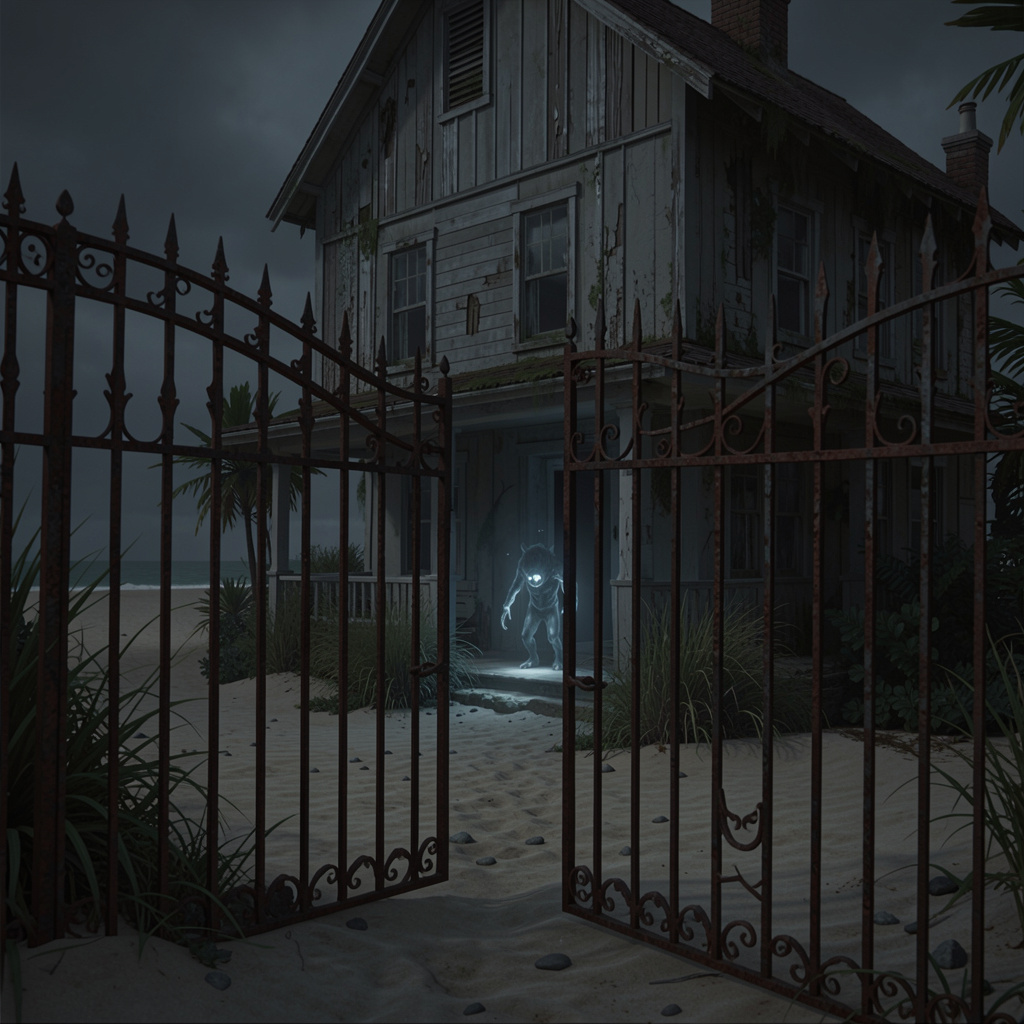
The rusted gate.
The same gate.
The paint had almost completely disappeared.
I parked the car.
For several minutes, I simply sat there.
I couldn’t explain what I felt.
It was as if some part of me had been waiting twenty-six years to return.
Finally, I got out.
The gate creaked when I pushed it open.
The path toward the house was covered with weeds.
The porch was gray and weathered.
The windows were dusty.
I reached into my pocket for the key.
Julie had given it to me the week before she died.
“Keep this,” she’d said.
I had laughed.
“You’ve got another one?”
“No.”
“Then why are you giving it to me?”
She had looked at me strangely.
“Because you’ll need it.”
I hadn’t asked what she meant.
Now, standing in front of that door, I suddenly remembered her expression.
My hand trembled as I inserted the key.
The lock clicked.
The door opened.
And I froze.
At first, I thought someone had broken in.
There were blankets on the sofa.
A kettle on the stove.
Fresh vegetables on the counter.
A pair of muddy boots beside the door.
And then I heard something.
A sound from upstairs.
A floorboard creaked.
I stopped breathing.
Someone was living here.
I slowly reached for my phone.
“Who’s there?”
Silence.
Then—
A child’s voice.
“Are you Mr. Harris?”
My blood went cold.
A little boy appeared at the top of the staircase.
He couldn’t have been more than ten.
Thin.
Messy brown hair.
Bare feet.
He stared at me with enormous frightened eyes.
I stared back.
“Who are you?”
He didn’t answer.
Instead, he ran downstairs and stood several feet away.
“I knew you’d come.”
“What?”
“I knew you’d come eventually.”
My mouth went dry.
“Where is your mother?”
He looked toward the hallway.
“She’s sick.”
“Where is she?”
He pointed.
I followed his finger.
There was a closed bedroom door.
I walked toward it.
“Wait,” the boy whispered.
I stopped.
“She said you might be angry.”
“Who?”
“My mom.”
I opened the door.
A woman was lying on the bed.
She looked exhausted.
Pale.
Her breathing was shallow.
She couldn’t have been much older than forty.
When she saw me, her eyes filled with tears.
“Oh,” she whispered.
“You’re him.”
I stood frozen.
“Who are you?”
She slowly sat up.
“My name is Maria.”
I stared at her.
“How do you know me?”
She looked at the boy.
Then back at me.
“Because Julie told me everything.”
The room seemed to tilt.
“Julie?”
Maria nodded.
“Your wife.”
I took a step backward.
“What did she tell you?”
Maria began crying.
“That you’d come here one day.”
My voice hardened.
“What is going on?”
She reached beneath her pillow.
And pulled out an envelope.
My name was written across it.
In Julie’s handwriting.
My hands began shaking.
I knew that handwriting.
I’d seen it on grocery lists.
Birthday cards.
Love letters.
Notes left on the refrigerator.
I took the envelope.
It was sealed.
“She told me not to give it to you until you came here yourself.”
I opened it.
Inside was a single sheet of paper.
I read the first line.
My love, if you’re reading this, then I finally failed to explain something to you.
I stopped.
My eyes burned.
I continued.
Please don’t be angry with me.
I sat down.
The letter continued.
Twenty-six years ago, when we left this house, you believed we were leaving it empty.
We weren’t.
I looked at Maria.
She was watching me.
There was a girl living in the village. Her name was Maria.
She was seventeen.
Her father had died. Her mother was gone. She was alone and pregnant.
I found her one morning behind the market.
I stopped reading.
My hands were numb.
Maria whispered,
“I was seventeen.”
I looked at her.
Julie had never told me.
The letter continued.
She had nowhere to go.
I brought her to the beach house.
I thought we’d help her for a few weeks.
But then I discovered the truth.
The father of her baby was a married man from town.
When he learned she was pregnant, he threatened her.
He told her if she spoke, he’d make sure she’d never see her baby.
My jaw tightened.
“Who was he?”
Maria looked away.
Julie continued.
I knew the man.
And I knew what he was capable of.
So I made a decision.
I told Maria she could stay.
I told her this house was hers.
I stared at the page.
“But why didn’t she tell me?”
Maria answered quietly.
“Because you would’ve helped.”
I looked at her.
“Of course I would’ve.”
“That’s why she didn’t tell you.”
I didn’t understand.
Maria continued.
“Julie knew you had a good heart. She knew you’d try to fix everything. She was afraid you’d put yourself in danger.”
I looked back at the letter.
You would’ve wanted to take Maria to the city.
You would’ve wanted to involve the police.
You would’ve wanted to confront the man.
And perhaps that would’ve made everything worse.
So I made a promise to Maria.
I would keep this house.
And I would return four times every year.
My eyes filled with tears.
Suddenly, Julie’s strange trips made sense.
Spring.
Summer.
Autumn.
Winter.
She wasn’t going to remember the past.
She was protecting someone.
I continued reading.
I told you I went there because I needed the ocean.
That wasn’t completely true.
I went because Maria needed someone to remind her that she mattered.
I looked toward the little boy standing in the hallway.
“How old are you?”
“Ten.”
“What is your name?”
“Daniel.”
My son’s name.
I swallowed.
“Daniel?”
Maria nodded.
“Julie chose it.”
My heart cracked.
“Why?”
Maria looked at the floor.
“Because she said your son was the bravest person she’d ever known.”
I sat there in silence.
Then I noticed something.
A photograph on the bedside table.
Julie.
Maria.
And the little boy.
They were smiling together.
The photograph was dated three years earlier.
Julie had been holding Daniel’s hand.
I stared at her face.
She looked happy.
Really happy.
Happier than I’d seen her in years.
“Why didn’t she ever tell me?”
Maria’s eyes filled with tears.
“Because she thought you deserved your life.”
“My life?”
“She said you had already sacrificed enough.”
I shook my head.
“She was my wife. She should’ve trusted me.”
Maria looked at me for a long moment.
“She did.”
“Then why?”
“Because she knew you’d choose us.”
I didn’t know what to say.
I looked down at the letter again.
The final paragraphs were written shakily.
There is one more thing I need you to know.
The house isn’t empty.
It never was.
For twenty-six years, it has been a home.
Maria has cared for it.
Daniel was born here.
He took his first steps on the same floor where you and I danced on our wedding anniversary.
He learned to read beside the same window where you once taught Emily to spell her name.
I closed my eyes.
Memories came rushing back.
Our children.
Julie laughing.
Rain hitting the windows.
The smell of pancakes.
Summer mornings.
Everything I had forgotten.
I know you’ll wonder why I never brought you here.
I was afraid.
Not of you.
Of what would happen if you knew.
I thought you might see this house as a burden.
Instead, I hope you’ll see what it became.
Not a vacation home.
Not an investment.
A shelter.
Then the final sentence.
If you still want to sell it after knowing the truth, I won’t blame you.
But please don’t sell it before meeting the boy.
I lowered the letter.
Daniel was still standing in the doorway.
I looked at him.
“Come here.”
He hesitated.
Then slowly walked toward me.
I knelt.
“Your name is Daniel?”
He nodded.
“Do you know who I am?”
He shook his head.
“Julie said you were important.”
I smiled sadly.
“She was right.”
He looked confused.
“Are you my grandfather?”
I couldn’t speak.
Maria answered for me.
“Yes.”
Daniel’s eyes widened.
“My grandfather?”
I nodded.
He stepped closer.
Then, unexpectedly, he hugged me.
I held him.
And something inside me broke.
Twenty-six years.
Twenty-six years of believing I had left this house behind.
But my wife had spent those years building something here.
Something I never knew existed.
A family.
My family.
That evening, I walked through every room.
I found things I hadn’t seen since we moved.
Our old dining table.
The blue curtains Julie loved.
A crack in the hallway wall where our son had thrown a toy.
A faded height chart on the kitchen door.
And photographs.
Dozens of them.
Julie had taken them over the years.
Maria growing older.
Daniel as a baby.
Daniel taking his first steps.
His first birthday.
His first day of school.
Christmas mornings.
Beach trips.
Every photograph had a date.
And in almost every one, Julie was there.
Sometimes smiling.
Sometimes holding Daniel.
Sometimes simply sitting beside Maria.
She had built a second life.
Not one that replaced me.
One that existed alongside ours.
I found another box in the attic.
Inside were letters.
Hundreds of them.
Letters Julie had written to me but never sent.
I opened one.
Today Daniel asked why you don’t come here.
I told him you’re busy.
He said that’s sad.
Another.
Maria is finally smiling again.
Another.
I wish I could tell you.
And another.
You’d love him.
I sat on the attic floor and cried.
Not because Julie had lied.
But because I finally understood the size of the secret she’d carried alone.
The next morning, I called my children.
“Don’t sell the house.”
There was silence.
“Dad?”
“I’m keeping it.”
“Why?”
“Because your mother wasn’t finished with it.”
I told them everything.
They came that weekend.
When Emily saw Maria, she stared at her mother through photographs for a long time.
Then she started crying.
“I didn’t know,” she whispered.
Maria hugged her.
Daniel met my children.
My daughter cried again when she heard his name.
“Mom named you after my brother.”
He nodded.
“I know.”
She laughed through her tears.
“And she never told us.”
Maria smiled.
“She wanted to protect everyone.”
We spent the weekend together.
For the first time in decades, the beach house was full again.
Children running through the hallway.
Coffee brewing in the kitchen.
Laughter on the porch.
The sound of the ocean outside.
It felt like time had folded in on itself.
On Sunday evening, Emily walked beside me on the beach.
“Dad?”
“Yes?”
“Did Mom know she was dying?”
I looked toward the water.
“Maybe.”
“Did she tell you anything?”
I thought about the key.
The final letter.
The way she’d looked at me.
“She told me I’d need the key someday.”
Emily nodded.
“That’s Mom.”
We stood quietly.
Then she asked,
“What are you going to do with the house?”
I smiled.
“I think your mother already decided.”
“What do you mean?”
I pointed toward the house.
“Look.”
Maria was standing on the porch.
Daniel was beside her.
He was holding a small wooden sign.
We walked closer.
The sign read:
JULIE’S HOUSE
Underneath it, in smaller letters:
A HOME FOR ANYONE WHO NEEDS ONE.
I looked at Maria.
“What’s this?”
“Julie made it.”
“When?”
“Two weeks before she died.”
She handed me another envelope.
I opened it.
Inside was one final note.
My love,
If you’re reading this, you’re probably standing on the porch.
I know you.
You’re probably wondering what to do next.
Don’t do anything dramatic.
I laughed through my tears.
That was Julie.
Just keep the door open.
That’s all.
For Maria.
For Daniel.
For our children.
For whoever needs a place to breathe.
You always thought this house was something we owned.
It wasn’t.
It was something we were trusted with.
And now I’m trusting it to you.
I love you.
I always did.
Julie.
I folded the letter carefully.
Then I looked at the ocean.
For twenty-six years, I had thought Julie was returning to this place because she couldn’t let go of the past.
I finally understood.
She wasn’t looking backward.
She was protecting the future.
That night, I slept in our old bedroom.
For the first time in twenty-six years.
The windows were open.
I could hear the waves.
I could smell the salt.
And somewhere downstairs, I heard Daniel laughing.
I closed my eyes.
“Goodnight, Julie,” I whispered.
The wind moved gently through the curtains.
For just a moment, I could almost hear her voice.
“I told you you’d understand someday.”
I smiled.
“Yes, you did.”
The next morning, I called the real estate agent.
“I’m sorry,” I said.
“We’re not selling.”
There was a pause.
“Are you sure?”
I looked around the kitchen.
Maria was making breakfast.
Daniel was sitting at the table.
Emily was helping him with his homework.
My son Daniel was repairing the old porch railing.
The house was alive again.
“Yes,” I said.
“I’m sure.”
And I hung up.
Six months later, we opened the house to the community.
Not as a hotel.
Not as a business.
As a shelter.
A place where women escaping dangerous situations could stay.
A place where children could sleep safely.
A place where someone who had nowhere else to go could knock on the door.
We named it The Julie House.
People asked why.
I always gave them the same answer.
“Because my wife spent twenty-six years teaching me what a house is supposed to be.”
They would ask what that meant.
I’d smile.
“A house isn’t the walls.”
“The furniture isn’t the house.”
“The ocean view isn’t the house.”
“A house becomes a home when someone inside it decides another person is worth protecting.”
Years passed.
Daniel grew taller.
Maria got stronger.
My children visited every summer.
And I returned to the beach house four times a year.
Spring.
Summer.
Autumn.
Winter.
Just like Julie had.
At first, I did it because I wanted to continue her tradition.
Eventually, I understood why she had never missed a visit.
Every season changed the view.
The flowers in spring.
The bright blue water in summer.
The golden leaves in autumn.
The quiet gray ocean in winter.
But the house remained.
Waiting.
Watching.
Holding memories.
One afternoon, many years later, Daniel—now a grown man—stood beside me on the porch.
“Grandpa?”
“Yes?”
“Why did Grandma keep this secret from you for so long?”
I looked toward the ocean.
“Because she thought she was protecting me.”
“Did it work?”
I smiled.
“No.”
He laughed.
“Then why aren’t you angry?”
I thought about that.
For twenty-six years, I had believed I knew my wife.
But love, I discovered, doesn’t mean knowing every secret someone carries.
Sometimes love means understanding why they carried it.
“Because,” I said, “she gave twenty-six years of her life to people she believed needed her.”
Daniel nodded.
Then he asked,
“Do you miss her?”
I looked at the old wooden chair beside me.
Julie’s chair.
The one she always sat in when watching the sunset.
“Every day.”
He put his hand on my shoulder.
I smiled.
“But missing someone doesn’t mean they’re gone.”
He looked confused.
“What do you mean?”
I pointed toward the house.
“She’s here.”
He looked at the walls.
“The house?”
“No.”
I pointed toward Maria laughing in the kitchen.
Toward the photographs lining the hallway.
Toward the children playing in the yard.
Toward the old sign above the door.
“She’s in everything she left behind.”
The sun began sinking into the ocean.
Golden light spilled across the porch.
I sat in Julie’s chair.
For a moment, I closed my eyes.
And I remembered the first day we’d bought the house.
We were young.
Poor.
Terrified.
Happy.
Julie had stood on the porch, looked at the ocean, and said,
“Someday, this place is going to save someone.”
I’d laughed.
I thought she was being sentimental.
I never realized she was making a promise.
Twenty-six years later, I finally understood.
She hadn’t been saving the beach house.
The beach house had been saving people.
And in the end…
it saved me, too.