I Was 18 When I Gave My Last $20 to a Stranger… And Two Days Later, She Changed My Life Forever
I was eighteen years old when I learned that sometimes the smallest thing you give away can come back to you in a way you never imagined.At eighteen, I didn’t have much.Actually, that wasn’t completely true.
I had twenty dollars.And by the end of one rainy Tuesday night, even that was gone.
My name is Daniel Carter, and back then, I was just a broke teenager trying to keep my family afloat.
My mother, Renee, had been raising me alone since I was nine.
She worked mornings at a nursing home, cleaning rooms and helping elderly residents get dressed. In the afternoons, she cleaned offices downtown. Some nights, she came home so exhausted that she’d fall asleep at the kitchen table before she even finished eating.
I had dropped out of community college after one semester because we couldn’t afford the tuition.
I told Mom it was temporary.
She knew I was lying.
So I found a job delivering food for a small Italian restaurant called Tony’s.The pay wasn’t great, but the tips helped.Every night, I’d ride my old bicycle through the city, carrying pizzas, pasta, burgers, whatever people ordered.
Most customers barely looked at me.They’d open the door, take the bag, say thanks, and disappear.I didn’t blame them.
When you’re hungry, you’re not thinking about the person bringing your food.
You’re thinking about your own life.
That Tuesday night, a storm rolled into town.
Rain hammered the streets so hard that the gutters overflowed within minutes.
Lightning flashed between apartment buildings.
Most drivers refused to deliver.
My manager, Frank, kept asking if I wanted to go home.
But I needed the money.
Mom’s electricity bill was due Friday.
We were already behind.
So I stayed.
Around 9:40 p.m., the restaurant received one final order.
A small pasta dinner.
Spaghetti with tomato sauce.
Two pieces of garlic bread.
And two bottles of water.
The delivery address was an old apartment building on Jefferson Street.
I knew the place.
Everyone did.
It was one of those buildings that looked abandoned even when people lived inside.
The elevator hadn’t worked in years.
The hallway lights flickered.
The paint peeled from the walls.
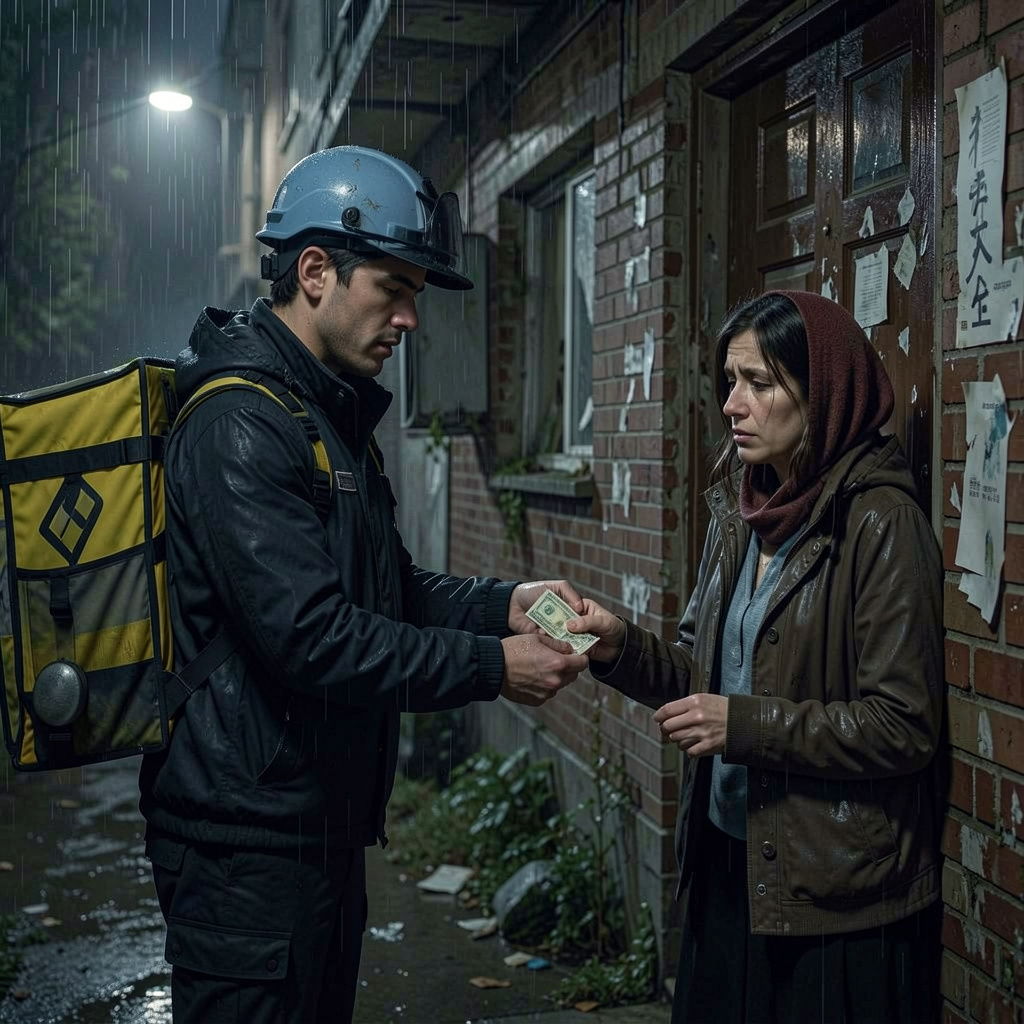
When I arrived, I stood under the broken awning and stared at the address.
Apartment 4B.
I climbed four flights of stairs.
By the time I reached the door, I was soaked.
I knocked.
Nothing.
I knocked again.
Finally, I heard a woman’s voice.
“Just a second.”
The door opened a few inches.
A woman stood behind it.
She looked exhausted.
Maybe thirty-five.
Her hair was messy.
Her eyes were red.
Behind her were two children.
A little girl who couldn’t have been older than six and a boy around eight.
The children weren’t looking at me.
They were looking at the food.
Not casually.
Not excitedly.
They were staring at that paper bag like it contained treasure.
And suddenly I understood.
They were hungry.
Really hungry.
The woman noticed me looking at them.
She quickly stepped outside and pulled the door nearly closed behind her.
“I’m sorry,” she whispered.
“Sorry?”
“I know I’m late.”
“It’s okay.”
She reached into her pocket.
Her fingers trembled.
“I don’t have the full amount.”
I looked at the receipt.
The order had already been paid online.
“You’re good,” I said.
She shook her head.
“No. I mean… I don’t have anything for a tip.”
I smiled.
“You don’t have to tip me.”
She looked embarrassed.
“I usually do.”
“It’s okay.”
She glanced behind her.
The little girl was still staring at the bag.
Then the woman whispered something I’ll never forget.
“They haven’t eaten since yesterday afternoon.”
My heart sank.
I looked at the food.
Then at the children.
Then at the twenty-dollar bill folded inside my wallet.
It was everything I had.
That twenty dollars was supposed to buy groceries the next morning.
Milk.
Eggs.
Bread.
Maybe some chicken if it was on sale.
I pulled the bill out.
The woman stared at it.
“No,” she said immediately.
“It’s okay.”
“I can’t take that.”
“You can.”
“No.”
I held it toward her.
“Please.”
She shook her head, tears filling her eyes.
“I don’t know you.”
“I know.”
“Why would you do this?”
I shrugged.
Because I didn’t know what else to say.
“Because they’re hungry.”
She covered her mouth.
For several seconds, neither of us spoke.
Then she took the twenty.
Her hand closed around mine.
“Thank you.”
I nodded.
“Goodnight.”
I walked down the stairs.
I didn’t look back.
Outside, the rain was still coming down.
I climbed onto my bicycle and started pedaling.
For the first few minutes, I felt good.
Then I remembered the grocery list on our refrigerator.
Milk.
Eggs.
Bread.
And suddenly, I felt stupid.
By the time I got home, my clothes were dripping onto the floor.
Mom was sitting at the kitchen table.
She looked up.
“You didn’t bring groceries.”
I froze.
“I’ll get them tomorrow.”
“With what?”
I didn’t answer.
She stared at me.
“Daniel.”
I sat down.
“I gave the money to someone.”
She closed her eyes.
For a moment, I thought she’d be angry.
Instead, she sighed.
“Who?”
“A woman.”
I told her everything.
When I finished, Mom looked at me for a long time.
Then she smiled.
“You did the right thing.”
“But we needed that money.”
“So did they.”
“But what about us?”
She reached across the table and squeezed my hand.
“Sometimes, Danny, being poor doesn’t mean you have nothing to give.”
That night, I slept badly.
I kept thinking about those children.
I hoped the food had been enough.
I hoped the woman hadn’t been embarrassed.
I hoped I’d made the right choice.
The next morning, I woke up before Mom.
I made coffee.
Then I went to work.
Nothing happened.
The woman didn’t call.
There was no miracle.
No envelope of cash.
No unexpected check.
Life simply continued.
Until two days later.
Thursday morning.
I was carrying a stack of boxes into the restaurant when Frank called my name.
“Daniel.”
I turned.
“Office.”
I immediately worried.
Had I messed up an order?
Broken something?
Gotten a complaint?
I followed him into the tiny office.
Frank closed the door.
Then he pointed at the chair.
“Sit.”
I sat.
There was someone else in the room.
A woman.
She was wearing a dark coat.
Her hair was neatly pulled back.
She looked completely different from the exhausted mother I’d met two nights earlier.
But I recognized her eyes.
I stood so quickly that the chair nearly fell over.
“You.”
She smiled.
“Hello, Daniel.”
I stared at her.
“What are you doing here?”
She looked at Frank.
Then back at me.
“Your manager was kind enough to let me wait.”
I didn’t understand.
Frank leaned against his desk.
“Daniel, she asked to speak with you.”
“Why?”
The woman stood.
“My name is Claire Morgan.”
I waited.
“And I owe you an explanation.”
I glanced at Frank.
He seemed just as confused as I was.
Claire reached into her purse.
She pulled out an envelope.
Then she placed it on the desk.
“This is for you.”
I didn’t touch it.
“What’s inside?”
“Please open it.”
I looked at Frank.
He nodded.
I opened the envelope.
There was a cashier’s check inside.
I stared at the number.
$20,000.
My mouth went dry.
“What is this?”
“Ten times what you gave me.”
I immediately pushed it back.
“No.”
Claire frowned.
“Why?”
“Because I didn’t give you twenty dollars so you’d give me twenty thousand.”
“I know.”
“Then take it back.”
She shook her head.
“I can’t.”
“Why?”
She sat down.
“Because that twenty dollars didn’t just feed my children.”
I said nothing.
She took a breath.
“That night, I had already made a decision.”
“What decision?”
“To disappear.”
The room went silent.
“I had lost my job six months earlier,” she continued. “My husband died the year before. He left us with debt. I tried everything. Eventually, I couldn’t pay rent.”
She looked down.
“I was ashamed.”
I listened.
“That night, after my children fell asleep, I planned to take them somewhere and end my life.”
My stomach turned.
“Claire…”
“But then you showed up.”
She wiped her eyes.
“You gave me your last twenty dollars without asking my name. Without judging me. You didn’t even know whether I deserved it.”
“I just saw two hungry kids.”
“I know.”
She smiled sadly.
“That’s what changed everything.”
She explained that after I left, she sat on the floor and cried.
Not because of the money.
Because someone had noticed.
Someone had looked at her life and decided she was worth helping.
The next morning, she called an old friend.
That friend worked for a nonprofit organization.
Within twenty-four hours, Claire had temporary housing and an interview.
The interview went well.
But there was more.
Claire wasn’t just an unemployed mother.
She had once been a financial analyst.
Before her husband’s death, she had worked for a major investment firm.
Then she said something that confused me.
“Daniel, I need you to understand something.”
“What?”
“The twenty thousand isn’t a reward.”
“Then what is it?”
She leaned forward.
“It’s an opportunity.”
I frowned.
She pulled another document from her purse.
“I’ve started a foundation.”
“A foundation?”
“Yes.”
She explained that she wanted to help struggling families before they reached the point she had reached.
Food.
Temporary housing.
Job placement.
Emergency assistance.
But she needed someone who understood what desperation looked like from the other side.
She wanted me involved.
I laughed nervously.
“Me?”
“Yes.”
“I’m eighteen.”
“Exactly.”
“I deliver pasta.”
“I know.”
She smiled.
“And that’s why I chose you.”
I didn’t understand.
Claire explained that her foundation was going to partner with restaurants to provide meals to families in crisis.
She wanted me to help design the delivery program.
I thought she was crazy.
“I’m not qualified.”
“You don’t need a degree to know when someone is hungry.”
Frank laughed softly.
Claire continued.
“And I spoke with your manager.”
I turned toward Frank.
“What?”
Frank smiled.
“She offered to pay for your college.”
My heart stopped.
“What?”
“Full tuition.”
I looked at Claire.
She nodded.
“College. Books. Housing if you need it.”
I couldn’t speak.
Then Claire said something that made me cry.
“Your mother sacrificed everything for you. I don’t want her sacrifice to end with you giving up your future.”
I looked down.
Tears hit the floor.
For years, I’d believed that being poor meant choosing between survival and dreams.
Claire was telling me I didn’t have to choose.
But there was still something I didn’t understand.
“Why me?”
She smiled.
“Because you gave away your last twenty dollars.”
“But lots of people give money.”
“Not their last twenty.”
She paused.
“Your manager told me something.”
“What?”
“He said you often gave customers extra food if they couldn’t afford delivery.”
I looked at Frank.
He shrugged.
“I noticed.”
Claire smiled.
“Kindness wasn’t something you did that night, Daniel. It was something you were already doing.”
That afternoon, I went home and told Mom.
She didn’t believe me at first.
Then I showed her the documents.
She started crying.
She hugged me so tightly that I could barely breathe.
“I told you,” she whispered.
“What?”
“Being poor doesn’t mean you have nothing to give.”
The twenty dollars had somehow become the beginning of everything.
I went to college.
I studied business and social work.
I worked with Claire’s foundation during summers.
And something incredible happened.
The program grew.
Restaurants joined.
Grocery stores joined.
Local landlords donated apartments.
Employers offered jobs.
Within five years, the foundation had helped thousands of families.
And Claire became like family.
She never forgot that night.
Neither did I.
Ten years after I gave her that twenty dollars, she invited me to the opening of a new community center.
The building was enormous.
There was a food pantry.
A children’s learning center.
A job placement office.
And a small kitchen where families could receive free meals.
Outside was a plaque.
I walked toward it.
Then I stopped.
The plaque read:
THE TWENTY DOLLAR CENTER
Established in honor of one simple act of kindness.
I turned around.
Claire was standing behind me.
“You named it after that?”
She smiled.
“You gave me the name.”
I laughed.
“I gave you twenty dollars.”
“No.”
She shook her head.
“You gave me a reason to believe tomorrow existed.”
I hugged her.
Then I noticed two children standing beside her.
A teenage boy.
And a teenage girl.
I recognized them immediately.
The hungry children from Apartment 4B.
They were grown now.
The boy walked up to me.
“I’m Marcus.”
“I remember you.”
He smiled.
“My sister’s Emily.”
Emily hugged me.
“You saved our family.”
I shook my head.
“Your mom did.”
Claire stepped closer.
“No,” she said.
“We all saved each other.”
That evening, we held a dinner for the community.
Hundreds of people came.
Families.
Volunteers.
Restaurant owners.
Teachers.
Donors.
People whose lives had been changed by the foundation.
Before dinner, Claire asked me to speak.
I stood at the microphone.
I looked around at all those people.
Then I told them about the stormy night.
The broken apartment building.
The two hungry children.
The twenty dollars.
And the woman who had been ready to give up.
“I used to think I gave away twenty dollars that night,” I said.
“But I was wrong.”
Everyone listened.
“I didn’t lose twenty dollars.”
“I invested it.”
“In a woman I didn’t know.”
“In two children I’d never see again.”
“And, without realizing it, in myself.”
I looked toward Claire.
“Sometimes we think kindness has to be huge to matter.”
“It doesn’t.”
“Sometimes it’s twenty dollars.”
“Sometimes it’s a meal.”
“Sometimes it’s five minutes of listening.”
“Sometimes it’s simply telling someone, ‘You are not alone.'”
I paused.
“And sometimes, the person you help today becomes the reason your own life changes tomorrow.”
The room erupted in applause.
But I wasn’t finished.
I looked at my mother sitting in the front row.
“Mom taught me something when I was eighteen.”
She smiled through her tears.
“She told me that being poor doesn’t mean you have nothing to give.”
I turned back to the audience.
“She was right.”
After the speech, I walked outside.
The rain had started again.
Just a light drizzle this time.
Claire joined me beneath the awning.
“Funny,” she said.
“What?”
“Rain.”
I smiled.
“Yeah.”
She reached into her purse.
Then she handed me something.
An old, folded twenty-dollar bill.
I stared at it.
“What is this?”
“The one you gave me.”
My eyes widened.
“You kept it?”
“For ten years.”
I unfolded it.
It was worn.
Soft from being carried.
But still recognizable.
Claire smiled.
“I didn’t spend it.”
“Why?”
“Because I wanted to remember.”
She pointed toward the building.
“Every family helped by that center represents what that twenty dollars started.”
I stared at the bill.
Then I laughed.
“You could have put this in a frame.”
“I almost did.”
“What changed your mind?”
She looked at me.
“I realized it wasn’t meant to be displayed.”
“Then what?”
She smiled.
“It’s meant to keep moving.”
The next morning, Claire and I went to a grocery store.
We bought groceries for a family that had just lost their home.
Milk.
Bread.
Eggs.
Fruit.
Chicken.
And a twenty-dollar bill.
We left the envelope anonymously.
Inside was a note.
I had written it myself.
“You are not alone. Someone believed you were worth helping.”
Years passed.
I became the director of the foundation.
Then the president.
Eventually, we opened centers in several cities.
And every center had the same rule.
Anyone who received help was encouraged, when they were able, to help someone else.
Not necessarily with money.
Maybe with time.
Maybe with food.
Maybe with a phone call.
Maybe with a ride.
Because kindness wasn’t supposed to stop with you.
It was supposed to move.
One evening, almost twenty years after that stormy night, I received a letter.
There was no return address.
Inside was a photograph.
It showed a young woman holding a little boy.
Underneath was a handwritten sentence.
“Tonight, my son ate his first full dinner in three days because someone gave us twenty dollars.”
I sat at my desk for a long time.
Then I smiled.
Because I finally understood what Claire had meant.
The twenty dollars had never been about money.
It was about interruption.
Interrupting despair.
Interrupting hopelessness.
Interrupting the belief that nobody cared.
That night, I looked at the old bill sitting in a frame on my desk.
It was the same twenty dollars Claire had returned to me years earlier.
Except now, there was something written underneath it.
“One small act can change a life.”
And beneath that:
“Never underestimate what you have to give.”
I was eighteen when I gave away my last twenty dollars.
I thought I was helping a stranger.
I didn’t know I was helping build a future.
I didn’t know I’d go to college.
I didn’t know I’d meet the people who would become my family.
I didn’t know I’d help thousands of people.
I didn’t know that the woman standing behind that apartment door would become one of the most important people in my life.
All I knew was that two children were hungry.
And I had twenty dollars.
Sometimes, that’s all kindness needs.
Not wealth.
Not power.
Not perfect timing.
Just someone willing to say:
“I see you.”
“I know you’re hurting.”
“And for tonight, you don’t have to face it alone.”
Because you never really know what your smallest act of kindness might become.
A meal.
A second chance.
A career.
A family.
A foundation.
A life.
Or maybe…
A future you never knew was waiting for you.
And that’s why, even now, whenever someone asks me what the greatest investment I’ve ever made was, I don’t tell them about college.
I don’t mention the foundation.
I don’t talk about the millions of dollars raised.
I simply reach into my wallet.
Pull out a twenty-dollar bill.
And smile.
Because twenty dollars once changed my entire life.
And I intend to keep changing lives with it.