The Word That Brought Me Back
In 1985, I worked the night shift as a housekeeper at County General Hospital.People called us the invisible staff.Doctors saved lives. Nurses comforted families. Administrators ran the building.
We quietly emptied trash cans, mopped blood from emergency room floors, polished hallways before dawn, and erased the evidence of everyone’s worst day.
My name was Evelyn Carter, and I was forty-three years old back then.
Widowed.Mother of one son buried before his twentieth birthday.
After Tommy died in Vietnam, silence became too heavy to carry inside my little apartment. So I volunteered for every overtime shift the hospital offered.At night, work kept grief from speaking too loudly.
County General after midnight felt like another world.Machines beeped softly.Floor wax reflected pale fluorescent lights.Coffee burned in forgotten pots at the nurses’ station.
Every room held someone’s hope—or heartbreak.
Room 4B became part of my routine in late September.
The patient was listed simply:Daniel Brooks. Age 16. Motor vehicle accident. Severe traumatic brain injury. Coma.The first night I cleaned his room, I noticed something strange.No flowers.
No balloons.No cards.No family photographs.Just a skinny boy lying impossibly still beneath white sheets.His chart hung at the foot of the bed.
The nurses told me he’d been transferred from another county after a terrible highway accident.
No visitors.Not one.”Doesn’t anybody come?” I asked.One nurse sighed.
“Mother died years ago. Father disappeared. Social services is trying to locate relatives.”
She shrugged sadly.”So far… nothing.”
That answer stayed with me.
The following night I returned with my cleaning cart.
As always, I dusted windowsills, wiped tables, changed the trash.
The television remained dark.
The room felt unbearably quiet.
“I hate quiet,” I whispered.
I remembered the paperback western sitting in my locker.
Shane.
It had belonged to Tommy.
The cover was bent.
Several pages were loose.
Without thinking too hard, I pulled up a chair.
“I don’t know if you can hear me,” I said.
“But if you can… here’s chapter one.”
So I began reading.
The next night I continued.
Then the next.
Soon it became part of my shift.
Dust.
Sweep.
Read.
Sometimes twenty minutes.
Sometimes an hour if work was slow.
The nurses smiled whenever they passed.
“There goes Evelyn,” they’d whisper.
“Reading cowboy stories again.”
I didn’t care.
Maybe the boy heard.
Maybe he didn’t.
Either way, someone should talk to him.
Everyone deserved a voice in the darkness.
When I finished Shane, I borrowed another western from the public library.
Then another.
Louis L’Amour.
Zane Grey.
Max Brand.
I wasn’t particularly fond of westerns before.
But Tommy had loved them.
Reading them aloud felt strangely comforting.
Occasionally I added little comments.
“Don’t trust this fellow, Daniel.”
“This sheriff reminds me of my uncle.”
“I cried when Tommy first read this.”
The room no longer felt empty.
It felt… shared.
Christmas came.
The hospital filled with poinsettias and paper snowflakes.
Families crowded every room.
Except 4B.
Daniel spent Christmas morning exactly as he’d spent Thanksgiving.
Alone.
That night I smuggled in a tiny battery-powered Christmas tree from the dollar store.
Hospital rules technically prohibited personal decorations.
I broke them anyway.
“Merry Christmas,” I whispered.
Then I read three chapters before moving on.
Three months passed.
His hair grew longer.
His face looked older somehow.
Still no visitors.
Still no movement.
Yet I kept reading.
Because hope isn’t always logical.
Sometimes it’s simply stubborn.
Then one January morning everything changed.
I pushed my cart toward Room 4B.
The bed was empty.
Sheets stripped.
Room cleaned.
My stomach dropped.
I hurried to the nurses’ station.
“Where’s Daniel?”
The charge nurse smiled.
“He opened his eyes yesterday.”
“What?”
“They transferred him to the neurological rehabilitation center.”
I nearly cried.
“Did he… say anything?”
“They’re optimistic.”
“That’s all?”
She nodded.
“I wish I knew more.”
And that was it.
No forwarding address.
No updates.
No goodbye.
Life simply moved forward.
Hospitals do that.
Years became decades.
Medicine changed.
Computers replaced paper charts.
Cell phones replaced pagers.
I retired at sixty-eight after forty years pushing that same cleaning cart.
The hospital held a small retirement party.
Someone gave me flowers.
Another person gave me a coffee mug.
The nurses hugged me.
I went home.
Life became quieter.
Too quiet.
My knees finally admitted they couldn’t climb stairs without complaint.
My hands ached when rain approached.
Some mornings I forgot why I’d entered a room.
Age has a way of shrinking your world.
Still, every now and then, I’d wonder about the boy from 4B.
Did he survive?
Did he walk again?
Did he remember anything?
Probably not.
Coma patients don’t remember housekeeping ladies.
I told myself that.
Yet sometimes I’d pass the western novels on my bookshelf and smile.
In the spring of 2025, County General celebrated its hundredth anniversary.
Former employees received invitations.
I almost declined.
Fancy dinners weren’t really for people like me.
Then my old supervisor called.
“You have to come.”
“I don’t belong there.”
“Nonsense. Half this hospital still remembers you.”
So I went.
I bought a navy-blue dress from a department store clearance rack.
Nothing expensive.
Just respectable.
I even wore Tommy’s little silver pin on my collar.
The ballroom glittered with crystal lights.
Doctors.
Nurses.
Administrators.
Former patients.
Everyone looked successful.
Important.
I quietly found my assigned table near the back.
Perfect.
Invisible again.
Exactly where I felt comfortable.
Dinner was delicious.
Chicken.
Mashed potatoes.
Chocolate cake.
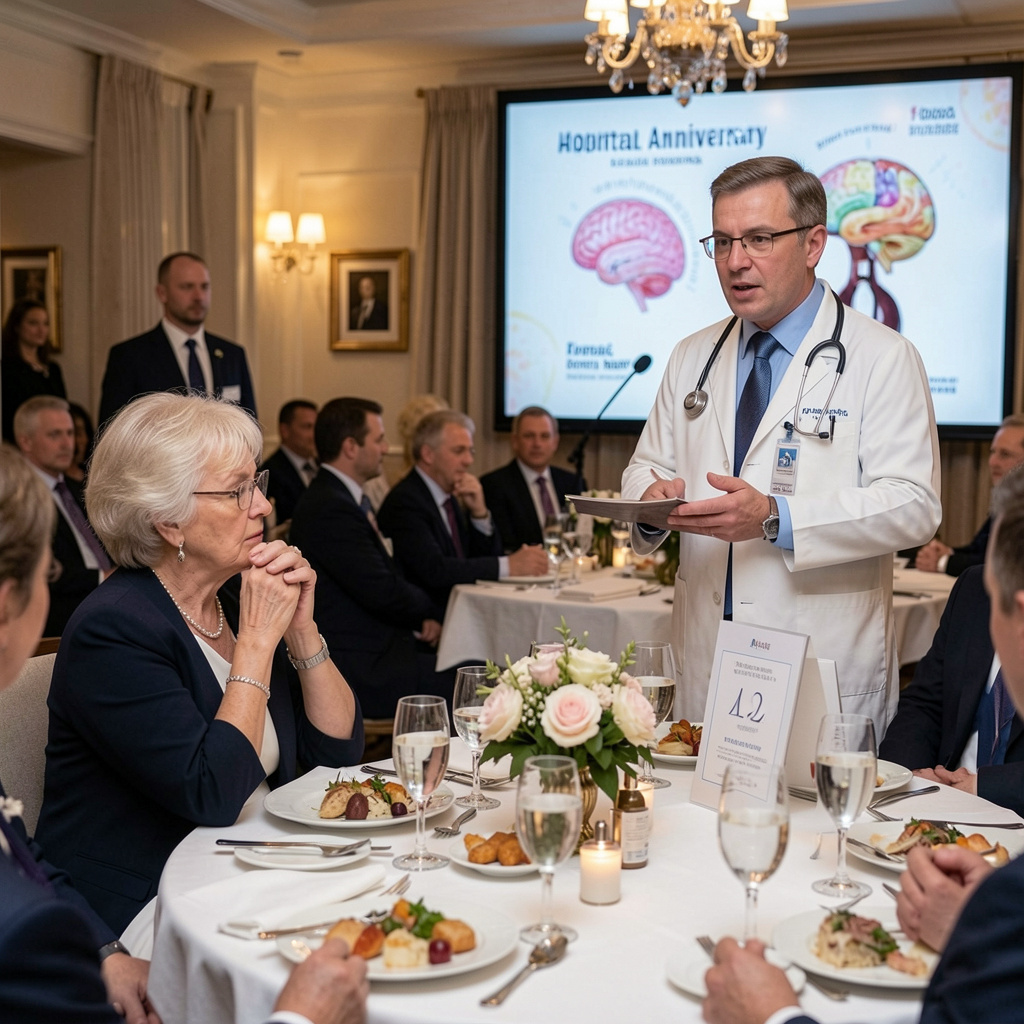
After dessert, the master of ceremonies introduced the keynote speaker.
“The world-renowned neurosurgeon, Dr. Daniel Brooks.”
Applause thundered.
A tall man in his mid-fifties walked onto the stage.
Gray touched his temples.
His posture was confident.
His smile calm.
He thanked everyone before beginning.
“I’ve operated on thousands of brains.”
People laughed softly.
“I’ve published research.”
More applause.
“But none of those accomplishments explain why I became a doctor.”
The room grew quiet.
“When I was sixteen, I was in a terrible automobile accident.”
Something stirred inside me.
“I spent over three months in a coma.”
My heart skipped.
“There were no visitors.”
Silence spread across the ballroom.
“My mother had died years before.”
“My father disappeared.”
“I was completely alone.”
I stopped breathing.
“But I wasn’t really alone.”
He smiled gently.
“Every night someone came into my room.”
Not possible.
“She cleaned while talking about ordinary things.”
My hands trembled.
“Then she sat beside my bed and read western novels.”
The ballroom disappeared around me.
I heard only his voice.
“I couldn’t move.”
“I couldn’t answer.”
“But somewhere deep inside, I heard every word.”
Tears blurred my vision.
“I followed every horseback ride.”
“Every gunfight.”
“Every lonely hero.”
“One story stayed with me above all others.”
He paused.
“Shane.“
People looked confused.
Daniel smiled.
“When I finally woke up during rehabilitation, the therapists asked me to say something.”
He laughed.
“My first word was ‘Shane.'”
The audience chuckled warmly.
“The doctors thought it was random.”
“It wasn’t.”
“It was proof that somewhere inside the darkness, I had never been alone.”
I covered my mouth.
Surely…
Surely it couldn’t be…
Then he looked across hundreds of guests.
“I searched hospital employment records.”
“I searched retirement lists.”
“I searched old payroll files.”
“I wanted to thank the woman whose voice carried me home.”
His eyes slowly scanned the ballroom.
Then stopped.
Right on me.
“She’s here tonight.”
My entire table turned.
“My name is Daniel Brooks.”
His voice broke.
“And hers…”
He smiled through tears.
“…is Evelyn Carter.”
Gasps echoed everywhere.
A spotlight found me before I could hide.
“Oh, goodness…”
People began applauding.
I shook my head.
“No…”
Daniel stepped down from the stage.
The applause grew louder.
He walked slowly until he stood beside my chair.
For one impossible moment, neither of us spoke.
Then he knelt.
A world-famous brain surgeon.
Kneeling before an old cleaning lady.
“You saved my life.”
I burst into tears.
“No, sweetheart.”
“The doctors saved you.”
He shook his head.
“They repaired my brain.”
“You repaired my reason to come back.”
He gently took my hands.
“I remember your voice.”
“I remember you laughing when the sheriff forgot his horse.”
I laughed through tears.
“I remember you crying when you talked about your son.”
My breath caught.
“I never told anyone about Tommy.”
“You told me.”
“You thought I couldn’t hear.”
Around us, the ballroom had fallen silent.
Daniel reached into his jacket pocket.
He removed an old paperback.
Its cover was worn beyond recognition.
It was Shane.
My copy.
“I asked the archives if anything from my room survived.”
He smiled.
“A nurse had packed this with my belongings.”
Inside the cover, written in faded blue ink, were the words:
Property of Evelyn Carter. Please return.
“I kept it all these years.”
I stared at the handwriting.
Mine.
From forty years earlier.
“I’ve carried it to every hospital where I’ve worked.”
He swallowed hard.
“Whenever a patient is unconscious, my residents ask why I speak to them.”
He looked at the audience.
“I tell them because hearing may remain when everything else seems gone.”
Then he turned back to me.
“And because one cleaning lady once believed a silent boy deserved a story.”
The applause became a standing ovation.
Doctors wiped away tears.
Nurses embraced each other.
Even the hotel staff paused to watch.
Daniel stood and helped me to my feet.
Then, without embarrassment, he hugged me as though I were family.
Perhaps I always had been.
A few weeks later, Daniel invited me to tour the neuroscience wing.
One room caught my attention immediately.
Each patient had a small bookshelf.
“What are these?” I asked.
He grinned.
“The Evelyn Library.”
I blinked.
“My residents take turns reading to patients every evening.”
I could barely speak.
“You named it after me?”
“I named hope after you.”
On the wall hung a bronze plaque.
It read:
“Healing comes through medicine, but recovery also comes through kindness, patience, and the human voice.
Dedicated to Evelyn Carter, who reminded us that no patient should ever face the darkness alone.”
I ran my fingers across the engraved letters.
For forty years, I had believed my greatest contribution to the world was polishing floors no one remembered.
I had been wrong.
Sometimes the smallest acts travel farther than we ever know.
A few minutes of reading.
A worn paperback.
A lonely boy.
A single word.
Shane.
It crossed four decades, survived silence, and found its way home.
And in that moment, I finally understood something Tommy had once told me when he was just a little boy curled up beside me with a western novel in his lap.
“Mom,” he had said, “stories don’t just entertain people.”
“They keep them company.”
He had been right all along.