Chapter 1 – Into the Inferno
“Because,” Evelyn had told the six-year-old boy that night, “he wouldn’t let anyone else hold you until he knew you were safe.”
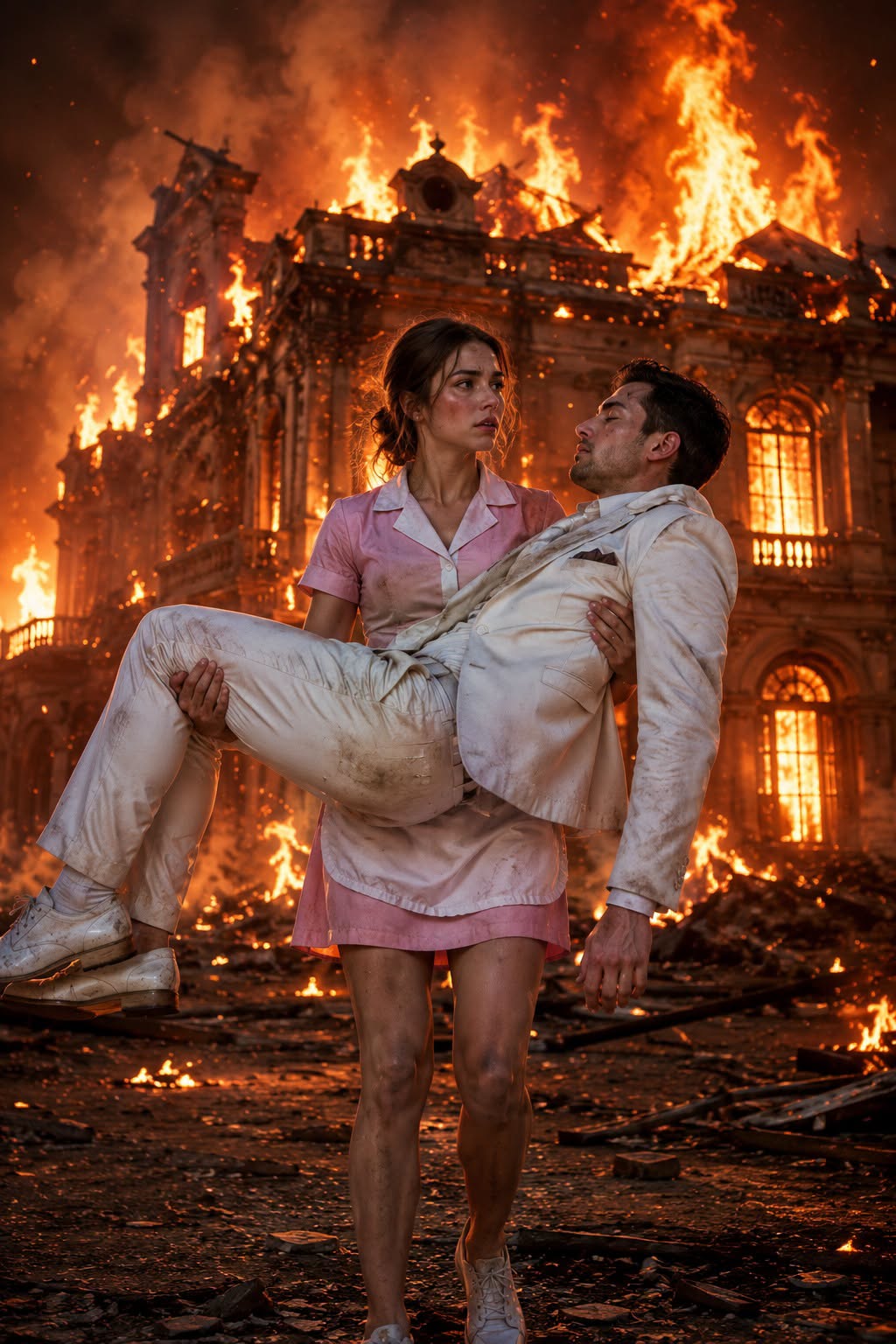
Those words echoed in Evelyn’s ears now, eight years later, as she plunged into the thick, suffocating smoke of Whitmore House.
The heat hit her like a physical wall, searing the exposed skin of her neck and forearms. Up on the second-floor landing, the grand mahogany staircase was already crowned in brilliant, terrifying orange flames. Smoke rolled across the ceiling in heavy, dark clouds, blocking out the light from the crystal chandeliers that were now crashing to the marble floor below, shattering like ice in a furnace.
Outside, the chaos had felt surreal. Victoria Whitmore had stood on the manicured lawn, her silk wrap pristine, her face pale but strangely composure-bound as she restrained Evelyn. “Don’t go back. The east wing is gone.” But Evelyn had looked into Victoria’s icy blue eyes and seen no panic for the boy—only a cold, calculating resolve. And then came Noah’s voice, a raw, piercing shriek from the nursery suite that cut through the roaring flames: “Evelyn! Please!”
Evelyn soaked her cotton apron with the water from a overturned decorative vase near the foyer, tied it tightly over her mouth and nose, and began her ascension up the burning staircase.
Every step was a battle against oxygen deprivation and blinding heat. The antique wallpaper sizzled and peeled away from the plaster in long, blackening strips. As she reached the second-floor corridor, she had to drop to her hands and knees. The air near the floor was cooler, but still filled with acrid chemical fumes from burning carpets and lacquer.
“Noah!” she screamed, her voice raspy and burning. “Noah, I’m coming! Stay low!”
“Evelyn!” A faint reply came from behind the reinforced oak doors of the east wing suite—the isolated room where Charles and Victoria had relegated the boy two years prior under the guise of “giving him more privacy.”
Evelyn crawled down the long hallway, her hands blistering as she dragged herself past burning oil paintings of Whitmore ancestors. When she finally reached Noah’s door, she found it jammed. But it wasn’t jammed because of heat expansion.
Evelyn reached up to grab the heavy brass door handle, only to find a thick, iron security bar slatted across the outside brackets—locked into place from the exterior.
Chapter 2 – The Locked Door and the Ledger
A surge of protective rage gave Evelyn strength she didn’t know she possessed. She looked around through the hazy gloom and spotted a heavy bronze bust of Charles Whitmore’s father sitting on a burning pedestal nearby. Wrapping her jacket around her hands, she grabbed the heavy statue and smashed it repeatedly against the iron security bar’s locking mechanism.
Crack! Crack! Clang!
On the fourth strike, the cheap, rusted padlocking latch gave way. Evelyn threw the iron bar to the floor, where it clattered heavily, and shoved the heavy oak door open.
Smoke poured into the room, but what Evelyn saw inside stopped her in her tracks.
Noah was not in his automated wheelchair. He was crawling on the floor near his heavy oak study desk, his weak legs dragging behind him, his face covered in soot and tears. But he wasn’t trying to open the window—the window had been screwed shut from the outside weeks ago under the pretense of “winter weatherproofing.”
Instead, Noah was frantically clutching a locked steel cashbox to his chest.
“Evelyn!” he sobbed, choking on the smoke. “They turned off the elevator! The secondary stairs were locked! Stepmother came up right before the alarms went off—she dropped the bar on the door!”
“I know, darling, I know!” Evelyn rushed over, scooping the thin twelve-year-old boy into her arms. Despite his age, he was light—frail from years of controlled diets and enforced isolation. “We have to go, now!”
“No! The box!” Noah gasped, pressing the steel cashbox into her hands. “My father’s desk… the floorboard under his rug was loose. I found it last night when I dropped my marble. Evelyn, my father didn’t die in an accident! And… and the money isn’t gone! Look inside!”
The lock on the small steel box had already been pried open by a letter opener that lay on the carpet. Evelyn flipped the lid. Inside was not cash or jewelry, but a thick, leather-bound personal ledger belonging to Daniel Whitmore, along with a stack of signed, uncashed cashier’s checks worth tens of millions of dollars, made out directly to Noah. Attached to them was an original, un-amended trust document bearing the seal of the state court.
And on top lay a letter written in Daniel’s frantic, elegant handwriting, dated three days before his fatal plane crash:
“If anything happens to me, do not trust my father or Victoria. They have liquidated the firm’s reserve accounts into offshore shell entities. They know I am going to the SEC on Monday. If I am gone, Noah inherits everything directly at age eighteen—unless they prove him incompetent, or unless he dies before reaching adulthood.”
Chapter 3 – Escape from the East Wing
Getting out was infinitely harder than getting in. The hallway was now a swirling vortex of red flame and blinding white smoke. The main staircase had collapsed into the grand foyer below, creating a crater of roaring fire.
“The laundry chute!” Evelyn remembered.
Near the end of the east corridor was a heavy metal door leading to the industrial linen chute—a wide, stainless-steel tube that dropped three floors down into the basement washroom. It was designed to send heavy bags of bedding down to the laundry staff.
Evelyn dragged Noah down the corridor, dodging a falling oak beam that showered them in sparks. Her lungs burned; her vision was narrowing to a pinpoint of tunnel vision.
“Evelyn, it’s too high!” Noah cried as she pulled open the metal hatch.
“It’s a smooth metal slide, Noah. The basement has a concrete floor, but the laundry bin at the bottom is full of hundreds of pounds of dirty velvet draperies from last week’s gala,” Evelyn said, her voice fiercely confident despite the terror gripping her heart. “I’m putting you in first. Slide down, land on the linen, and stay down until I come! Do you hear me?”
Noah looked into her eyes, seeing not a maid, but the only mother figure he had ever truly known. He nodded bravely. “I trust you.”
Evelyn helped him slide his legs into the dark chute and released him. A moment later, she heard a muffled thump and his distant voice echoing from below: “I’m okay! I landed on the velvet!”
Without hesitating, Evelyn tucked the steel box into her coat, swung her legs into the opening, and let go.
The dark descent was a blur of cold steel and screaming friction. She slammed into the massive mountain of heavy fabrics in the basement, coughing frantically as the cool air of the underground washroom hit her face.
The basement was rapidly filling with smoke from above, but the exterior storm doors leading to the service garden were unlatched. Evelyn grabbed Noah, hoisted him into a laundry cart, and pushed it through the heavy metal doors out into the crisp, cool autumn night air.
They collapsed onto the damp grass near the high stone perimeter wall, hidden behind a thick hedge of overgrown rhododendrons. Across the wide lawn, half a mile away, the main mansion was now fully engulfed in towering flames, painterly reds and golds licking the dark Connecticut night sky.
And near the driveway, illuminated by the flashing lights of approaching fire engines, stood Charles Whitmore and Victoria.
Chapter 4 – Shadows in Greenwich
Evelyn kept Noah hidden deep within the shadows of the estate wall as the fire sirens grew deafening. She knew that if they stepped onto that driveway, they wouldn’t be saved—they would be silenced.
“We can’t go to the police here,” Evelyn whispered, kneeling by the laundry cart where Noah sat shivering in his soot-stained clothing. “Greenwich police know your grandfather by his first name. Half the station’s charity ball was funded by Whitmore Enterprises.”
Noah’s eyes were wide, reflecting the distant flames. “Where do we go?”
“To someone who loved your father as much as we do,” Evelyn said.
Ten years ago, before Daniel’s death, there had been an attorney named Marcus Vance. Vance had been Daniel’s personal counsel and closest friend from Yale Law—until Charles Whitmore had engineered a corporate scandal that got Vance ousted from his firm and disbarred in the state of New York. Vance now ran a small, quiet legal aid clinic in a working-class district of Bridgeport, twenty miles north.
Evelyn led Noah through a forgotten maintenance gate in the rear stone wall—a gate she used when taking out bulk waste, far away from the security cameras. They reached the dark backroad where her fifteen-year-old sedans was parked.
She lifted Noah into the passenger seat, buckled him in, threw the locked steel box onto the floorboards, and started the engine. As they pulled away from the estate, Evelyn looked in the rear-view mirror. The roof of the east wing caved in with a shower of brilliant sparks.
Twenty minutes later, the first news broadcasts were hits on the car radio:
“…a tragic disaster in Greenwich tonight. A catastrophic fire has destroyed the historic Whitmore Manor. Local officials report that billionaire Charles Whitmore and his wife survived, but authorities mourn the death of young Noah Whitmore, twelve, who reportedly perished in the east wing after heroic rescue efforts were thwarted by the rapid spread of flames…”
Chapter 5 – The Exile’s Haven
“Because,” Evelyn had told the six-year-old boy that night, “he wouldn’t let anyone else hold you until he knew you were safe.”
Those words echoed in Evelyn’s ears now, eight years later, as she plunged into the thick, suffocating smoke of Whitmore House.
The heat hit her like a physical wall, searing the exposed skin of her neck and forearms. Up on the second-floor landing, the grand mahogany staircase was already crowned in brilliant, terrifying orange flames. Smoke rolled across the ceiling in heavy, dark clouds, blocking out the light from the crystal chandeliers that were now crashing to the marble floor below, shattering like ice in a furnace.
Outside, the chaos had felt surreal. Victoria Whitmore had stood on the manicured lawn, her silk wrap pristine, her face pale but strangely composure-bound as she restrained Evelyn. “Don’t go back. The east wing is gone.” But Evelyn had looked into Victoria’s icy blue eyes and seen no panic for the boy—only a cold, calculating resolve. And then came Noah’s voice, a raw, piercing shriek from the nursery suite that cut through the roaring flames: “Evelyn! Please!”
Evelyn soaked her cotton apron with the water from a overturned decorative vase near the foyer, tied it tightly over her mouth and nose, and began her ascension up the burning staircase.
Every step was a battle against oxygen deprivation and blinding heat. The antique wallpaper sizzled and peeled away from the plaster in long, blackening strips. As she reached the second-floor corridor, she had to drop to her hands and knees. The air near the floor was cooler, but still filled with acrid chemical fumes from burning carpets and lacquer.
“Noah!” she screamed, her voice raspy and burning. “Noah, I’m coming! Stay low!”
“Evelyn!” A faint reply came from behind the reinforced oak doors of the east wing suite—the isolated room where Charles and Victoria had relegated the boy two years prior under the guise of “giving him more privacy.”
Evelyn crawled down the long hallway, her hands blistering as she dragged herself past burning oil paintings of Whitmore ancestors. When she finally reached Noah’s door, she found it jammed. But it wasn’t jammed because of heat expansion.
Evelyn reached up to grab the heavy brass door handle, only to find a thick, iron security bar slatted across the outside brackets—locked into place from the exterior.
Chapter 6 – The Plot Unravels
Over the next three weeks, a ghost war was waged in the dark.
While Charles and Victoria held a lavish, star-studded memorial service for “poor little Noah” at St. Patrick’s Cathedral in Manhattan—complete with fake tears, press photo-ops, and glowing eulogies about their devotion to the disabled boy—Marcus, Evelyn, and Noah worked tirelessly from a hidden apartment in Connecticut.
Marcus utilized his old network of federal investigators and legal allies who had long suspected Charles Whitmore of corporate fraud. With the physical evidence from Daniel’s ledger, they traced the money trail directly to private bank accounts used to pay off the mechanics who had serviced Daniel’s private plane days before his fatal crash.
Even more shocking was what they found regarding the mansion fire.
Evelyn secretly met with a former security guard from the estate—a young man named Paul whom she had once helped when his daughter was ill. Paul revealed that on the night of the fire, Victoria had ordered all security cameras in the east wing shut down for “maintenance” at 8:00 PM. The fire alarms in the main house had been manually delayed by fifteen minutes, giving the flames time to trap Noah before anyone on the ground floor was alerted.
“They locked him in,” Paul confessed, his voice shaking as he handed Evelyn a thumb drive containing recorded audio from the security desk intercom. “I heard Mrs. Whitmore tell the chief guard: ‘Make sure no one goes upstairs until the roof drops. We can’t afford a rescue.’ I took this file and quit that night. I was too terrified to go to the police alone.”
With the audio recording, Daniel’s ledger, the uncashed cashier checks, and forensic proof that the east wing door had been barred from the outside, Marcus had an airtight criminal case.
But Marcus knew that taking down a billionaire required more than a courtroom—it required total public exposed exposure.
“The annual Whitmore Enterprises Shareholder Gala is next Thursday in Manhattan,” Marcus announced, slapping a glossy invitation onto the table. “Charles is planning to announce the complete liquidation of Daniel’s trust and merge the private holdings into his own offshore firm. It’s his final victory lap.”
While Charles and Victoria held a lavish, star-studded memorial service for “poor little Noah” at St. Patrick’s Cathedral in Manhattan—complete with fake tears, press photo-ops, and glowing eulogies about their devotion to the disabled boy—Marcus, Evelyn, and Noah worked tirelessly from a hidden apartment in Connecticut.
Marcus utilized his old network of federal investigators and legal allies who had long suspected Charles Whitmore of corporate fraud. With the physical evidence from Daniel’s ledger, they traced the money trail directly to private bank accounts used to pay off the mechanics who had serviced Daniel’s private plane days before his fatal crash.
Even more shocking was what they found regarding the mansion fire.
Evelyn secretly met with a former security guard from the estate—a young man named Paul whom she had once helped when his daughter was ill. Paul revealed that on the night of the fire, Victoria had ordered all security cameras in the east wing shut down for “maintenance” at 8:00 PM. The fire alarms in the main house had been manually delayed by fifteen minutes, giving the flames time to trap Noah before anyone on the ground floor was alerted.
“They locked him in,” Paul confessed, his voice shaking as he handed Evelyn a thumb drive containing recorded audio from the security desk intercom. “I heard Mrs. Whitmore tell the chief guard: ‘Make sure no one goes upstairs until the roof drops. We can’t afford a rescue.’ I took this file and quit that night. I was too terrified to go to the police alone.”
With the audio recording, Daniel’s ledger, the uncashed cashier checks, and forensic proof that the east wing door had been barred from the outside, Marcus had an airtight criminal case.
But Marcus knew that taking down a billionaire required more than a courtroom—it required total public exposed exposure.
“The annual Whitmore Enterprises Shareholder Gala is next Thursday in Manhattan,” Marcus announced, slapping a glossy invitation onto the table. “Charles is planning to announce the complete liquidation of Daniel’s trust and merge the private holdings into his own offshore firm. It’s his final victory lap.”
Chapter 7 – The Ghost at the Gala
The Grand Ballroom of the Plaza Hotel in New York City was filled with five hundred of the world’s most powerful industrialists, politicians, and media moguls.
Chandeliers glittered above women in silk gowns and men in tailored tuxedos. At the head of the main stage stood a massive black-and-white portrait of Daniel and Noah Whitmore, bordered by black ribbons.
Charles Whitmore, impeccably dressed in an Italian suit, stepped up to the crystal podium. Beside him, Victoria leaned gracefully against the podium, dabbing an empty tear from her eye with a lace handkerchief for the benefit of the rolling TV cameras.
“Ladies and gentlemen,” Charles began, his deep, authoritative voice echoing through the silent room. “This month has brought unimaginable tragedy to our family. First, the loss of my brilliant son Daniel years ago… and now, the tragic, unfathomable loss of my sweet grandson, Noah, in the devastating fire that claimed our ancestral home.”
Victoria placed a comforting hand on Charles’s shoulder as low murmurs of sympathy swept through the audience.
“In memory of Noah’s legacy,” Charles continued, clearing his throat, “the board of directors has unanimously voted to retire the Daniel Whitmore Memorial Trust and consolidate all subsidiary assets under Whitmore Global Holdings. We will use these funds to build a secondary charitable—”
“You won’t be building anything with my father’s money, Grandfather.”
The voice was clear, crisp, and amplified by a microphone from the main entrance of the ballroom.
The room froze. Five hundred heads turned simultaneously.
Standing at the double doors were federal marshals and New York Police Department detectives. And in the center of the entrance stood Evelyn Brooks, dressed in a sharp, elegant navy suit—and beside her sat Noah Whitmore in an electric wheelchair, alive, impeccably groomed, and holding a thick red legal folder in his lap.
Behind them stood Marcus Vance, holding a federal injunction signed by a Supreme Court justice.
Victoria turned pale as ash, her champagne glass slipping from her fingers and shattering on the stage floor. Charles grabbed the edges of the podium, his face twisting from aristocratic calm into a grotesque mask of shock and fury.
Chapter 8 – Confrontation on Stage
A collective, deafening gasp erupted from the five hundred guests. Reporters scrambled, flashbulbs began flashing like a lightning storm, and news camera operators pushed forward to capture every second.
“This is an outrage!” Charles roared into the microphone, his knuckles white. “This boy is delusional! He is traumatized by the fire! Security—remove these impostors immediately!”
“Touch him and you’ll be charged with federal obstruction,” Marcus Vance stepped forward, his voice ringing with thunderous authority. He held up a certified court document. “I am Marcus Vance, legal counsel for Noah Daniel Whitmore. I hold in my hand a bench warrant issued by the Southern District of New York, along with an emergency freeze on all Whitmore Enterprises assets!”
Two federal agents walked straight up the steps of the stage toward Charles and Victoria.
“This is insane!” Victoria shrieked, backing away toward the velvet curtains behind the stage. “Evelyn! You dirty, thieving maid! You kidnapped him! You set that fire to steal from us!”
Evelyn stepped forward onto the center aisle, walking with steady, unyielding grace. She looked up at Victoria with a smile that was colder than steel.
“I didn’t steal anything, Victoria,” Evelyn said clearly. “I saved the boy you tried to murder. And unlike you, I brought the receipts.”
Evelyn raised her hand. On the giant projector screens behind the stage—screens that were supposed to display the company’s financial reports—a video began to play.
It was the clear, high-definition audio and digital logs recovered from the mansion’s internal security system. Victoria’s voice boomed out of the ballroom speakers:
“Make sure no one goes upstairs until the roof drops. We can’t afford a rescue.”
Followed by the forensic photos taken by state police arson investigators just two days prior: high-resolution images of the iron security bar, bearing Victoria’s fingerprints, recovered from the charred ruins of the east wing corridor.
The ballroom erupted into complete chaos. Board members stood up in outrage, shouting at Charles. Shareholders screamed for answers. Photographers swarmed the stage like locusts.
Charles Whitmore looked around at his empire collapsing in real-time. He looked at the cameras, he looked at his wife who was already trying to blame him to the federal agents, and finally, he looked down the long aisle at his grandson.
Noah didn’t look away. He looked his grandfather dead in the eyes—no longer a helpless, forgotten boy at the end of a twenty-four-person table, but the true heir of Daniel Whitmore.
Chapter 9 – Rebuilding from the Ashes
The aftermath was a swift, unrelenting avalanche of justice.
The criminal trial of Charles and Victoria Whitmore became the trial of the decade. With the overwhelming evidence provided by Evelyn, Marcus, and the state arson investigators, both were convicted on multiple felony counts including attempted murder, grand larceny, conspiracy, and corporate fraud. Charles was sentenced to thirty years in maximum-security federal prison without parole, while Victoria received twenty-five years. Their vast, illegally accumulated personal fortunes were seized by the state and used to pay restitution.
Whitmore Enterprises underwent a total overhaul. Under Marcus Vance’s legal guidance—his disbarment overturned and his reputation fully restored by the state bar—the fraudulent board was dismantled. The company’s assets were placed into a secure, ethical trust managed by an independent committee until Noah came of age.
As for the burned remains of Whitmore House in Greenwich, Noah made a decision the moment the court gave him full control of the property.
He didn’t rebuild the mansion.
Instead, he ordered the total demolition of the stone walls, iron gates, and burnt ruins. In its place, Noah established the Daniel & Noah Brooks Foundation—a thirty-acre, state-of-the-art residential center and school for disabled children and young orphans, providing world-class medical care, education, and emotional support, entirely free of charge.
When the legal documents were finalized for the foundation, Noah sat in Marcus’s office with a pen in his hand. He looked up at Evelyn, who had stayed by his side every single day through the nightmare of the trial and the recovery.
“Evelyn,” Noah said softly, looking at the legal guardianship papers spread out before them. “There’s one last document I need you to sign.”
Evelyn blinked, surprised. “What is it, Noah?”
Noah pushed a document across the desk. It was an official petition for legal adoption and guardianship.
“You gave up your life to run into a burning building for me,” Noah said, his eyes shining with tears. “You protected me when my own blood tried to destroy me. You showed me my father loved me. I don’t want a senior housekeeper anymore, Evelyn. I want a mother.”
Chapter 10 – The Heir’s True Legacy
Six years later.
The summer sun shone brightly over the rolling green hills of Greenwich, Connecticut. Where the cold, oppressive stone walls of Whitmore Manor once stood, there was now a sprawling, beautiful park filled with laughter, flowers, and open space.
Modern, light-filled buildings with wide ramps, accessible gardens, and state-of-the-art therapy facilities covered the land. Dozens of children—some in wheelchairs, some with braces, others holding hands with loving caregivers—played freely across the grassy lawns.
Near the central fountain stood a bronze statue. It was not a grand portrait of an industrialist or a billionaire. It was a life-sized sculpture of Daniel Whitmore sitting on a park bench, holding a newborn child, with a plaque that read:
“Love is not built on power or wealth. It is proven in the dark, and forged in the fire.”
Eighteen-year-old Noah Whitmore stood near the fountain. He was taller now, strong, his arms built from years of physical therapy and swimming. He stood using light forearm crutches, looking out over the crowded park with a proud, peaceful smile. Beside him stood Marcus Vance, now the chairman of the foundation’s legal board, chatting happily with state representatives.
Evelyn walked up beside Noah, placing a gentle hand on his shoulder. She looked regal, happy, and deeply at peace, dressed in a light summer dress.
“You ready for your speech, Mr. Chairman?” she asked with a subtle, warm wink.
Noah looked at her and smiled—the bright, genuine smile of a young man who was finally completely whole, completely safe, and completely loved.
“I’m ready, Mom,” Noah said softly.
He walked forward to the microphone set up near the fountain, looking out at the hundreds of children, caregivers, and community members who had gathered for the foundation’s sixth anniversary.
“When I was a child,” Noah spoke, his voice carrying clearly across the sunny park, “I lived in a mansion built of stone and iron. It was a place where people measured worth in dollars and treated human lives like furniture. They thought that by burning down that house, they could erase the truth.”
He turned and looked back at Evelyn, who was watching him with tears of pride in her eyes.