The bench was made of metal, and in July, it held heat the way grief holds breath — quietly, relentlessly, long after the source was gone.
Mara Calloway sat on the edge of it with her hands folded in her lap, as if she were waiting for a bus, as if everything were ordinary, as if her husband hadn’t just leaned across the passenger seat of their silver Camry and said, with the calm of a man who’d been rehearsing it for months, “Get out.”
She had not moved at first.
“Mara.” His voice had dropped one degree colder. “I said, get out.”
“Derek, we’re thirty miles from—”
“I know where we are.”
And that was the thing about it, wasn’t it? He knew. He had chosen this stretch of road for a reason — far enough from home that she’d be stranded, close enough to civilization that he could tell himself he hadn’t done anything truly monstrous.
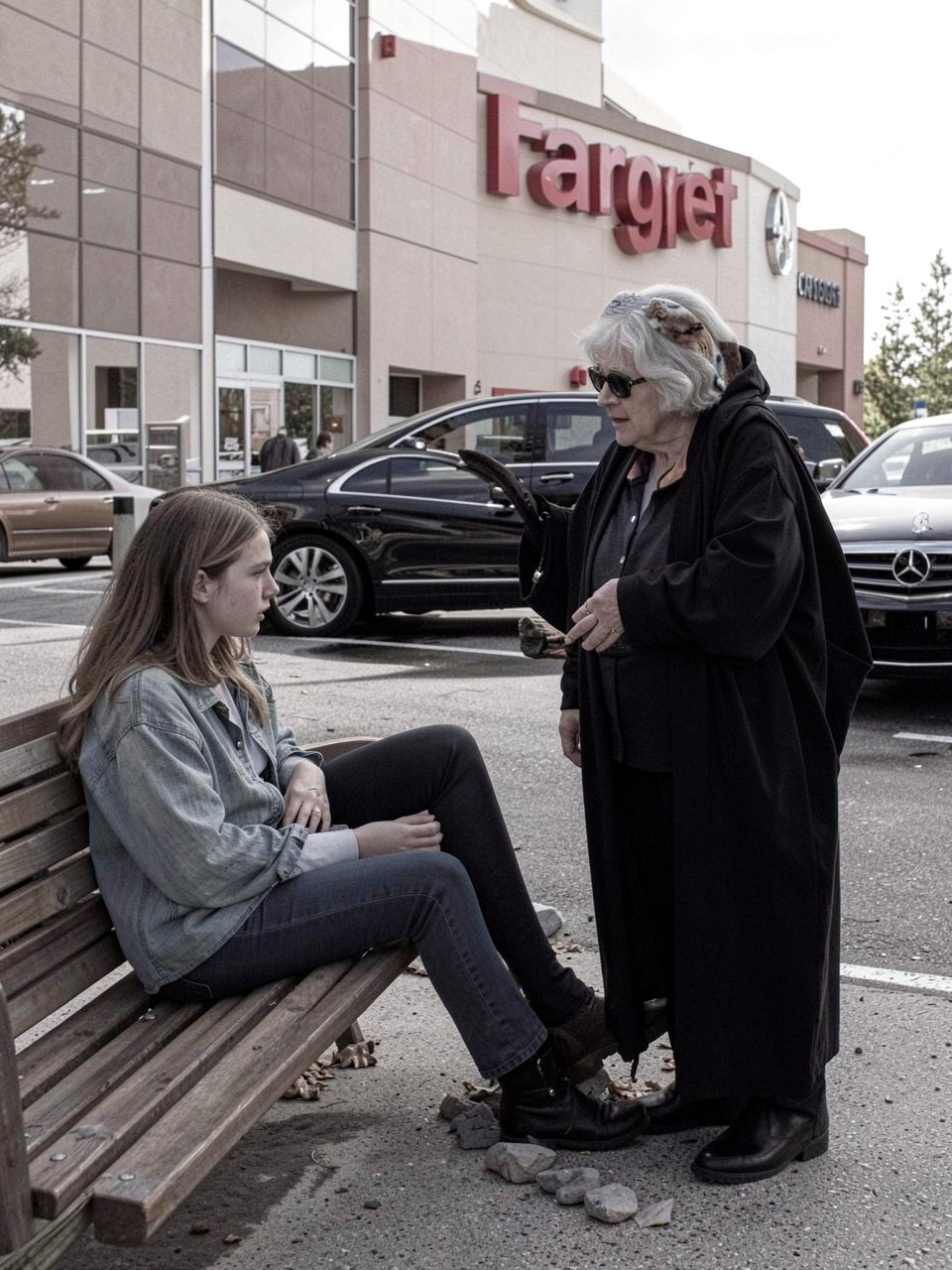
A Target parking lot. A public bench. There were people nearby. He wasn’t cruel.
That’s what he’d tell himself tonight, probably over a beer, watching something on television with the volume up too loud. I didn’t leave her in the middle of nowhere. There was a Target.
He’d taken her purse by accident — or maybe not by accident. It was still on the back seat when the door slammed. She had watched through the window as he reached back, noticed it, and kept driving.
Good luck getting home, he’d said, and the words had a kind of terrible jingle to them, the rhythm of something you might say to a friend before a footrace, not to your wife of six years whom you were abandoning on the side of a state highway in the middle of summer.
She pressed her fingers flat against her thighs and focused on breathing. She would not cry here. There were people going in and out of the Target doors thirty feet away — mothers with strollers, teenagers, a man in a work uniform eating chips from a bag. She was not invisible. She was not nothing. She would figure this out.
But her phone was in her purse.
And her wallet was in her purse.
And her dignity, she was starting to feel, had driven away in the silver Camry.
“Stop crying.”
Mara startled. She hadn’t heard anyone sit down beside her, but there was a woman there now — older, perhaps seventy, perhaps older, it was difficult to say. She wore a cream linen blazer despite the heat, white trousers, low heels the color of caramel. Her silver hair was pinned in a low knot. She had sunglasses with amber lenses perched on a nose that suggested she had once been considered formidable and never really stopped.
“I’m not crying,” Mara said.
“You’re about to.” The woman didn’t look at her. She was watching the parking lot the way a general watches a battlefield — measuring distances, calculating. “And I’m telling you not to. Not here. Not yet.”
“I don’t know you.”
“No,” the woman agreed. “You don’t.”
There was a pause in which Mara expected her to leave or say something else or at least turn toward her, but she did none of those things. She simply sat with the stillness of someone who had learned, a long time ago, that silence was its own kind of power.
Mara took a breath. “My husband left me here.”
“I know. I saw.”
“You saw?”
“I was sitting here before you were.” The woman adjusted her sunglasses. “I watched him drive away. I watched you sit down and arrange your hands like you were posing for a portrait of a woman who is definitely not falling apart.” A pause. “You’re falling apart.”
“A little,” Mara admitted.
“That’s fine. Just not yet.” She checked something on her wrist — an actual watch, silver, without any smart features. “In about ninety seconds, pretend you’re my granddaughter.”
Mara stared at her. “I’m sorry?”
“You heard me.” The woman’s voice was crisp, not unkind, but it left no gap for negotiation. “You don’t have a phone or a wallet. You need help. I am offering it. The only price is a few minutes of theater.” She finally turned to look at Mara directly, and behind the amber lenses her eyes were gray and very clear. “Can you act?”
“I — what? I took drama in high school.”
“Then you’re overqualified.” She turned back to the parking lot. “His name is Thomas. He’s been driving me for eleven years. He will not ask questions if he believes you’re family. He asks questions if he senses charity.”
“He has a problem with charity?”
“He has a problem with strangers. He’s protective.” Something shifted in her expression, brief and warm and quickly recomposed. “It’s a quality I’ve always appreciated.”
A black Mercedes pulled into the lot with the unhurried confidence of a car that had never once been stuck in a drive-through. It was spotless in the way that things are spotless when someone is paid to keep them that way, not in the frantic, apologetic way of things scrubbed clean before company comes. It moved to the curb in front of the bench and stopped without drama.
The woman stood. “Right on time,” she said, with a satisfaction that suggested punctuality was, in her view, the baseline of civilization.
She didn’t look at Mara again. She simply reached over and patted her hand once — firmly, briefly, the way you steady something that’s tilting before it falls — and walked toward the car.
The rear door opened from inside.
Mara stood up. She wasn’t sure why. Her legs moved before her mind agreed, and she found herself walking toward the Mercedes the way you walk toward the only lit window on a dark street — not because you’ve decided to, but because the alternative is standing in the dark.
Thomas was sixty, give or take, with the build of someone who had once been an athlete and had arrived at a dignified truce with age. He had a gray mustache trimmed to military precision and eyes that did, in fact, take a brief sharp inventory of Mara as she slid into the back seat.
The woman said, without looking up from the small notebook she’d produced from her blazer pocket, “My granddaughter needs a ride home. Thirty miles, approximately. She’ll direct you.”
Thomas’s eyes met Mara’s in the rearview mirror for exactly one second.
“Of course,” he said, and that was the end of it.
The car was cool and smelled of leather and something faintly floral — not perfume exactly, more like the memory of a garden in the air conditioning. Classical music played at a volume just below conscious hearing. Mara felt some coiled thing in her chest begin, incrementally, to loosen.
“I don’t know your name,” she said quietly.
The woman made a small note in her notebook. “Eleanor.”
“I’m Mara.”
“I know.” She turned a page. “You said it when your husband told you to get out. You said, ‘Derek, we’re thirty miles from—’ and then you didn’t finish the sentence.” She looked up. “Where were you going to say?”
Mara blinked. “Home. We’re thirty miles from home.”
“You were going to say home.” Eleanor considered this. “Not ‘the house’ or ‘my house.’ Home.” She made another small note. “That’s interesting.”
“How is that interesting?”
“Because a man who leaves his wife on a roadside is not someone she should still be calling home.”
The words landed quietly, without cruelty, the way a correct diagnosis lands — not to wound but to clarify. Mara looked out the window at the highway unspoiling behind them.
“We’ve been married six years,” she said.
“And how many of those years were good?”
Mara opened her mouth. Closed it. Looked at her own hands. “The first two,” she said finally. “The first two were good. And then there were moments. Good moments inside the other ones.”
“That’s not the same as good years.”
“No,” Mara agreed. “It’s not.”
Eleanor did not offer consolation and did not pursue the subject. She went back to her notebook, and Mara had the strange sense that she had just passed some kind of interview without knowing she’d applied for anything.
They drove for a while in quiet, Thomas navigating the highway with the same unhurried confidence as the car itself. Mara watched the landscape change from commercial sprawl to older neighborhoods to the tree-lined streets she recognized, and the familiarity of it — the way the body knows its territory even when the mind is spinning — made her eyes burn.
“Can I ask you something?” she said.
Eleanor didn’t look up. “You may.”
“Why did you do this? You don’t know me. You could have just — watched me figure it out.”
Eleanor was quiet for a moment. Then she closed the notebook with a soft click and held it in both hands in her lap.
“When I was thirty-four years old,” she said, “my first husband left me at an airport.”
Mara turned to look at her.
“We’d had a terrible fight on the plane. We landed, he picked up his bag, and he walked out of the terminal without me. I had two dollars in my coat pocket and a one-way ticket stub.” A pause. “This was before cell phones. Before the age of asking strangers for help felt dangerous.”
“What did you do?”
“A woman at a payphone — she was finishing a call — saw me standing there looking as you looked on that bench. She didn’t ask questions. She just handed me a quarter and said, ‘Call someone who’ll come.’” Eleanor smoothed the cover of the notebook with her thumb. “I called my sister. She drove three hours.”
“That was kind of her.”
“She was furious the whole drive.” Something ghosted across Eleanor’s mouth. “But she came.” She looked out her own window. “I have thought about that woman at the payphone many times. I don’t know her name. I never saw her again. She gave me one quarter and changed the trajectory of everything.” She paused. “I have spent forty years trying to justify the cost of that quarter.”
Mara didn’t say anything for a moment. Then: “And the first husband?”
“Gone,” Eleanor said simply. “Thoroughly and permanently.” She opened her notebook again. “The second husband was considerably better. He died four years ago, which was not his fault, and I still miss him ferociously.” She found her page. “You’ll want to turn left ahead.”
Mara blinked. “I didn’t tell you where I live.”
“You told me thirty miles. I’ve been watching the route.” Eleanor glanced up. “I’m old, not incurious.”
They turned into Mara’s neighborhood, and as the streets narrowed and slowed and her house came into view — a blue craftsman with a hanging basket of petunias she’d planted in April — something in Mara’s chest seized.
The silver Camry was not in the driveway.
She hadn’t known, until it wasn’t there, that she’d been afraid it would be.
“This is it,” she said. “The blue one.”
Thomas pulled to the curb with the same quiet authority. He put the car in park and said nothing, which was — Mara thought — a profound act of tact.
She didn’t move immediately. She sat looking at her house, at the door she would have to unlock with the spare key under the third porch stone, at the windows she’d look through once she got inside and find the specific quality of emptiness that meant she was alone in the way she was going to be alone for a while now.
“Eleanor,” she said.
“Mm.”
“Do you have advice? I know you’re not — you don’t have to. I just—” She stopped. Started again. “I don’t know what I’m walking into.”
Eleanor was quiet for a thoughtful moment.
“You’re walking into a house,” she said, “that belongs to you. Whatever else has happened, that is still true. Start there.” She tilted her head slightly. “Get inside. Drink something cold. Sit somewhere comfortable. Let yourself feel whatever you’re going to feel when there’s no one watching.” She closed the notebook and tucked it back in her blazer pocket. “And then tomorrow — not tonight, you’re not in a state for decisions tonight — tomorrow, figure out what you want.”
“I don’t know what I want.”
“Yes, you do. You said the first two years were good. That means you know what good feels like.” Her voice was even, unflinching, kind in the way of things that are honest without being brutal. “That knowledge is the beginning. Start there.”
Mara looked at her. Eleanor’s profile was sharp against the window — age had made her handsome in a way that youth hadn’t quite managed, all the extraneous softness resolved into something definite and clear.
“You paid a lot more than a quarter,” Mara said.
Something shifted in Eleanor’s expression — a warmth she didn’t bother to suppress this time. “Don’t worry about that. You’ll pay it forward in your own way.” She opened her notebook again. “Now go. Thomas has places to be.”
Thomas made a small sound from the front seat that may or may not have been a suppressed laugh.
Mara climbed out of the car. The July heat was immediate and total. She turned back to the open door.
“Thank you,” she said, and there wasn’t a word large enough for it, but she said it anyway, with everything she had.
“Door-to-door service,” Eleanor said, without looking up. “Don’t waste it.”
The door closed. The Mercedes pulled smoothly from the curb and moved down the street and around the corner with unhurried grace, and was gone.
Inside the house, it was dim and cool. The air conditioning had been running all day, the way it always ran when Derek was home and she wasn’t — he ran cold, she ran warm, it was one of the ten thousand small negotiations of a life built with someone else. She had always turned the thermostat up after he left for work. He had always turned it down when he came home. This, she thought, would no longer be a negotiation she needed to lose.
She sat on the kitchen floor. She didn’t mean to, exactly, but the floor was there, and her knees made the decision.
She sat there and let herself cry — properly, honestly, not the performative not-crying she’d been doing on the bench, but the real kind that has no audience and needs none. She cried for the first two good years. She cried for all the moments she’d dressed up as years and tried to pass off as the same thing. She cried for the version of herself that had kept renovating a house that had already been condemned and called it optimism.
She cried for approximately fifteen minutes.
Then she got up, went to the freezer, and found the emergency pint of salted caramel ice cream she kept behind the frozen peas. She brought it to the couch. She turned on the television and watched two episodes of a British baking show, where kind people made intricate things and were gentle with each other’s failures, and the world seemed, for thirty seconds at a time, manageable.
At eight o’clock, Derek’s key turned in the lock.
She turned off the television.
He stood in the doorway looking at her with the expression of a man who had expected to find a disaster and had found something sitting very calmly on a couch with a spoon and an ice cream container. He hadn’t expected that, clearly. He’d expected something he could respond to — tears, accusations, a storm he could either weather or use as evidence.
This, he did not know what to do with.
“You’re home,” he said.
“I am,” she said. “Someone gave me a ride.”
A pause. He stepped inside, set his keys on the hook. “We should talk.”
“Yes,” she said. “We should. But not tonight.” She picked up her spoon. “Tonight I’m going to finish this, and I’m going to sleep in the guest room, and tomorrow — tomorrow, we’ll talk.”
He stood there for a moment with the lost expression of someone who had been braced for an argument and found no wall to push against. Then he nodded, once, and went upstairs.
Mara turned the television back on.
The divorce took eight months. It was not entirely civil but became civil toward the end, the way things do when people realize that prolonging ugliness costs more than they can afford. She kept the house. She kept the hanging basket of petunias, which she replaced every spring. She kept the thermostat at whatever temperature she pleased.
The first year alone was hard in all the ways she’d expected and strange in ways she hadn’t — the particular freedom of choosing her own radio station in the mornings, the disorienting absence of small conflicts, the slow rediscovery of things she’d liked before she’d arranged her preferences around someone else’s.
In October, fourteen months after the parking lot, she was eating lunch at a sandwich shop downtown when she saw a young woman sitting at an outdoor table with her hands folded in her lap, wearing the expression Mara recognized as trying very hard not to fall apart in public.
Mara looked at her for a moment.
Then she picked up her sandwich, walked outside, and sat down.
“Hey,” she said. “Are you okay?”
The woman — young, maybe twenty-five, eyes red-rimmed — looked up with the startled expression of someone not expecting to be seen.
“I’m fine,” she said automatically.
“You don’t have to be,” Mara said. “Not right now. Not here.” She set her sandwich down. “I’m Mara. Do you want to talk to someone? I’m not going anywhere for a while.”
The woman stared at her. She opened her mouth and closed it. And then, slowly, carefully, like something that has been held tight for too long finally being set down, she said, “My boyfriend just — he broke up with me and took the car and I don’t have a way to get home and I don’t know what to do.”
Mara nodded. She pulled out her phone.
“Let’s figure it out,” she said. “Together.”
Later, after the young woman — whose name was Jo — had been delivered home by a rideshare paid for from Mara’s phone, after she’d texted Mara to say thank you in three separate messages because once didn’t feel like enough, Mara sat in her car for a moment in the parking lot.
She thought about Eleanor. The cream linen blazer. The amber sunglasses. The notebook. You’ll pay it forward in your own way.
She thought about the woman at the airport payphone, handing over a quarter to a stranger, not knowing she was handing over the thread of something that would unspool forty years into the future, through a parking lot, through a Mercedes, through a kitchen floor and a container of ice cream and eight months of legal proceedings, and land here, today, in a girl named Jo getting home safely on a Tuesday.
One quarter. Thirty miles. A spoon scraping the bottom of a container. The specific, unmeasured, incalculable weight of someone sitting down beside you when you need it.
She thought about the fact that she had never, in all the months that followed, been able to find Eleanor. She’d looked — a woman of that description, that bearing, in this city, that car. She’d asked around. No one had matched. Eleanor remained the thing she had been from the beginning: a stranger on a bench with gray eyes and very good shoes and something to prove to the universe about the cost of a quarter.
Don’t waste it, she’d said.
Mara started her car.
She was not wasting it.