Part One: The Morning After
The transfer confirmation had arrived at 11:47 PM.
Elena Vasquez remembered the exact moment—sitting at the marble kitchen island, her laptop open, her hands trembling slightly as she clicked the button that moved $150,000 from her private account,
the one she had built quietly over six years of consulting work, into the joint account that would clear Marcus’s debt. She had done it without hesitation, without resentment, and with the kind of love she believed was unshakeable.
She had been wrong about a great many things.
She came downstairs at seven the following morning wearing her favorite cashmere robe—grey, soft as a whisper, a gift to herself after landing her largest contract three years prior. The smell of coffee reached her first. Then the sounds. Rustling. The thud of something heavy being dragged.
Elena rounded the corner into the living room and stopped.
His mother, Diane, was kneeling beside Elena’s bookshelf, pulling out armfuls of her design books—first editions, collected over a decade—and dropping them into a black trash bag. His father, Robert, was unhooking Elena’s framed artwork from the walls with the casual efficiency of a man doing yard work. Two of Marcus’s cousins she barely knew were ferrying boxes toward the front door.
For a moment, Elena simply stood there, her mind unable to process what her eyes were seeing.
Then she walked into the kitchen.
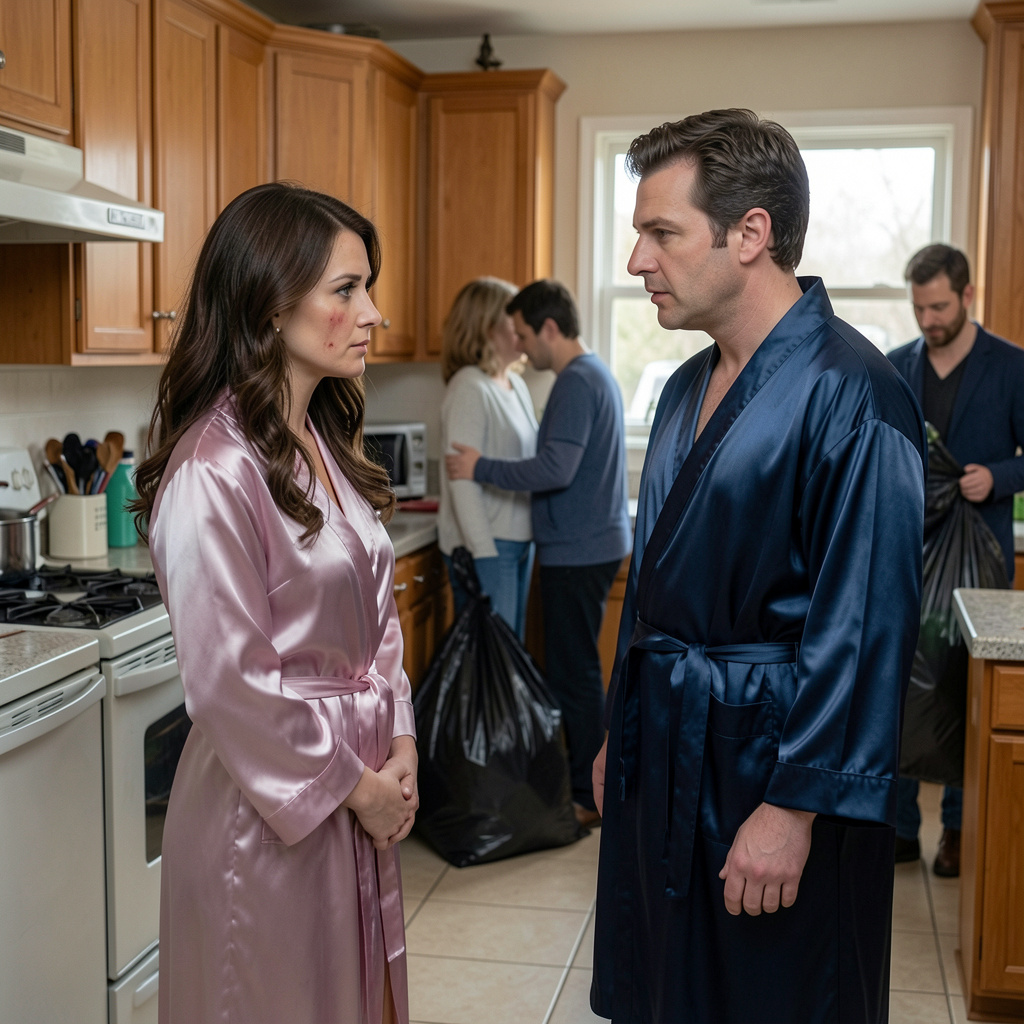
She smelled the perfume before she saw her. Heavy, floral, the kind designed to announce arrival. The woman was standing at Elena’s Italian espresso machine—the one Elena had shipped from Milan, the one that took three weeks to arrive and cost more than most people’s rent—wearing Elena’s silk robe. The emerald one. The one Marcus had given Elena on their third anniversary, the one she never wore casually because she loved it too much.
The woman was beautiful in an obvious way, constructed and deliberate, with the confident posture of someone who had been told her whole life that she deserved to occupy space.
Marcus stood beside her, leaning against the counter, arms folded. When he saw Elena, his expression shifted—not into guilt, not into shame, but into something practiced. Resolved. He had rehearsed this.
He picked up a manila envelope from the counter and held it out toward her.
“Elena.” His voice was even. “Sign these. You can keep the car. We’re being generous.”
She looked at the envelope. Divorce papers. Thick ones.
She looked at his mother through the kitchen doorway, still filling trash bags.
She looked at the woman in her robe, who had the audacity to meet her gaze with a small, satisfied smile, wrapping both hands around Elena’s coffee mug like she was settling in for a performance.
Elena set her phone face-down on the counter. She breathed once, slowly, through her nose. Then she turned to the woman.
“First of all,” she said quietly, “take off my robe.”
The woman blinked. The smile flickered.
“Excuse me?”
“That robe belongs to me. Take it off.”
Marcus laughed—short, dismissive. “Elena, don’t make this—”
“Second,” Elena continued, as if he hadn’t spoken, her voice dropping even lower, almost to a murmur, “you might want to check the espresso machine before you drink that.”
The woman looked down at the cup in her hand. “What does that mean?”
“It means,” Elena said, “that machine requires a specific descaling tablet every three months. I descaled it last night. If you didn’t flush the full cycle before brewing—which you wouldn’t know to do, because it’s my machine and I never told you how it works—then what you just drank contains a fairly significant concentration of citric acid solution.” She paused. “It won’t kill you. But the next ten minutes are going to be extremely unpleasant.”
The woman stared at her cup.
Then the cramping started.
She dropped the mug.
It shattered on Elena’s handmade Portuguese tile floor as the woman doubled over, clutching her stomach, a sound escaping her that was somewhere between a gasp and a wail. She stumbled toward the hallway, pushing past a stunned Robert, knocking a trash bag sideways, disappearing toward the downstairs bathroom.
The screaming started approximately forty seconds later.
Part Two: What Elena Had Actually Done
Marcus stared at the hallway. Then at Elena.
“What did you—”
“She’ll be fine,” Elena said calmly, pulling out one of her kitchen stools and sitting down. “Citric acid flush is unpleasant, not dangerous. She should have read the manual.”
“Elena—”
“Sit down, Marcus.”
Something in her voice—the absolute absence of hysteria, the almost clinical composure—made him obey before he seemed to realize he was doing it.
His parents had appeared in the doorway. Diane still held a trash bag. Robert had one of Elena’s framed prints tucked under his arm—a signed watercolor she had purchased in Florence.
“Put that back,” Elena said to Robert, without looking at him. “Put everything back.”
“Now listen here,” Diane began.
“Mrs. Harmon.” Elena looked at her then, and something in her expression made Diane stop. “I want you to think very carefully about what you’re doing in my house. I want you to think about whose name is on the deed.”
Silence.
“Marcus’s name,” Diane said, but her voice had lost some of its certainty.
“No,” Elena said. She opened the Notes app on her phone, turned it around, and set it on the counter facing them. “My name. Only my name. Marcus signed a quitclaim deed fourteen months ago when we refinanced. He may not have read it carefully. His attorney at the time was a friend of mine.”
Marcus’s face went through several rapid transformations.
“That’s not—I never—”
“You signed it,” Elena said simply. “I have the original. I also have the refinancing documents, which your parents co-signed as witnesses.” She looked at Diane and Robert again. “Which means you both legally attested to the validity of a document that transferred full property ownership to me. If you’d like to dispute that, we can absolutely involve lawyers. I have three on retainer.”
Robert set the watercolor down very carefully against the wall.
“Now,” Elena said, folding her hands on the counter. “Let’s talk about the $150,000.”
Part Three: The Architecture of the Trap
Elena had not always been this precise.
Six years ago, she had been warm, impulsive, generous to a fault—the woman who paid for dinner without looking at the bill, who lent money without paperwork, who believed that love made contracts unnecessary. She had married Marcus Harmon at twenty-nine, dazzled by his easy confidence and his enormous, boisterous family who had welcomed her with what she’d mistaken for genuine warmth.
It had taken her four years to understand that she had been recruited, not courted.
Marcus had charm and connections and a lifestyle that required significantly more income than he generated. Elena had a thriving interior design consultancy, a sharp mind for investment, and the particular blindness of someone who had grown up without family and wanted one badly enough to overlook the warning signs of people who treated love as a transaction.
The first time she noticed money missing from their joint account, she said nothing. She tracked it instead.
The second time, she opened a private account at a different bank and began quietly moving the majority of her income there.
By the time she had discovered the affair—eight months ago, a hotel receipt she found entirely by accident in a jacket she was taking to the dry cleaner—she had already consulted a divorce attorney. Not because she’d suspected infidelity, but because she had understood, with the cold clarity of someone finally seeing a thing whole, that she needed to know where she stood before anything happened.
What she had learned was instructive.
The $150,000 debt was real. Marcus had borrowed against a business venture that had collapsed, and the creditors were serious men who were applying pressure in serious ways. Elena’s attorney had explained what would happen if they divorced while that debt was unresolved: entanglement, contested assets, lengthy proceedings. Marcus’s family would claim contribution to marital assets. It could take years.
Unless Marcus genuinely believed the debt was cleared.
Unless he was confident enough in his position to move quickly, overplay his hand, and show his cards before Elena showed hers.
She had transferred $150,000.
She had also, six hours before the transfer, filed a legal instrument through her attorney that she had been preparing for three months—a document reclassifying the transferred funds as a personal loan from Elena Vasquez to Marcus Harmon, with the debt to be repaid in full upon dissolution of marriage, secured against Marcus’s remaining personal assets, including his equity stake in his brother’s restaurant and the vintage car collection he kept in a storage unit outside the city, which he believed Elena didn’t know about.
The loan paperwork had been signed, notarized, and filed before the money moved.
The $150,000 was not a gift.
It was a hook.
Part Four: The Unraveling
“I don’t understand,” Marcus said. He had the look of a man trying to find the floor of a pool and discovering there isn’t one.
“You borrowed $150,000,” Elena said. “I paid that debt on your behalf. That loan is now owed to me. My attorney filed the documentation yesterday afternoon. By the time you received the transfer confirmation, the legal instrument was already recorded.” She tilted her head slightly. “The divorce papers you’ve just handed me are, in a sense, perfect timing. I was going to file next week.”
“You can’t—that’s not—” Marcus pushed back from the counter, color rising in his face. “You did that deliberately.”
“Yes.”
“You set me up.”
“You set yourself up,” Elena said. “I simply paid attention.”
His mother made a sound from the doorway—something between outrage and the dawning recognition of a mistake.
“Marcus,” Diane said carefully, “call David.” David was their family attorney, a man Elena had met twice at Christmas dinners and found deeply unimpressive.
“David is familiar with the filing,” Elena said pleasantly. “My attorney contacted his office yesterday as a professional courtesy.” She glanced at Diane. “He’ll tell you the instrument is valid.”
From down the hallway, the sounds of distress had quieted. Elena heard water running, then slow footsteps. The woman—she had learned her name was Cassandra, which seemed almost too fitting—reappeared in the kitchen doorway, pale, the silk robe clutched around her, looking significantly less triumphant than she had twenty minutes ago.
“Marcus,” Cassandra said, her voice thin, “I need to go home.”
“We’re in the middle of—”
“I need to go home now.”
Elena stood, smoothed her cashmere robe, and walked to the cabinet beside the refrigerator. She retrieved a glass, filled it with water from the filtered tap, and held it out toward Cassandra.
Cassandra stared at her.
“It’s just water,” Elena said. “I’m not angry at you. You didn’t make any promises to me.”
Cassandra took the glass with unsteady hands.
“The robe,” Elena said gently.
Cassandra set down the water, shrugged the silk robe from her shoulders with whatever dignity she could assemble, and handed it over. She was wearing a dress underneath—she had clearly arrived last night, Elena noted, while Elena had been at her attorney’s office across town.
Cassandra left without looking at Marcus.
The front door opened and closed.
Part Five: What Remained
Elena folded the silk robe over her arm and turned back to her husband.
Marcus was a man who had operated his entire life on the assumption that warmth could be mistaken for weakness. He had married a woman who paid attention and made the fundamental error of assuming she didn’t notice things simply because she hadn’t reacted to them.
“Here is what happens now,” Elena said. She picked up the divorce papers from the counter, tapped them straight, and set them back down. “I will sign these. I want the divorce. I wanted it eight months ago when I first consulted an attorney, and I want it now.”
“Then what was all this?” Marcus gestured vaguely at the counter, the robe, the kitchen, the general wreckage of the morning.
“This was me making sure I was protected before you knew I was leaving,” Elena said. “You were going to try to move quickly, take as much as possible, and present me with facts I couldn’t contest. You’ve been planning this for months.” She said it without bitterness, simply as an observation. “I’ve been planning longer.”
His father cleared his throat from the doorway. “There may be grounds to challenge the loan instrument—”
“There aren’t,” Elena said, without turning around. “But you’re welcome to spend money finding that out.”
She picked up her phone from the counter.
“The personal property your family has begun removing should be returned to exactly where it was. All of it. If anything is missing or damaged, it comes off the debt settlement.” She looked at Marcus directly. “The books. The art. The things I collected before I ever met you.” She let that sit for a moment. “They are mine. They were always mine. I just hadn’t thought I’d need to say it out loud.”
Marcus sat very still.
“I’ll have my attorney contact David today,” Elena continued. “We can settle this cleanly or we can settle it expensively. That choice is yours.” She moved toward the kitchen doorway, and his parents parted for her without appearing to decide to. “I’ll be in my office until noon. I have a client call.”
She walked to the foot of the stairs.
Then she stopped, and looked back.
“One more thing.” Her voice was even, almost kind. “The storage unit on Meridian Road. Unit forty-seven. The cars.” She watched his face go careful and very still. “My attorney knows about those too. Make sure David knows that before you make any decisions about how hard to fight this.”
She climbed the stairs.
Behind her, she heard absolute silence.
Epilogue: Eleven Months Later
The office she chose for her expanded consultancy occupied the top floor of a building in the arts district, all glass and natural light, the kind of space she had designed for clients for years and had finally allowed herself. Her name was on the door in brushed brass—Vasquez Design Group—and there were four employees now, with a fifth being interviewed next week.
The divorce had been settled in four months, which was considered fast. It had been fast because Marcus had run the numbers, consulted David, consulted two additional attorneys, and reached the same conclusion each time: the loan instrument was valid, the property deed was unambiguous, and the storage unit full of vintage cars was not, it turned out, an asset he wanted publicly inventoried in court proceedings.
He had settled.
Elena had not taken everything. She had taken what was hers, plus repayment of the loan—structured across eighteen months, which was more generosity than he deserved, though she thought of it less as generosity and more as practicality. A man who lost everything had no ability to pay. A man left with a foothold could honor a payment schedule.
She still had the silk robe. She wore it on Sunday mornings, with coffee she made herself, in the house that had always been hers.
On the morning the last loan payment cleared, she sat at the same marble island where she had signed the divorce papers, opened her laptop, and looked at the confirmation for a long moment.
Then she closed the laptop, took her coffee to the window, and watched the light come through the garden she had replanted in spring—new flowers, her choices entirely, in colors Marcus had always said he didn’t like.
They were extraordinary.
She had known they would be.
She had simply needed the space to let them grow.