The sprawling, modern mansion we shared in the affluent hills of Colorado felt more like a mausoleum than a home. It was a monument to glass, steel, and a terrifyingly silent emptiness. I stood in my husband’s dimly lit home office, my eight-month pregnant belly resting heavy against my aching spine. My trembling hands clutched a thick stack of decrypted offshore bank statements—a digital paper trail I had spent the last three nights quietly unearthing from his unsecured private server.
Richard stood by the mahogany wet bar, meticulously pouring himself a glass of twenty-year-old bourbon. He was a prominent real estate developer, a man whose public face was all philanthropic smiles and ribbon-cutting ceremonies. But the papers in my hand told the truth of the man in the shadows: rampant money laundering, aggressive extortion, and the systematic defrauding of countless vulnerable families to inflate his empire.
He didn’t panic when I laid the papers on his desk. He didn’t even flinch. He simply dropped a single, spherical ice cube into his crystal glass, the clink echoing sharply in the quiet room.
“You’re too righteous for your own good, Abigail,” he sighed, taking a slow, appreciative sip of the amber liquid. He looked at me with a detached, clinical amusement. “I built this empire. I provide for you. The Lord you pray to every Sunday didn’t buy that diamond on your finger; I did.”
A cold dread coiled in my gut, but I stood my ground, moving a protective hand over my stomach. “This is blood money, Richard. Every cent of it. I won’t let our daughter be raised in a house built on theft and lies. I’m going to the authorities.”
The ambient temperature in the room seemed to plummet. Richard’s charismatic charm—the weapon he used to disarm the world—vanished instantly, replaced by a dead, reptilian stare. He set the glass down on the leather blotter. He didn’t yell. He didn’t throw anything. He just looked at me the way a butcher looks at a side of beef.
“You really shouldn’t have said that, my love,” he whispered, his voice dangerously soft. “Especially with a storm coming.”
Two days later, my water broke. After a surprisingly rapid labor, I gave birth to a beautiful, healthy baby girl we named Grace. I was exhausted, my body aching for the familiar, albeit cold, comfort of my own bed. But as the nurses wheeled me out to the hospital drop-off zone, Richard didn’t turn the heavy SUV toward the city. Instead, he merged onto the highway heading north, insisting we needed “quiet family time” at our remote cabin in Aspen Ridge. I argued, I pleaded, but he simply turned up the radio, drowning out my voice just as the first wailing sirens of a historic, blinding Category 4 blizzard began to echo across the valley.
The drive up the winding mountain pass was a descent into a white-out nightmare. The snow fell in thick, suffocating sheets, burying the asphalt and obscuring the towering pines. Inside the plush, heated cabin of the SUV, the silence between us was violently loud. Grace was asleep in her car seat, blissfully unaware of the predator gripping the steering wheel.
Five miles from the cabin, on the most desolate, sheer drop-off stretch of the mountain road, Richard slammed on the brakes. The heavy vehicle skidded on the black ice, coming to a jarring halt near the edge of the guardrail.
Before I could ask what was wrong, he unbuckled his seatbelt, his face a mask of terrifying, calculated calm. He reached across the console, unbuckled my belt, and shoved the passenger door open. The wind howled into the car, a physical blow of sub-zero air that stole the breath from my lungs.
“Get out,” he ordered.
“Richard, what are you doing? It’s freezing!” I cried, trying to pull the door shut.
He didn’t answer. He lunged over me, violently shoving me out of the high cabin. I tumbled into the deep, wet snow, scraping my knees against the hidden ice. Before I could scramble up, he reached into the backseat, unclipped Grace’s carrier, and carelessly dropped it into the snowbank beside me. I screamed, throwing myself over the carrier to shield my newborn from the biting wind.
When I looked up, Richard had my phone and my heavy winter coat in his hands. He tossed them onto the passenger seat and looked down at me.
The wind howled like a wounded animal, the snow blindingly white and sharp as glass against my exposed skin. Richard locked the heavy doors of his SUV. “Nature is cruel, Abigail,” he yelled over the roar of the storm, a sick, triumphant smile twisting his features. “Such a tragedy that my wife wandered off into the storm in a state of postpartum psychosis.”
He climbed back into the driver’s seat. He didn’t look back as the engine roared and the taillights faded into the impenetrable whiteout, leaving us completely entirely alone in the freezing dark.
Left in nothing but a thin cashmere sweater and maternity leggings, the cold sank into my bones immediately. I unzipped the carrier with shaking, numb fingers, pulling tiny, wailing Grace out and pressing her directly against my bare chest, wrapping my sweater tightly around us to share whatever body heat I had left. I stumbled blindly along the buried road, the snow drifting up to my thighs. Every step was agony.
My extremities went numb. The violent shivering stopped—a terrifying biological sign that hypothermia was shutting down my organs. Darkness began to edge my vision, narrowing the world to a small, gray tunnel. I collapsed beside a massive snowbank, my legs unable to carry us another inch.
I didn’t waste my last breaths cursing Richard. Human anger wouldn’t raise the temperature. Human vengeance couldn’t stop the snow. I closed my eyes, not to surrender, but to pray.
“Lord,” I whispered through cracked, bleeding lips, the wind snatching the words from my mouth. “I am not afraid to come home to You. But please, do not let evil consume this innocent child. Give me the strength of a lioness. Give me the fire to survive.”
I pulled Grace closer, preparing for the long sleep.
Ten minutes later, the faint, impossible, golden glow of halogen headlights pierced the storm. It was an off-duty county snowplow driver who had taken a wrong turn trying to navigate the closed mountain pass.
Thirty-six hours later, safe in a rural hospital bed under an assumed name, the IV line dripping warm fluids into my veins, I watched the local news on the muted television mounted to the wall. Richard was on the screen. He was weeping fake, agonizing tears into a microphone, announcing the tragic disappearance of his beloved wife and child, and launching a “memorial charity fund” in our honor.
I didn’t cry. I didn’t scream at the screen. I felt a profound, chilling clarity settle over my spirit. I turned to the local police chief standing tentatively in my doorway and whispered, “I need to speak to the FBI.”
Six weeks passed.
To the outside world, Richard was a grieving, tragic hero. He used the “catastrophe” of my disappearance to elevate his public profile to saintly heights. Behind closed doors, he moved with the aggressive speed of a man who believed he had outsmarted God himself. He swiftly liquidated my personal assets, funneled the fraudulent charity money into his shell corporations, and, in a display of breathtaking audacity, publicly announced his engagement to Jessica, a twenty-four-year-old junior executive he claimed had “helped him find the light again.” He told the press he needed to move forward, “as Abigail would have wanted.”
While Richard was busy ascending his hollow throne, I was entirely submerged in the shadows.
I lived in a secure safe house, spending my days in a sterile, fluorescent-lit FBI command center fifty miles away from my former life. Agent Caldwell, a seasoned, sharp-eyed federal investigator, had become my constant shadow. I didn’t just give them my story; I gave them the map to Richard’s buried kingdom. I walked their forensic accountants through every encrypted server, every offshore routing number, every piece of dirty leverage Richard had used to bribe city officials.
In the grand ballroom of the city’s most exclusive hotel, Richard was tasting vintage champagne with Jessica, laughing as he signed the final, digitized paperwork to transfer my life insurance payout into an untraceable account in the Caymans. He felt like a god, untouchable and supreme.
Meanwhile, back in the command center, I sat in a rolling office chair, gently rocking a thriving, cooing Grace in my arms. Caldwell stood behind me, pointing a pen at a bank of surveillance monitors displaying intercepted feeds of Richard’s financial movements.
“We have him, Abigail,” Caldwell said, his voice thick with suppressed adrenaline. “We have him on wire fraud, tax evasion, money laundering, and thanks to your testimony and the plow driver’s statement, two counts of premeditated attempted murder. We have the warrants. We can arrest him right now.”
I looked at the monitor. I watched the grainy, silent feed of Richard kissing his new bride-to-be, raising a glass to his corrupt board members who had gathered for a pre-wedding toast. I felt the phantom, biting cold of the snow on my skin. I felt the weight of my newborn daughter in my arms.
“The wicked boast of the desires of their soul,” I quoted softly, my voice steady, vibrating with an unnatural, divine calm.
I looked up at Caldwell. “No. Not today. Let him have his wedding day. Let him gather every investor, every corrupt board member, and every enabler into one single, windowless room. We wait for God’s perfect timing.”
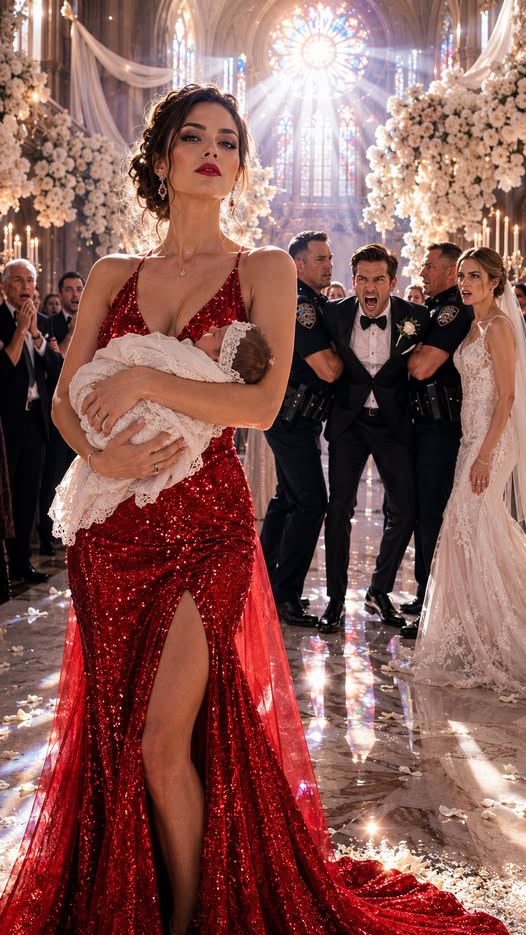
The evening of the wedding finally arrived. The city was gripped by an unseasonable, biting chill, but inside the Cathedral of St. Jude, the atmosphere was electric with opulent wealth. Richard stood at the altar in a custom velvet tuxedo, beaming down at the crowd of the city’s elite. He had absolutely no idea that the waitstaff preparing to serve champagne in the vestibule were carrying federal badges beneath their vests, and the woman he left to freeze to death in the snow had just stepped through the heavy, rear oak doors of the chapel.
The sanctuary was a masterpiece of vaulted ceilings and gilded arches, dripping with thousands of white orchids. The string quartet in the balcony played a soft, sweeping classical arrangement as Richard turned to face the congregation, his chest puffed out with the arrogant pride of a conqueror awaiting his spoils. He adjusted his cuffs, smiling benevolently at the mayor sitting in the front row.
Then, the music abruptly, violently stopped.
The jarring silence sucked the air out of the massive room. From the deep shadows of the vestibule, I emerged. I wore a simple, elegant dark wool coat, my hair pulled back, cradling Grace tightly against my chest. I didn’t rush. I walked with the slow, measured cadence of a ticking clock.
The sanctuary descended into a horrified, breathless silence. Heads turned. Whispers died in the throats of the city’s elite.
At the altar, Richard went entirely rigid. The triumphant flush drained from his face so fast it left him looking like a wax corpse. His jaw slacked. He blinked rapidly, desperately trying to compute the impossibility standing at the end of the aisle.
“Security!” he barked, his voice cracking into a high, reedy pitch of pure panic. “Security, get her out of here!”
No one moved.
At the back of the room, the men in black suits guarding the exits simultaneously pulled FBI badges from their jackets. The heavy mahogany doors at the front and rear of the church slammed shut with a synchronized, echoing thud. The metallic click of the deadbolts engaging sounded like gunshots.
Guests began pulling out their phones, only to stare at screens displaying zero bars of service. The signal jammers the FBI had installed in the choir loft were fully operational.
I walked slowly down the center aisle, the only sound the steady click of my heels on the marble floor. I stopped ten feet from the altar. I looked at the man who had tried to bury me in the ice.
“You always thought you controlled endings, Richard,” I said softly. I didn’t need to shout. In the cavernous, dead-silent church, my voice carried with absolute clarity. “You threw us into the dark, you bought the narrative, and you thought you were God.”
Richard stepped backward, his heel catching on the carpeted altar step. He looked wildly at the federal agents slowly advancing down the side aisles.
“But the Lord is a refuge for the oppressed,” I continued, holding his terrified gaze. “A stronghold in times of trouble. I didn’t want to ruin your special day. I let you have this one final performance.”
I smiled. It wasn’t a smile of malice, but a look of profound, terrifying peace.
“Congratulations on your wedding, Richard,” I whispered. “It’s also your arrest.”
The illusion of his power shattered completely. The cornered animal inside him broke loose. With a guttural roar of pure, desperate rage, Richard lunged down the steps, his hands outstretched, aiming directly for me in a final act of violence. But before he could take two steps, three federal agents converged on him like a tidal wave. They tackled him hard to the marble floor, driving his face directly into the very aisle where he had intended to walk as an untouchable king.
The flashing red and blue lights of two dozen federal cruisers bled through the intricate stained-glass windows, painting the interior of the church in chaotic, fractured colors.
The aftermath was a masterclass in swift, merciless legal execution. Richard was dragged down the church steps in handcuffs, his custom tuxedo torn at the shoulder. He was screaming profanities, spitting at the arresting officers as the sudden swarm of local reporters’ cameras flashed wildly, capturing the brutal, humiliating fall of the great billionaire.
Jessica was nowhere to be seen. The moment the FBI badges appeared, she had slipped out a side door, abandoning her golden ticket the second it turned to lead. Half the congregation—Richard’s corrupt board members and bribed politicians—were instructed to remain in their pews, their faces pale as federal agents began passing out subpoenas and reading Miranda rights.
I didn’t stay to watch the circus outside.
Inside the rapidly emptying, echoing sanctuary, I walked to the very front row and sat down in the wooden pew. I shifted Grace in my arms, gently kissing her warm, soft forehead. She slept soundly through it all, perfectly safe, entirely unharmed.
I looked at the massive wooden cross hanging above the altar. I expected to feel a burning, euphoric thrill of vengeance. I thought I would want to spit on him as he was dragged away. But I didn’t. I only felt an overwhelming, tearful relief. The heavy, suffocating burden of fear, the trauma of the last ten months, lifted from my shoulders like a physical weight.
I bowed my head, pressing my cheek against my daughter’s head.
“Thank you,” I prayed into the quiet, sacred hall. My voice trembled with profound gratitude. “Thank you for the cold that kept me awake. Thank you for the light in the storm. Thank you for giving me the strength to wait. Thy will be done.”
The sound of heavy footsteps approached. Agent Caldwell walked up the aisle and stopped beside my pew. He looked exhausted, but a deeply satisfied smile crinkled the corners of his eyes. He reached into his coat pocket and handed me a sleek, thick manila folder.
I opened it. Inside were the recovered, untouched deeds to my grandfather’s trust, the frozen assets Richard had tried to steal, and a fresh, secure set of identification documents.
“He’s in the transport van. He’s not getting bail, Abigail. With the evidence you provided, he’s never seeing the outside of a cell again,” Caldwell said softly, sitting in the pew across the aisle. He looked at me, a deep respect in his eyes. “It’s over. You’re free. Where do you want to go now?”
Three years later, the salty, warm ocean breeze blew softly through the open bay windows of a beautiful, sprawling coastal home in Monterey.
I stood on the wrap-around wooden porch, holding a mug of black coffee, watching three-year-old Grace run across the sunlit grass. Her laughter rang out like a bell as she chased a bright yellow butterfly toward the edge of the garden.
On the kitchen island behind me sat the morning newspaper. Buried on page twelve was a small, two-paragraph article mentioning that Richard’s final, desperate appeal for his federal sentence had been decisively denied. He was serving forty years in a maximum-security penitentiary, stripped of his wealth, his name, and his godhood. He would die behind bars, utterly forgotten by the world he had once tried to rule.
I hadn’t even bothered to read it. My mind was entirely focused on the present.
I had used my recovered wealth to open The Horizon Foundation, a fully-funded shelter and legal advocacy center for women and children escaping domestic abuse. We provided housing, security, and an impenetrable shield for those who felt they had no voice.
I took a sip of my coffee and stepped out into the morning sun, feeling the warmth seep into my skin. I had taken the darkest, coldest, most terrifying night of my life and allowed God to use it as an anvil to forge an unbreakable future. I had learned that true power didn’t roar from a boardroom; it waited patiently in the quiet dark, trusting the light to eventually break.
I touched the small silver cross resting at the base of my throat.
“He thought he could bury us in the snow,” I whispered to the wind, watching my beautiful daughter spin in the sunlight. A gentle, triumphant smile graced my lips. “He didn’t realize we were seeds.”
As I watched Grace play, the low crunch of gravel caught my attention. A familiar black SUV pulled up into the long driveway. I set my coffee mug down on the railing as the door opened. Agent Caldwell stepped out, dressed in a casual suit, holding a thick, bound portfolio. He gave me a warm, familiar wave, bringing news of a major federal grant our foundation had just been awarded—a new, unexpected blessing that suggested my story of faith and redemption had only just begun its most beautiful chapter.
If you want more stories like this, or if you’d like to share your thoughts about what you would have done in my situation, I’d love to hear from you. Your perspective helps these stories reach more people, so don’t be shy about commenting or sharing.