I noticed her before she even finished unpacking. A moving truck idled in the driveway next door for most of a Saturday, and by Sunday evening there was a woman standing in the yard in white linen pants, watching my husband mow our lawn like it was a performance staged for her benefit.
Her name was Vanessa. Twenty-five years old, recently divorced from a man old enough to be her father, and — according to the gossip that travels a cul-de-sac faster than the mail — she’d walked away from that marriage with the house, the car, and a settlement that made the rest of us look like we were still saving up for retirement. She didn’t need to charm anyone. She did it anyway, the way some people can’t help reaching for the last slice of cake even when they’re full.
I’m Margaret. Fifty-two years old, married to Richard for twenty-six of those years, and not nearly as naive as Vanessa seemed to assume.
It started small. A wave over the fence that lingered a beat too long. A laugh at something Richard said that wasn’t actually funny. She’d appear in her backyard exactly when he was out there grilling, dressed like she was expecting a photographer, not a neighbor with a spatula. I told myself I was imagining it. Twenty-six years gives a woman a certain confidence in her marriage, and I didn’t want to become the kind of wife who manufactures jealousy out of nothing.
But nothing has a way of becoming something if you let it sit long enough.
By the second month, the visits had a pattern. She’d knock on our door in the late afternoon, always around the time she somehow knew I’d be at my book club or running errands. A cup of sugar she didn’t need. A question about the sprinkler system that any internet search could’ve answered. Richard, to his credit — or so I believed then — always mentioned it afterward. “Vanessa stopped by again. Wanted to know about the irrigation timer.” He said it the way you’d report a mildly annoying chore, and I chose to hear it that way too.
Until the conversations got longer. Until I came home early one Thursday and found them on our back porch with a bottle of wine between them, and Richard laughed at something in a way I hadn’t heard in years — easy, unguarded, the way he used to laugh at me before life sanded the edges off everything.
I didn’t make a scene. I’m not built that way. I said hello, made polite conversation for ten minutes, and went inside to start dinner with my hands shaking just slightly, just enough that I dropped a spoon and had to breathe through gritted teeth before I picked it back up.
That night I told myself, again, that I was being paranoid. That a beautiful, bored, recently-rich twenty-five-year-old wouldn’t actually want anything from a fifty-five-year-old man with a bad knee and a tendency to fall asleep during movies. I told myself a lot of things that month. Most of them were lies I needed in order to keep functioning.
Then came the night with the burst pipe.
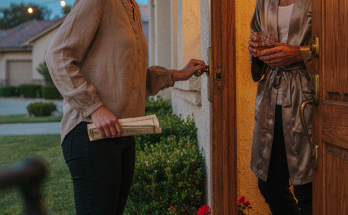
It was a Tuesday, raining hard, the kind of storm that rattles gutters and makes the whole neighborhood feel like it’s underwater. Vanessa knocked on our door just after nine, hair plastered to her face, voice pitched into a perfect tremor of distress. A pipe had burst under her kitchen sink, she said. Water everywhere. Could Richard please, please come help, just for a minute, she didn’t know who else to call.
I was upstairs, half-asleep with a magazine on my chest, and I heard the whole exchange through the floor vent the way you hear things you’re not supposed to hear. Richard’s voice, concerned and instantly mobilized. Her voice, breathless and grateful. The door closing. His footsteps crunching across the wet grass toward her house.
I don’t know what made me get up. Maybe it was the vent. Maybe it was twenty-six years of learning to read the small print under big, ordinary moments. I pulled on a raincoat over my nightgown and walked across our yard and stood at the edge of her lit kitchen window, the rain soaking through my collar, and I watched.
There was no pipe. There was no water on the floor. There was Richard standing awkwardly near her kitchen island, and there was Vanessa, in front of him, reaching up and unbuttoning her blouse with the calm, unhurried confidence of someone who has done this before and expects it to work.
I want to tell you I burst through the door. I want to tell you I screamed, threw something, dragged my husband out by his collar while delivering a monologue he’d remember for the rest of his life. That’s what the version of me from twenty years ago would have done.
But I’m fifty-two. I’ve buried both my parents, survived a malignant mole removed from my shoulder, and learned, somewhere in the messy middle of my life, that the loudest reaction is rarely the most effective one. I watched Richard take a step back, hands up, saying something I couldn’t hear through the glass but could read in the shape of his mouth — Vanessa, no, what are you doing — and I watched her press forward anyway, and I watched him actually leave, jaw tight, before anything more happened.
He came home soaked and shaken and told me the truth without me even having to ask for it. Said it like a confession that had been sitting on his chest since the walk back across the yard. Said he’d left immediately, that nothing happened, that he felt sick about even being in the position to have to make that choice.
I believed him. That part, I actually believed. Richard has never been a smooth liar — it’s one of the most reliable things about him — and the panic in his face was the panic of a man who’d nearly been ambushed by his own decency, not the panic of a man caught.
But belief in my husband didn’t touch the fury sitting under my ribs like a stone. Because here was a woman who had looked at our marriage, decided it was an inconvenience standing between her and something she wanted, and tried to dismantle it in one rainy Tuesday like it was nothing. Like I was nothing. Like twenty-six years could be erased by a blouse and a fake pipe.
I didn’t sleep that night. I lay next to Richard, listening to him breathe, running through every version of confrontation I could imagine — the screaming match across the fence, the call to her ex-husband’s lawyer, the public scene at the neighborhood barbecue. All of it felt like exactly what she wanted. A woman who stages a flood to get a married man alone has already calculated for outrage. Outrage is what she’d expect, maybe even what she’d enjoy, a little drama to spice up her new house in her new life. I wasn’t going to hand her that satisfaction.
So I decided to give her something else instead.
The plan came to me three days later, fully formed, the way good and terrible ideas sometimes do — in the shower, of all places, water running cold because I’d been standing there too long, just thinking.
Vanessa wanted Richard. Fine. I would let her think she was finally getting him, on her own terms, in front of the one audience that would actually matter to a woman like her: the neighborhood. She cared what people thought of her — I’d seen it in the way she dressed for an audience of lawn-mowing husbands, in the way she’d mentioned her settlement to three different women within a month of moving in, like a woman building a reputation as someone you couldn’t push around. People who perform that hard for an audience are terrified of that same audience laughing at them.
The neighborhood was having its annual summer block party that Saturday — the kind of event where forty families spill into the street with foldable tables and an inflatable bounce house for the kids, where everyone brings a dish and everyone watches everyone else, even if they pretend not to. It was, in other words, the single most public moment our suburban universe had to offer. If I was going to give Vanessa her stage, that was the one I’d choose.
Richard’s phone sat charging on his nightstand most evenings while he showered. I’d never once looked through it in twenty-six years — not out of saintly restraint, just lack of interest — but that Wednesday night, while the water ran in the bathroom, I picked it up, opened his messages, and started typing to Vanessa’s contact, the one labeled simply “V — neighbor,” which told me something about how careful he’d already been trying to be.
I am not proud of what came next, exactly, but I’m not ashamed of it either. There’s a particular clarity that comes from finally deciding to stop being patient.
Hey… why don’t you come over to the block party Saturday a little early. Around 5, before everyone shows up. I want to talk to you alone. About us.
I read it back twice. It was vague enough to be deniable if Richard ever saw it, specific enough to be exactly what a woman like Vanessa would want to believe. I sent it before I could talk myself out of it, deleted it from the sent messages, and put the phone back exactly where it had been, screen down, charging cable still plugged in, three minutes before the shower shut off.
She replied within eleven minutes. I watched the notification slide across the screen from across the room while Richard toweled his hair dry, oblivious. I’ll be there. Wear the blue shirt, it’s my favorite. A small, satisfied smile had already arranged itself into the shape I imagined on her face when she typed that.
I deleted her reply too.
The week crawled. I went about my normal routine — grocery shopping, a dental appointment, a phone call with my sister in which I said absolutely nothing about any of this, because some things you have to carry alone until they’re finished. Richard noticed I was quieter than usual and asked twice if everything was alright. I told him I was just tired. It wasn’t entirely a lie. Plotting takes more out of a person than people expect.
Saturday arrived bright and unreasonably pleasant, the kind of day that seems to mock whatever ugliness you’re nursing underneath it. By four-thirty, the street was already filling with folding tables and coolers, kids chasing each other around sprinklers, the smell of someone’s overambitious barbecue drifting from three houses down. I’d arranged, the night before, for Richard to help our neighbor Frank set up the badminton net at four forty-five — a task that would keep him at the opposite end of the street, fully visible to thirty witnesses, at five o’clock sharp.
I positioned myself near my own driveway with a tray of deviled eggs, chatting with the Hendersons, watching the street from the corner of my eye like a woman waiting for a bus.
At 4:58, Vanessa came out of her house.
She’d dressed for a date, not a barbecue — a fitted ivory dress, hair down and styled, the kind of makeup that takes forty minutes and is engineered to look like none at all. She scanned the street, found Richard at the far end wrestling with badminton poles, and made her way toward him with the unhurried, performative stroll of a woman who believes she is the only person actually paying attention.
I’d told exactly two people what was about to happen: my friend Carol, who has a mouth like a town crier and absolutely no loyalty to discretion when something juicy is on offer, and Diane from three doors down, who’d had her own brush with Vanessa’s particular brand of friendliness toward married men and had been quietly furious about it for weeks. I hadn’t told them the mechanics. I’d simply said, watch the Carters’ end of the street around five, and watch Vanessa.
She reached Richard just as he straightened up from the net, sweat on his brow, completely unaware he was the centerpiece of anything. I watched her tilt her head, say something to him with a smile that could’ve sold toothpaste, and reach out to touch his arm in that lingering, unmistakable way that means something to anyone who’s ever been on either side of it.
And Richard — God love him — looked at her like she’d grown a second head.
“What are you talking about?” I heard him say, his voice carrying across the quieting chatter of the street, because nothing travels faster at a block party than the first hint of a scene. “Talk about us? Vanessa, there is no us.”
She faltered, just slightly, then recovered with the practiced grace of someone used to controlling a room. “You texted me,” she said, loud enough now that heads were turning. “Wednesday night. You said to meet you here, alone, in the blue shirt.” She gestured at his shirt — which was, in fact, blue, because I’d laid it out for him that morning myself, a detail I’d quietly arranged days in advance. “You said you wanted to talk about us.”
“I didn’t text you anything,” Richard said, and I could see the exact moment confusion turned into alarm, because thirty of our neighbors were now watching a twenty-five-year-old woman in a cocktail dress accuse a fifty-five-year-old man of inviting her to a romantic rendezvous at a children’s barbecue.
This was the part I hadn’t fully planned for — not because I doubted Richard’s innocence, but because I hadn’t accounted for how it would feel to watch him stand there, blindsided, while the woman who’d tried to seduce him in his own raincoat-soaked panic three weeks earlier now stood in public claiming he’d pursued her. For one disorienting second, I almost stepped in to rescue him.
Then I remembered: I had the receipts. Literally.
I walked over — not fast, not dramatic, just a woman crossing her own street at her own block party — and stood beside my husband, the deviled egg tray still balanced in one hand because some habits don’t abandon you even in moments of reckoning.
“He didn’t text you,” I said to Vanessa, pleasantly, the way you’d correct someone about the time. “I did.”
The street went so quiet I could hear the bounce house generator humming two houses down.
“I sent that message from his phone Wednesday night,” I went on, “because I wanted to see exactly how far you’d go for a man who has never once given you a reason to think he was interested. And here you are. Dressed up. In front of everyone. Telling people my husband invited you here to talk about us.” I let the word sit there, ugly and small in my mouth, exactly the way she’d probably imagined saying it to me one day, except now it belonged to her, in front of an audience, with nothing behind it but her own eagerness.
Vanessa’s face went through several colors. Embarrassment, mostly, though I’d like to think I saw a flash of something close to respect in there too, buried under the humiliation. “You — that’s insane,” she managed. “That’s manipulative. You can’t just—”
“I can’t just what,” I said. “Catch you climbing toward my husband for the second time in a month? The first time involved a pipe that never burst. Ask anyone who’s looked under your sink lately.”
I hadn’t planned that line. It came out of somewhere old and tired and finally done with being polite. A few people gasped, audibly, the way people do at block parties when the entertainment turns out to be better than the potato salad.
Vanessa didn’t have a comeback for that one. There wasn’t one available. She turned, dignity in tatters, and walked back toward her house at a pace just shy of running, ivory dress catching the late sun in a way that, for the first time since she’d moved in, made her look exactly her age — twenty-five, humiliated, and very much alone in a neighborhood that had just watched her get caught reaching for something that was never hers to take.
Richard didn’t speak to me until we were home, dishes from the party still sitting unwashed in the sink. He stood in the kitchen doorway for a long moment, looking at me like he was recalibrating twenty-six years of assumptions about who exactly he’d married.
“You used my phone,” he said finally. Not angry. Something closer to stunned.
“I did.”
“You set the whole thing up. The block party. My shirt.”
“I did that too.”
He sat down slowly at the kitchen table, ran a hand over his face, and then — to my genuine surprise — started to laugh. Not the easy, unguarded laugh I’d heard on our porch with Vanessa weeks earlier. Something rougher, more disbelieving, with real relief threaded through it.
“Margaret,” he said, “I have been sick to my stomach for three weeks wondering how to tell you what happened that night without you thinking I’d done something I hadn’t. And you were just — sitting there. Planning that.”
“I wasn’t going to scream at a woman who wanted an audience,” I said, sitting across from him. “I was going to give her one. And let her perform exactly what she’d been planning, in front of everyone who’ll remember it the next time she tries to flirt over a fence.”
He reached across the table and took my hand, and for a moment neither of us said anything, because there wasn’t really anything left that needed saying out loud.
The house next door went up for sale six weeks later. I heard, secondhand, through Carol, that Vanessa had decided the neighborhood “wasn’t a good fit.” I didn’t go to the open house. I didn’t need to see her go to know what it meant that she did.
Richard still mows the lawn most Saturdays. I still bring out lemonade around four. Nobody watches over the fence anymore — not because the fence changed, but because there’s nothing left over there worth watching for.
Twenty-six years taught me that trust isn’t naivety, and patience isn’t weakness. It just means you wait until you’re certain, and then you act in a way nobody sees coming — least of all the person who assumed you never would.