The first Christmas, I brought a bottle of wine I’d chosen myself, something Australian and bright that the man at the shop had promised would go with anything. Eleanor took it from me at the door, read the label with the brief, total attention of a customs officer, and set it on the sideboard where it stayed, unopened, for the rest of the night. “We have a cellar,” she said, not unkindly. Just informationally. As though she were saving me from a future embarrassment.
That was eleven years ago. I have been coming back every December since, and every December there has been some version of that bottle of wine — some small offering of mine, identified, weighed, and quietly set aside.
I want to say I learned to expect it. That isn’t quite true. You don’t get used to a thing like that so much as you build a room around it in your chest, a room with good locks, and you go in there when you need to.
My husband, Daniel, doesn’t see it. To be fair to him, I don’t think he’s failing to see it on purpose. Eleanor has spent thirty-one years training her son to read her affection as default and her cruelty as aberration, a glitch, a bad night, never a pattern. He loves his mother in the specific, exhausting way of an only son whose father died too early for the balance of power in the house to ever shift. When I tell him what she’s said, he hears it as a complaint about her mood. When I tell him what she’s done, he hears it as a complaint about me being too sensitive for his family’s particular sense of humor. I stopped trying to make him see it around year four. It wasn’t generosity. It was triage.
This year, my mother-in-law’s house smelled like clove and roasting fat and the particular cold, expensive smell of a fire that is mostly for show, built in a hearth that hasn’t actually heated the room since they redid the insulation. Eleanor was wearing the green dress she wears every year, the one that makes her look like a department store window display of Christmas rather than a person having one. She kissed my cheek without quite touching it. She always does that. It’s a masterpiece of a gesture, actually — all the choreography of warmth with none of the contact.
“You look tired, dear,” she said, which from Eleanor is not concern. It’s an opening bid.
I had brought a dish. This is the part that, in retrospect, should have told me how the night would go, though at the time it felt like such a small thing — a roasted squash and lentil thing with pomegranate and feta, the kind of dish you bring because you’re proud of it, because you make it well, because for once you wanted something on that table that was yours and not selected from a catering binder by a woman who has never once asked what I like to eat.
Eleanor employs a caterer for the holidays. Has for years — ever since, I gathered early on, she decided that cooking for a crowd was beneath the house she’d built, or perhaps beneath the house she was still building, room by room, year by year, the way some people build a reputation. The caterer’s food is excellent and entirely impersonal, the kind of food that tastes like a hotel banquet, competent and cold at the center. I’d never minded eating it. I minded, this year, the idea of contributing nothing.
So I’d called ahead, the way you do when you’re trying to do something thoughtful without making it a production, and asked if I could bring a dish. Eleanor had said, “Of course, if you’d like,” in the tone of a woman granting a child permission to help set the table with the plastic dishes.
I should have known “of course, if you’d like” was never permission. It was rope.
The dish sat on the counter the whole afternoon, between the caterer’s trays, looking — I thought — lovely. Daniel’s aunt, Carol, complimented it twice before dinner even started, which I noticed Eleanor noticed.
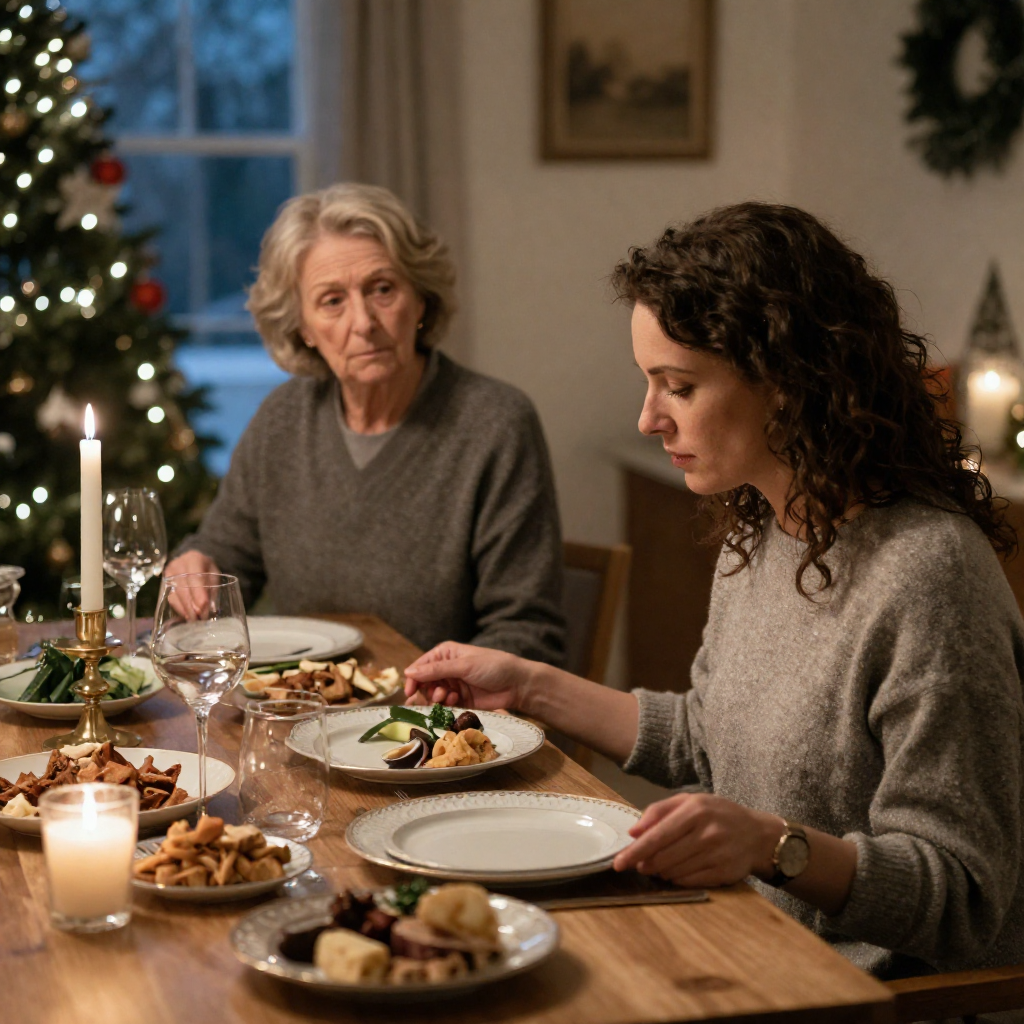
We sat. The candles were lit, the ones that always smell faintly of cinnamon and money. Eleanor’s sister-in-law Patricia was there, down from Maine, sharp-eyed and mostly silent the way she always is at that table, like a woman keeping count of something. Daniel’s cousins were there with their wives, who’d long ago learned to laugh at Eleanor’s jokes a half-beat before they understood them, a survival skill I’d never quite picked up. Daniel sat to my left, oblivious in the specific, protected way of a man who has never had to learn to read a room because the room has always been built around him.
Eleanor waited until the plates were full. She always waits until the plates are full. It’s better theater that way — everyone trapped at the table, forks halfway to mouths, a captive audience with their hands full.
“Well,” she said, looking at my dish like she was examining a stain, “isn’t this homey.” She let the word sit there a moment, dressed up in a smile. “I do think it’s sweet when people bring something from home. It’s just—” and here she did the laugh, the small closed-mouth one she does, the one that isn’t really a laugh at all but a punctuation mark, “—some girls never quite shake where they came from, do they.”
Nobody said anything. Patricia’s eyes flicked to me and away, fast, like checking a stove burner. Daniel’s cousin’s wife laughed the half-beat laugh. Daniel, beside me, was cutting his turkey and hadn’t looked up, hadn’t — I was almost certain — even fully registered the sentence as aimed at anyone.
I have absorbed eleven years of some girls. I have absorbed learned how their family does things yet and we have a cellar and the silent, devastating ritual of watching her take something I made or chose or said and set it gently, smilingly, to one side, like an object she was too polite to throw away in front of me. I used to go home from these dinners and cry in the car before Daniel got in, fast, efficient tears, the kind you can finish in ninety seconds if you’re practiced enough. I am very practiced.
This year I didn’t cry in the car beforehand because there wasn’t time. The crying, if there was going to be any, would have to wait until after.
I stood up to clear the bread basket — an old habit, useful work, the kind of motion that lets you leave a table without leaving a table — and that’s when I remembered the thing Marion had told me.
Marion is — was — Eleanor’s late husband’s sister. Frank’s sister. She’d come to Daniel’s father’s funeral six years ago, a small, dry, watchful woman who smoked on the porch alone and didn’t speak to Eleanor for the entire reception beyond what courtesy strictly required. I’d gone out for air at some point during that long gray afternoon and found her there, and because grief makes people strange and porches make people honest, she’d talked to me for forty minutes like she’d been waiting years for someone to ask.
She told me about the town they’d left when Daniel was four. Cedar Falls, a name Eleanor has mentioned exactly twice in eleven years, both times with the brisk, closed-door tone of someone describing a town that simply stopped being convenient. We outgrew it, she’d say. Frank’s work moved us on.
What Marion told me, smoking in the cold with her coat still buttoned, was that Frank hadn’t been transferred. Frank had been having an affair — had been having it for two years, with a woman who worked at the bank, a woman named Carrie Donnelly who had, eventually, made the mistake of telling people. And Eleanor, rather than leave him, rather than even confront it publicly, had spent eight months systematically destroying Carrie Donnelly’s life in the small, deniable ways a woman with social capital and no scruples can manage in a small town — false rumors fed to the right gossips, a complaint to the bank that cost the woman her job, a campaign waged so quietly and so completely that by the time it was finished, nobody could point to a single thing Eleanor had actually done. Carrie left town within the year. Eleanor stayed exactly long enough to make sure everyone understood who had won, and then she moved her family two states away anyway, because — Marion said, exhaling smoke like punctuation — staying would have meant admitting there’d ever been a fight.
“She didn’t leave because of the affair,” Marion told me. “She left because winning, once everyone already knew she’d won, got boring. She needed somewhere new to start being right about everything again.”
I never told Daniel. I’d thought about it more times than I can count — turned it over at two in the morning, imagined saying it at this very table, imagined the particular silence that would follow. I never told him because I understood, even then, on that porch, that the information wasn’t really a gift to be used. It was a key to a room I hadn’t decided yet whether I wanted to walk into.
I set the bread basket back down. I picked up the gravy boat, mostly empty, and I picked up the last clean plate from the sideboard — there’s always one extra, a habit of Eleanor’s, in case someone arrives. I carried it to the table and set it down at the empty seat across from her, the seat that’s always set and never filled, the seat I’d never once asked about because some unkindnesses you don’t dignify with curiosity.
Eleanor was still smiling that small, finished smile, watching me do this domestic, biddable little task, looking — I want to be precise about this — satisfied. The way you look when a thing you’ve trained finally performs.
I straightened up. I looked at her, not Daniel, not the table, just her, and I let the silence sit there exactly as long as she usually lets hers sit.
“You know,” I said, “I think you’re right that people carry where they came from. I think about that a lot, actually. About Cedar Falls.”
It wasn’t loud. I want that understood — I didn’t raise my voice, I didn’t perform anything, I didn’t reach for the cruelty she’d have reached for in my position, because I have spent eleven years learning the difference between her weapons and mine, and hers require an audience to land and mine, I’d decided somewhere in the space of carrying that plate to the table, did not.
Eleanor’s face didn’t move. That’s the thing about Eleanor — she has spent a lifetime making her face into a wall, and walls don’t fall, they crack, slowly, from somewhere you can’t see, long after the blow that caused it.
“I don’t know what you mean,” she said. Her voice was exactly the same temperature it always is. But her hand, resting on the table beside her fork, had gone very still, the particular stillness of a hand that has just remembered it’s being watched.
“No,” I said. “I don’t suppose you’d want to.” I picked my napkin back up, sat back down, and reached for the dish I’d brought, the one with the pomegranate and the feta, and served myself a second, unhurried helping. “This turned out well, I think. I’m glad I made it.”
That was all.
Patricia, across the table, had gone very quiet in a different way than her usual quiet — alert, sharp, a woman recalculating. I think Patricia knew. I think Patricia had known for thirty years and had simply never had cause to watch someone else know it too. Daniel’s cousin’s wife had stopped her half-beat laugh somewhere in her throat, sensing without understanding that the temperature of the room had shifted, the way animals sense weather.
Daniel looked up, finally, brow furrowed, two beats too late, the way he always is. “Cedar Falls? What’s in Cedar Falls?”
“Nothing, sweetheart,” Eleanor said, and her voice had recovered its register, smooth again, but a half-second too quickly, the recovery of someone who has practiced recovering. “Ancient history. Your father’s company moved us.” She picked up her wine. Her hand was steady by the time the glass reached her mouth, but I had seen it not be steady, and so, I understood, had Patricia, and that was, in its way, the whole of what I’d wanted.
I hadn’t wanted to ruin Christmas. I want to be honest about that, even now, even writing it down. I hadn’t wanted Daniel to find out what his father had done, not at that table, not in front of his cousins, not as a gift wrapped in his mother’s humiliation. I’m not sure, even, that I wanted Eleanor humiliated. I think — and this took me a long time to understand about myself, longer than it should have — I think I only wanted, once, for her to know that I knew something. That the room she’d built where she got to decide what was shameful and what wasn’t, who came from where and who’d “shaken” it and who hadn’t, had a door in it she didn’t control. That was the whole of the violence I was willing to do: a door, opened a half-inch, in full view of her, and then closed again, gently, by my own hand, because I am not her, and I had decided a long time ago, on that porch with Marion’s smoke going gray in the cold, that I did not want to become the kind of person who needed forty years to recognize when she’d already won.
The rest of dinner went on the way dinners do when something has happened that nobody can name. Conversation found its footing again, thin in places, the way ice does after a stone’s gone through it and the cold has started sealing the hole back over. Eleanor did not look at me again, not directly, not the rest of the night — which, for a woman who has spent eleven Christmases finding reasons to look at me, was its own kind of confession.
Daniel asked me in the car, on the way home, headlights cutting through a light snow that had started while we ate, “What was that about, with my mom? You said something about Cedar Falls and she got weird.”
I thought about it for the length of one streetlight, then another.
“Your aunt Marion told me something once,” I said. “About why you left there. I’m not going to tell you what it was tonight. I don’t think it’s mine to hand you over Christmas dinner, and I don’t think you actually want it that way — I think you want it from her, eventually, if you want it at all.” I watched the road. “But I wanted her to know that I knew it. That’s all. I think I’ve earned that much, after eleven years of her deciding what I should be ashamed of.”
Daniel didn’t say anything for a long time. When he did, it wasn’t tell me, which I’d half expected and half dreaded. It was: “Has she really been doing that? All these years?”
And something in his voice — not disbelief, for once, but the slow, dawning sound of a man finally hearing a frequency that had always been there — told me that whatever room I’d opened that night, it wasn’t only Eleanor’s.
I didn’t cry in the car. Not that night. I sat with my hands folded in my lap and watched the snow come down harder, and felt, for the first time in eleven Decembers, something other than the small, contained grief of having survived another one. It wasn’t triumph, exactly. It was quieter than that, and stranger — something closer to the feeling of setting down a weight you’d carried so long you’d forgotten it was a weight, and finding your arms ache in the sudden, unfamiliar shape of being empty.
Whatever this cost me — and it will cost something, I’m not naive about that, there will be a version of Eleanor now who is colder and more careful and possibly more dangerous, a woman who knows the door exists and will spend her remaining holidays making sure it never opens again — I find I don’t regret it. Not the saying, and not the choosing, after everything, not to say more.
I’d set the last plate down at an empty seat that wasn’t really for anyone, and for the first time in over a decade at that table, the empty seat looked, to me, exactly like what it was. Not an invitation. A warning, set out every year, that some history isn’t owed an audience to be true.
I am still the daughter-in-law she wouldn’t have chosen. I find, this year, that I don’t especially need her to.