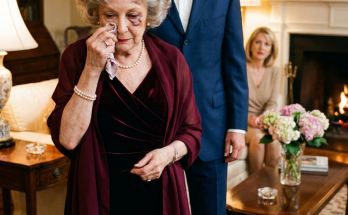
The drive from Atlanta to Ocala takes about seven hours if you don’t stop, and Renata Voss hadn’t stopped.
She’d eaten half a granola bar somewhere around Valdosta and thrown the rest out the window because it tasted like chalk, and she’d drunk a gas station coffee that was so bad it felt like a punishment. She drove with both hands on the wheel, which she never did normally, because it gave her something to focus on besides the phone call she’d gotten from her mother at 2 a.m.
Not a desperate call. That would have been easier to interpret. It was just her mother saying, “I think the freezer is broken, sweetheart. The ice cream is soft,” and then a long pause in which Renata heard the particular silence of a woman who had learned not to ask for things, and then, “It’s been soft for a few weeks, I think. I lose track.”
Renata had not slept after that.
She pulled off I-75 at the Marion County exit as the sun came up pink and flat over the scrub palms, and she drove the twelve miles to Shady Pines Estates — which had no pines and was not particularly shady, just a grid of mobile homes on small lots with a community mailbox and a concrete recreation room nobody used — and she parked in front of Unit 14 and sat in the car for a moment looking at it.
The flower boxes her father had hung under the windows were still there, but the flowers had been replaced by dirt and one desiccated stem. The wooden steps had a new crack running diagonally across the middle one. The curtains, the ones with the little yellow roosters her mother had made herself thirty years ago, were drawn.
It was 7:40 in the morning. Her mother would be up. Her mother had been up by six every day of her life.
She knocked, and after a moment the door opened, and there was Dolores Voss, eighty-four years old, in a housecoat Renata recognized from a decade ago. It hung on her. That was the thing that hit first — not the kitchen, not the fridge, not any of it — just the way the fabric fell off her mother’s shoulders like it was hung on a wire hanger, not a person.
“You didn’t have to drive all this way,” her mother said, and smiled, and the smile was real. That was the thing about her mother. The smile was always real.
Renata had a system for not crying in front of her mother. She’d developed it over the years, through her father’s decline, through the funeral, through all the small devastations that accumulate around a parent’s aging. She breathed through her nose. She found something to do with her hands. She asked practical questions.
“Mom, when did you last go to the grocery store?”
“Oh, Darlene usually picks things up.”
Darlene. Her sister. Renata opened the refrigerator.
The expired milk she’d learn about later was there, pushed to the back. Two eggs. A jar of pickle relish. Half a block of Velveeta in its foil, the edges gone hard and orange. In the freezer: a bag of corn, a pint of freezer-burned ice cream, and a frost-coated chicken breast that she estimated had been there for at least a year based on its transformation into something geological.
“Mom.” Renata closed the refrigerator. “What did you eat yesterday?”
“I had some crackers. And I wasn’t very hungry for dinner.”
“What about the day before?”
Her mother looked at the window. “I think Darlene brought something. A casserole. Or maybe that was last week.”
Renata breathed through her nose. She found something to do with her hands, which was gripping the refrigerator handle until her knuckles hurt.
“Mom, I’m going to go get some groceries. While I’m out, I’m going to stop at the bank, okay? Just to make sure everything is in order with the accounts.”
“Oh, you don’t need to do that. Darlene handles all of that.”
“I know she does,” Renata said.
The branch manager’s name was Patricia, and she had the particular facial expression of someone who has just bitten into something bad and is working out how to spit it out politely. She’d asked Renata to come to her office after Renata had stood at the teller window for three minutes while the young man behind the counter typed things into his computer with increasing slowness, like a person stalling.
“Your mother has a pension account with us,” Patricia said. She had the account pulled up, and she turned her monitor slightly so Renata could see the screen without seeing it fully, a gesture that communicated both transparency and caution. “The monthly deposit comes in on the third. $2,100.”
“Yes,” Renata said. “Dad’s pension from the railroad. It transferred to her as survivor benefit when he passed.”
“That’s right. And there’s an automatic transfer set up. Goes out on the fourth.” Patricia paused. “To a linked account.”
“What linked account?”
Another pause. “I’m not able to share the account holder’s information without authorization. But I can tell you that your mother’s account — after the transfer — retains $300 each month. The remainder transfers out.”
Renata did the math in the way you do when you already know the answer and are just confirming the wound. $1,800 a month. Twelve months a year. Six years since her father died.
“$129,600,” she said.
Patricia looked at her. “I’ve been here eleven years,” she said quietly. “I’ve seen this before. I want you to know — the paperwork appears to have been filed correctly. Power of attorney. All of it. Notarized. Your mother came in herself, with her daughter, about six months after her husband passed. The authorization was signed.”
“My mother signed it?”
“Your mother signed one document, yes.” Patricia folded her hands. “There were multiple documents that day.”
Renata sat with that for a moment. Her mother, six months a widow, grief-soft and trusting, sitting at this desk or one like it, Darlene beside her with a stack of papers, just sign here, Mom, it’s just the banking stuff, I’ll take care of everything.
“There was also,” Patricia said carefully, “a secondary authorization. A co-signer on the power of attorney document. For additional legal weight, apparently. The name on it is—”
“Mine,” Renata said. She didn’t know how she knew. She just knew.
Patricia said nothing.
“I didn’t sign anything,” Renata said. “I’ve never been in this branch. I’ve never signed any document related to my mother’s accounts.”
Patricia’s expression didn’t change, but her hands tightened slightly on the desk. “I think,” she said, “that you may want to speak with Adult Protective Services.”
She sat in the parking lot for forty-five minutes. She watched people come and go — a man with a deposit envelope, a woman with a stroller, a teenager on a phone — and she felt entirely outside of it, like she was watching it through glass. The shaking in her hands had started when she was still at Patricia’s desk and hadn’t stopped.
She called Darlene.
Three rings. Then her sister’s voice, easy, slightly annoyed in the way she always was when Renata called, like the call was an interruption of something more important.
“I’m at Mom’s bank,” Renata said.
A pause. “Okay.”
“I’ve been talking to the branch manager. About the account.”
“Renata, I handle Mom’s finances. That’s been the arrangement. You live in Atlanta, you’re not—”
“Where does the money go, Darlene?”
“To Mom’s expenses—”
“She has expired milk and two eggs in her refrigerator. She’s lost eighteen pounds. She has three outfits. Where does the money go?”
Silence. Then, in a different tone — flatter, harder, the voice Darlene used when she’d decided to stop pretending: “Mom doesn’t need $2,100 a month. She doesn’t go anywhere. She doesn’t do anything. The money was just sitting there.”
“It’s her money.”
“She doesn’t even know what to do with it.”
“Darlene—”
“I have a mortgage. Do you understand what the market is like? I have a daughter in college. I have—”
“You forged my signature.”
The silence this time was different. Longer.
“I don’t know what you’re talking about,” Darlene said.
“On the power of attorney. My name. My signature. Notarized. I’ve never signed any document for Mom’s accounts.”
“You’re confused.”
“Tell me who notarized it.”
“I’m not doing this with you.”
“Tell me.”
The call ended. Renata looked at her phone for a long moment, then set it face-down on the passenger seat, and pressed the heels of her hands against her eyes, and let herself shake.
The Adult Protective Services investigator was a compact, watchful woman named Sylvia who had a yellow legal pad and a pen she clicked three times before she started writing. She came to the house two days after Renata filed, and she sat on the couch with the yellow rooster curtains behind her and asked Dolores gentle, careful questions.
“Do you understand where your pension money goes each month, Mrs. Voss?”
“Darlene handles all of that,” Dolores said. She said it the way she said most things related to Darlene — with a faint protective quality, like she was speaking about someone fragile. Renata had noticed this her whole life. Their mother had always protected Darlene. Even now. Especially now.
“Did you know that after a transfer each month, your account holds approximately $300?”
Dolores looked at her hands. “I have enough for my needs.”
“Mom,” Renata said softly. “You don’t have enough to eat.”
Her mother’s face did something complicated. Not surprise, exactly. More like the expression of someone who has been carefully not-knowing something, and has just been asked to know it.
“She said she’d take care of things,” Dolores said. “Darlene said she’d take care of everything.”
“I know, Mom.”
“After your father died — I didn’t understand any of it. The bank accounts, the pension, all of it. Your father always — he was so good with all of that. And Darlene said she’d take care of it.”
Sylvia wrote something. Clicked her pen. “Mrs. Voss, did you ever sign any documents authorizing your daughter Darlene to manage your finances?”
“I signed what she put in front of me,” Dolores said simply. “I trusted her.”
It was the plainest thing in the world. The most devastating.
The notary, as it turned out, was a woman named Connie Ferrell who worked out of a UPS store in Lake Worth and who had, over a period of three years, notarized eleven documents for Darlene Voss Marchetti. Including the power of attorney with Renata’s forged signature. Including two documents that bore the signatures of people who, when the investigator made calls, had never heard of Darlene Marchetti at all.
Connie Ferrell, when visited by law enforcement, cried and said she hadn’t known. Then she said she’d been paid $200 per document. These two statements were irreconcilable, and Sylvia noted that in her report.
The forensic accountant hired by the attorney Renata found — a woman named Grace Okafor who wore reading glasses on a chain and had the energy of someone who had seen everything and judged most of it — spent three weeks with bank records and produced a document that ran to forty-one pages. The total, across six years and several accounts, was $151,200.
“The house in Lake Worth,” Grace said, spreading printouts across the conference table. “She put $60,000 down in 2019. Traced directly from your mother’s pension, routed through a business account — your sister had an LLC, nominal flooring business, two invoices ever issued, both to herself. The rest went to mortgage payments, a car, a vacation to Costa Rica, her daughter’s tuition.” Grace looked at Renata over the reading glasses. “Her daughter — your niece — doesn’t appear to have known.”
Renata thought about that. Her niece Becca, twenty years old, who sent emojis on holidays and had her mother’s eyes.
“Does she need to be—”
“She’s not implicated,” Grace said. “She’s a recipient of stolen funds, but there’s no evidence of knowledge or intent. She may be subpoenaed as a witness. That’s for the DA to decide.”
The DA, as it turned out, had things to say.
Darlene was arrested on a Tuesday. Renata knew because Sylvia called her, and she sat in her car in the parking garage of the building where she worked in Atlanta and received the information in silence.
Elder financial exploitation. Forgery. Fraudulent notarization — Connie Ferrell had agreed to testify. Wire fraud, because the transfers had crossed state lines at one point in the routing. The charges had a weight to them, an accumulation, and each one was another name for the same thing: her sister had looked at their mother, eighty-four years old, alone since their father died, trusting, afraid to ask for things — and had decided that this was an opportunity.
She didn’t feel triumphant. She’d expected to feel something cleaner than what she felt, which was a grief so layered she couldn’t find the bottom of it. Grief for her mother. Grief for the six years. Grief for the version of her sister who had not done this. Grief for the fact that she kept reaching for that version and finding it wasn’t there.
She thought about all the Christmases she hadn’t come down. The times she’d called and her mother had said “I’m fine, sweetheart, Darlene takes care of everything” and Renata had felt, she was ashamed to admit, relieved. Because Darlene taking care of everything meant Renata could stay in Atlanta and work her job and live her life and send $200 a month and tell herself that was enough. That she was doing her part.
Her part. While her mother ate crackers and lost eighteen pounds and wore the same three outfits until they hung off her like grief.
Dolores moved in with Renata in October. They painted the guest room a color her mother picked from a catalog, something called Pale Seagrass, and Renata bought a reading chair that her mother sat in for the first week with the expression of someone who was worried it would be taken away. They went to the grocery store together on Saturdays. Her mother put things in the cart slowly, carefully, and Renata learned not to watch her face when she did it.
“You don’t have to choose the store brand,” Renata said once. “Get whatever you want.”
Her mother looked at a jar of name-brand pasta sauce for a long moment, then put it in the cart. It was a small thing. It felt enormous.
The civil case ran parallel to the criminal. Grace Okafor’s report was entered as evidence. Darlene’s attorney — the second one, after she’d dismissed the first — argued that the financial arrangement had been consensual, that Dolores had understood and approved, that the documents were valid. The judge, a woman named Honorable Tessa Whitmore who wore her hair in a silver bun and had clearly encountered this argument before, was not moved.
Darlene sat at the defense table and looked at her hands, and Renata sat in the gallery and looked at Darlene, and their mother sat beside Renata and looked at nothing, which was the thing that Renata thought about afterward, lying awake at 3 a.m. in Atlanta. Not Darlene’s face. Not the judge’s face. Her mother’s face, with its expression of careful absence, the face of a woman who had loved her daughter for seventy years and had run out of ways to hold that alongside what her daughter had done.
The house in Lake Worth was sold. The proceeds, along with Darlene’s car and the contents of her business account, were applied toward restitution. It didn’t come to $151,200. It came to $89,000. The remainder was a judgment that would take years to collect, if it was collected at all.
Becca called Renata from a dorm room. She could hear the particular acoustics of it — hard floors, small space, someone’s music bleeding through a wall.
“I didn’t know,” Becca said.
“I know,” Renata said.
“I keep thinking about Grandma’s fridge.” A pause. “Mom told me Grandma was fine. That she had everything she needed. I believed her.”
“She’s your mother.”
“I could have — I went down there for a weekend once. Two years ago. Grandma made me a grilled cheese and I thought it was sweet, her doing that. I didn’t think—” Her voice broke. “I didn’t think it was because that was all she had.”
Renata closed her eyes. “Becca. You were eighteen. This was not your job to find.”
“Whose job was it?”
Renata sat with that. It was not a rhetorical question. It was a genuine one, and it deserved a genuine answer.
“Mine,” she said finally. “It was mine. I should have looked sooner.”
There was a long silence in which neither of them tried to fill it with something false.
Her mother started talking about her father more, in the Pale Seagrass room. Not the end of him, not the illness, but the earlier parts — the railroad job, the way he danced badly and knew it and didn’t care, the year they’d tried to grow tomatoes in the backyard of the house in Kissimmee and the raccoons had gotten every one.
“He would have caught it sooner,” her mother said once. Not bitterly. Just as a fact.
“Maybe,” Renata said.
“He never trusted anyone with money. He’d have been watching.” She smiled faintly. “I always thought that was just him being a certain way. Old-fashioned. Suspicious. Turns out he just understood something I didn’t.”
“What’s that?”
“That love doesn’t mean the same thing to everyone.” Her mother smoothed the arm of the Pale Seagrass chair. “I kept thinking — it’s Darlene. She’s my daughter. Of course she’s looking after me. I didn’t want to think anything different, so I didn’t.” She paused. “That’s not naivety. That’s a choice. I know that now.”
Renata thought about this for a long time after her mother went to sleep. The way love can be weaponized by its own completeness. The way trust can be the thing someone counts on when they decide to take from you.
She thought about the forged signature. Her name, on a document she’d never seen, authorizing what had been done. There was something in that she kept turning over — the specific quality of the contempt it implied. Not just the taking. But the decision to use Renata’s name to do it. As if implicating her was part of the satisfaction.
She thought about the phone call in the parking lot. Mom doesn’t need that money. She barely goes anywhere.
She barely eats, Renata had said. And that was true. But what she understood now, in a way she hadn’t fully then, was that hunger wasn’t even the worst of it. The worst of it was the $300 a month. Not because of what it couldn’t buy. Because of what it said. That after all the paperwork was signed and the account was linked and the money was flowing the other way, someone had decided that $300 was enough for their mother. That she was worth $10 a day. That her life, at eighty-four — her comfort, her warmth, her groceries, her dignity — was worth $300, and the other $1,800 was more usefully applied elsewhere.
That was the number Renata kept coming back to. Not the $151,200, which was staggering, which was crime. The $300. Which was the intimate arithmetic of how much someone had decided their mother’s life was worth.
Darlene was sentenced to four years, with the possibility of parole after two. Renata did not go to the sentencing. She stayed home and made her mother breakfast — eggs and toast and the good orange juice, the kind with the pulp — and they ate at the kitchen table and her mother told her about the raccoons again, how her father had chased one across the yard in his bathrobe at midnight and slipped in the wet grass and laughed so hard he couldn’t get up.
“He just laid there laughing,” her mother said. “The raccoon was already gone. Just him in the wet grass, laughing.”
Renata laughed. The real kind — the kind that surprises you.
“He was a good man,” her mother said.
“He was.”
“He would have liked you doing all this.” Her mother looked at her over the orange juice. “Driving down. Going to the bank. All of it. He would have said — he would have said you didn’t let it stand.”
“I should have come sooner.”
“You’re here now,” her mother said.
It was not absolution. It was not meant to be. It was just what was true: she was here now, and her mother was here, at a table with good orange juice and eggs, in a city where she didn’t have to count what was left in the fridge against what was left in the month. It was not nothing. It was, in its own specific, painfully clear-eyed way, enough to begin with.
Outside, October light came through the window at an angle and fell across the table, and her mother wrapped both hands around her coffee cup, and they sat there together in the ordinary warmth of it — which is all anyone, at eighty-four, should ever have had to ask for.