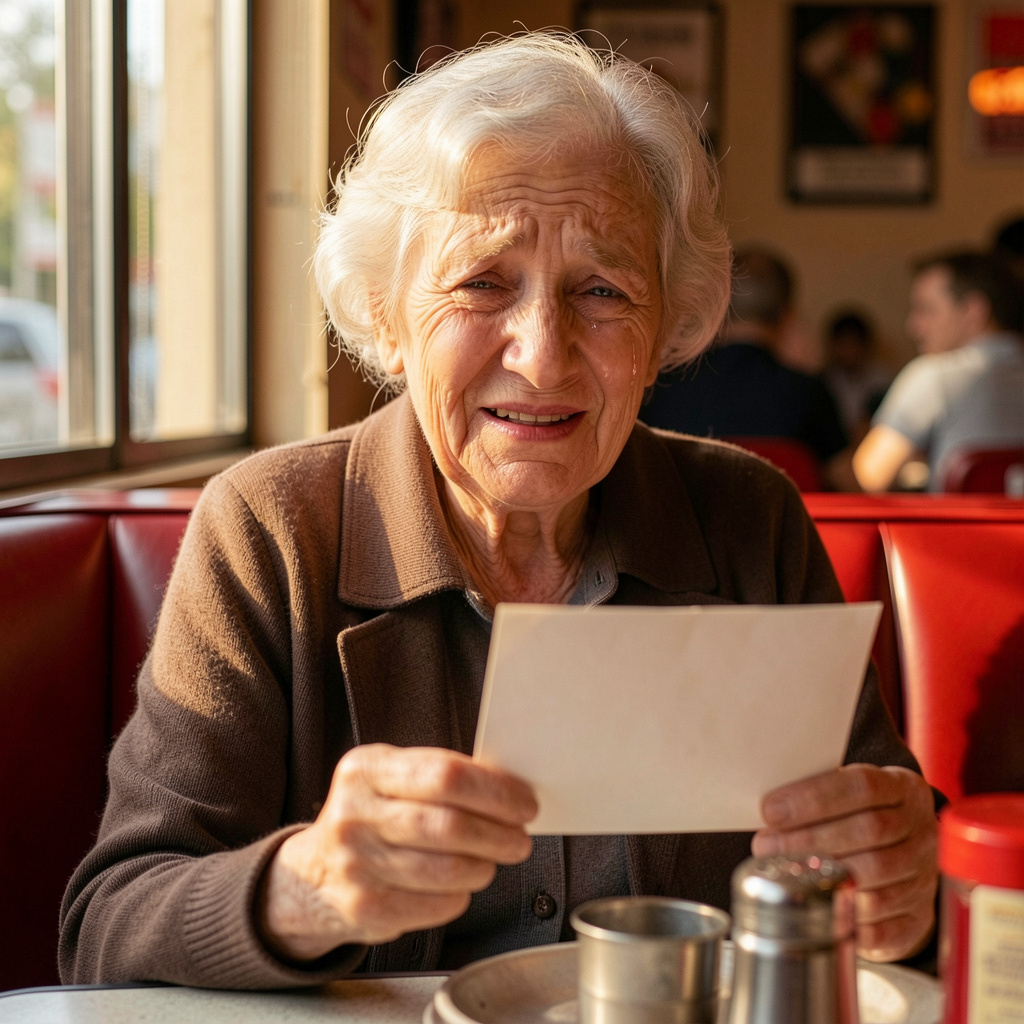
That was the first thing Linda Patterson noticed — before she could bring herself to open it, before she could make her fingers stop trembling long enough to slide beneath the seal. She pressed it to her chest the way she’d described to the manager, the way she’d told Becca, but what she hadn’t told either of them was that she stayed like that for a very long time. Long enough that the couple in the next booth finished their chicken and dumplings and left. Long enough that the lunch rush thinned and the restaurant settled into its drowsy mid-afternoon quiet, the kind of hush that smells like biscuit flour and woodsmoke and maple syrup soaked into old timber.
Old Spice and peppermint. That was Harold. Forty-nine years of Old Spice and peppermint, and somehow — God only knew how — the envelope had held it.
“Take your time, hon.” Becca’s voice was soft, barely above a whisper. She had slid into the seat across from Linda without being asked, the way she always did on her break, setting her glass of sweet tea on the table between them. But she wasn’t on her break now. She’d come straight from a four-top by the window the moment she’d seen Linda’s face go white. The four-top could wait. The four-top would understand, or they wouldn’t, and either way Becca did not particularly care.
Linda lowered the envelope from her chest. She looked at it in her hands. The handwriting on the front — For my Linda — was Harold’s careful, deliberate print, the way he wrote when something mattered. When he made grocery lists, he scrawled. When he signed birthday cards, he scrawled. But For my Linda was printed with the patience of a man who wanted every letter to last.
She had not seen his handwriting in six years.
She had thought she’d forgotten what it looked like. She had been wrong.
Harold Patterson had never been a man of grand gestures.
He had not proposed on bended knee. He had asked her while they were washing dishes after Sunday dinner at his mother’s house, him washing, her drying, and he had turned to her with soap on his forearms and said, I think we ought to get married, Linda. I think we’d be good at it. She had laughed so hard she’d dropped the plate she was holding, and his mother had come running from the living room, and the plate had been a wedding gift from his grandmother, and that had been 1974.
He didn’t bring her flowers for no reason. He didn’t write poetry. He didn’t whisper sweet nothings in the dark. What Harold did was quieter than that, more stubborn, more permanent. He noticed things. He remembered things. He acted on what he noticed and remembered without ever making a fuss about it.
He noticed that she always got cold in movie theaters, so he kept a cardigan in the back seat of the car. He noticed that she felt invisible at parties where she didn’t know anyone, so he always steered them toward the people standing alone at the edges of rooms. He noticed that she loved Tuesdays — had always loved Tuesdays, for no reason she could ever articulate, just the way some people love the smell of rain or the particular quality of October light — and so for forty-nine years of marriage, he had tried to make her Tuesdays good.
When the kids were young, it meant pancakes shaped like animals. When the kids were gone and money was tight, it meant a wildflower he’d picked from the roadside left on her pillow. When they got older and quieter and more comfortable in their silences, it sometimes just meant that he would look at her on a Tuesday afternoon and say, Good day today, wasn’t it? And she would say, Yes, it was, and mean it.
She didn’t know, until she was sitting in a Cracker Barrel holding an envelope that smelled like him, that he had been planning for Tuesdays after he was gone.
The diagnosis had come eighteen months before he died.
Pancreatic cancer, stage three, caught late the way it almost always was. The doctor had used words like aggressive and timeline and quality of life, and Harold had listened to all of it with the same expression he wore when someone was giving him directions to a place he’d already decided to find on his own. Polite attention. Private determination.
He had not fallen apart in the office. He had not fallen apart in the car on the way home. Linda had been the one who fell apart — had crumpled against the passenger window and cried in a way she hadn’t cried since her mother died — and Harold had driven with one hand on the wheel and one hand covering hers on the center console and said, We’re going to figure it out. We always figure it out.
They did not figure it out. Nobody figures that out.
But Harold, in the eighteen months that followed, figured out something else. He spent that time with a quiet, methodical purposefulness that she had understood as acceptance and had admired and had been a little frightened by. He organized the files. He updated the will. He had long, careful conversations with their son David and their daughter Maureen that Linda was only partially invited into — conversations about logistics, about the house, about the investment account — and she had let him lead because he needed to, because it was the only thing he had left to manage, and a man like Harold needed to manage something.
What she did not know was that one afternoon in the spring before he died — a Tuesday, as it happened, a warm April Tuesday with the dogwoods in full bloom — Harold Patterson had driven to the Cracker Barrel on Route 9 and asked to speak to a manager.
His name had been Dennis. Not the manager Linda knew; Dennis had moved on some years ago, transferred to a location in Knoxville, but before he left he had passed the arrangement to his successor, and that successor had passed it to the next, and somehow — through three management changes and one corporate restructuring and a pandemic that had threatened to end the whole thing — the arrangement had held.
Harold had explained it simply. His wife loved this restaurant. She came every Tuesday, always had, ordered the same thing every time, sat in the same booth. He was going to be gone soon and he wanted her to keep coming. He wanted to pay for it in advance. He did not want her to know.
Dennis had initially tried to explain that this was unusual, that they didn’t typically, that there would be questions about —
Harold had put an envelope of cash on the counter. Thirty-one hundred dollars. And then he’d said, I know it’s unusual. I’m asking you anyway.
What Dennis had felt in that moment — and he had described it later to his wife, then to his mother, then eventually to anyone who asked why he’d gone into restaurant management, as a way of explaining that the work was sometimes quietly sacred — was that he was in the presence of something he didn’t have the right to obstruct. The man across the counter was dying. The man across the counter was trying to take care of his wife from the other side of a threshold he was about to cross.
You didn’t say no to that.
Dennis had taken the envelope. Harold had paid for an additional amount in the months before he died, in installments, slipping into the restaurant when he still could, then having David bring envelopes on his behalf when he couldn’t. The arrangement had been recorded in a private ledger, kept separate from the register, honored by everyone who had ever worked the Tuesday lunch shift and known about it.
Only Becca had known the whole story. Harold had made sure of that.
She’s your —
Linda sat with the card open in her hands. She’d finally opened it, had finally worked her finger under the seal and drawn out the single index card inside — Harold never used full sheets of paper when an index card would do, she’d teased him about it for decades — and she read it now for the third time, lips moving slightly the way they did when she was trying to memorize something.
For my Linda. Every Tuesday until the money runs out. If Becca is still there, tell her I kept my promise. She’s your guardian angel, and she doesn’t even know it. Neither do you. But I do. I always saw these things. That’s my job.
Don’t cry too long. You’ve got a good booth and a good meal and a good friend. That’s more than most people get.
I love you on every day, but especially Tuesdays.
— H
She looked up at Becca.
Becca was crying in a way she had clearly been trying not to cry — jaw set, eyes too bright, the particular expression of a woman who cries easily and is not embarrassed by it but knows that right now it is not her turn.
“He came in on a Tuesday,” Becca said. “I was his server. He came in alone, which I thought was — he seemed like the kind of man who didn’t go places alone much. You know what I mean. Like he had a person.”
“He had a person,” Linda agreed.
“He ordered the same thing you always order. I didn’t know that then, I figured it out later. And he ate by himself and he was very quiet and then when I brought the check he asked if I had a minute.” She paused. Pressed her fingers to her lips. “I said sure, because I had a few minutes, and I sat down — right here, actually, this booth — and he told me about you.”
Linda waited.
“He said you’d be coming in on Tuesdays. He said you’d sit in this booth. He said — this is what got me, this is what I’ve never forgotten — he said, She’s going to need someone to sit with her. Not every week, just sometimes. Just so she knows the world still sees her.” Becca’s voice broke on the last words, reassembled. “He said he knew that was a lot to ask of a stranger. He said he figured you’d make it worth his while because that was the kind of woman you were. He was right.”
Linda pressed the index card flat against the table.
“He paid you?” Her voice was careful. Not wounded. Just needing to understand.
“He left a tip. On the table, in an envelope, before he left. I opened it in the break room.” Becca shook her head. “It was two hundred dollars and a note that said, For your kindness in advance. I almost ran out to the parking lot to give it back. And then I thought — no. This man is asking me to look after his wife. The least I can do is accept it gracefully.” A small, watery laugh. “I used it to pay my electric bill, honestly. It was February and I’d been cutting it close.”
“Harold would have liked that,” Linda said. And she meant it. Harold had had no patience for money that sat around doing nothing. Money was for electric bills in February.
Becca went back to work eventually. She had to; the four-top by the window was on their third sweet tea refill and starting to look pointed about it. She squeezed Linda’s hand before she went, a quick firm pressure that said everything that needed saying, and Linda sat alone in the booth with the index card and the empty envelope and her untouched glass of water.
She thought about Harold driving here alone on a Tuesday in April, parking his truck in the handicapped space he’d only recently gotten the placard for, walking in with his careful new walk — the one the pain had given him, measured and deliberate — and sitting down in this booth. Ordering her meal. Eating it without her.
Practicing being without her, maybe, so she could practice being without him.
She thought about him finding Becca — and it would have been luck, wouldn’t it, the luck of which server was assigned to which section on which Tuesday afternoon — and seeing something in her worth trusting. Harold had been good at that. Seeing the trustworthy thing in people. He’d seen it in Linda at nineteen years old, washing dishes with soap on her arms, laughing at his graceless proposal. He’d seen it in Becca across a lunch counter, and he’d been right.
She thought about three years, then four, then five, then six, Tuesdays accumulating like pressed flowers in a book, each one identical on the surface and each one quietly different the way all living things are quietly different if you pay attention. The weeks she’d come in feeling hollow and sat in this booth and felt, somehow, slightly less hollow by the time she left. The weeks she’d told Becca about David’s new job, Maureen’s grandchildren, the bird feeder she’d finally put up in the backyard because Harold had always wanted one and she’d always said it would attract squirrels and he’d said, So? Let the squirrels eat.
The squirrels did eat. She’d put the feeder up three months after Harold died, and the squirrels descended immediately and with great enthusiasm, and she had laughed — had laughed alone in her backyard on a cold November morning — and it had been the first time since the funeral.
She wondered if he’d known that would happen too.
Before she left, she asked the manager — Greg, his name was Greg, and he was about thirty-five and had clearly been dreading this conversation for some time based on his expression when she’d waved him over — she asked him to tell her what happened now.
Greg cleared his throat. “Well, Mrs. Patterson, the account — the, uh, the arrangement — the funds ran out about four months ago, actually. I wasn’t sure how to — I kept meaning to —”
Linda looked at him steadily.
“We’ve been covering it,” he said. “Me and the Tuesday staff. We didn’t want to interrupt — it didn’t feel right to just — ” He stopped. Tried again. “Nobody wanted to be the person who ended it.”
She looked at this young man in his manager’s polo shirt and his slightly too-tight khakis and she thought: Harold would have liked you too.
“That ends today,” she said firmly, and watched his face fall before she continued: “I’m paying my own tab from now on. And I’m paying yours, every Tuesday you’re here, and Becca’s, and whoever else is working the section. That’s my arrangement.” She paused. “Can your system handle an arrangement like that?”
Greg smiled. It started slow and then took over his whole face. “Yes, ma’am. I think we can manage that.”
She sat in the parking lot for a while before she drove home. A habit of Harold’s she’d picked up somewhere in the years of grieving him — this sitting still in cars, letting the radio play or not play, letting the world be quiet around her while she caught up with herself.
She read the card one more time. Don’t cry too long.
She had cried too long, she knew. Not that there was a right amount, not that anyone could have told her how long was enough — but she knew, sitting here, that she had spent six years in a kind of holding pattern, returning to this booth the way a bird returns to a tree it no longer needs to return to, out of habit, out of the comfort of repetition, out of an unwillingness to ask herself what came next.
What came next.
Harold had, characteristically, already thought about what came next. He had thought about it and arranged it and left her a note on an index card and trusted a stranger to take care of her until she was ready.
She was seventy-four years old. She was not done.
She thought about the bird feeder in the backyard and the squirrels Harold had wanted to feed and the laugh that had broken open in her chest on that cold November morning like a window being thrown up in a room that had been closed too long.
She thought about Becca, who was twenty-six years old and working the Tuesday lunch shift at a Cracker Barrel on Route 9, and who was also, it turned out, not done — who had ambitions she’d mentioned in passing over the years, small mentions that Linda had filed away the way you file away things you might use later. Night school. A nursing program. The cost of it, the time of it, the way her eyes went a little faraway when she talked about it.
Linda thought about $3,888. She thought about the math of small things accumulating. She thought about Harold, who had always been better at math than she was, sitting in this very booth working out that $12.49 times 52 weeks times some number of years equaled enough to make sure his wife never ate alone on a Tuesday.
She took a small notebook from her purse — she had always kept a small notebook in her purse, a habit from her teaching days — and she wrote down Becca’s full name, which she’d learned sometime in year two: Rebecca Ann Fowler.
She put the notebook back. Started the car. Sat a moment more.
She’s your guardian angel, and she doesn’t even know it.
She pulled out of the parking lot onto Route 9, heading home past the dogwoods that were just coming into bloom again — spring again, always spring again — and she thought: maybe angels need someone watching over them too. Maybe that was how it worked. Maybe Harold, who had always understood these things better than she did, had understood that as well.
She would be back on Tuesday.
She had things to figure out.
And Tuesdays, it had always turned out, were very good days for figuring things out.
The following autumn, Rebecca Ann Fowler enrolled in the nursing program at Stanton Community College. Her tuition was paid in full by an anonymous donor. She graduated three years later, first in her class. She still worked Tuesdays at the Cracker Barrel until her final semester, in the booth by the window, sitting down with a white-haired woman named Linda whenever her break allowed.
In her nursing school graduation photo, if you look closely, she is wearing a small pin on her lapel that was not given to her by the school. It is a tiny silver bird.
She has never told anyone where it came from.
She doesn’t need to.