have always been good at pretending things are fine. It is a skill you learn early when you grow up in a house full of silences — the kind of silences that have weight, that sit at the dinner table and take up more space than the people.
I learned to pour coffee and smile and say everything’s good the way other people learn to ride a bike: automatically, without thinking, leaning into the motion so you don’t fall.
Marcus was the kind of man who filled silences. That was the first thing I loved about him. He talked about everything — the neighbor’s dog, a documentary he’d half-watched, a theory he had about why Italian food tastes better on Tuesdays. He filled the rooms of my quiet life like warm light fills a house at dusk, and I thought: this. This is the person. This is what it feels like to not be alone in your own home.
We married on a Saturday in October, eleven years ago. My mother cried. His mother danced. I wore my grandmother’s pearl earrings and thought I had never in my life felt so entirely safe.
The Thursday nights started about two years ago. He’d always played cards — I knew this about him, it was woven into his personality the same way his preference for black coffee and his habit of reading every plaque in every museum were woven in — so when he mentioned a regular poker game with some colleagues, I didn’t blink. I packed him a snack sometimes. A bag of pretzels. A thermos.
I am almost embarrassed now by how thoroughly I believed him. Not because the lie was clever — it wasn’t, particularly — but because I wanted to believe it. That’s the thing no one tells you about betrayal: it doesn’t arrive as a thunderclap. It arrives as a slow, low hum at the back of your consciousness that you keep choosing to ignore, because the alternative — the thing the hum is trying to tell you — is simply too large to hold.
The receipt was in his jacket. I was taking it to the dry cleaner. A small cream-colored slip, the kind that feels expensive between your fingers: Hartwell & Sons Fine Jewelers. One ladies’ bracelet, 14K white gold, pavé diamonds. $4,200. The date was February. My birthday had been in November.
I stood in the front hallway for a long time holding that receipt. Outside, a neighbor walked a golden retriever. A child rode past on a bicycle. The world looked exactly as it always had, and I felt like I was watching it through glass.
The following Thursday I told Marcus I was going to my book club. He kissed me on the cheek. He smelled like himself — cedar, a little soap, something warm underneath — and I thought, briefly, that I might be sick.
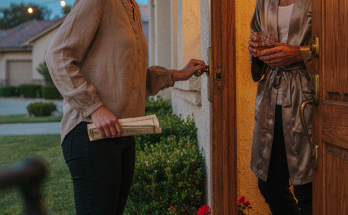
I parked two blocks from our house and waited. At 7:12 his car backed out of the driveway. I followed it at a distance, the way people follow cars in films, which is to say clumsily and with my heart in my throat. He drove twenty minutes across town to a neighborhood I didn’t know well — older homes, wide porches, oak trees arching over the street. Maple Street. He parked in front of a white house with a yellow light on in the window and walked to the front door without hesitating, without looking left or right, with the easy confidence of a man who has done this many times before.
A woman opened the door.
She was wearing a red dress. Her hair was dark, shoulder-length, slightly wavy. She was slim, medium height. She smiled when she saw him. He put his hand on her face and she kissed him — not a greeting kiss, not a peck — and something in my chest cracked cleanly in two like a piece of sea-glass.
I took photos. My hands were shaking so badly that the first three were blurred, and I remember thinking, with some distant and still-functioning part of my brain, that I needed to steady my elbows against the steering wheel. Evidence, I thought. You need evidence.
Then I noticed the mailbox.
It was a simple black mailbox, the kind you find at every hardware store, fixed to the porch railing. There was a name on it in white stick-on letters: CALLOWAY.
Calloway was my maiden name.
I sat with that for a moment. My first thought was coincidence — it’s not an uncommon name, there are Calloways all over this city, Calloways in the phone book, Calloways who have nothing to do with me or with Marcus or with any of this. But even as I constructed that thought I was looking at the woman again through the windshield, through the long rectangle of the open doorway, and something about her was pulling at me, tugging at the hem of my attention the way a child tugs at a sleeve.
Her hair. The way she stood. The tilt of her head when she laughed.
I drove home. I went directly to the shelf in the living room where we keep the photo albums — we are one of the few couples left who still print photographs; Marcus had always insisted on it, said there was something important about holding a memory in your hands — and I pulled out our wedding album and sat down on the floor and opened it.
There is a photo near the middle of the album, page fourteen, that I have always been fond of without entirely knowing why. It’s not a formal shot. It was taken by my aunt during the cocktail hour — one of those candid moments that a photographer misses and a relative with a disposable camera catches. In it, Marcus is laughing at something someone has said. And beside him, half-turned away from the camera, is a woman in an ivory dress.
I had always assumed it was me. Same hair. Same build. She’s slightly blurred, caught mid-turn, her face not quite visible. I had seen this photo dozens of times and each time filed it away without examination, the way you file away anything familiar.
I looked at it now — really looked at it — and understood that the woman in the photo was my twin sister.
My twin sister who had died fourteen years ago.
Or who I had been told had died.
Her name was Clara. We were not identical — fraternal twins, the doctor had always said, though people who knew us both thought we looked more alike than the word fraternal implied. Same dark hair, same build, same small scar near the left collarbone from a fall off a bicycle when we were seven years old. We finished each other’s sentences. We had the same laugh. We could not, as children, bear to be in different rooms.
When I was twenty-three, Clara was in a car accident on the interstate near our hometown. The car was totaled. I had identified her — or what I was told was her — at the hospital. The casket had been closed. My mother had said it was better that way. I had worn black for a year and built my grief into a monument inside myself, something I walked around every day without walking through.
I sat on the floor now with the wedding album in my lap and looked at the woman in ivory and thought about the things I had not questioned at twenty-three because I had been too broken to question anything. The closed casket. The speed of the funeral. My mother’s strange composure, a composure I had interpreted as stoicism and now wondered about differently. And one other thing, a thing I had buried so deeply I had nearly forgotten it: a phone call, two days after the accident, a number I didn’t recognize, a woman’s voice saying my name and then nothing — silence, then a click, as though she’d changed her mind.
I had thought it was a wrong number. I had not thought of it again for fourteen years.
I called Marcus. He answered on the second ring, his voice its usual warm tenor, and I said: I need you to come home.
He was there in thirty minutes, which told me something — that he had not gone far, that wherever he’d been he had left quickly. When he came through the door I was still sitting on the floor with the album. He looked at my face and something in his own face shifted, a settling, like a building absorbing a tremor.
“I know,” he said. Just that.
He sat down across from me. He told me everything, which took a long time, and during which I did not cry, because I had moved somewhere beyond crying into a country with no name.
He had met Clara three years before he met me. They had been together, briefly and intensely, and then she had disappeared — he had been told, by her, that she needed to vanish, that there were circumstances she couldn’t explain, that he needed to let her go. He had done what she asked. He had carried it. And then, at a mutual friend’s birthday, he had walked into a room and seen me.
“I thought I was losing my mind,” he said. “You were so like her. And completely different. You were you.”
He had fallen in love with me — genuinely, he said, and I still believe this, or I try to — but the question of what had happened to Clara had never fully left him. When he found her, two years ago, alive and living twenty minutes away under her own name, he had not told me, because he did not know how. He said it as though this were a reasonable explanation. Maybe it was. I don’t know yet.
What I know is this: my sister is alive. She lives on Maple Street in a white house with a yellow light in the window. She has my hair and my laugh and a scar near her left collarbone. She has been alive for fourteen years while I built my grief into a monument and walked around it every day.