Part One: The Counter
The Formica was cold under my hands.
I remember that detail with a strange precision — how the countertop felt cold even though it was June, even though the kitchen was warm with the smell of coffee I’d made at six that morning and hadn’t finished. I was gripping it the way people grip things when the floor has stopped being trustworthy.
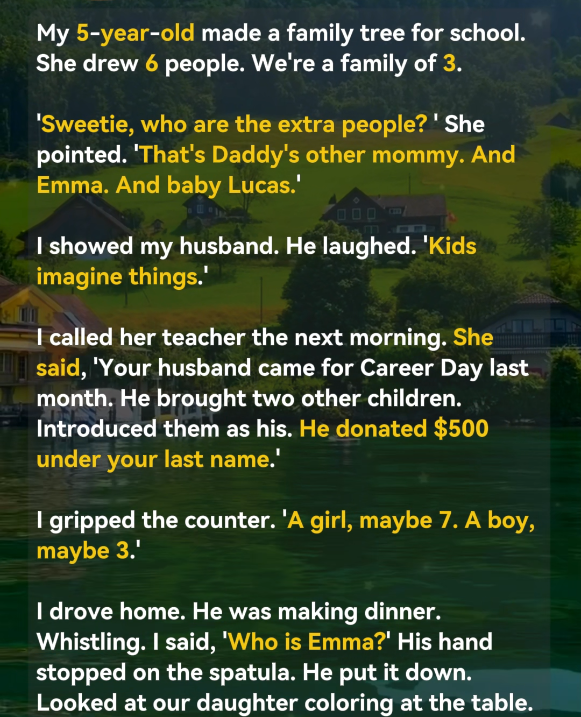
“A girl, maybe seven,” the teacher had said. Her name was Mrs. Calloway. She’d been teaching second grade for twenty-two years, she’d told me during orientation, and she had the voice of someone who had seen every variety of human difficulty walk through her classroom door. She was not rattled. She was simply telling me what she knew, the way you might describe a car you’d seen parked outside for too long. “And a boy. Maybe three. He introduced them as his.”
I had thanked her. I had thanked her, which is the thing I think about now. Some automated courtesy still running even as everything else was shutting down. Thank you, Mrs. Calloway. Thank you for letting me know.
I drove home on autopilot. The route is twelve minutes from Maplewood Elementary and I have driven it so many times that my hands and feet do it without me — left on Birchwood, right at the light by the CVS, the long curve where the road dips and you can see the whole valley for just a moment before it disappears. I don’t remember seeing the valley. I don’t remember the light by the CVS. I remember the cold counter and before that, the telephone, and between the two, nothing.
He was making dinner.
This was the part that kept reassembling itself in my mind in the days that followed: he was making dinner. Whistling. The particular domestic tableau of a man comfortable in his life — spatula in hand, the sizzle of onions, the small radio on the windowsill playing the jazz station he’d liked since college. Everything in its place. Everything performing normalcy with a fluency that now seemed less like contentment and more like practice.
“Who is Emma?”
Four words. The spatula stopped.
I watched his hand. It didn’t shake. It simply — stopped, the way a machine stops when you cut the power. No drama. No cascade. Just cessation.
He put the spatula down on the ceramic spoon rest — his mother had given us that spoon rest as a housewarming gift, seven years ago, painted blue and white with little fish on it — and he turned to check where our daughter was. She was at the table, coloring, her dark head bent over a worksheet, her small sneakers swinging.
He looked at me.
And I knew then — not what the specifics were, not the full shape of it, but I knew in the way you know certain things in your body before your mind will touch them. The way you know bad news is coming from the tone of a phone call before a word is spoken.
“Emma,” he said, his voice low and precise, “is your—”
Part Two: What He Said
He said: Emma is your daughter’s sister.
He said it the way a surgeon might describe a procedure. Clinical. As if clarity were a form of mercy. As if the shorter the sentence, the smaller the wound.
I sat down on the kitchen floor. Not a collapse — I remember choosing it, actually setting myself down with my back against the cabinets because my legs had made a decision and I decided to cooperate. The linoleum was cold too. Everything was cold that day.
He crouched down to my level. He did not touch me.
He told me, still in that low voice angled away from our daughter’s ears, that Emma was seven and Lucas was three. That their mother’s name was Deirdre. That he had known Deirdre for nine years — four years before we were married, five years into our marriage. That she had not known about me, at first. And then she had. And then she had decided some things were tolerable if everything else was sufficient, and she had drawn her own calculations, and here they were.
He told me he had been paying for an apartment across town. He told me the $500 donated to Career Day under our last name had been a mistake in judgment — he’d been trying to do something good for Emma’s school and had not thought through the visibility of it. He told me Deirdre had asked him not to come to Career Day, and he had come anyway because Emma had asked him. He told me this as though Emma’s asking were significant. As though it explained something.
I sat on the floor and listened to the whole recitation. Our daughter kept coloring. She was working on a picture of a horse, I could see from where I sat — brown and slightly misshapen, the way children’s animals always are, full of conviction and inaccuracy. She was pressing hard with the crayon, making the brown as solid as she could.
“How long,” I said, “have you been two people?”
He looked at me for a long moment. The onions were burning. He stood and turned them off.
“I was never two people,” he said. “I was just one person who made choices I didn’t know how to stop making.”
I thought about that. I’ve been thinking about it ever since.
Part Three: The Family Tree
Our daughter’s name is Rosie.
She is five years old and she drew six people on a piece of white paper with a blue crayon border and a sun in the corner that had exactly sixteen rays. I counted them later. I don’t know why I counted them. I needed to count something.
She drew them in her five-year-old way: circles for heads, lines for bodies, a variety of hairstyles represented by scribbles and squiggles. She had given the baby the most hair, which she explained was because babies have soft hair. She had given the other mommy a red dress, which she explained was because she had seen her wearing a red dress at the park once, when Daddy had taken Rosie to visit Emma while they were walking their dog.
I learned more from Rosie’s explanations than I had from my husband’s recitation.
The visit at the park had been six months ago. Rosie had thought Emma was very good at cartwheels. She had thought baby Lucas was funny. She had asked her daddy if Emma could come to her birthday party and he had said maybe. He had said maybe, and then her birthday had come and gone, and Emma had not come, and Rosie had apparently filed this away as simply one of the many inexplicable decisions adults make, along with eating vegetables and going to bed when it wasn’t even dark yet.
“Did you like Emma?” I asked.
Rosie considered this with the seriousness she brought to most things. “She’s nice,” she said. “She showed me how to do a cartwheel but I fell down.” She paused. “Lucas drooled on my sleeve.”
“Does it bother you?” I asked. “That Daddy has another family?”
She looked at me. She had his eyes, which was an observation I was going to have to find a way to live with.
“Does he have another family, or a bigger family?” she said.
I didn’t have an answer for that. I still don’t, entirely.
Part Four: Deirdre
I called her.
I shouldn’t have. Every reasonable person I spoke to in the aftermath — my sister, my therapist, the one friend I told — said not to. They said there was nothing to be gained, that it would only cause more pain, that I would either hate her or feel sorry for her and neither would help. They were probably right. I called her anyway.
She answered on the third ring. Her voice was careful, the voice of someone who had been waiting for a call she wasn’t sure would come.
“I figured you’d find out eventually,” she said.
“Did you want me to?”
A pause. “I wanted him to tell you. I told him to tell you. Two years ago. Last year. Six months ago.”
I sat with that.
“He has good qualities,” she said, finally, as though she were offering me something. An explanation, or maybe a consolation — I couldn’t tell. “I know that’s not helpful. But he has good qualities, and for a long time I convinced myself that was enough to justify — ” She stopped. “It was never enough. I just kept recalculating.”
“Why did you stay?” I asked.
She was quiet for a moment. When she answered, she sounded tired in a way that went all the way down.
“Because of Emma,” she said. “And then because of Lucas. And at some point I stopped asking whether it was a good reason and just let it be the reason I had.”
I understood that. I didn’t want to, but I did.
Part Five: The Counter Again
The night I called Deirdre, I stood at the kitchen counter again.
The spoon rest was still there, the blue and white fish swimming in their permanent ceramic loop. The radio was off. My husband was at a hotel — this had been decided with the quiet efficiency of two people who have been together long enough to accomplish even devastating things without raised voices. Our daughter was asleep.
I thought about the family tree.
Rosie had drawn six people and she had drawn them all in the same size, which is how children draw families — equalized by the limits of their understanding, or maybe by a more democratic instinct than the one adults develop. Daddy. Mommy. Rosie. Daddy’s other mommy. Emma. Baby Lucas.
No asterisks. No footnotes. No gradations of legitimacy.
I thought about what she’d said: Does he have another family, or a bigger family?
I didn’t know the answer to that question in terms of my marriage. What was salvageable, what wasn’t, what I wanted, what I could tolerate — all of that was ahead of me, in a country I hadn’t mapped yet. Some of it I would figure out. Some of it, maybe, I wouldn’t.
But I thought about Emma, who was seven and good at cartwheels. Who had asked her father to come to Career Day and he had come. I thought about Lucas, who drooled on sleeves and had soft hair. I thought about a five-year-old girl who had looked at her crayons and drawn, with complete unselfconsciousness, the full actual shape of her world as she understood it.
Kids imagine things, my husband had said.
But Rosie hadn’t imagined anything. She had simply drawn what she saw.
Epilogue: Six Crayons
The drawing is still on the refrigerator.
I don’t know why I kept it there. Maybe because taking it down felt like a decision I wasn’t ready to make — about what to erase, about what to pretend hadn’t been true. Maybe because I look at it sometimes and I see Rosie’s steady, unfrightened five-year-old hand drawing six people with the same simple love, and I think: she is going to be okay.
However it goes. Whatever gets decided. She drew a sun with sixteen rays and put everyone in it.
She is going to be okay.
I stand at the counter and drink my coffee and I look at six crayon people on white paper, and outside the kitchen window the summer is still happening — unreasonably, almost offensively, the way summer always is — and I think about all the shapes a family can take. All the ways people draw the borders and then redraw them. All the negotiations that happen in the space between what we promised and what we did.
The coffee is warm.
The counter is warm.
I don’t know yet what comes next.
But Rosie is upstairs sleeping, and her sun has sixteen rays, and that — for right now, for this morning — is enough to hold onto.