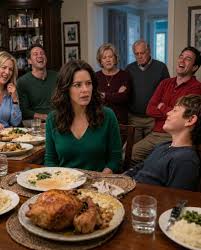
My mother is a woman of routine. Every Sunday, for as long as I can remember — through my father’s passing, through my brother Marcus’s divorce, through the years I lived three time zones away and came home only twice a year — she sent the same message to our family group chat at exactly 10 a.m.
Not “please bring tupperware.” Not “dinner’s at six if you’re free.” Just that. Terse, certain, immovable — the way she said everything. She had never once missed a week. Not when it snowed. Not when her hip was bad. Not the Sunday after we buried my father, when none of us wanted to be around food or each other. She sent it anyway, and we came anyway, and we ate in near-silence with her good china and cried quietly into our soup.
So on the first Sunday of November, when my phone buzzed at 10:07 a.m. and I saw her name, I smiled before I even unlocked the screen.
I stared at it. Read it again. Read it a third time the way you re-read something that doesn’t make grammatical sense, waiting for your brain to resolve it into meaning. No emoji. No explanation. No “love, Mom” or “xo” — not that she had ever added those, but their absence felt suddenly conspicuous, like a held breath.
I typed back immediately.
The two gray checkmarks appeared. Then, after a pause that lasted just long enough to make my chest tighten, they turned blue. She had read it. And then nothing. The typing indicator appeared for three seconds, then vanished. Then silence.
I set the phone down. Picked it up. Set it down again. I was still in my pajamas, half-drunk on my first coffee, the Sunday newspaper spread across the kitchen table in the way I let myself indulge only on weekends. The morning had been ordinary in every dimension, and now it felt like a stage set — like I was the only one who didn’t know the play had changed.
Marcus texted me at 10:14.
I was already pulling on my coat.
Our mother’s house is twenty minutes away on a good day — through the old part of town where the roads still follow the logic of cow paths and everything is named after trees that were cut down a century ago. I drove it in fourteen. Marcus, who lived on the other side of the city, was at least thirty minutes out. I texted him that I was going ahead and he replied with a single word: Hurry.
I don’t know what I expected to find. My mind had already run the spectrum — she had fallen, she was ill, someone had broken in, something had happened to the house. The imagination, when frightened, becomes ruthlessly efficient at conjuring catastrophe. By the time I turned onto Elm Street, I had already buried her three times over in the theater of my own head.
Her car was in the driveway. The curtains were drawn, which was unusual — she considered closed curtains in the morning a form of moral failure, something she’d say with enough lightness that you couldn’t be sure she was joking. The Sunday paper was still on the front step, which was worse. She always retrieved it by eight.
I knocked. Waited. Knocked again, harder.
“Mom?” My voice came out strange — too high, unsteady. “Mom, it’s me. Open up.”
Nothing.
I stood there for a moment with my hand against the door, as if I might be able to feel some vibration of life through it, some warmth. Then I dug into my bag for the spare key she had given me years ago — pressed into my palm one afternoon with a look that said I am giving you this because I love you, not because I expect you to use it.
The lock turned. The door swung open. I stepped inside and called her name again — and then I screamed.
The living room was filled with people.
Not burglars. Not paramedics. Not anything my panicked brain had prepared for. Forty, maybe fifty people, crammed into my mother’s small front room and spilling back into the hallway and kitchen beyond — neighbors, cousins, my mother’s friends from her book club and her Tuesday morning walk and the parish council she had served on for nineteen years. They were holding wine glasses and little plates of appetizers, and every single face turned toward me the moment I screamed, and then the whole room erupted into laughter.
“She came anyway!” someone shouted. More laughter. I stood in the doorway with one hand pressed to my sternum, genuinely unsure whether my heart would survive this.
My mother appeared from the back of the crowd, moving through it with the unhurried dignity she brought to everything. She was wearing her good dress — the navy one with the pearl buttons — and her hair was done, and she was smiling in the way she rarely let herself smile in photographs, wide and unguarded and real.
“I told you not to come,” she said.
“You left me on read,” I managed. “I thought you were — I thought something had—”
“I didn’t want to lie to you,” she said simply, as if this explained everything. “So I told you not to come. I assumed you wouldn’t listen. You never have.”
She said it without any edge. It was just a fact, the way gravity is a fact. I had never, in thirty-four years, been particularly good at being told what to do by this woman, and she had long since made her peace with it.
I looked around the room, at the decorations I was only now registering — the photographs pinned along a string of lights, decades of them, arranged in order: her as a young woman, barely older than I am now; my father in his best suit the day they married; Marcus and me as small, frowning children; the gradual accumulation of a life lived in rooms like this one, among people like these.
“What is this?” I asked.
“Your uncle Teddy thought I needed a fuss made.” She glanced across the room at her brother, who raised his glass. “I told him I didn’t. He did it anyway. You see where you get it from.”
I finally understood. Her birthday was in three days. She had refused every offer of a party for the past decade — had actively, firmly, and with great consistency declined to be celebrated. And so her brother and her children and her forty-odd years’ worth of friends had conspired to do it without her permission, on the one day she could not quite bring herself to cancel.
She had tried, though. One text, seven words, capital letters — her version of a plea. And then she had sat with her phone and watched the read receipts turn blue and known, the way she seemed to always know things, that it wasn’t going to work.
Marcus arrived eighteen minutes later, out of breath and wild-eyed, his jacket on inside-out. He stood in the doorway exactly as I had, and when the crowd laughed, he looked at me with an expression of pure betrayal.
“You could have texted me,” he said.
“I needed you to experience it,” I said. “It seemed fair.”
He considered this. “I hate you.”
“Dinner at six,” I said. “You brought tupperware?”
He held up the bag in his hand, the same cheap blue containers we had all been bringing to this house for years, and something about the sight of them — so ordinary, so stubbornly, reliably ordinary — made my throat tighten in a way I hadn’t expected.
Later, after the food and the speeches and the slideshow Uncle Teddy had made with more enthusiasm than technical skill, after the cake that made my mother close her eyes for a long moment before she blew out the candles, I found her at the kitchen sink doing dishes the way she always did — alone, methodical, refusing every offer of help.
I stood beside her and picked up a dish towel.
“You scared me,” I said.
“I know.” She handed me a plate. “I’m sorry for that.”
“Was it that bad? The idea of a party?”
She was quiet for a moment, her hands moving in the soapy water. Outside the kitchen window, the November dark had come early, and the backyard was invisible, and the window gave back only our reflections — hers and mine, side by side.
“It’s not the party,” she said finally. “It’s the counting. Every birthday, people count. They say the number out loud. They make it mean something.” She rinsed a glass, held it to the light, set it on the rack. “I don’t need it to mean anything. I just need it to be Sunday.”
I thought about that — about the message she’d sent every Sunday for years without variation or explanation. Dinner at six. Bring tupperware. Not a celebration. Not a statement. Just the simple assertion that there would be a next time, and the time after that, and that we would be there for it, and that this, unremarkably and reliably, was enough.
“Okay,” I said.
She handed me another plate.
We finished the dishes together without saying much else, and through the kitchen doorway I could see Marcus on the couch with Uncle Teddy, and the photographs still strung along their lights, and the leftover cake on the table in its white box. The house smelled like garlic and candle smoke and the particular warmth of too many people in too small a space.
It smelled, I thought, like every Sunday. Like the thing she had been sending us toward, week after week, with seven plain words and no explanation — not because she needed us to celebrate her, but because she needed us to keep showing up. To ignore the message that said don’t come. To use the spare key.
To be the kind of people who arrive anyway.