My name is Paula Mendoza. I am thirty-three years old, and this Sunday, I discovered that cruelty can also wear the face of family photos on Instagram.
Chloe, my sister-in-law, called me at eleven in the morning. Her voice sounded cheerful. Too cheerful.
“Pau, sweetie, can you do me a huge favor? We’re at the Golden Lake Resort with the kids. Can you drop by the house to feed Buddy? Things ran so late for us, and I don’t want the poor dog to suffer.”
Buddy was her Golden Retriever. Large. Slobbery. Affectionate. The kind of dog that greets you as if you had just saved the world.
I said yes without thinking. I always say yes without thinking when it comes to Chloe, and I suspect she has always known this about me. I grabbed my keys, a hoodie, and two cans of wet dog food from the pantry — the fancy kind, with real chicken, because Buddy deserved at least that much from a Sunday morning. I drove the twenty minutes to their house in Maplewood, listening to a podcast about nothing important, thinking about nothing important.
I should have known something was wrong when the front garden looked too still. Chloe’s house always had a specific kind of noise to it — Buddy’s nails on hardwood, the distant drone of cartoons, the particular clatter of a household that contains a child and a large dog and a woman who keeps every surface covered in decorative objects. That Sunday, the house was silent in the way that rooms are silent when something bad has happened inside them and the walls have absorbed it.
I used the spare key she had given me two Christmases ago. “For emergencies,” she’d said, pressing it into my palm with a smile I now understand differently.
The door opened.
The smell reached me first.
Not rot. Not danger. Just — stale air, and underneath it, something sweetly acidic that I would later understand was the smell of a child who had not had enough water for too long. It was dark inside. The curtains were drawn. I called out for Buddy in a low voice, the way you do when you’re not sure if someone is sleeping.
Then I heard it.
A small sound. Not a dog’s sound.
I followed it down the hallway, past the framed photos of Chloe’s children arranged in the kind of artful gallery wall that gets twelve hundred likes. Past the side table with the ceramic vase. Past the bathroom. To the room at the end — the room that used to be a home office and had been converted, Chloe had told us at Thanksgiving, into “a little creative space for Mateo.”
The door was closed. I tried the handle. It gave.
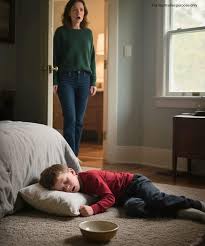
Inside, in the grey half-light filtering through a single curtain, sitting on the floor with his back against the bed frame and his knees pulled to his chest, was my nephew. Mateo. Five years old. He was wearing a dinosaur pajama top and mismatched socks, one yellow and one blue. His lips were dry. His eyes, when they found me, were enormous and very, very careful — the eyes of a child who has learned not to expect too much from the sound of footsteps.
He looked at me for a long moment.
“Mom said you weren’t going to come,” he whispered.
I don’t remember crossing the room. I remember being on my knees in front of him, and I remember that my voice, when I finally found it, came out steadier than I felt.
“Hey, buddy,” I said. Not the dog’s name. His. The way I had always called him, since the first time my brother Rodrigo placed him in my arms at the hospital and Mateo had looked up at me with those same enormous eyes. “I’m here. I’ve got you.”
He leaned into me with the specific weight of a child who has been alone for too long. I held him and I looked around the room and I counted the evidence: a half-drunk juice box, shriveled and sucked dry. A plate that had held crackers and now held only crumbs. A blanket twisted at the foot of the bed. No dog. No Buddy. I would find out later that Buddy had gone to the resort with them — of course he had — because Chloe had specifically chosen a pet-friendly property. The dog food had been a prop. A reason that sounded ordinary enough to get me into the house without asking questions.
I carried Mateo to my car. He was lighter than he should have been. He kept one hand curled in my hair the whole walk to the front door, like an anchor, like proof.
In the car, I gave him my water bottle and watched him drink with the focused urgency of someone who has been thirsty for longer than they should ever have to be. I asked him, gently, how long he had been alone. He considered this with the gravity that five-year-olds bring to questions of time.
“Since yesterday when it got dark,” he said.
I drove to Mercy General. I drove the way you drive when someone small is in the back seat and the road feels both too long and somehow not long enough, because you need the time to hold yourself together before the part where you have to talk to people and use words and explain what you found.
The nurses at the pediatric intake desk were efficient and kind. They took Mateo’s vitals. They gave him apple juice in a small paper cup and a sticker shaped like a star. He accepted both with a solemnity that broke something in me quietly, the way old wood cracks — not loudly, but permanently.
Mild to moderate dehydration. No other injuries. He was going to be fine, the doctor said, and I nodded as though I were fine too.
It was while I was sitting in the waiting room, Mateo dozing against my shoulder with the IV line taped to the back of his small hand, that my phone buzzed.
The text was from Chloe.
You had no right to go into that room. That was a parenting decision. I’m calling my lawyer.
I read it twice. Then I read it a third time, slowly, the way you read something when part of you is still hoping it will rearrange itself into something that makes sense.
She had known I would find him. She had sent me there knowing I would find him. And now she was calling it a parenting decision.
I thought about calling Rodrigo. My brother, who had married Chloe eight years ago in a ceremony where I wore a pale green dress and cried during the vows because I believed in them, in him, in the life they were building. My brother, who worked offshore two weeks out of every four and came home to a house where something had been slowly going wrong in the in-between, and either hadn’t seen it or hadn’t let himself see it.
I did not call Rodrigo. Not yet.
I called the police.
The officer who took my statement was a woman about my age with a short braid and the practiced stillness of someone who has sat across from people in crisis many times and learned not to flinch. I told her everything. The call. The spare key. The room. The juice box. The text. She wrote it all down in the careful, neutral way that official records require, and when she looked up at me at the end, something in her expression told me she had seen this category of thing before.
Child Protective Services was contacted. That was how it worked, she explained. There would be an investigation.
I sat with Mateo until he woke up and asked for more apple juice and then for a sandwich, and the wanting of ordinary things felt like the best possible sign. I told him that he was safe and that people were coming who would make sure he stayed safe. He thought about this.
“Is Buddy okay?” he asked.
“Buddy is fine,” I said. “Buddy is probably swimming in a lake right now.”
He nodded, satisfied by this, and accepted the sandwich.
Later, much later, after the social worker had come and the paperwork had begun its slow institutional crawl, I drove back to Chloe’s house alone. I don’t entirely know why. Maybe I needed to see it again with different eyes — not the panicked eyes of someone following a sound, but the steady eyes of someone who wanted to understand.
I stood in the hallway and I looked at the gallery wall.
There was a photo of Mateo at his fourth birthday, frosting on his chin, laughing at something off-camera. There was a photo of Chloe holding him at the beach, her sunglasses pushed up, both of them squinting into the same direction. There was a photo of the whole family at Christmas, everyone in matching pajamas, Rodrigo’s arm around Chloe’s shoulders, Buddy’s golden face pressing into the frame from the lower left corner like a signature.
The photos were beautiful. They were the kind of photos that made people comment what a perfect family and mean it, because they couldn’t see what was behind the closed door at the end of the hall.
I thought about the cheerfulness in Chloe’s voice. Too cheerful. The way it had felt off in a register I couldn’t name at the time. I understand it now. It was the cheerfulness of someone executing a plan. She had needed Mateo found — she couldn’t have him die, couldn’t have that — but she had also needed it to not be her who found him. She had needed the weekend. The resort. The photographs on the lake.
I left the house and I did not take anything, though I wanted to take the photo of Mateo at his birthday. That one felt like evidence of something true.
My brother called me that night. His voice was different from how it usually was — flatter, scraped-out, the voice of a man running a hard audit on eight years of his life.
“Tell me what you saw,” he said.
I told him. All of it. I did not soften it and I did not embellish it. I just said what I had seen, the way the officer had written it down: the room, the light, the juice box, the eyes, the text.
He was quiet for a long time.
“I didn’t know,” he said finally.
“I know,” I said.
“That’s not — I should have—”
“Rodrigo.” I stopped him. Not to excuse him, and not to condemn him. Just to stop the spiral, because it wouldn’t help anything tonight. “He’s okay. He’s going to be okay. That’s what matters right now.”
Another silence. Then: “Can I see him?”
“Yes,” I said. “Come see him.”
Mateo is staying with me while things are sorted out. He sleeps in my guest room, which I have tried to make less like a guest room and more like a place a five-year-old might actually want to be — there’s a string of lights along the window, and I bought a secondhand basket of dinosaur figurines from the thrift store on the corner.
On his second morning here, he woke up early and came and found me in the kitchen while I was making coffee. He climbed onto the stool at the counter and watched me with those careful eyes.
“Paula,” he said. He had started using my name, which he hadn’t done before. “What if I’m too much trouble?”
I put down the coffee pot. I turned around and I looked at him — at the mismatched socks he was wearing again, at the sleep-crease on his cheek, at the five years of him that had somehow gotten here intact against the odds.
“You’re not,” I said. “You’re exactly the right amount.”
He considered this for a moment, turning it over the way children do with answers they’re deciding whether to trust.
Then he nodded, and asked if we had cereal, and I said yes, and that was that.
Cruelty, I have learned, does not announce itself. It posts photos of lake sunsets and texts you about the dog. It smiles at weddings and uses your yes against you and counts on the fact that you will not look behind the closed door at the end of the hall.
But I looked.
And I am still looking.
For every child who has ever waited in a quiet room, hoping the footsteps would keep coming.