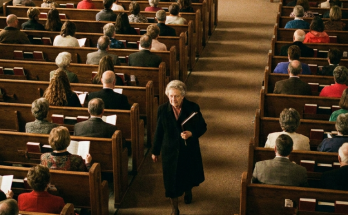
The Christmas tree was too large for the room. It always was.
Renata Villanueva-Marsh had insisted on this every December for sixty-one years — a tree so tall it bent against the ceiling, so wide it swallowed the corner of the living room in the old colonial house in Pasadena — and even now,
even at ninety-two, even from the wheelchair she had not expected to need, she had pointed at the tallest tree on the lot and said nothing more than that one to her great-nephew, who had loaded it into his truck without comment.
Thirty-five people filled the house that Tuesday. Her grandchildren, her great-grandchildren, her children’s spouses and ex-spouses and the new companions nobody had officially introduced but everyone quietly accepted. The smell of the house was the same smell it had always been: cinnamon and cedar and something underneath, some mineral permanence that belonged to old California houses and could not be replicated or removed. Plates of food crowded every surface. Someone had set up a card table in the hallway. A toddler was sleeping upstairs in a room full of things that had belonged to people now dead.
Renata sat near the window, slightly removed from the center of the room, which was her preference and always had been. She watched. She had not said much in months — not since the fall, not since the small strokes the doctors catalogued with the careful detachment of archivists — but watching had never required speech, and she had always been better at it than anyone gave her credit for.
Her son Dario stood near the fireplace. He was sixty-four, tanned in the specific way of men who spent significant time on boats and golf courses, who lived close to water they had not earned. He was holding a glass of wine. He was smiling at something his daughter had said. He had her grandfather’s jaw and their father’s ease in rooms, that particular quality of occupying space as though it had been arranged for him.
Renata watched him.
Her granddaughter Celeste stood at the edge of the dining room, where she had positioned herself near the projector screen her husband Marcus had helped set up two hours earlier while Dario supervised the arrangement of additional chairs. Celeste was thirty-nine. She had her grandmother’s way of going still when she was thinking, which the family had sometimes mistaken for absence but which was in fact its opposite. She had driven here from Sacramento with her son Tomás, who had turned eighteen in October and who sat now on the floor beside his great-grandmother’s wheelchair, close enough that Renata could have touched his hair if she’d lifted her hand.
The screen had been explained as a photo slideshow. Family photos, Grammy, the old ones you gave me. Celeste had shown Renata the first few slides on her laptop a week before Christmas, and Renata had looked at them carefully, and had not said whether she knew what else the presentation contained.
At seven-thirty, when the plates had been cleared and the children younger than ten had been settled in the den with a movie, Celeste stood at the front of the room and said she wanted to share something.
The room organized itself the way rooms do when a person with sufficient gravity commands attention — not loudly, but completely.
“This year,” Celeste said, “Tomás turned eighteen.”
There was the warm sound of acknowledgment, the murmur of an extended family performing its affection. Tomás, on the floor, looked at his shoes.
“When my mother turned eighteen, she received a call from the trust executor telling her there was money waiting for her. Grandfather Ernesto’s trust. Ten thousand dollars, which in 1987 paid for her first year of college.” Celeste clicked to the first slide: a photograph of a young woman in a dorm room, laughing, holding a letter. “When I turned eighteen, same thing. Same call. Same ten thousand dollars. I used it for a car and for the security deposit on my first apartment. I felt him in that money. I felt like he was still taking care of us.”
The room was very quiet.
“When Tomás turned eighteen in October, I called the executor.” A pause. “Uncle Dario.”
Dario did not move.
“He told me the trust was empty.” Celeste clicked to the next slide. It was a spreadsheet, printed and scanned, columns of numbers and dates running in rows across the white screen. “I filed a petition with the probate court. I requested a full accounting. These are the records the court ordered released.”
She gave the room time to read.
The withdrawals began in April of 2002. Monthly. Irregular in amount but consistent in origin: a single authorized signatory, the name listed in the trust’s execution documents as executor and sole fiduciary. The amounts ranged from four thousand to eleven thousand dollars. Twenty-two years of entries. The total, calculated at the bottom of the last page in the clean indifferent font of a court document, was four hundred and thirty-one thousand, two hundred dollars.
Someone across the room made a sound that was not quite a word.
“I have the full documentation,” Celeste said. “The court has the full documentation. There are also property records.” She clicked again. A county assessor’s page. A house in Flagler Beach, Florida: purchased 2003, four bedrooms, gulf access, currently valued at eight hundred and ninety thousand dollars. “The down payment was forty-two thousand dollars. Paid in a single wire transfer in November of 2002, seven months after the first withdrawal.”
Dario set down his wine glass. It made a sound on the mantel.
“We’ve all been to that house,” Celeste said. She was not shouting. She had not raised her voice at any point, and this was somehow the most frightening thing about it, the flatness of her delivery, the way she was simply describing what was true. “We spent Thanksgiving there. Multiple times. I thought it was Uncle Dario’s vacation home. I didn’t know we had paid for it.”
The room was silent in a way it had never been silent before. Thirty-five people and no sound except the tree lights humming faintly on their timer and somewhere outside a neighbor’s dog.
Dario turned to face the room fully. His color had changed, but his posture had not — he still had that quality of claiming space, of standing as though the room were there for him, and this more than anything seemed to harden something in the people watching him.
“This is,” he said, and stopped, and started again. “This is a family matter. This is being taken out of context and presented as something it isn’t, and I think we all know that Celeste has had issues with me for a long time that have nothing to do with—”
“Four hundred and thirty-one thousand dollars,” Celeste said.
“My father,” Dario said, and his voice found something then, some register of feeling that was either genuine or very well-constructed, “loved this family. He loved life. He worked for forty years so that we could have beautiful things, so that we could enjoy what we built together. He told me, more than once, that what mattered was that we lived fully. That we didn’t save everything for some future that might never—”
“Dario.”
It came from the window.
Everyone turned.
Renata Villanueva-Marsh had not spoken in seven weeks. She had not spoken at Thanksgiving, had not spoken at her doctor’s appointments, had answered questions with the slow blink the speech therapist had taught her for yes and no. She had sat in the wheelchair and watched and the family had arranged themselves around her silence as they would arrange furniture around a load-bearing wall, carefully, with full acknowledgment of what it was holding up.
She was looking at her son.
Her voice, when it came, was not the voice of an infirm woman. It was not frail. It was the voice of a woman who had been born in 1933 in a small town outside Guadalajara, who had come to California at nineteen with sixty dollars and a cousin’s address, who had raised five children and buried a husband and outlasted everything that had tried to diminish her. It was the voice of someone who had been quiet by choice.
“Your father,” she said, “worked in a factory for thirty-one years.”
The room did not move.
“His hands.” She paused. Something passed across her face — not grief, exactly, or not only grief. Recognition, perhaps. The specific lucidity of someone who has been waiting a long time to say one true thing. “You never looked at his hands.”
Dario opened his mouth.
“He set aside money every month from 1965,” she said. “Every month. Even when we had nothing. Even when the car needed the transmission and when you were sick that winter and we couldn’t pay the hospital on time. He kept setting aside. Because he wanted his grandchildren to have a beginning. That was his word. A beginning.”
She had not looked away from him.
“He did not work thirty-one years in a factory so that you could buy a vacation home.”
Someone in the room was crying. More than one person, probably.
“I knew,” she said. “Not all of it. Not the numbers. But I knew something had changed in you after he died. I thought grief. I told myself grief does strange things.” Her hands, folded in her lap, tightened briefly. “I was wrong to tell myself that.”
Dario said, “Mamá—”
“I want you to look at these people.” She did not raise her hand to indicate the room. She didn’t need to. “These are Ernesto’s grandchildren. These are the people he was thinking about when he went to work every day. These are the people you took from.”
The silence afterward was not the same silence as before. Before, it had been the silence of shock, of people waiting to understand what was happening. Now it was something more considered. The room had reached a conclusion, collectively, the way rooms sometimes do, and the conclusion had settled over everything like a change in air pressure.
Dario looked at his mother. Then he looked at the floor.
“I need you to leave this house,” Renata said. “Tonight.”
She said it without cruelty and without hesitation and without any of the theatrical weight the moment could have supported. She said it the way she might say anything that was simply true and needed to be said, and when she finished saying it she turned her head toward the window, toward the dark December street outside, and that was the end of what she had to say.
Dario left twenty minutes later. He took his coat from the hook by the door, the same hook where coats had hung for forty years, where his own coat had hung at every Christmas since his father died in 1999, and he walked out to his car without looking back at the house.
He sat in the driveway for a while. Long enough that Celeste’s husband Marcus came to the window once and looked out, then looked away.
Then he drove.
Later, after the smaller children had been put to bed in various configurations across the upstairs rooms, after the dishes had been washed and the wine finished and the family had arranged itself in the quieter way it arranges itself at the end of a long night, Tomás sat on the floor beside his great-grandmother’s wheelchair. The tree lights were still on. The rest of the room had dimmed.
He didn’t say anything for a while. Then he said, “I’m sorry about your son.”
Renata looked at him. He had Celeste’s eyes. He had, somewhere in the jaw, something of Ernesto.
“Tell me something,” she said. Her voice was tired now, worn from the evening, but present. “What will you do with a beginning, if someone gives you one?”
He thought about it seriously, which she appreciated. He didn’t perform the thinking; he actually did it.
“Go somewhere I chose,” he said. “Not somewhere that was chosen for me.”
She nodded, slowly.
“That’s enough,” she said. “That’s what he wanted.”
She closed her eyes. The tree held its lights against the window. Outside, the street was quiet, and the neighborhood was quiet, and somewhere to the south a plane crossed the dark sky toward somewhere else, its lights blinking their small patient signals into the nothing.
The trust was empty.
But the room was full.
And Renata Villanueva-Marsh sat in her chair in the house she had lived in for fifty-three years, holding the weight of what her husband had tried to build, and what her son had stolen, and what her granddaughter had refused to let disappear quietly — and she understood, in the way that only the very old can understand it, that love was not the feeling. Love was the decision, made again and again, to protect what mattered even when it cost you something. Even when it cost you everything.
Ernesto had known this.
Now, finally, so did they.