I made pot roast that evening.
That is the detail I keep returning to — not the photos on my phone, not the smell of her perfume on his collar, not even the way his face went the color of old ash when he looked at the screen. I keep returning to the pot roast. I had peeled the carrots by hand. I had browned the meat in the good pan, the one we bought together at a Saturday market in Lyon on our honeymoon, before Mia was born, before Karen’s sink needed fixing every Friday for three years running.
I set the table. I folded the napkins. I lit the candle in the center because it was something I used to do, back when candles meant something, and I suppose I wanted to remember what that felt like.
He walked in at ten past ten.
I heard his key in the lock the way you hear a thing you have been bracing for — a held breath finally released into sound. He came into the kitchen still wearing his jacket, his hair slightly disturbed, and she was in the room with him as surely as if she’d walked through the door herself. That scent. Gardenia and white musk. Karen had worn it since college. I used to borrow it from her dresser when we were teenagers, before I knew what it meant to borrow something you could never give back.
He saw me at the table.
I did not speak. I picked up my phone, unlocked it, and slid it across the wood toward him the way you slide a card in a game you already know you’ve won.
He looked down. His hand went very still on the edge of the table. He looked at the first photo, and then the second, and I watched his jaw tighten with each one, not from guilt — I recognize guilt, I have worn it myself — but from something more complicated. Something that looked almost like grief.
He set the phone down.
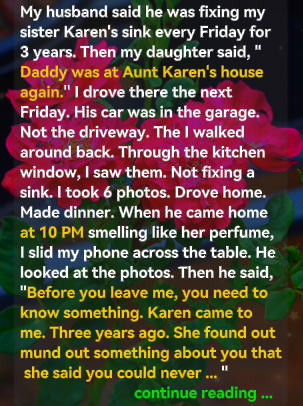
He said, “Before you leave me, you need to know something. Karen came to me. Three years ago. She found out something about you — something she said you could never—”
“Stop.” The word came out quieter than I intended.
“Claire—”
“Whatever she told you,” I said, “whatever she’s been holding over your head, whatever arrangement the two of you have been conducting in her kitchen for the past three years — I want you to understand that nothing justifies what I saw through that window. Nothing. Do you understand me?”
He pulled out the chair across from me and sat down heavily, like a man much older than forty-four. He did not reach for the food. He put his hands flat on the table, and I noticed, not for the first time, how familiar those hands were to me. How many ordinary things they had done. How impossible it was to make them strange.
“She didn’t tell me to sleep with her,” he said quietly. “That’s not what she wanted.”
I looked at him.
“She came to me in November. Three years ago November.” He paused. “You remember that month. You remember what happened.”
I did remember. November three years ago had been a month I had since buried under layers of routine and deliberate forgetting. The miscarriage — our second, and the one we’d told no one about, not even Karen, because I had not been ready to be comforted by anyone who knew me too well.
“She found out,” he said. “Not from me. She said she’d spoken to Dr. Heller’s receptionist — I don’t know how, I don’t know what was said. But she came to me and told me she knew about the pregnancy. And about the other thing.”
The room felt different. The candle flickered.
“What other thing?” My voice was very careful.
He looked at me for a long time.
“The DNA test,” he said. “The one you did in October. The one where you found out that Mia—”
“Don’t.” The word came out like something breaking. “Marcus, don’t.”
“She found out, Claire. I don’t know how. But she knew. And she told me she would tell Mia herself if I didn’t — if we didn’t—” He stopped. He passed his hand over his face. “She said she wanted someone. She said she was lonely and she was angry and she said she’d been watching us for years and couldn’t stand it anymore. She gave me a choice.”
I stood up from the table. I walked to the window over the sink and looked out at the backyard, at the dark shape of the oak tree we’d planted when Mia turned five. Mia, who had her father’s laugh — her other father’s laugh, as it turned out, though I had spent three years convincing myself the test had been wrong, that the lab had made an error, that some things were better left unverified.
“She was going to tell her,” I said. It was not a question.
“She said she would. If I stopped going.”
I turned around.
My husband — the man who had raised Mia from her first breath, who had coached her soccer team and taught her to parallel park and cried at her eighth-grade graduation — sat at our table in the candlelight with the ruins of three years between us, and I understood for the first time the shape of what Karen had done. Not a seduction. A hostage situation. A slow, meticulous extraction of payment for a crime she had appointed herself to punish.
“She’s known this whole time,” I said softly. “About Thomas.”
Marcus nodded.
Thomas. A name I had not said aloud in nine years. A weekend that had lasted three days and lived in me for much longer — a mistake made in the last cold weeks of a marriage that had already started becoming this marriage, before I had fully understood that I wanted it to be this marriage. Before Marcus had become who he became. Before Mia.
“Why didn’t you tell me?” I asked. “Why didn’t you come to me and say, Karen knows, and she’s threatening us, and we need to deal with this together?”
He was quiet for a moment.
“Because I thought you’d think I was making it up,” he said. “To justify it. I thought you’d look at me the same way you’re looking at me right now, and I wouldn’t be able to explain it fast enough before I lost you.”
“So instead you let it go on for three years.”
“I didn’t know how to stop it without—”
“Without me finding out what you were doing, or without her telling Mia the truth?”
The silence that followed was the loudest thing I had ever heard.
I sat back down. I looked at the pot roast growing cold between us, and the good wine I had opened an hour ago, and the napkins I had folded, and all the ordinary props of a life I had been assembling and reassembling for fifteen years, and I thought: this is the part no one tells you about. Not the betrayal. The inventory. The sitting down afterward and counting what is real.
Mia was real. Whatever a test said, whatever Karen believed she knew, Mia was ours in every way that mattered — she was the child Marcus had walked the floor with at two in the morning, the child whose nightmares he had talked her out of, whose homework he had sat beside for hundreds of evenings. Biology was one kind of fact. Sixteen years of fatherhood was another kind entirely. A harder kind to argue with.
Karen was my sister. Had been my sister. I thought about her face — a face so much like mine that strangers had always asked if we were twins — and I tried to find something in my memory that would explain this. Some wound I had given her that I had not known about. Some accumulating resentment I had been too absorbed to notice.
Maybe that was the worst part. That I could almost understand it.
Loneliness makes people into versions of themselves they wouldn’t recognize in ordinary light. I had been lonely too, once. Lonely enough to make a choice that had echoed nine years forward into this kitchen, this table, this ruined Friday night.
“Does Mia know?” I asked.
“No.”
“Are you sure?”
“I’m sure.”
I looked at my husband’s hands on the table. I thought about how much I did not know about the inner life of this man I had chosen — and how much, in fairness, he did not know about mine. How a marriage was not really an act of knowing but an act of continued choosing, repeated daily, sometimes hourly, in the small decisions no one ever sees.
“You should have told me,” I said again.
“I know.”
“What she did to you — what she made you do — I’m not going to pretend that changes everything I saw today. It doesn’t. It changes the shape of it, but it doesn’t erase it.”
“I know that too.”
The candle had burned down to a thin, guttering light. Outside the window, somewhere in the neighborhood, a car passed and its headlights moved across the ceiling like something searching.
“I’m going to call Karen tomorrow,” I said.
He looked up.
“Not to forgive her. Not yet. Maybe not ever.” I pushed back from the table and stood. “But I need to look her in the face and understand what she thought she was doing. I need her to say it out loud to me.”
“And us?” he asked. The question was very small.
I picked up the phone from the table. I looked at the photos — six images taken through a kitchen window, evidence of a thing I wished I had never needed to prove. I deleted them one by one.
Not because they hadn’t happened.
Because I already knew what I had seen, and I did not need to keep seeing it. Grief is not the same as evidence. You don’t have to preserve the wound to honor the fact that it is real.
“I don’t know yet,” I said honestly. “I need to think. I need some time.”
He nodded. That was all. He did not beg or argue or explain further. He simply nodded, and perhaps that was the most honest thing he had done all evening — accepting that there are thresholds you cannot charm your way back across, that some doors require patience rather than words.
I went upstairs.
I stood in the hallway outside Mia’s room and listened to her breathing in the dark — slow and even, the sound of a person who does not yet know the thing she does not need to know. Not tonight. Maybe not ever, if we were careful enough, honest enough with each other at last.
I went into our room. I did not lock the door.
I lay down on my side of the bed in the dark and looked at the ceiling and thought about Lyon. About the good pan. About the Saturday market and the man I had been standing next to when I bought it, and how I had known, even then, that I was choosing something durable.
I thought about Karen wearing our mother’s perfume, alone in her house on a Friday night, building a trap out of her loneliness and my secrets.
I thought about all the things we do to the people we love because we cannot bear to look at ourselves.
And then I closed my eyes, and waited for what came next.