The research paper arrived by email on a Tuesday morning in October, three weeks before the formal publication date. My son had sent it early, just for me — “so you see it before the world does, Mom.” The subject line read:
Dedicated to Margaret Ellen Voss, who stayed. I read those words standing at my kitchen counter in my bathrobe, holding a cup of coffee that went cold before I ever drank it.
His name on the paper — Dr. Daniel Voss, MD, PhD, Department of Pediatric Neurology, Massachusetts General Hospital — still catches me off guard, the way a bright light does when you turn a corner. That’s my boy. The one who screamed for three months without stopping. The one whose cry split the air like a physical thing, like a blade.
The one who nearly took me with him, into the dark.
I’ll tell you what those ninety days were like, because I think people need to understand what it actually means when a newborn doesn’t stop crying.
It means the inside of your skull becomes a place you can’t live. It means you start to lose the edges of yourself — the edges that tell you where you end and the noise begins. By week six, I had stopped trying to soothe him. Not because I gave up on him. Because I had learned there was nothing to soothe. He wasn’t hungry. He wasn’t wet. He wasn’t in pain — the doctors had checked everything, twice, three times, and sent me home each time with a look I came to recognize: the look that meant we think it might be the mother.
My husband David left at week five. I remember the exact moment: Daniel had been crying for eleven hours straight, and David stood in the doorway of the nursery with his coat already on, his suitcase already in the car — he’d packed while I was nursing — and he said, “I can’t do this, Maggie.” Just that. Not I’m sorry. Not I’ll get help. Just a statement of personal limitation, delivered with the resignation of a man reporting weather. I nodded. I didn’t even turn around. I was too busy holding a screaming child to watch my marriage leave the house.
My mother came at the end of week three and lasted four days. She slept in the guest room with a pillow over her head and on the morning of day five, over breakfast, she told me “something is wrong with that baby.” As if I didn’t know. As if I hadn’t been living inside the wrongness of it, had not memorized every frequency of it.
“Something is wrong with the situation, Mother,” I said. And then she left too.
So it was just the two of us. Me and Daniel, in a house that felt like it existed outside of time. I stopped answering the phone. I stopped opening mail. I got very good at surviving in two-hour intervals — a skill I didn’t know I was learning, the way you don’t notice yourself getting stronger when you’re only trying not to die.
The hallucinations started around week eight. Nothing dramatic — just presences, peripheral. A shape in the hallway. A second shadow on the wall. Once, I was certain my grandmother was sitting in the rocking chair across from the crib, just watching. I knew it wasn’t real. I also didn’t entirely mind. By that point, I would have welcomed any company.
The shower incident was week ten. I stepped in, turned the water on, stood under it — and then came back to myself some unknowable time later, the water gone cold, no memory of the intervening minutes. I stood there dripping on the bath mat, Daniel screaming down the hall, and I thought: I’m disappearing. Not dramatically. Just — piece by piece, like a sandcastle that doesn’t know it’s being taken by the tide.
And the dark thoughts. I won’t describe them in detail. I’ll only say: they came, and they were specific, and I understood in a new and terrible way how a person arrives at those places. Not through madness. Through exhaustion. Through the slow erosion of every buffer between yourself and the abyss. I did not act on them. But I want to be honest that they were there, because I think the world lies about that — pretends those thoughts only visit the weak, the ill, the unfit. They visited me. I was none of those things. I was just alone, and I hadn’t slept, and the baby wouldn’t stop.
Day ninety-one was a Wednesday. I know because I’d been counting — crossing days off a calendar in my mind, though I couldn’t have told you why. There was no finish line I was counting toward. I just needed to know how long I’d been inside it.
I had been up since two in the morning. Daniel had cried through the night as always, and I had walked him, rocked him, sung to him, sat with him in the dark. Around six, as the light was beginning to grey the windows, something shifted. The crying tapered. Then quieted. Then stopped.
I froze.
The silence was so absolute it felt structural, like a wall. I stood very still for a long moment, listening to the absence of sound the way you listen to a ringing that’s just stopped.
Daniel looked up at me.
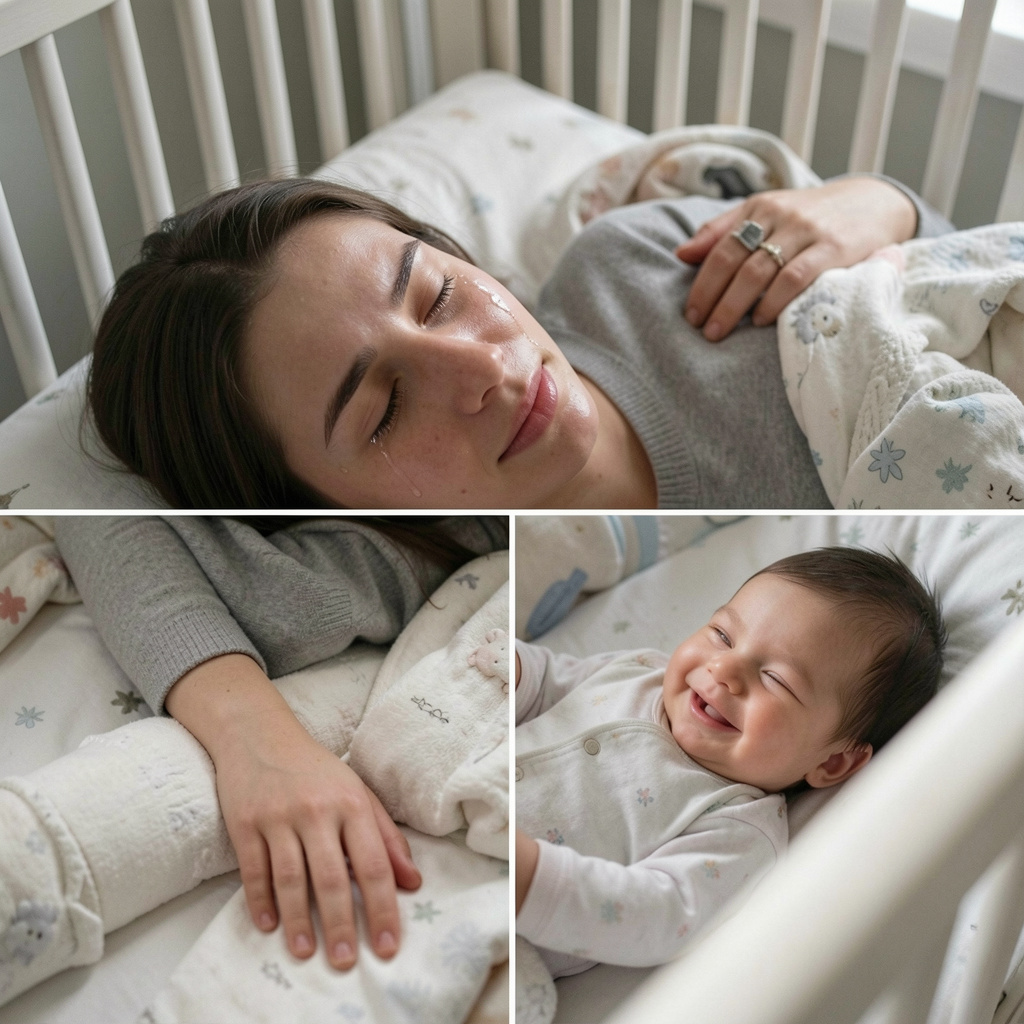
And he smiled.
It was the first real smile — not gas, not reflex, but a genuine, effortful, communicative smile. His whole face reorganized itself around it. His eyes, which had spent three months squeezed tight against the world, opened fully. They were brown, I realized. I hadn’t known they were brown.
I sat down on the nursery floor. I didn’t plan to — my legs just gave way beneath me. And I cried. I sobbed in a way I hadn’t allowed myself to for three months, and Daniel watched me from his blanket with curious brown eyes, and the house was so quiet I could hear my own breathing.
He grew up easy after that. Sunny, curious, obsessive in the way brilliant children are. He went through a dinosaur phase that lasted four years. He taught himself to read at three. He asked me once, at age seven, why babies cry so much, and I told him that sometimes babies have things going on inside them that they can’t explain. He nodded very seriously. “I’m going to figure that out,” he said.
I thought it was the kind of thing children say.
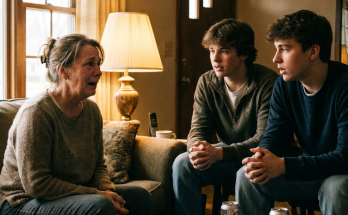
He called me the night before his paper published, after he’d sent the early copy. He said: “Mom, I need to tell you something about my case.”
I had read the paper twice by then. It was about a subset of neurologically healthy infants who exhibit extreme and prolonged crying behavior — what the medical community had, for thirty years, vaguely attributed to “temperament” or parental anxiety or simply written off. Daniel had discovered a pattern: a delay in the maturation of a specific inhibitory pathway in the brainstem. The circuit that regulates arousal — that turns down the volume on incoming sensory data — had, in these infants, taken longer to develop. The babies weren’t in pain. They weren’t disordered. They were experiencing the full, unfiltered, unmediated intensity of the world, and they had no way to turn it down.
Their nervous systems were fine. They were just finishing being built.
“I found the imaging from my own newborn scans,” Daniel said on the phone. “Dad had requested a brain MRI around week four, before he — before he left. The radiologist who read it noted it as normal. And it was normal, but I can see now what was happening. The pathway just wasn’t there yet. It formed right around day ninety. Give or take.”
I was quiet for a moment. “So he didn’t do anything wrong,” I said. “That’s what you’re telling me.”
“He was fine. You were both fine. His brain was just — finishing. He was finishing being born, in a way. It just took longer for him than for most.”
I sat with that for a while. I thought about the rocking chair where I’d imagined my grandmother sitting. I thought about the calendar I’d been crossing off in my mind, the days adding up toward no destination I could name. I thought about the moment the crying stopped, and the brown eyes that opened, and the smile.
“Mom?” Daniel said.
“I’m here.”
“Are you okay?”
I thought about what the word okay means. How it is so often asked in place of the deeper question: did it break you? And how the real answer, the one you give yourself in the dark, is not a simple yes or no. The real answer is: it remade me. Something was lost in those ninety days that I will not recover — a lightness, a certainty, a particular innocence about what people owe each other and what the body can endure. But something was built in its place. I know how long I can last. I know what I am made of. I know that the bottom of the well is not the end of the water.
“Yes,” I told my son the neurologist. “I’m okay.”
“I dedicated the paper to you because I wanted the world to know,” he said. “All the mothers who are in it right now — the ones sitting on nursery floors at three in the morning, the ones who are disappearing. I wanted them to know that someone is working on it. And that it doesn’t mean anything is wrong with their baby.”
“What does it mean?” I asked.
He was quiet for a moment, the way he gets when he’s choosing words carefully — a habit he’s had since he was four.
“It means their baby is almost done arriving,” he said.
The paper published on a Thursday. By Friday afternoon, Daniel told me it had been shared forty thousand times. He was getting emails from mothers — hundreds of them, from everywhere — who had lived some version of those ninety days. They wrote to him because he was the doctor, the researcher, the expert.
But more than one of them wrote to ask about the woman in the dedication. The one he called who stayed.
I don’t know what I would say to them if I could. I’m not a doctor. I’m not a researcher. I’m just a woman who sat on a nursery floor in the wreckage of her life and waited, not because she was strong, but because there was nowhere else to go.
I’d probably just say: Day ninety-one is coming.
Count the days if you have to. Cross them off.
He will open his eyes, and they will be brown, or blue, or grey, and you will not have known until that moment what color they were, because he has been somewhere else — somewhere bright and loud and overwhelming, somewhere his nervous system was still learning to navigate.
He is almost done arriving.
Stay.