The Gray House on Route 12 “Mommy?”
I looked up from my laptop. Emma stood in the doorway of her bedroom, clutching her stuffed rabbit.
It was already past bedtime. “What is it, sweetheart?” She hesitated. “The bus driver stops at a house sometimes.” I frowned. “What house?” “A gray house.” I closed my laptop. “What do you mean?”
Emma climbed onto my lap. “He tells us to stay quiet. Then he goes inside.” My stomach tightened. “How long does he stay?” She shrugged. “A long time.” “Are there other adults there?”
“No.”
“How many kids are on the bus?”
“Sometimes six. Sometimes seven.”
I felt a chill.
“What happens while he’s inside?”
“We wait.”
“How long?”
“Sometimes ten minutes.”
I stared at her.
“Why didn’t you tell me before?”
Emma looked down.
“He said not to.”
“Who?”
“The bus driver.”
The answer sent a wave of alarm through me.
The next morning, after Emma left for school, I called the transportation office.
A cheerful secretary answered.
“Route 12? Mr. Doyle?”
“Yes.”
“I have a question about unauthorized stops.”
There was a pause.
“What kind of stops?”
I explained what Emma had told me.
The woman laughed softly.
“Mr. Doyle has been driving Route 12 for eighteen years.”
“So?”
“There are no unauthorized stops.”
“My daughter says there are.”
“Children imagine things.”
I felt irritation rising.
“Are you saying she’s lying?”
“Not at all. I’m saying there’s probably a misunderstanding.”
The call ended without answers.
That afternoon, I left work early.
Emma’s bus route began at 3:15.
I parked near the elementary school and waited.
At 3:18, the familiar yellow bus pulled away from the curb.
I started my car.
The bus followed its normal route for several miles.
Then, exactly four miles from the school, something happened.
The bus signaled.
Turned left.
And drove onto a dirt road.
My pulse quickened.
This wasn’t part of the neighborhood route.
Dust rose behind the tires.
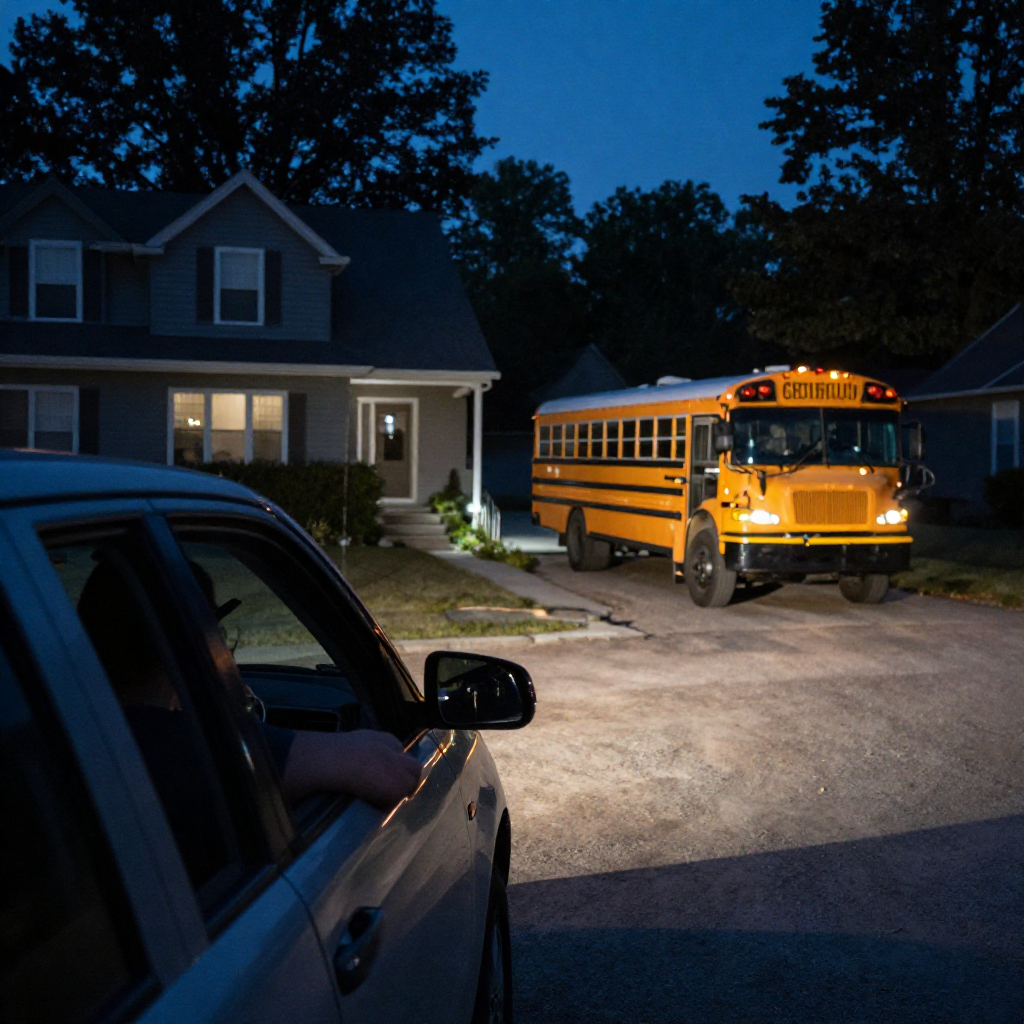
The road wound through a patch of trees before opening onto a clearing.
A single gray ranch house stood in the center.
The bus stopped.
I parked behind a row of bushes and grabbed my phone.
The door opened.
Mr. Doyle stepped out.
A tall man in his sixties with white hair and broad shoulders.
He walked directly to the front door.
Knocked once.
Then disappeared inside.
The bus remained parked.
Children visible through the windows.
Waiting.
Alone.
I checked the clock.
One minute.
Three minutes.
Seven.
Ten.
My hands shook as I recorded everything.
Thirteen minutes later, the door opened.
Mr. Doyle emerged.
Calmly walked back to the bus.
Climbed inside.
And drove away.
I followed only long enough to confirm he resumed the route.
Then I pulled over.
And called the police.
An officer arrived twenty minutes later.
I showed him the video.
His expression darkened.
“Can you take me there?”
I nodded.
The two of us drove back to the gray house.
The property looked abandoned.
Overgrown grass.
Peeling paint.
Sagging porch.
Yet someone clearly lived there.
A curtain moved in one of the windows.
The officer ran the address through his computer.
Then froze.
“What?”
He stared at the screen.
“This house is registered to a woman named Claire Jensen.”
“Okay.”
His face had gone pale.
“She filed a missing persons report two years ago.”
“What?”
The officer looked at me.
“The report states her daughter disappeared.”
I felt a knot form in my stomach.
“Her daughter?”
“Nine years old.”
The silence stretched.
“Was she found?”
“No.”
The officer stepped out of the car.
“Stay here.”
But I didn’t.
I followed.
We walked toward the porch.
The front door opened before we reached it.
Mr. Doyle stepped outside.
He looked surprised but not frightened.
The officer approached him.
“Sir, we need to ask a few questions.”
Mr. Doyle glanced at me.
Then at the patrol car.
“What about?”
“The children on your bus.”
His face changed.
Not guilt.
Pain.
Deep, exhausted pain.
The officer pointed toward the house.
“What’s in there?”
Mr. Doyle closed his eyes.
Then whispered:
“You don’t understand.”
“Help us understand.”
He looked toward the doorway.
“The woman in there is my daughter.”
Everything stopped.
“What?”
The officer blinked.
Mr. Doyle nodded.
“Claire is my daughter.”
Neither of us spoke.
“Come inside.”
The house smelled faintly of lavender.
The furniture was old but clean.
Family photographs covered the walls.
One picture showed a younger Claire holding a little girl with dark curls.
Another showed Mr. Doyle standing beside them.
A woman sat in a recliner near the window.
She looked no older than forty.
But her eyes seemed decades older.
Empty.
Exhausted.
Broken.
“Claire,” Mr. Doyle said softly.
She looked up.
For a moment, confusion crossed her face.
Then she nodded politely.
The officer crouched beside her.
“Ma’am, we’re investigating a concern involving school children.”
Claire stared past him.
“I know.”
The officer frowned.
“You know?”
Tears filled her eyes.
“Those children save my life.”
Nobody moved.
Mr. Doyle sat beside her.
Holding her hand.
After several moments, he began to explain.
Two years earlier, Claire’s daughter Lily had vanished.
No warning.
No clues.
No suspects.
One ordinary afternoon she had simply disappeared.
The investigation consumed everything.
Weeks became months.
Months became years.
The case went cold.
Claire never recovered.
She stopped eating.
Stopped sleeping.
Stopped speaking to friends.
Eventually she stopped leaving the house.
Doctors called it severe traumatic grief.
Mr. Doyle called it losing his daughter without burying her.
“I thought I’d lose her too,” he said.
The room fell silent.
Then he continued.
“One day I was driving my route.”
His voice cracked.
“I looked in the mirror and saw a little girl who looked exactly like Lily.”
Claire wiped her eyes.
“I hadn’t smiled in months,” she whispered.
Mr. Doyle nodded.
“So after my route, I brought Claire a picture of the bus.”
The smallest smile appeared on her face.
“It helped.”
The officer listened carefully.
“What happened next?”
Mr. Doyle looked ashamed.
“I made a terrible decision.”
He swallowed.
“I started stopping here.”
I stared at him.
“The children?”
“They stayed on the bus.”
“Why?”
“Because hearing them laugh helped her.”
No one spoke.
“She’d sit by the window.”
Claire’s hands trembled.
“And I’d listen,” she said softly.
“To what?”
“The children talking.”
Tears rolled down her cheeks.
“Their jokes.”
More tears.
“Their stories.”
She looked toward the window.
“The way they argued over seats.”
A broken laugh escaped her.
“It reminded me of Lily.”
The room felt impossibly heavy.
The officer remained quiet.
Finally he asked:
“Did any child ever enter this house?”
“No.”
“Did you ever speak to them?”
“No.”
“Touch them?”
“Never.”
The answer came instantly.
The officer nodded.
Yet concern remained.
“Mr. Doyle, you understand why this is serious.”
“Yes.”
“Children cannot be left unsupervised.”
“I know.”
“You cannot make unauthorized stops.”
“I know.”
His voice broke.
“I just couldn’t watch my daughter disappear.”
The investigation lasted three weeks.
School officials reviewed surveillance footage.
Police interviewed students.
Parents were notified.
The community erupted.
Some demanded criminal charges.
Others defended him.
The school board suspended Mr. Doyle immediately.
Local news stations camped outside the district office.
The story spread everywhere.
Most headlines painted him as reckless.
Some called him dangerous.
Few knew the entire truth.
Then something unexpected happened.
A petition appeared online.
Started by a parent.
Not to reinstate him.
But to help Claire.
Within days thousands of signatures appeared.
Counselors volunteered services.
Neighbors delivered meals.
A support group formed.
For the first time in years, Claire wasn’t alone.
The attention embarrassed her.
But it also helped.
Slowly.
Painfully.
She began stepping outside.
At first only onto the porch.
Then into the yard.
Then short walks.
One month later she attended her first support meeting.
Mr. Doyle cried afterward.
Emma and I followed the story closely.
One evening she asked:
“Is the bus driver a bad person?”
I thought carefully before answering.
“No.”
“Then why is everyone mad?”
Because some questions don’t have simple answers.
“Sometimes good people make bad decisions.”
She considered that.
“Because they’re sad?”
“Sometimes.”
She hugged her rabbit.
“I feel sad for him.”
I did too.
Three months later, I received a letter.
The return address surprised me.
Claire Jensen.
Inside was a handwritten note.
Dear Mrs. Parker,
You don’t know me, but you changed my life.
When you called the police, I hated you.
I thought you were taking away the only thing that still made me feel connected to my daughter.
Now I understand.
You weren’t taking something away.
You were forcing the world to see us.
For two years I lived inside grief.
Hidden.
Forgotten.
The day the police came was the day my life started again.
I still miss Lily every second.
I always will.
But now I leave the house.
I speak to people.
I laugh sometimes.
And that happened because someone cared enough to ask questions.
Thank you.
Claire
I sat at my kitchen table reading the letter twice.
Then three times.
Tears blurred the words.
A year later, a memorial garden was built beside the community center.
Not for Lily.
Not because she had been found.
Because she hadn’t.
The garden became a place for families with missing loved ones.
A place of hope.
And remembrance.
At the dedication ceremony, Claire spoke publicly for the first time.
Hundreds attended.
She stood before the crowd.
Nervous.
Shaking.
But standing.
“My daughter is still missing,” she said.
The words hung in the air.
“And I still wait for her every day.”
Many people cried.
Including me.
Then she smiled.
A real smile.
Small but genuine.
“But while I was waiting, I forgot how to live.”
She looked toward her father.
Standing in the front row.
“He made mistakes trying to save me.”
Mr. Doyle lowered his head.
“But he never stopped loving me.”
The crowd applauded.
Claire continued.
“Love doesn’t always know the right answer.”
Silence.
“But it keeps trying.”
She stepped away from the microphone.
The audience rose to its feet.
For several minutes nobody sat down.
Not because the story had a happy ending.
It didn’t.
Lily was still missing.
Questions remained unanswered.
Pain remained.
Loss remained.
But something else remained too.
Hope.
And sometimes, after everything else is gone, hope is enough to keep a person moving forward.
As we walked back to our car, Emma slipped her hand into mine.
“Do you think they’ll find Lily someday?”
I looked toward the sunset.
Toward Claire and her father standing together near the memorial garden.
“I don’t know.”
Emma squeezed my hand.
“I hope so.”
I smiled.
“So do I.”
And for the first time since hearing about the gray house on Route 12, the future didn’t feel quite so dark.