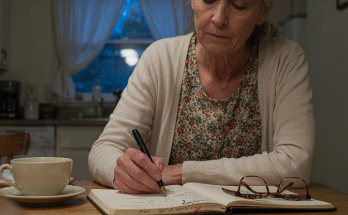
My name is Helen Russell. I’m sixty-four years old, and I raised three children with one paycheck, a crockpot, and more sleepless nights than I can count. I know the difference between a hungry cry and a tired cry. I know when a baby is fighting sleep and when a baby is fighting pain.
And the moment my grandson screamed in my arms, I knew something was wrong.
Thomas and his wife, Ellie, lived in one of those spotless new apartments outside Columbus. White walls. Gray furniture. Fancy baby gadgets lined up perfectly on the counter. The place smelled like detergent, baby lotion… and something else underneath it.
Something sharp.
Like bleach.
Too clean.
My grandson, Noah, was only two months old. Tiny. Sweet. The kind of baby who melted against your shoulder and made every worry disappear.
That Saturday afternoon, Thomas handed him to me while Ellie rushed around gathering diaper bags and bottles.
“We’ll only be gone a few hours,” Thomas said.
Then he hesitated.
“Mom?”
“Yes?”
His face tightened strangely.
“Don’t take his onesie off. He just got out of the bath.”
The comment struck me as odd.
Why would I take his clothes off?
But before I could ask, Ellie called from the doorway.
“Thomas! We’re late!”
He forced a smile.
“Just… leave it on, okay?”
Then they were gone.
For the first thirty minutes, Noah slept peacefully.
Then he woke up screaming.
Not crying.
Screaming.
The kind of scream that comes from somewhere deep inside a child.
I checked his diaper.
Dry.
I warmed a bottle.
He refused it.
I rocked him.
Nothing.
His little body arched backward.
His fists clenched.
His face turned bright red.
My stomach twisted.
I had heard that cry before.
Years ago.
When my youngest daughter had an ear infection.
When Thomas broke his wrist at age seven.
Pain.
Pure pain.
I called my son.
No answer.
I texted.
No response.
Noah’s screams grew louder.
Then I noticed something else.
His movements were careful.
Almost protective.
Like he didn’t want anything touching his torso.
That was enough for me.
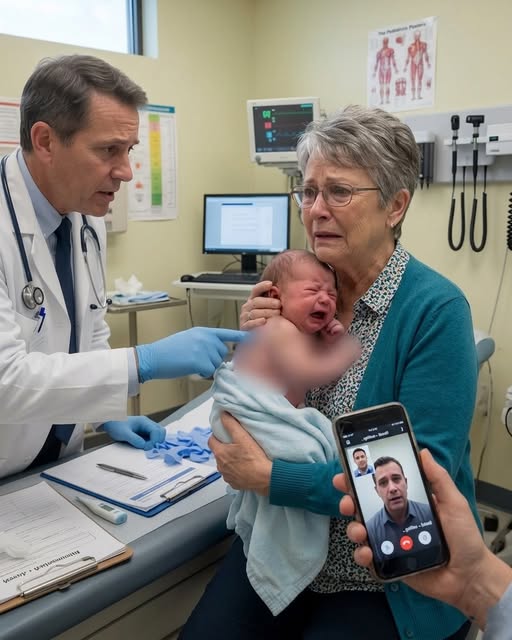
I grabbed the diaper bag, wrapped him in a blanket, and drove straight to St. Vincent’s Pediatric Emergency Department.
The waiting room was crowded.
Parents sat holding coughing toddlers and feverish children.
A television played cartoons nobody was watching.
At triage, a young nurse greeted us with a warm smile.
“What brings you in today?”
“I think something’s wrong with my grandson.”
She glanced at Noah.
“He looks healthy.”
Then Noah screamed again.
The nurse’s smile faded.
“Let’s take a look.”
I laid him on the examination table.
She gently unwrapped the blanket.
Then she reached for the zipper on his onesie.
I remembered Thomas’s warning.
Don’t take his onesie off.
Suddenly, the words felt different.
Heavy.
The nurse pulled down the zipper.
Her smile vanished instantly.
Her eyes widened.
“Oh my God.”
My heart stopped.
“What is it?”
She didn’t answer.
Instead, she pressed a button beneath the desk.
“Dr. Patel to triage. Immediately.”
I looked down.
And saw it.
Large red patches covered Noah’s chest and stomach.
Some areas looked raw.
Angry.
Burned.
My knees nearly gave out.
“What happened to him?”
The nurse looked at me carefully.
“Ma’am, do you know how these injuries occurred?”
“No.”
The word barely escaped my mouth.
“I had no idea.”
Within seconds, the hallway filled with medical staff.
A doctor arrived.
Then another.
Someone carried Noah into an examination room.
Another nurse gently guided me into a chair.
My hands wouldn’t stop shaking.
An hour later, Noah was stable.
The burns were not life-threatening.
But they were serious.
Second-degree chemical burns.
Chemical.
The word echoed in my mind.
How does a two-month-old baby get chemical burns?
Then my phone lit up.
Thomas.
Finally.
I answered immediately.
“Where are you?” he asked.
His voice sounded panicked.
“At St. Vincent’s.”
Silence.
Then:
“You took him to the hospital?”
“Of course I did!”
Another silence.
Longer this time.
When he spoke again, his voice cracked.
“Mom… what did they find?”
I closed my eyes.
“They found burns, Thomas.”
The line went dead.
Two hours later, Thomas arrived alone.
Ellie wasn’t with him.
His face was pale.
His eyes were bloodshot.
He looked ten years older than he had that morning.
The moment he saw me, he started crying.
Not quietly.
Not politely.
The kind of crying that comes when someone has carried a secret too long.
“What happened?” I demanded.
He sank into a chair.
For several seconds, he couldn’t speak.
Then the truth came out.
Piece by piece.
After Noah was born, Ellie had struggled.
Not with motherhood itself.
With perfection.
She became obsessed with germs.
Every surface had to be sanitized.
Every bottle sterilized repeatedly.
Every blanket washed daily.
At first, Thomas thought she was simply being careful.
New mothers worry.
That’s normal.
But things got worse.
Much worse.
She began cleaning constantly.
Wiping counters.
Spraying furniture.
Disinfecting toys.
Scrubbing walls.
She barely slept.
Barely ate.
Everything revolved around keeping Noah “safe.”
One night, Thomas came home from work and found Ellie crying because a delivery driver had touched the apartment door handle.
She spent three hours disinfecting the entire entryway.
He begged her to talk to someone.
She refused.
Then came the accident.
Three days before.
Ellie had been cleaning Noah’s changing station.
She used an industrial-strength cleaner she’d ordered online.
A product never intended for use around infants.
While cleaning, some of the solution soaked into a blanket.
She didn’t realize it.
Later, after Noah’s bath, she wrapped him in that blanket.
Within minutes, he started crying.
His skin turned red.
By the time they realized what happened, the burns had already formed.
Thomas wanted to take him to the hospital immediately.
Ellie panicked.
She insisted it wasn’t serious.
She was terrified people would think she had hurt the baby intentionally.
The argument lasted all night.
Finally, Thomas agreed to monitor Noah.
A decision he regretted every minute afterward.
“He kept crying,” Thomas whispered.
“I knew something was wrong.”
I stared at him.
“Then why didn’t you bring him in?”
His shoulders collapsed.
“Because I was trying to protect my wife.”
The answer hurt.
Because I understood it.
And because it was wrong.
The hospital contacted Child Protective Services that evening.
That frightened Thomas even more.
But the investigation quickly revealed the truth.
The burns were accidental.
There was no evidence of abuse.
What concerned everyone was something else.
Ellie’s mental state.
A psychiatrist evaluated her the next day.
The diagnosis shocked nobody except Ellie herself.
Severe postpartum obsessive-compulsive disorder with anxiety.
Not because she didn’t love Noah.
Because she loved him so intensely that fear had taken control of her life.
Every germ looked deadly.
Every risk felt catastrophic.
Every mistake felt unforgivable.
And that fear had nearly cost her son his safety.
Over the next several weeks, Noah healed.
Babies are resilient in ways adults rarely understand.
The angry red burns slowly faded.
His laughter returned.
His appetite came back.
His bright blue eyes followed everyone around the room again.
But healing wasn’t limited to Noah.
It happened throughout the family.
Ellie entered treatment.
Therapy.
Medication.
Support groups.
For the first time since Noah’s birth, she admitted how terrified she had been.
Not of germs.
Of failing.
Of being a bad mother.
Of hurting the baby she loved more than anything.
Ironically, that fear had pushed her into making dangerous choices.
The day she finally spoke openly about it, she cried for nearly an hour.
So did Thomas.
So did I.
Because none of us had realized how much she had been suffering behind that perfect apartment and those spotless countertops.
Three months later, I visited again.
The apartment looked different.
Still clean.
But lived in.
A blanket sat folded on the couch.
A coffee mug rested on the table.
A few baby toys were scattered across the floor.
The place finally felt like a home.
Not a showroom.
Not a fortress.
A home.
Noah lay happily on a play mat kicking his legs.
His scars were nearly invisible.
Ellie sat beside him smiling.
A real smile.
Not the strained, exhausted expression I’d seen before.
When she noticed me looking at the fading marks on Noah’s chest, her eyes filled with tears.
“I’m so sorry, Helen.”
I squeezed her hand.
“I know.”
She nodded.
“I’ll spend the rest of my life feeling guilty.”
“No.”
She looked surprised.
“No, you won’t.”
“What do you mean?”
I glanced down at Noah.
“Good parents make mistakes.”
She shook her head.
“Not mistakes like that.”
“Sometimes exactly like that.”
Tears rolled down her cheeks.
I continued.
“The important thing isn’t what happened. It’s what you do afterward.”
She looked at her son.
Then at Thomas.
Then back at me.
“And what if people judge me?”
I smiled gently.
“People always judge.”
She laughed through her tears.
That was true.
As I prepared to leave, Thomas walked me to my car.
Before I got in, he stopped me.
“Mom?”
“Yes?”
“I never thanked you.”
“For what?”
He swallowed hard.
“For ignoring me.”
I stared at him.
“What?”
“If you’d listened when I said not to take his onesie off… if you’d trusted me instead of your instincts…”
His voice broke.
“…we might have lost precious time.”
I thought about that strange warning.
The one that had made no sense at the time.
Don’t take his onesie off.
Not because Noah had just had a bath.
Not because it was unnecessary.
Because Thomas was terrified someone would discover the truth.
Terrified of what would happen next.
But sometimes the truth needs to be uncovered, no matter how frightening it is.
I hugged my son tightly.
Then I looked through the apartment window at Ellie and Noah.
At a family still standing.
Bruised.
Humbled.
Healing.
But together.
And as I drove away, I realized something.
The nurse hadn’t stopped smiling because she discovered a monster.
She stopped smiling because she discovered a baby in pain.
The real story wasn’t about blame.
It was about what happened after the truth came into the light.
And sometimes, that is where healing finally begins.