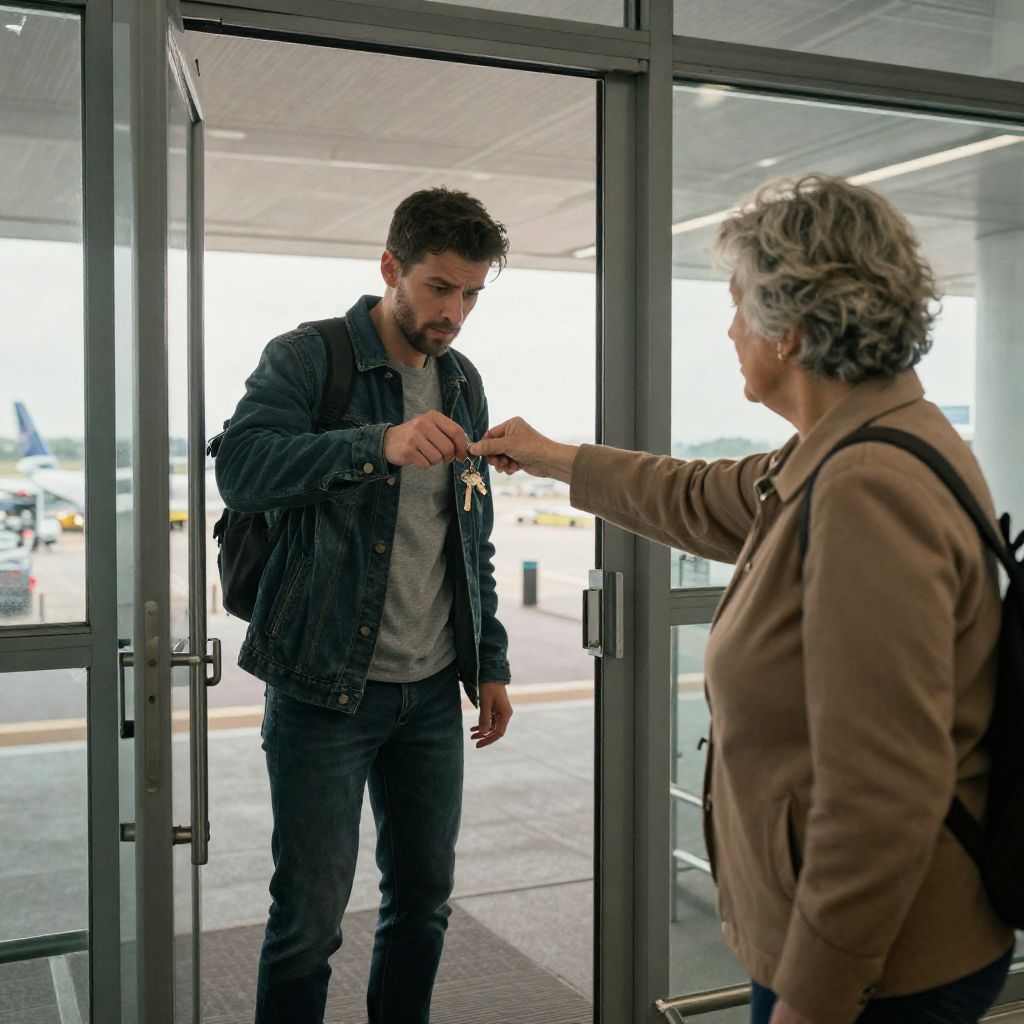
The key wouldn’t turn.
Daniel stood on the porch in his airport clothes, one hand wrapped around a hard-shell suitcase, the other twisting that silver key again and again like the lock had somehow made a mistake.
Melissa stood beside him in oversized sunglasses, shopping bags dangling from her wrist, still smiling—until the door refused to open.
Then Daniel tried again.
Nothing.
He frowned.
“Mom must have changed the lock.”
I watched from across the street, sitting quietly inside a rental car.
Three weeks earlier, that possibility would have terrified me.
Now it felt like justice.
Daniel stepped back and looked at the house—the white colonial his father and I had spent thirty-two years paying off. The house where Daniel learned to ride a bike. The house where I stayed awake through fevers and nightmares. The house where I worked double shifts after his father died.
The house he already considered his.
He pulled out his phone and called me.
I let it ring.
Then again.
And again.
Melissa crossed her arms.
“Where is she?”
Daniel shook his head.
“I don’t know.”
I watched him pace the porch.
For the first time in years, I didn’t rush to solve his problems.
Because three weeks earlier, I’d accidentally overheard a conversation that changed everything.
It happened on a Tuesday.
Daniel had called to check in while driving home from work.
At least, that’s what I thought.
We talked for a few minutes about groceries, the weather, and his upcoming vacation to Italy and France with Melissa.
Then he said, “Love you, Mom.”
“Love you too.”
We hung up.
Or so he thought.
A few seconds later, I heard Melissa’s voice through the phone.
“She still doesn’t know?”
Daniel laughed.
“No.”
My finger froze over the screen.
The call hadn’t disconnected.
“What are you waiting for?” Melissa asked.
“Honestly? There’s no point telling her. The house will be ours eventually anyway.”
I stopped breathing.
“The place is worth almost nine hundred thousand now,” Melissa said.
“I know.”
“Imagine selling it after she moves into assisted living.”
Daniel chuckled.
“That’s basically the retirement plan.”
My stomach dropped.
Then came the sentence I still hear in my nightmares.
“Sometimes I feel bad,” Melissa said.
“Why?”
“Because your mom is lonely.”
Daniel sighed.
“She is lonely.”
A pause.
Then he laughed.
“But honestly? She’s becoming a burden.”
A burden.
Not Mom.
Not the woman who sacrificed everything for him.
A burden.
The call continued for several minutes.
Every word cut deeper than the last.
They talked about renovating the house after I was gone.
About knocking down walls.
About converting my sewing room into a gym.
About how expensive elderly care might be if I lived too long.
I listened until the call finally disconnected.
Then I sat in silence.
For hours.
The next morning, I cried.
The morning after that, I cried again.
Then something changed.
I looked around the kitchen.
Every cabinet.
Every photograph.
Every piece of furniture carried memories.
And suddenly I realized something.
The house belonged to me.
Not Daniel.
Not Melissa.
Me.
I had spent decades assuming sacrifice automatically created gratitude.
But gratitude isn’t inherited.
Respect isn’t guaranteed.
And love certainly isn’t owed.
That afternoon I called a realtor.
“Are you sure?” she asked.
“Yes.”
“The market is strong.”
“Good.”
“Your son knows?”
“No.”
She hesitated.
“That’s unusual.”
I smiled sadly.
“So is finding out your child has already planned your death.”
She didn’t ask any more questions.
The house sold in eleven days.
Cash offer.
$875,000.
The buyers wanted a quick closing.
Perfect.
I rented a beautiful condo near the coast two states away.
Smaller.
Modern.
Peaceful.
Nobody knew where I was going.
Not even Daniel.
Especially not Daniel.
For years I’d funded emergencies.
Paid bills.
Babysat.
Loaned money that was never repaid.
I had mistaken dependency for closeness.
Now I wanted to know who I was without constantly rescuing someone.
So I packed.
Quietly.
Methodically.
One box at a time.
The hardest part wasn’t leaving.
It was sorting through memories.
Daniel’s kindergarten drawings.
His baseball trophies.
Father’s Day cards.
Photos of camping trips.
Birthday parties.
Christmas mornings.
Evidence of a life I genuinely loved.
I didn’t hate my son.
That’s what made everything hurt.
If I had hated him, leaving would have been easy.
Instead, I loved him deeply.
But love doesn’t require self-destruction.
Eventually, every box was packed.
Every room was empty.
Every chapter was closed.
The day before Daniel returned from Europe, I left.
Now I watched him standing on the porch.
Confused.
Angry.
Lost.
Exactly how I’d felt listening to that phone call.
His phone rang again.
Voicemail.
Then Melissa spotted a real-estate sign lying beside the garage.
A SOLD sign.
Her face turned pale.
“Daniel.”
He turned.
“What?”
She pointed.
I watched the realization arrive.
Slowly.
Like a storm rolling over water.
“No,” he whispered.
Then louder.
“No.”
His phone rang.
This time it was me.
He answered immediately.
“Mom!”
“Hello, Daniel.”
“What happened?”
“The house sold.”
“What do you mean it sold?”
“I sold it.”
Silence.
Then:
“You can’t be serious.”
“I am.”
“Why would you do that?”
I almost laughed.
Why indeed.
“Because it was my house.”
“Mom, where are you?”
“Safe.”
“Safe from what?”
I looked through the windshield.
“From being treated like a burden.”
The silence that followed felt endless.
Then:
“You heard that?”
“Yes.”
Nothing.
No denial.
No confusion.
He knew exactly what I meant.
“Mom—”
“No.”
“Please let me explain.”
“Go ahead.”
His voice cracked.
“I didn’t mean it.”
I closed my eyes.
“You said it.”
“That’s different.”
“No, Daniel. It’s not.”
For several moments neither of us spoke.
Then I heard Melissa in the background.
“What is she saying?”
Daniel ignored her.
“Mom, we’re family.”
“Family doesn’t make plans for someone’s house before they’re gone.”
“It wasn’t like that.”
“It was exactly like that.”
He swallowed hard.
“Can we talk in person?”
“Maybe someday.”
“Where are you living?”
“I have a condo.”
“You bought another house?”
“Yes.”
“With the money?”
“Yes.”
Again, silence.
I knew what he was calculating.
How much remained.
What I’d done with it.
Whether any would eventually become his.
Old habits die hard.
“Mom,” he said carefully, “I was worried about your future.”
“No.”
“What?”
“You weren’t worried about my future. You were excited about yours.”
The truth landed like a hammer.
He couldn’t argue.
Because we’d both heard the conversation.
The following months were difficult.
Daniel called often.
Sometimes I answered.
Sometimes I didn’t.
At first, every conversation centered on the house.
Then money.
Then inheritance.
Each time he spoke, he revealed more than he realized.
Eventually I asked him a simple question.
“If I’d been renting an apartment with no assets, would you still call every week?”
He couldn’t answer.
That told me everything.
Life in my new condo surprised me.
For decades I’d built my identity around motherhood.
Now I had mornings to myself.
I joined a book club.
Took painting classes.
Made friends.
Traveled.
I laughed more than I had in years.
One afternoon I sat beside the ocean with a cup of coffee and realized something remarkable.
I wasn’t lonely.
I’d simply been living inside a relationship where my value depended on what I provided.
Once that ended, space opened for something healthier.
Nearly a year passed.
Then Daniel called unexpectedly.
His voice sounded different.
Quieter.
Older.
“Mom?”
“Yes?”
“Can I visit?”
I hesitated.
“Why?”
“Because I miss you.”
The answer came instantly.
No mention of money.
No mention of property.
Just me.
For the first time in a long while, I believed him.
“Okay.”
He arrived two weeks later.
Alone.
No Melissa.
No agenda.
Just a son carrying regret.
When I opened the door, neither of us spoke immediately.
He looked around my condo.
Family photos decorated the walls.
Plants filled the windows.
Paintings from my classes hung in the hallway.
Evidence of a life he’d never imagined for me.
“You seem happy,” he said.
“I am.”
His eyes filled with tears.
“I didn’t think you would leave.”
“I know.”
“You always stayed.”
There it was.
The truth.
He had built his expectations around my permanence.
Around my endless forgiveness.
Around the certainty that I’d never choose myself.
“I should have appreciated you,” he said quietly.
“Yes.”
“I was selfish.”
“Yes.”
“I hurt you.”
“Yes.”
Tears rolled down his face.
“I hate that I became that person.”
I believed him.
Not because he was crying.
But because for the first time, he wasn’t defending himself.
We spent hours talking.
Really talking.
About grief.
About entitlement.
About how easy it is to mistake love for ownership.
He admitted that after his father’s death, he’d started viewing the house as his eventual inheritance rather than my home.
A subtle shift.
But a dangerous one.
Melissa had encouraged it.
Friends had reinforced it.
And over time he stopped seeing me as a person with decades still ahead of me.
Instead he saw me as an obstacle standing between him and something he expected to receive.
Hearing him say it aloud was painful.
But it was honest.
And honesty was where healing could begin.
Before leaving, he stood near the door.
“Mom?”
“Yes?”
“Will you ever forgive me?”
I looked at him carefully.
The answer mattered.
“Forgiveness isn’t the issue.”
He frowned.
“What do you mean?”
“I forgave you months ago.”
“Then what’s left?”
“Trust.”
He nodded slowly.
Because he finally understood.
Forgiveness can happen in a moment.
Trust is rebuilt brick by brick.
Year by year.
Choice by choice.
Two years later, our relationship looked different.
Smaller.
Healthier.
Real.
Daniel visited regularly.
He stopped discussing inheritance entirely.
When he called, he asked about my life.
My friends.
My travels.
My paintings.
Me.
The way a son should.
One afternoon we sat together on my balcony overlooking the water.
The sunset painted the horizon gold.
“You know,” he said, “losing that house was the best thing that ever happened to me.”
I laughed.
“I doubt that.”
“No.”
He smiled.
“I thought the house was my future.”
“And?”
“It wasn’t.”
He looked toward the ocean.
“You were.”
For a moment neither of us spoke.
Then I reached over and squeezed his hand.
Because despite everything, he was still my son.
And people can change when they’re willing to confront the worst parts of themselves.
Not everyone does.
But some do.
The old house was gone.
The inheritance he’d expected was gone.
The assumptions were gone.
Yet somehow, after all the damage, something more valuable remained.
A relationship rebuilt on respect instead of entitlement.
On gratitude instead of expectation.
On choice instead of obligation.
And every time I remembered Daniel standing on that porch, twisting a key that no longer worked, I realized it had never really been about a lock.
It was about a lesson.
The moment he discovered that parents are not waiting rooms for inheritance.
They are people.
People with dreams.
People with dignity.
People with every right to choose their own future.
And sometimes, the most loving thing a parent can do is close one door so a better one can finally open.