That morning, my son Daniel stood in front of the hallway mirror, smoothing the front of his black graduation gown like he was preparing to step into a life where I no longer fit.
I had been up since five.
I ironed his shirt twice because the first crease bothered me. I packed a bottle of water in my purse because he always forgot to drink when he was nervous. I even brought the old silver tie clip his late father wore to work, thinking maybe Daniel would want one small piece of where he came from near his heart.
But when I held it out to him, he barely glanced at it.
“Maybe another time, Mom.”
Another time.
Those two words had become his favorite way of putting distance between us.
I folded the tie clip back into my palm and smiled anyway.
“Of course.”
The apartment smelled faintly like coffee and starch from the iron. Outside, the city buzzed with spring sunlight and weekend traffic. Families were already heading toward the university campus carrying flowers, balloons, cameras, and loud pride.
For years, I had imagined this day.
Not because I cared about titles or degrees.
Because I remembered the nights Daniel almost gave up.
I remembered overdue bills stacked beside textbooks.
I remembered him studying at our kitchen table while I quietly pretended not to notice that the electricity had been shut off again.
I remembered the winter after his father died, when Daniel was only twelve and refused to cry because he thought someone had to be “the man of the house.”
He had worked so hard to survive that grief.
So had I.
When we arrived at the university auditorium, everything shimmered with celebration. Rows of white chairs lined the entrance lawn. Music drifted through the speakers. Parents hugged their children while photographers barked instructions from every angle.
Daniel’s wife, Priya, waved at us from near the registration table. Beside her stood her mother, Meera, elegant in a pale blue sari with diamonds sparkling at her ears.
Meera smiled politely when she saw me.
Not warmly.
Politely.
That had always been our relationship.
She came from old money and polished conversations. I came from double shifts at a nursing home and coupon folders tucked into kitchen drawers.
She never insulted me directly.
She never had to.
Her pauses did enough.
Daniel walked toward them immediately.
I slowed my pace, giving them space to greet each other.
Then I heard him say it.
“Actually, I wanted Meera to walk in with me.”
For a second, I thought I’d misunderstood.
The university had a small tradition where graduates could choose one person to accompany them through the ceremonial entrance before taking their seats.
Parents usually walked beside their children.
Sometimes spouses.
Sometimes grandparents.
Daniel rubbed the back of his neck awkwardly.
“Priya thought it would mean a lot to her mom,” he explained.
Priya avoided looking at me.
Meera placed one manicured hand lightly against her chest.
“Oh, Daniel, you don’t have to explain.”
But he kept talking.
“It’s just… you’d probably be more comfortable in the audience anyway, Mom.”
Comfortable.
As if I had spent twenty-six years wanting comfort instead of closeness.
The air around me seemed to thin.
I noticed ridiculous details.
The sharp scent of roses from a nearby bouquet.
A child whining over melted ice cream.
A tassel blowing across the pavement.
I could have argued.
Could have reminded him who sat beside hospital beds when he had pneumonia.
Who skipped meals to cover tuition deposits.
Who worked nights and mornings and weekends.
But people were watching.
And more than that, Daniel looked nervous.
Not cruel.
Just eager to keep everyone pleased.
So I swallowed the hurt and nodded.
“Of course,” I said softly.
His shoulders relaxed instantly.
“Thanks, Mom.”
He kissed my cheek quickly before turning back toward Priya and Meera.
And just like that, I became part of the audience.
I found my assigned seat in the sixth row.
Around me, families buzzed with excitement.
A father practiced camera angles. A grandmother dabbed tears into a handkerchief before the ceremony even began.
I sat quietly, smoothing invisible wrinkles from my dress.
I told myself not to ruin the day.
That was motherhood too, wasn’t it?
Learning how to disappear gracefully.
The procession music began.
Everyone stood.
Graduates entered in pairs while applause echoed across the auditorium.
And there was Daniel.
Tall.
Confident.
Walking beside Meera.
She glowed under the lights, smiling proudly as though she had personally carried him through every exam.
People around me whispered compliments.
“What a beautiful family.”
“They look so close.”
I clapped with everyone else.
No one noticed my hands trembling.
The ceremony stretched through speeches, awards, and endless names.
I listened politely, though my thoughts wandered.
Maybe this was natural.
Children grow.
They build new loyalties.
Maybe mothers simply become background music after enough years pass.
Then the dean stepped to the podium near the end of the ceremony.
He adjusted his glasses and smiled.
“Before we conclude today,” he announced, “there is one more recognition we would like to present.”
The room quieted.
“We have an annual faculty honor awarded to a graduating student who demonstrates exceptional perseverance, leadership, and service despite significant personal hardship.”
Daniel straightened in his chair.
I felt a flicker of pride.
The dean continued.
“This year’s recipient is Daniel Harper.”
Applause erupted.
Daniel looked stunned as Priya grabbed his arm excitedly.
The dean lifted a hand.
“However, this award includes something unusual.”
He looked down at a card.
“When our committee reviewed Daniel’s journey, we repeatedly encountered the story of one person whose sacrifices made his education possible.”
Daniel’s smile faltered slightly.
The dean continued.
“A parent who worked overnight shifts for years while attending community college classes herself during the daytime so she could earn higher wages.”
My chest tightened.
“A woman who donated plasma during difficult financial periods to help cover textbooks.”
A murmur spread through the audience.
“A mother who once slept in her car outside the hospital after a double shift because she could not afford both parking and gas in the same week.”
Daniel slowly turned toward me.
The dean smiled warmly.
“Mrs. Evelyn Harper, would you please join us on stage?”
For a moment, I genuinely thought there had been some mistake.
People nearby started looking around until several heads turned directly toward me.
My heart pounded.
I hadn’t expected this.
Hadn’t prepared myself.
Daniel stared as if he were seeing me from a distance he hadn’t noticed before.
Priya’s expression shifted from confusion to embarrassment.
Meera’s posture stiffened.
The applause grew louder.
Someone behind me whispered, “Go on.”
I stood carefully, gripping my purse so tightly my fingers hurt.
The walk to the stage felt impossibly long.
The dean met me halfway up the stairs.
“Mrs. Harper,” he said quietly, “thank you for everything you did.”
I blinked rapidly.
“How did you even know any of that?”
He smiled.
“Your son wrote about you in every scholarship essay he ever submitted.”
I looked toward Daniel.
His eyes filled instantly.
The dean guided me beside the podium.
“Daniel,” he said into the microphone, “your professors nominated you because you never took personal credit without acknowledging the woman who carried you here.”
The auditorium erupted again.
This time the applause sounded different.
Not polite.
Personal.
Daniel stood slowly.
And then, to my surprise, he stepped away from his row and walked directly toward the stage.
When he reached me, his face had completely unraveled.
“I’m sorry,” he whispered.
I could barely hear him over the clapping.
“I don’t know why I did that today.”
I saw it then.
Not arrogance.
Not cruelty.
Weakness.
The desperate kind that makes people perform for approval until they lose sight of who stood beside them first.
He wiped at his eyes roughly.
“You should’ve walked with me.”
The room grew quieter as microphones picked up fragments of our conversation.
I touched his sleeve gently.
“It’s all right.”
“No,” he said, voice breaking. “It isn’t.”
The dean stepped aside respectfully.
Daniel turned toward the audience.
“I need to say something.”
A staff member handed him the microphone.
He inhaled shakily.
“My father died when I was twelve,” he began. “After that, my mom worked harder than anyone I’ve ever known.”
The room listened in complete silence.
“She cleaned offices at night. She worked weekends at a nursing home. She missed meals so I wouldn’t.”
I closed my eyes briefly.
Daniel continued.
“When I got accepted into university, I was terrified about money. I almost turned it down.”
He looked at me.
“But she sold her wedding ring without telling me.”
Gasps rippled softly through the audience.
“It paid my first semester deposit.”
I had never wanted him to know that.
Daniel’s voice cracked.
“And today… I worried more about keeping everyone comfortable than honoring the person who gave me every chance I ever had.”
He turned fully toward me.
“I’m ashamed of that.”
Tears blurred my vision.
Not because of the audience.
Not because of recognition.
Because for the first time in years, I heard my son speaking honestly instead of diplomatically.
The dean placed a hand on Daniel’s shoulder.
“Success,” he said gently, “means very little if we forget who helped us survive long enough to reach it.”
Even Meera lowered her gaze.
After the ceremony ended, families flooded the auditorium floor with flowers and photographs.
Daniel stayed close beside me the entire time.
Not out of obligation.
Out of something quieter.
Awareness.
At one point, Meera approached us carefully.
“I owe you an apology,” she said.
I blinked in surprise.
She clasped her hands together.
“I knew you sacrificed for Daniel, but I don’t think I ever understood the extent of it.”
There was no arrogance left in her voice.
Only sincerity.
“You raised an extraordinary man,” she added softly.
I almost laughed at the irony.
“He’s still learning,” I replied.
Daniel smiled weakly.
“Definitely still learning.”
Later, outside beneath the bright afternoon sun, graduates tossed caps into the air while cameras flashed across the campus lawn.
Daniel and I stood slightly apart from the crowd.
He reached into his pocket.
“I forgot something earlier.”
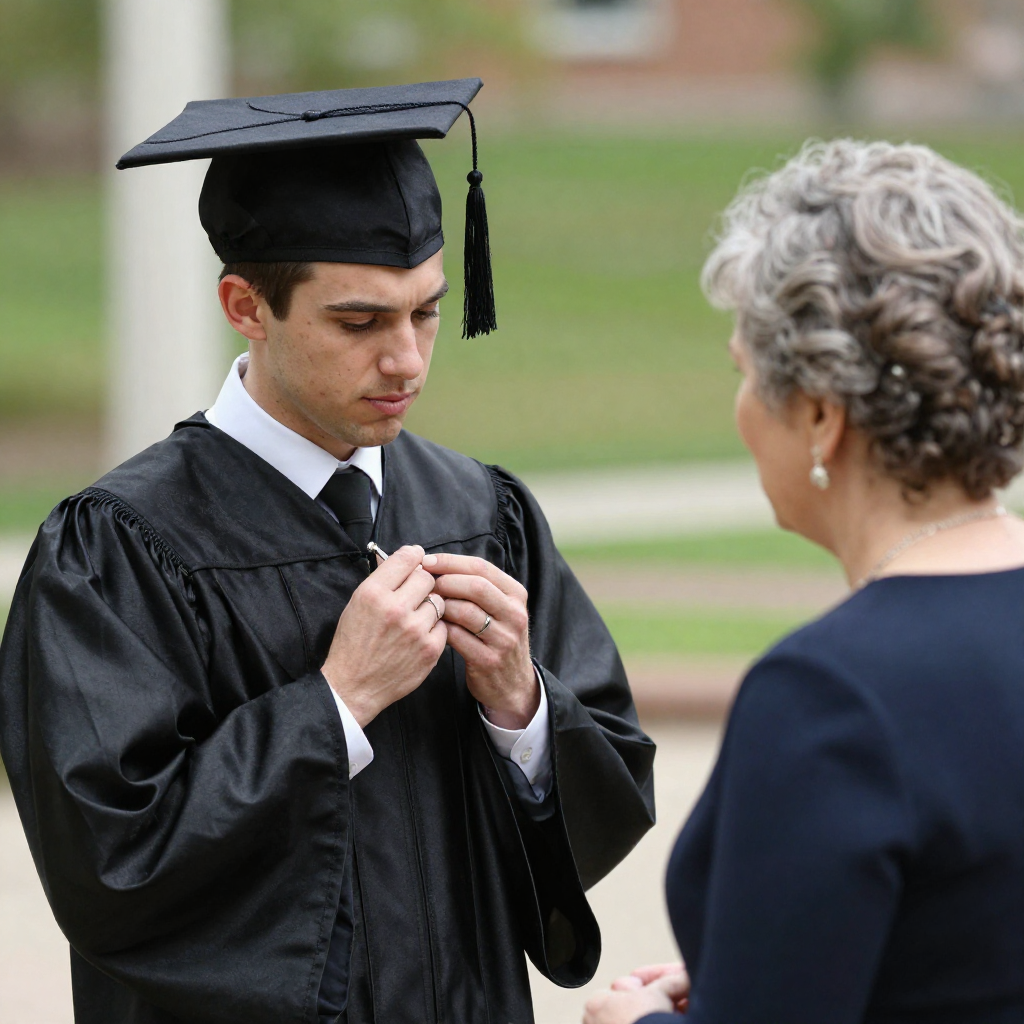
He pulled out the silver tie clip.
My throat tightened.
“I went back for it after you sat down,” he admitted.
The metal glinted in his palm.
“Can you help me put it on?”
My hands trembled as I fastened it carefully against his tie.
For one fleeting second, he looked like the little boy who used to hold still while I buttoned his school shirts before class.
“I’m proud of you,” I whispered.
He swallowed hard.
“I’m proud of you too, Mom.”
Then, without caring who watched, my grown son wrapped his arms around me and held on.
And this time, when people turned toward our story, I didn’t feel invisible at all.