The phone rang just after seven on a rainy Thursday evening.
Margaret Collins almost let it go to voicemail.
She had spent the entire afternoon reorganizing old files in the back office of the animal shelter where she volunteered three days a week. At sixty years old, she was tired in a deep, familiar way that settled into her bones after long days. She had just wrapped herself in a faded blue cardigan and lowered herself into her favorite armchair when the ringing started.
Unknown number.
She sighed and answered anyway.
“Hello?”
There was a pause.
Then a man’s voice, careful and uncertain.
“Is this Margaret Collins?”
“Yes.”
Another silence.
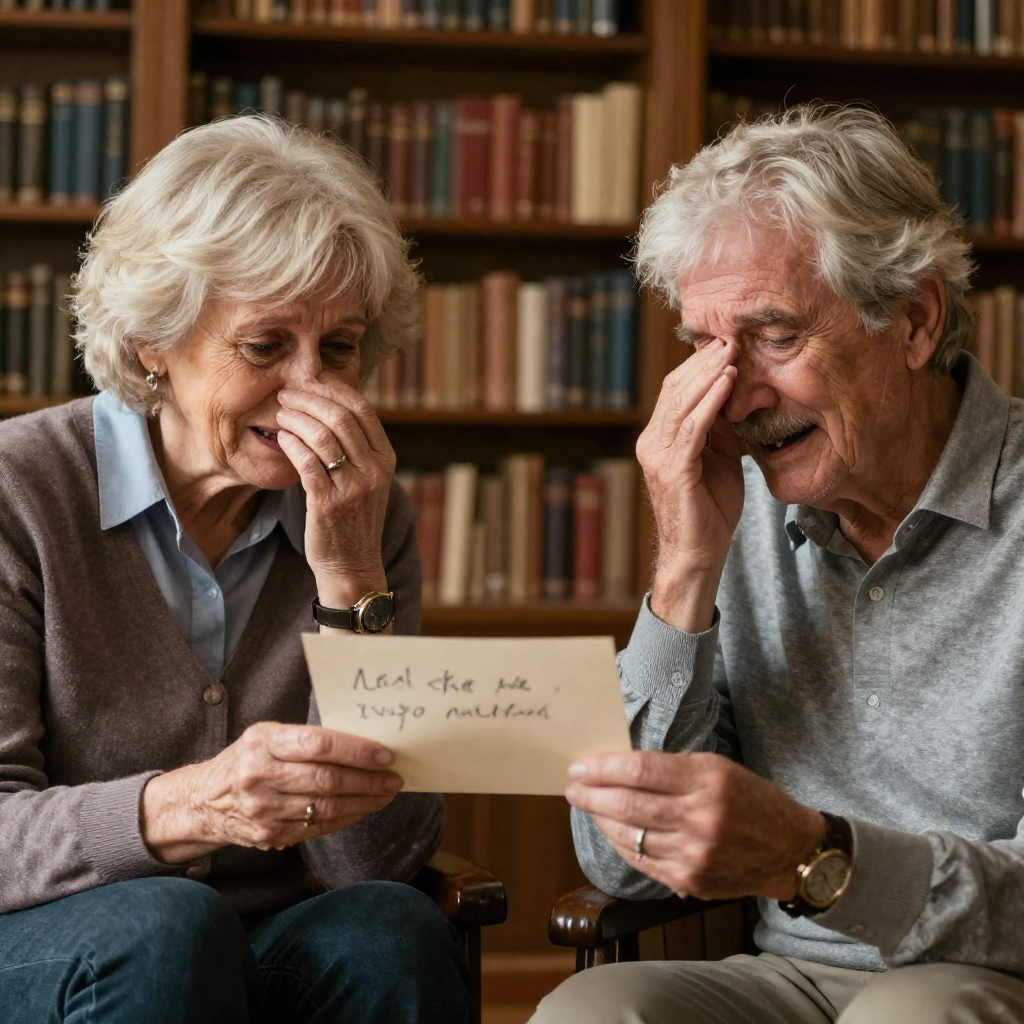
“This is going to sound strange,” he said. “I bought a used book at the Green Hollow Library sale last month. A letter fell out of it. It was addressed to someone named David Andrews.”
Margaret frowned.
“I’m sorry, I think you have the wrong person.”
“The letter was signed Margaret.”
Her breath caught.
The room suddenly felt smaller.
He continued softly.
“I didn’t mean to read it at first. I only opened it because it looked important. Then I saw the date. 1986.” He swallowed. “It said, ‘David, I’m pregnant. I need you. Please come back.'”
Margaret gripped the armrest so tightly her fingers hurt.
Forty years disappeared in an instant.
The smell of cut grass behind Lincoln High.
The crackling speakers at the summer carnival.
David’s warm hand wrapped around hers under the bleachers.
And the terrible ache of waiting for someone who never came back.
“Who is this?” she whispered.
The man on the other end let out a shaky breath.
“Margaret… it’s David Andrews.”
Her heart stopped.
For a moment she couldn’t speak.
Rain tapped against the windows. Somewhere in the kitchen, the refrigerator hummed steadily. Everything ordinary continued while her entire life tilted sideways.
“No,” she finally said weakly.
“I know this sounds impossible. But it’s me.”
She closed her eyes.
David.
The boy with dark hair that always fell into his eyes.
The boy who skipped school with her to drive out to Miller’s Lake.
The boy who promised he would marry her someday.
The boy who vanished.
“What happened to the baby?” he asked quietly.
Margaret opened her eyes again.
She stared at the framed photograph on the bookshelf across from her.
A smiling woman in a white coat stood between two children.
Emily.
Thirty-nine years old.
Her whole heart.
“She’s a doctor in Boston,” Margaret said softly. “She has your eyes.”
On the other end of the line, David started crying.
Not dramatic sobs.
Just the broken sound of a man grieving decades he could never get back.
“Oh my God,” he whispered. “Oh my God.”
Margaret felt tears sliding down her own cheeks.
“I waited for you,” she said.
“I know.”
“No, you don’t. I waited every day for almost a year.”
David inhaled sharply.
“Margaret, I never got the letter.”
Her chest tightened.
“I wrote three letters,” she whispered.
“I never saw any of them.”
She pressed a trembling hand against her forehead.
Forty years.
Forty years built on silence.
“Your mother told me you’d moved to California,” he said. “She said you didn’t want me involved.”
Margaret sat up straight.
“What?”
“I came back for you after my father’s funeral. About eight months after I moved to Ohio with my family. Your mother answered the door. She told me you were gone. Said you’d left town and wanted to start over somewhere else.”
Margaret felt cold all over.
“I never moved to California.”
David was silent.
Then, almost inaudibly, he said, “Your mother lied to me.”
Margaret looked toward the dark kitchen.
Her mother had been dead for fifteen years.
There would never be answers now.
But suddenly, pieces of her life rearranged themselves into something new and terrible.
Her mother’s disapproving face.
The way she’d called David “reckless.”
The way she’d insisted Margaret could raise a baby alone.
The way she’d always said, “Some men aren’t meant to stay.”
Margaret had believed he’d abandoned her.
All these years.
“I searched for you,” David said. “For ten years.”
Margaret covered her mouth.
“Then why stop?”
“Because eventually you start believing the lie.” His voice cracked. “And because I got tired of hoping.”
The words hit her harder than she expected.
She understood that exhaustion.
She had lived inside it too.
For a long moment neither of them spoke.
Then David said quietly, “I moved back here five years ago. I’ve been going to that library every Saturday morning ever since.”
Margaret laughed through her tears.
It was such a small thing.
Such an ordinary habit.
And somehow it had changed everything.
“I almost didn’t buy the book,” he admitted.
“What book was it?”
“To Kill a Mockingbird. Hardcover. Your name was written inside the cover.”
Margaret stared into the distance.
She remembered placing the letter there.
She had been nineteen, terrified, and too ashamed to mail it after her mother convinced her David didn’t want her anymore.
She had tucked it inside the book, thinking she’d send it someday.
Then someday became decades.
“Margaret?”
“Yes?”
“Can I see you?”
Her pulse jumped.
At sixty, she had long ago stopped imagining dramatic moments.
Life became routines.
Coffee in the morning.
Volunteer shifts.
Phone calls with Emily.
Quiet evenings alone.
You stopped expecting the past to knock on your door.
And yet here it was.
“I don’t know,” she admitted.
“That’s fair.”
She heard him exhale shakily.
“I just… I need to say I’m sorry. For every birthday I missed. Every school play. Every fever. Every hard day.”
Margaret closed her eyes again.
“You didn’t know.”
“But I should have fought harder.”
That sentence stayed with her long after the call ended.
Three days later, Margaret stood outside a small café on Maple Street, clutching her purse so tightly her knuckles turned white.
Rainwater shimmered along the sidewalks.
Inside the café window, she spotted him immediately.
Older.
Gray-haired.
Broader in the shoulders.
But unmistakably David.
He looked up.
For a second neither of them moved.
Then he stood.
Margaret felt nineteen again.
Not because he looked the same.
But because of the way he looked at her.
As if she mattered.
As if she always had.
When she reached the table, he seemed suddenly nervous.
“Hi,” he said.
She laughed softly.
“Hi.”
For a moment they simply stared.
Forty years was too large to cross all at once.
Finally David shook his head.
“You still wrinkle your nose when you’re nervous.”
Margaret blinked.
Then she laughed again, genuinely this time.
“And you still notice everything.”
They talked for three hours.
About small things at first.
Jobs.
Weather.
Old classmates.
Then slowly, carefully, they stepped into the missing years.
David had never married.
“Came close twice,” he admitted. “But it never felt right.”
Margaret looked down at her coffee.
“I married once. Briefly. Emily was twelve. He left after two years.”
David’s jaw tightened.
“Did he treat her well?”
“Mostly.” Margaret smiled faintly. “She never let anyone push her around. Even as a kid.”
“Sounds like you.”
She shook her head.
“No. Emily’s braver than I ever was.”
David reached into his jacket pocket.
He unfolded a worn photograph.
A younger version of himself stood beside a motorcycle, smiling at the camera.
“You took this,” he said.
Margaret stared.
“You kept it?”
“For forty years.”
Something inside her broke open then.
Not painfully.
Gently.
Like ice thawing after a brutal winter.
“I hated you,” she whispered.
David nodded.
“I know.”
“I told myself you abandoned us because it hurt less than believing you didn’t know.”
His eyes filled again.
“I would’ve come back.”
Margaret believed him.
That was the hardest part.
She believed him completely.
Emily called that evening while Margaret was washing dishes.
“So?” her daughter demanded immediately.
Margaret smiled despite herself.
“How do you know I met him?”
“Mom, you’ve been pacing for two days. Of course you met him.”
Margaret dried her hands slowly.
“He’s kind,” she said softly.
There was silence on the line.
Then Emily asked the question Margaret had dreaded.
“Why didn’t he come for us?”
Margaret leaned against the counter.
“Because Grandma lied to both of us.”
Emily didn’t speak for several seconds.
“Wow,” she finally muttered.
“I know.”
“Are you okay?”
Margaret considered the question.
No.
Yes.
Maybe both.
“I don’t know yet,” she admitted.
Emily sighed.
“Do you want me to be angry?”
“No.”
“Good, because honestly? I’m mostly curious.”
Margaret laughed weakly.
“You got that from him.”
“Probably.” Emily hesitated. “Do you think he wants to meet me?”
Margaret felt tears sting her eyes again.
“More than anything.”
They met two weeks later in Boston.
Margaret arrived early at Emily’s townhouse and nearly wore a path into the hardwood floors waiting.
“Mom,” Emily said gently, “you’re making me nervous.”
“Sorry.”
A car door slammed outside.
Margaret froze.
Emily glanced through the window.
“He’s here.”
David stood on the front porch holding a small paper bag.
For a terrifying second, nobody moved.
Then Emily opened the door.
David stared at her.
And Margaret saw it instantly.
The same eyes.
The same stubborn chin.
The same habit of tilting her head when uncertain.
David made a broken sound in the back of his throat.
“Hi,” Emily said softly.
He nodded too quickly.
“Hi.”
Then, to Margaret’s surprise, Emily smiled.
“You look overwhelmed.”
David laughed shakily.
“A little.”
He held out the paper bag.
“I didn’t know what to bring.”
Emily peeked inside.
Her eyebrows lifted.
“Lemon candies?”
David looked embarrassed.
“Margaret used to love them.”
Emily grinned.
“So do I.”
David sat down hard on the porch swing as if his legs had given out.
Margaret suddenly remembered telling him once, at seventeen, that lemon candy made every bad day better.
Somehow he remembered too.
Emily sat beside him.
“So,” she said lightly, “want to hear thirty-nine years of stories all at once?”
David looked at her like she had handed him the world.
“Yes,” he whispered.
And slowly, awkwardly, beautifully, they began.
Summer arrived early that year.
By July, David had become a strange, wonderful part of their lives.
He called Emily every Sunday.
He mailed postcards to Margaret from every town he visited for work, even tiny ones only two hours away.
He fixed the broken gate behind Margaret’s house.
He attended Emily’s son’s baseball game and cried when the boy hugged him goodbye.
Lost time could not be recovered.
They all knew that.
There were birthdays he missed.
Christmas mornings.
Nightmares.
First heartbreaks.
College graduations.
Entire lifetimes.
Nothing could return those things.
But something unexpected happened instead.
The grief softened.
Not disappeared.
Softened.
One August evening, Margaret sat beside David on her back porch while cicadas buzzed in the dark.
“Do you ever think about what would’ve happened if the letter reached you?” she asked.
David looked out into the yard.
“Every day.”
“What do you think would’ve changed?”
He smiled sadly.
“Probably everything.”
Margaret leaned back in her chair.
At nineteen, she had believed life was made of giant moments.
Wedding dresses.
Babies.
Goodbyes.
But now she understood differently.
Life changed because of tiny things.
A misplaced letter.
A frightened mother.
A donated book.
A man wandering into a library sale on an ordinary Saturday morning.
David reached for her hand carefully, as though still asking permission after all these years.
Margaret let him hold it.
Above them, porch lights glowed softly against the warm summer dark.
“You know what’s funny?” David said.
“What?”
“That letter spent forty years hidden in a book called To Kill a Mockingbird.”
Margaret smiled.
“And?”
He squeezed her hand gently.
“Maybe some things survive because they’re meant to be found eventually.”
For the first time in decades, Margaret allowed herself to believe that might be true.