Seven hours.
That was what the GPS said when I threw my suitcase into the back seat and pulled out of the hotel parking garage without checking out.
Seven hours of dark highway.
Seven hours of bitter gas station coffee.
Seven hours of rain misting across the windshield while one phone call replayed in my head until the words stopped sounding real.
“James, I don’t know what to do,” Carolyn Sherwood had whispered.
Carolyn was my neighbor.
Sixty-four years old.
Retired school librarian.
The kind of woman who brought zucchini bread in August, left Christmas cookies wrapped in foil, and complained when anyone on our street left trash cans out too long.
She was not dramatic.
She was not lonely enough to invent emergencies.
She did not call after midnight unless something was truly wrong.
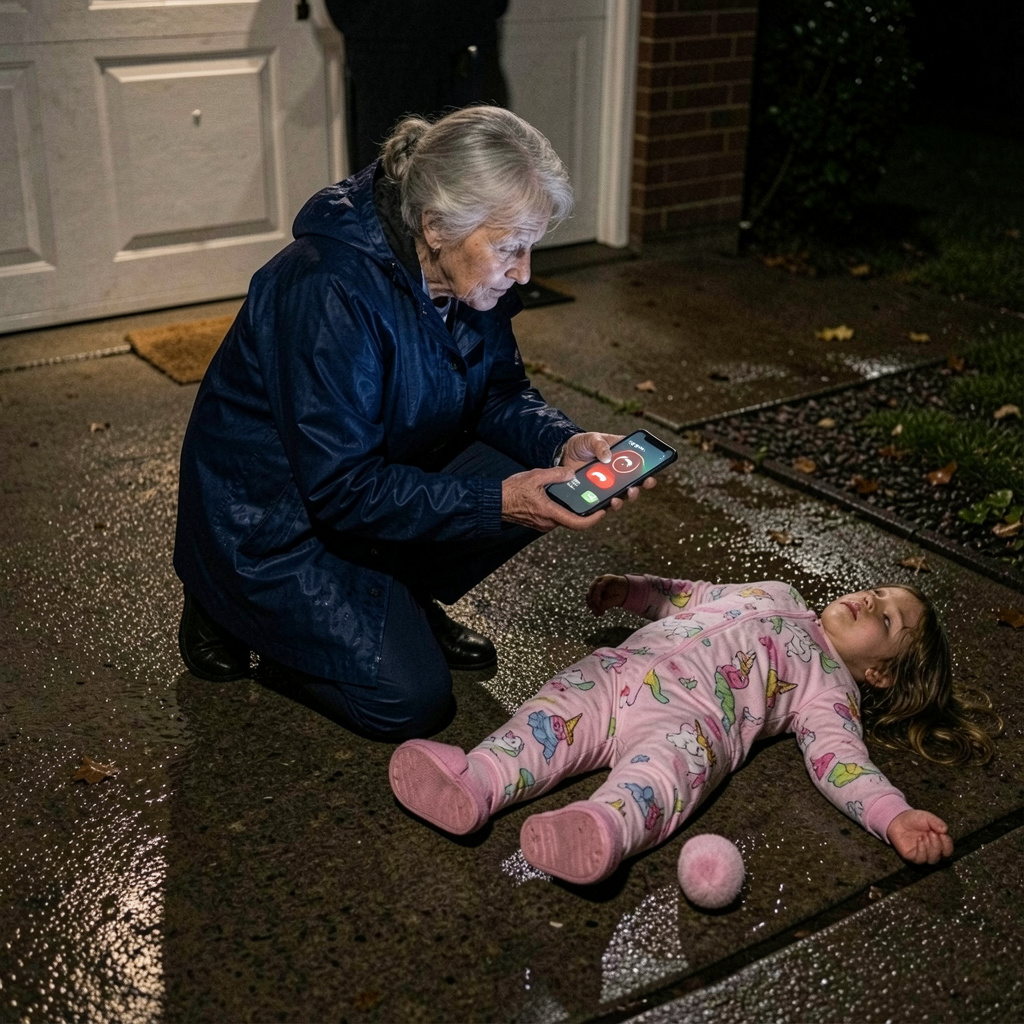
“Your daughter is sitting in your driveway,” she said.
Her voice had gone thin.
“Sarah. She has blood on her face. Blood on her clothes. She won’t move. She won’t talk. I tried calling Melissa, but she’s not answering.”
For one second, I thought I had misunderstood.
The hotel lobby behind me smelled like lemon cleaner and burnt coffee.
A couple laughed near the brass elevator doors.
A woman in heels dragged a blue suitcase over the marble floor, each wheel clicking like a metronome.
My life had still been normal then.
“What do you mean, blood?” I asked.
“I mean blood, James. On her forehead, her arm, her pajamas. I asked her what happened, and she just stared at me. Should I call the police?”
The word police should have made me move faster.
Instead, my body went still.
There are moments when terror does not arrive as screaming.
Sometimes it arrives as silence so complete that every ordinary sound around you becomes obscene.
The elevator bell.
The suitcase wheels.
The laugh of strangers.
My daughter was eight years old, and she was sitting alone in my driveway at midnight with blood on her pajamas.
I told Carolyn to stay with Sarah.
I told her not to leave her.
Then I called my wife.
Melissa did not answer.
Not the first call.
Not the second.
Not the fifth.
By the tenth call, my thumb had started slipping on the screen.
By the twentieth, I was standing outside the hotel under the valet awning, rain blowing sideways against my face, listening to her voicemail greeting until I hated the sound of her recorded voice.
Melissa always kept her phone within reach.
She slept with it charging on the nightstand.
She checked it while brushing her teeth, while making coffee, while pretending to listen when I talked about work.
She did not miss calls by accident.
By the time I called Norma Richard, my mother-in-law, my hands were shaking so badly I almost dropped the phone.
Norma answered on the fourth ring.
“James,” she said, as if I had interrupted her tea.
No worry.
No confusion.
No breathless, what happened.
Just my name, flat and polished.
“Norma, where is Sarah?” I asked. “What happened at my house?”
There was a pause.
Not confusion.
Not panic.
A pause like she was deciding how much I deserved to know.
Then she said, “Oh, James. She’s not our problem anymore.”
The road did not blur then because I was not on the road yet.
The whole world blurred.
The valet lights smeared yellow across the wet pavement.
The phone felt hot against my cheek.
“She is eight years old,” I said.
Norma sighed.
Not a guilty sigh.
Not a frightened sigh.
An inconvenienced one.
“You should speak to Melissa.”
“Melissa won’t answer.”
“That is between you and your wife.”
Then she hung up.
I stood beneath that awning with rain dripping from my hairline and heard the sentence again.
She’s not our problem anymore.
There are sentences that do not sound evil until you place a child inside them.
My daughter was sitting outside in the middle of the night, bleeding, and her grandmother had said she was not their problem.
I called my younger brother next.
Christopher answered half-asleep, but the second he heard my voice, he was awake.
“Go to my house,” I told him. “Now.”
Chris did not ask useless questions.
He never had.
We grew up on the South Side with a mother who worked three jobs and a neighborhood that taught boys early which sounds meant trouble.
A bottle breaking in the alley.
A door slamming twice.
A woman saying a child’s name too quietly.
Chris became a criminal defense attorney because he understood people at their worst.
I became a consultant because I understood systems.
Different paths.
Same training.
He only asked one question.
“Sarah?”
“Yes.”
“I’m leaving now.”
Thirty minutes later, he called me back.
“I’ve got her,” he said.
His voice was quiet.
Too quiet.
“Is she alive?” I asked.
“She’s alive, Jamie. She’s with me. I’m taking her to the ER.”
“What happened?”
A long silence opened between us.
I could hear car noise on his end.
I could hear Sarah breathing, or maybe I imagined it because I needed to.
“Drive safe,” he said. “Don’t call Melissa again. Don’t call Norma. Don’t call anyone.”
“Chris.”
“When you get here, we need to talk.”
The worst sentences are the ones people say when they are trying not to say something worse.
I threw my suitcase into the back seat and left the hotel parking garage without checking out.
The tires hissed over wet pavement.
The city lights of Minneapolis thinned behind me.
The highway opened ahead like punishment.
I drove through rain and truck lights with my jaw locked so tight my teeth hurt.
Every time my phone buzzed, my chest seized.
None of the calls were from Melissa.
At 2:14 a.m., Chris sent one photo.
Sarah’s small hand wrapped around a hospital blanket.
That was all.
No face.
No injury.
No explanation.
Just her hand, pale against white cotton, the hospital bracelet loose around her wrist.
I pulled into a rest stop and stared at that photo until the screen blurred.
Then a second message came.
She asked if you were mad at her.
Something inside me broke so quietly I almost missed it.
I pressed my forehead against the steering wheel.
The car smelled like coffee, rainwater, and panic sweat.
A truck idled two spaces away, its engine rumbling through the floorboards.
I wanted to scream.
I wanted to call Melissa until her phone caught fire.
I wanted to call Norma and make her say those words again so I could hear exactly what kind of person could leave an eight-year-old bleeding outside and still sleep.
Instead, I gripped the steering wheel until my knuckles went white.
I did not call.
Chris had told me not to.
And Chris never told me not to do something unless there was a reason.
At 5:36 a.m., he called again.
“She’s sleeping,” he said.
His voice was lower now.
“Mild concussion. Cuts. Bruising. Dehydration. They’re documenting everything.”
“Everything?”
“Yes.”
There was a sound in the background.
A nurse’s voice.
Paper moving.
A monitor beeping.
Then Chris lowered his voice.
“Jamie, Carolyn checked her doorbell camera. Sarah was in the driveway for five hours.”
Five hours.
I pulled off the highway again because the road went white in front of me.
Five hours in the dark.
Five hours bleeding.
Five hours waiting for someone inside that house to decide she was still a child.
“Was Melissa there?” I asked.
“I’m not answering that over the phone.”
“Chris.”
“I’m not answering that over the phone.”
I closed my eyes.
Rain tapped against the roof like fingernails.
“Can I talk to Sarah?”
“She’s asleep.”
“Wake her.”
“No.”
His answer was immediate.
Not cruel.
Protective.
“She needs sleep,” he said. “And you need to stay alive long enough to get here.”
That was my brother.
He would stand between me and anyone else.
He would also stand between me and my own worst instincts.
“Tell her I’m coming,” I said.
“I already did.”
“What did she say?”
He was quiet for a moment.
“She asked if you would still want her.”
I do not remember the next twenty miles.
I remember the dashboard clock.
I remember the wipers.
I remember my right hand clenched so hard around the gear shift that my wrist ached.
I remember thinking that Melissa had once held Sarah in a yellow blanket and cried because she was so small.
I remember thinking that Norma had visited the hospital with flowers and called Sarah “our little miracle.”
People do not become monsters overnight.
That would be easier.
Most of the time, they become monsters one decision at a time, while everyone else calls it stress, pride, misunderstanding, a rough patch, a family matter.
Melissa and I had been married eleven years.
Not perfect years.
Not storybook years.
But years with morning coffee, school forms, flu medicine, mortgage payments, and a thousand tiny routines that made betrayal feel impossible until it happened.
She had changed over the last year.
Or maybe she had only stopped hiding what had always been there.
There had been arguments about the house.
My house, technically, because I had bought it before the marriage with money from my mother’s life insurance.
Our house, practically, because Sarah learned to walk in the hallway and Melissa picked the blue tile in the kitchen and every Christmas photo we had was taken in front of that living room window.
Melissa hated that distinction.
She hated the word technically.
Norma hated it even more.
“You can’t build a marriage with separate foundations,” Norma had once said at dinner, smiling over a glass of white wine.
I had laughed because I thought it was just one of her polished little digs.
Chris had not laughed.
Later, in the driveway, he had told me, “Keep your paperwork clean.”
I told him he watched too many people lie for a living.
He said, “No. I watch people tell the truth too late.”
That sentence came back to me somewhere outside Gary, Indiana, as dawn started lifting gray over the highway.
The sky looked bruised.
My hands smelled like stale coffee.
My phone was nearly dead from being clenched and checked and clenched again.
Melissa still had not called.
By then, Chris had texted only three things.
She is safe.
Do not contact them.
Come to my office when you arrive.
Not the hospital.
Not my house.
His office.
That told me more than I wanted to know.
When I finally reached Chicago two days later, I had not truly slept.
The delay nearly destroyed me.
A jackknifed truck outside Madison had closed lanes for hours.
A storm line had slowed everything.
Chris kept telling me Sarah was medically stable and sleeping at his place under the supervision of people whose names he would not text.
I hated him for that.
I loved him for that.
By the time I stepped into his building, my clothes smelled like rain, sweat, and old coffee.
The receptionist looked up, saw my face, and did not ask me to sign in.
“Conference room,” she said softly.
I pushed through the glass door expecting to find my brother exhausted.
I expected him angry.
I expected the kind of rage that makes men pace and curse and punch walls.
I did not expect what I saw.
Three case folders were lined across the conference table.
Two social workers stood near the window with their coats still on.
A police detective reviewed printed screenshots under the fluorescent lights.
Carolyn Sherwood sat in the corner with both hands wrapped around a paper cup she had not touched.
Nobody spoke when I walked in.
One chair scraped softly against the floor.
One pen stopped clicking.
One social worker looked at the carpet like eye contact would be cruelty.
The room did not feel like an office.
It felt like the moment before a verdict.
Nobody moved.
Chris had not just picked up my daughter.
He had built a wall around her.
On the table were ER records.
Photos of Sarah’s injuries.
Carolyn’s doorbell footage.
A custody emergency motion already filed.
Phone logs showing my unanswered calls.
A transcript of Norma saying, “She’s not our problem anymore.”
There were three artifacts in front of me that made the truth feel colder than rage.
A time-stamped still of my driveway.
A hospital intake form with Sarah’s name typed in black.
A phone log thick with calls nobody had answered.
Evidence has a way of stripping excuses naked.
It does not care who meant well.
It does not care who was tired.
It does not care what a family wants to keep private.
It just sits there.
Ink.
Time.
Image.
Fact.
I looked at the photograph first.
Sarah was small in the frame.
Bare feet on the driveway.
One arm wrapped across her stomach.
Her hair hanging in damp tangles around her face.
The porch light was off.
The front windows were dark.
Or almost dark.
I leaned closer.
One upstairs window had a thin seam of light behind the curtain.
“Was someone home?” I asked.
The detective looked at Chris.
Chris looked at me.
“Yes,” he said.
The word entered me slowly.
I had prepared myself for an accident.
A fall.
A panic.
A terrible mistake.
I had not prepared myself for yes.
“Where is Sarah now?”
“Safe,” Chris said.
“I want to see her.”
“You will.”
“Now.”
His expression did not change.
“After you understand what happened.”
Something ugly rose in me.
For one second, I saw myself grabbing my brother by the collar.
I saw myself shoving him against the glass wall and demanding my child.
Then I saw his eyes.
He was not keeping Sarah from me.
He was keeping me from walking into a trap blind.
I sat down.
Chris slid a sealed envelope across the table.
“What is this?” I asked.
His face looked older than I had ever seen it.
“The truth,” he said. “About why Melissa left Sarah outside.”
My hands went cold.
I opened the envelope.
Inside was a printed message from Melissa to Norma, sent at 7:03 p.m. the night Sarah was found.
The first line made the room tilt.
If James wants his daughter back, he can sign over the house—
I stopped reading.
Not because I could not understand it.
Because I could.
The sentence was not written in panic.
It was not written in confusion.
It was neat.
Strategic.
Transactional.
My daughter’s safety had been turned into leverage before I had even known she was outside.
Chris put one hand on the back of the chair beside me.
“Sit down, Jamie.”
“I am sitting.”
“No,” he said quietly. “Sit all the way down.”
I realized I had risen halfway out of the chair without knowing it.
My legs were shaking.
The detective’s hand moved slightly, not toward his weapon, not dramatically, just enough to remind everyone in the room that fathers in rooms like this can become dangerous without meaning to.
I sat.
Chris pointed to the rest of the page.
“Read it.”
I did not want to.
I read it anyway.
If James wants his daughter back, he can sign over the house. I am done being trapped in a marriage where everything is “his.” Let him feel what it is like to lose something. She is outside. She is scared enough now. Do not answer him unless he agrees.
The room made a sound, or maybe I did.
Carolyn began crying silently into her hand.
One of the social workers turned toward the window.
The detective looked down at the table.
Chris watched me like he was ready to catch whatever part of me fell next.
“She wrote this at 7:03?” I asked.
“Yes.”
“Carolyn called me after midnight.”
“Yes.”
“That’s five hours.”
“Yes.”
My daughter was not forgotten.
That was the part my mind could not hold.
Forgotten would have been horrific.
This was worse.
This was selected.
Measured.
Used.
I kept reading because pain has momentum.
Under Melissa’s message was Norma’s reply.
Do not soften. Men like James only understand consequences. If he calls, make him come to terms. Sarah will survive one night outside.
Sarah will survive one night outside.
Eight words.
Eight words from a woman who had held my daughter as a baby.
Eight words from a grandmother who had bought Sarah purple rain boots and taught her how to fold napkins into swans.
I pressed my thumb against the paper so hard it bent.
My jaw locked until a sharp pain shot toward my ear.
“What happened to her head?” I asked.
Chris’s eyes flicked to the detective.
“Sarah says she fell.”
“She says?”
“That is what she said at first.”
“At first?”
Chris opened the first folder.
Inside were ER notes, photographs, and a diagram of a child’s body with marks circled in blue ink.
“Mild concussion,” he said. “Cuts. Bruising. Dehydration. Defensive bruising on one forearm.”
The words sounded clinical.
That made them worse.
Clinical language is how horror enters rooms where people are wearing suits.
“Defensive,” I repeated.
The detective spoke for the first time.
“Mr. Whitaker, we have not concluded how every injury occurred.”
“But you know enough to be here.”
“Yes.”
Chris tapped one printed still from Carolyn’s doorbell camera.
“We know Sarah was outside by 7:38 p.m. Carolyn’s first camera trigger caught her at the edge of the driveway. She did not reach the porch until 7:46.”
“Why?”
“Because she was limping.”
I closed my eyes.
I saw Sarah at six, insisting she could run faster in sparkly shoes.
I saw Sarah at seven, holding my hand across an icy sidewalk and telling me she was “brave but not foolish.”
I saw Sarah at eight, limping up our driveway while the people inside waited for my signature.
“Keep going,” I said.
Chris did.
“At 8:02, the porch light turned on.”
My head lifted.
“What?”
“At 8:02, the porch light turned on.”
He slid another still across the table.
There it was.
My front porch washed in yellow light.
Sarah sitting near the garage door, knees pulled to her chest.
Her face turned toward the house.
“At 8:03,” Chris said, “it turned off.”
The room tightened around me.
“Melissa saw her.”
The detective did not answer immediately.
That was answer enough.
“Melissa saw her,” I said again.
Chris’s mouth hardened.
“Someone did.”
The distinction landed.
Someone.
Not necessarily Melissa.
I looked around the table.
The social workers knew.
The detective knew.
Carolyn knew enough to be crying.
Chris knew enough to look like he had aged ten years overnight.
“Who?” I asked.
The detective took the laptop from beside him and turned it toward me.
“We need you to watch carefully.”
“I don’t want to watch my daughter sit outside bleeding.”
“I understand,” he said. “But this matters.”
Chris put a hand on my shoulder.
Not gentle.
Grounding.
The video began.
At first, it showed nothing but the driveway.
Rain swept diagonally across the frame.
The timestamp glowed in the corner.
7:46 p.m.
Then Sarah entered.
Small.
Barefoot.
Unsteady.
Her pajamas clung to her legs from rain.
One sleeve was dark.
She reached the driveway and stopped like she had forgotten where doors were.
She looked toward Carolyn’s house.
Then toward ours.
Then she sat down on the concrete.
No child should ever sit like that.
Not tired.
Not sulking.
Surrendering.
At 8:02, the porch light came on.
Sarah flinched.
That flinch destroyed me.
She did not jump up like help had arrived.
She flinched like light could hurt.
The front door opened a few inches.
A figure appeared in the gap.
The angle was bad.
A shoulder.
A hand.
Part of a face.
Sarah lifted her head.
The audio was faint, but Carolyn’s camera caught more than anyone in my house had expected.
“Please,” Sarah said.
One word.
Small enough to vanish in the rain.
The figure did not step out.
The door stayed cracked.
Then came a voice.
Not Melissa’s.
Norma’s.
“Stay there until your father learns.”
The sound that left me was not speech.
Chris’s grip tightened on my shoulder.
The detective paused the video.
Carolyn covered her mouth.
One social worker whispered, “God.”
I stared at the frozen image of my mother-in-law in my doorway.
Norma Richard.
Pearls at her throat.
Hair done.
Hand on my door.
My daughter on the concrete.
The porch light behind her like a stage.
“Where was Melissa?” I asked.
Chris did not answer quickly enough.
“Where was Melissa?”
The detective resumed the video.
Norma turned her head, looking back into the house.
Another voice came from inside.
Melissa’s.
“Is she still there?”
Norma replied, “Yes.”
Melissa said, “Then close the door.”
The door closed.
The porch light went off.
The screen returned to rain and darkness.
I do not remember standing.
I only remember the chair hitting the floor behind me.
I remember the detective saying my name.
I remember Chris stepping in front of me.
I remember the glass wall reflecting a man I barely recognized.
There are kinds of rage that burn hot.
This was not that.
This was cold.
It moved through me like black water.
It did not make me want to shout.
It made me want to become precise.
“Where are they?” I asked.
Chris shook his head once.
“No.”
“Where are they?”
“No, Jamie.”
“She closed the door.”
“I know.”
“She heard Sarah.”
“I know.”
“My daughter begged.”
“I know.”
His voice cracked on the last word.
That stopped me.
Chris had seen the video before me.
He had watched Sarah beg from a hospital room, from a lawyer’s office, from inside whatever promise he had made to her when he picked her up.
I looked at my brother and saw that his rage was not smaller than mine.
It was just better trained.
He bent, picked up the chair, and set it upright.
“Sit down,” he said.
This time I listened.
The detective closed the laptop halfway.
“We are pursuing charges,” he said.
“What charges?”
“Child endangerment at minimum. Neglect. Potential assault depending on Sarah’s full statement and medical findings. There may also be extortion implications based on the messages.”
Extortion.
The word sounded too clean for what they had done.
They had taken an injured child and turned her into a contract clause.
Chris opened the second folder.
“The emergency custody motion is already filed. Temporary protective order request included. I contacted a judge last night.”
“You did what?”
“I told you,” he said. “I built a wall.”
On the table, the paperwork formed rows.
ER records.
Photos.
Doorbell stills.
Phone logs.
Text transcripts.
The custody motion.
A sworn statement from Carolyn.
A preliminary note from the social worker.
Each page was a brick.
Each timestamp was mortar.
For the first time since Carolyn’s call, I felt something other than panic.
Not relief.
Not yet.
But structure.
A system.
A way forward that did not require me to become the worst version of myself.
“Does Sarah know?” I asked.
“Know what?”
“That I came.”
Chris’s face softened for the first time.
“Yes.”
“Can I see her now?”
He looked at the social worker.
She nodded.
“She has been asking,” she said.
Her voice was careful.
“She is scared she did something wrong.”
I closed my eyes.
She asked if you were mad at her.
Some wounds are not visible because children learn too fast where adults place blame.
We drove to Chris’s house in separate cars.
He said it was better that way.
I think he was afraid I would see Melissa’s car somewhere and forget every law ever written.
Chicago looked ordinary through the windshield.
People walked dogs.
Buses hissed at corners.
A man carried flowers under one arm.
The world does not stop because yours has split open.
That has always felt like one of its cruelties.
At Chris’s house, the curtains were half drawn.
His wife, Elena, opened the door before we knocked.
She hugged me once, hard, then let go quickly like she knew my body could not hold comfort yet.
“She’s in the guest room,” she said. “She wanted the door open.”
I nodded.
The hallway seemed longer than it was.
Every step sounded too loud.
At the doorway, I stopped.
Sarah was awake.
She sat propped against pillows, wearing one of Elena’s old Northwestern sweatshirts that swallowed her small frame.
A bruise shadowed one side of her forehead.
A bandage covered part of her arm.
Her hair had been brushed, but one piece still curled near her cheek.
She looked smaller than eight.
Then she saw me.
Her eyes filled instantly.
“Daddy?”
I crossed the room and dropped to my knees beside the bed.
I did not grab her.
I wanted to.
God, I wanted to pull her into my arms and hold her so tightly the world could never touch her again.
But the social worker had warned me in the doorway.
Let her choose contact.
So I held out my hands.
Sarah stared at them for one second.
Then she folded herself into me.
Carefully at first.
Then completely.
Her good arm wrapped around my neck.
Her face pressed into my shoulder.
“I’m sorry,” she sobbed.
“No.”
“I’m sorry, Daddy.”
“No, baby. No.”
“I didn’t mean to make Mommy mad.”
My eyes found Chris in the doorway.
His face had gone still.
“What did Mommy say?” I asked softly.
Sarah shook her head against me.
“She said I ruined everything.”
Elena turned away.
Chris looked at the ceiling.
I kept my voice steady because Sarah needed a father, not a storm.
“You did not ruin anything.”
“She said you would be mad because now you had to choose.”
“Choose what?”
Sarah’s fingers tightened in my shirt.
“The house or me.”
The room disappeared.
There was only my daughter’s small body shaking against mine and the knowledge that someone had put a price tag on her worth and made her carry it.
I pulled back just enough to look at her.
“Sarah,” I said, “listen to me carefully.”
She looked terrified.
I hated that she looked terrified of my answer.
“There is no house, no money, no paper, no anything in this world that I would choose over you.”
Her chin trembled.
“Promise?”
“I promise.”
“Even if Mommy says I’m bad?”
“You are not bad.”
“Even if Grandma says I’m difficult?”
“You are not difficult.”
“Even if—”
“No,” I said, and my voice broke. “No more even ifs.”
She cried then.
Not the quiet crying Chris had described.
Not the frozen crying of a child afraid to take up space.
She cried like her body had been waiting for permission.
I held her as gently as I could.
Over her shoulder, I saw the hospital bracelet still loose around her wrist.
I saw the edge of the bandage.
I saw a small dried line near her hairline that the nurses had missed.
Evidence.
Not for court.
For me.
Proof that this had happened to a real child, my child, not a file, not a case, not a motion.
Chris stepped away from the doorway.
Elena closed the hall behind him.
For a while, there was only Sarah breathing against me.
When she finally slept again, I stayed on the floor beside the bed with my back against the wall.
Chris came in carrying two mugs of coffee.
He handed one to me.
It had gone lukewarm by the time I drank it.
“Melissa has been calling,” he said.
I looked up.
“Me?”
“Him. Me. The office. Elena. She left voicemails.”
“What does she say?”
Chris’s mouth twisted.
“She says it got out of hand.”
I laughed once.
No humor in it.
Just air leaving a damaged place.
“She says Norma pushed it. She says she never meant for Sarah to get hurt. She says she panicked.”
“Panicked for five hours?”
Chris did not answer.
He sat on the edge of the chair near the bed.
“She also says you are unstable.”
There it was.
The next move.
Not remorse.
Positioning.
“She says you threatened her before.”
“I never did.”
“I know.”
“She’s going to say I’m dangerous.”
“Yes.”
“She’s going to say that’s why she kept Sarah from me.”
“Yes.”
I looked at my sleeping daughter.
Her lashes rested against bruised skin.
One hand clutched the blanket even in sleep.
“She left Sarah outside and thinks I’m the danger.”
Chris leaned forward.
“Jamie, listen to me. From this point on, you do nothing without talking to me.”
“I want to see Melissa.”
“No.”
“I want to hear her explain it.”
“No.”
“I want—”
“You want justice,” he said. “Not a moment that helps her lawyer.”
That shut me up.
He was right.
I hated that he was right.
“What happens now?” I asked.
“Emergency hearing first. Protective order. Police investigation. Sarah’s forensic interview. Medical follow-ups. Then custody.”
The list sounded endless.
“How do I get her through it?”
Chris looked at Sarah.
Then back at me.
“You tell the truth. You stay calm when everyone expects you not to. You let professionals do their jobs. And every time Sarah asks if you are mad at her, you answer until she believes you.”
That became the work.
Not revenge.
Repetition.
No, baby, I am not mad.
No, baby, you did nothing wrong.
No, baby, you are safe.
No, baby, I choose you.
The emergency hearing happened faster than I thought possible and slower than I could stand.
Chris stood beside me in court wearing the same charcoal suit from the conference room.
Melissa appeared by video.
Norma did not appear at all.
Melissa looked pale.
Smaller than I remembered.
Her hair was pulled back.
Her eyes were red.
For half a second, the old part of my brain tried to recognize my wife.
The woman who packed Sarah’s lunches.
The woman who sang badly in the car.
The woman who cried at animal shelter commercials.
Then the judge read the messages.
If James wants his daughter back, he can sign over the house.
Sarah will survive one night outside.
The courtroom changed when those words were spoken aloud.
Even through a screen, Melissa seemed to shrink.
Her attorney tried to speak about marital conflict.
Chris did not raise his voice.
That was the most terrifying thing about him.
He did not need volume.
He had documents.
He had timestamps.
He had a hospital record.
He had Carolyn’s statement.
He had the video.
The judge watched the porch light come on.
Watched the door open.
Listened to Sarah say, “Please.”
Listened to Norma say, “Stay there until your father learns.”
Listened to Melissa’s voice from inside our house.
“Then close the door.”
Nobody in that courtroom moved.
The judge took off her glasses.
She set them on the bench.
For a moment, she said nothing.
Then she granted emergency temporary custody to me.
She barred Melissa and Norma from contact with Sarah pending further proceedings.
She ordered supervised processes, evaluations, and cooperation with the investigation.
There were more legal words after that.
Important words.
Necessary words.
But I only heard one thing.
Sarah would not go back there.
Not that night.
Not because someone cried on camera.
Not because someone said it was a misunderstanding.
Not because a grandmother wore pearls and called cruelty discipline.
After the hearing, Chris and I stood in the hallway.
I expected to feel victorious.
I did not.
Victory is too bright a word for standing in a courthouse because your daughter was left bleeding in a driveway.
What I felt was oxygen.
Thin.
Painful.
Enough.
Melissa’s attorney approached us with a message.
“She wants to speak to James.”
Chris answered before I could.
“No.”
“She says she wants to apologize.”
“No.”
“She says he needs to hear her side.”
Chris stepped closer.
His voice remained polite.
“He heard her side on the doorbell camera.”
The attorney left.
I leaned against the wall.
My knees felt weak.
Chris handed me a bottle of water from his bag.
“You okay?”
“No.”
“Good,” he said.
I looked at him.
He shrugged.
“Okay would be weird.”
That was the first time I almost laughed.
Almost.
The weeks after that were not clean.
Stories like this never end where people online want them to end.
They want the arrest, the gavel, the villain exposed, the child safe, the father vindicated.
Real life keeps going after the most dramatic scene.
Real life is a child waking up at 3:00 a.m. because she dreamed the porch light went off.
Real life is her refusing to wear the pajama color she wore that night.
Real life is a father learning how to sit outside a therapist’s office without demanding every detail because healing is not a courtroom and children are not evidence.
Sarah started drawing houses.
At first, every house had one window lit and a small figure outside.
Then, slowly, the figure moved closer.
Then onto the porch.
Then inside.
One day, she drew a house with all the lights on.
She gave it to Chris.
He kept it in his office, framed behind his desk.
Under it, Sarah had written in purple marker: Uncle Chris came.
He cried when he thought nobody saw.
I saw.
Carolyn still brings zucchini bread in August.
She also installed two more cameras, which she pretends are for package thieves.
I know better.
Sometimes she sees Sarah in the yard and waves too carefully, like Sarah is made of glass.
Sarah waves back.
Not always.
But more often now.
Melissa eventually tried to explain.
Through attorneys.
Through letters Chris did not let me read until Sarah’s therapist said it would not help anyone.
Through relatives who suddenly cared about “keeping the family together.”
That phrase made me understand how many people confuse silence with peace.
A family is not kept together by hiding what someone did to a child.
That is not unity.
That is camouflage.
Norma’s words became part of the record.
So did Melissa’s.
So did mine.
So did Sarah’s, when she was ready.
I will not write everything Sarah said in those interviews.
Some truths belong first to the person who survived them.
But I will say this.
Children remember who opens the door.
They also remember who closes it.
For a long time, Sarah asked me the same question in different forms.
Would you have come if I was bad?
Would you have come if I cried too much?
Would you have come if Mommy said not to?
Would you have come if it was far?
Every time, I answered.
Yes.
Yes.
Yes.
Five hundred miles, five thousand miles, yes.
One evening months later, she found the original hospital blanket folded in a box of records Chris had returned to me.
She touched it with two fingers.
“That was the blanket from when Uncle Chris came,” she said.
I asked if she wanted me to throw it away.
She thought for a long time.
Then she shook her head.
“No,” she said. “That’s the one from after.”
After.
Not from the driveway.
Not from the door.
Not from the porch light going off.
After.
The blanket from after someone came.
I kept it.
Not as evidence.
Not as a reminder of what Melissa and Norma did.
As proof of what Chris did.
Because when I called my brother, he did not just pick up my daughter.
He took her to the ER.
He documented everything.
He called social workers.
He contacted police.
He pulled doorbell footage.
He filed an emergency motion.
He built a wall around a child before the people who hurt her could build a story around themselves.
I used to think love was the person who says the right thing when you are breaking.
I know better now.
Love is also the person who gathers the papers.
Love is the person who saves the screenshot.
Love is the person who tells you not to make the call that would ruin your case.
Love is the person who walks into the dark and brings your child back wrapped in a hospital blanket.
Sarah is older now.
She still has nights where rain against the window makes her quiet.
She still watches porch lights.
She still likes to know who is picking her up, what time, and from which door.
But she laughs again.
Not all at once.
Not like nothing happened.
Like something living returned by inches.
She runs across the yard in socks even though I tell her not to.
She leaves markers uncapped.
She makes pancakes shaped like countries and insists Illinois looks like a boot if you squint.
Sometimes, when I am on a business trip now, she FaceTimes me before bed and asks me where I am.
I tell her the city.
I tell her the hotel.
I tell her when I am coming home.
Then I say the words before she has to ask.
“No matter where I am, I will come.”
She pretends to roll her eyes.
“I know, Dad.”
But she smiles when she says it.
And every time, I remember that first photo Chris sent me at 2:14 a.m.
Sarah’s small hand wrapped around a hospital blanket.